
AlwaysInAGoodShape
AlwaysInAGoodShape
About
- Username
- AlwaysInAGoodShape
- Joined
- Visits
- 2,498
- Last Active
Comments
-
@Wezqu said:
So killers are never going to be able to pick up survivors with your flashlight change against anyone decent of doing them. So HARD NO to that one. Currently its fine and takes some skill to do yours would literally be survivors running the faster blind add-ons and beaming killed on the start of the pick up animation.
No for the totem thing too as making everything being easy with no effort from the user is the most boring way of trying to change a game.
"So killers are never going to be able to pick up survivors with your flashlight change against anyone decent of doing them"
This comment makes no sense. If this was true, then killers wouldn't be able to pickup anyone today already, which is obviously not the case"No for the totem thing too as making everything being easy with no effort from the user"
Considering this "effort" is mainly just map knowledge and thousands of hours of playing the game and seeing the random gen algorithm at work, it kinda proves my point. It harms accessibility for newer players without any real "effort" -
@100PercentBPMain said:
flocks of sables give me more attention than irl girls (maybe it's because I haven't showered in a week) so I don't mind them.
I just wish they'd play a little hard to get instead of being freaky off the get go.
xD
-
@not_Queef said:
Is this really a thing?
Tempted to start quick switching to Sable just to annoy people if it is.
You will not be disappointed. Skins can help increase the rate too
-
@pigslittlepet said:
i wouldn't. i would dodge a ace lobby, but not sable.
As killer?
-
@Rulebreaker said:
...is this a thing now? Are people dodging just because a sable in lobby?...
Yes, definitely, and very widespread
-
@Skeleton23 said:
I had a idea where the game can tell you how much blood points is Needed to reach a P-Level.
This can help players know how much they need to grind to become p-number.
Example: if im at p-13 and I want to reach p-30. It will Say you need X amount of Bloodpoints to get the P-Level.
What would you guys think of this Idea
I think it would be pretty niche. Mainly because you could just level 1 prestige level and check how much it costed and then calculate it yourself if you really wanted to know, which I estimate is around 1 mil bp somewhere
-
@gerolau said:
https://forums.bhvr.com/dead-by-daylight/discussion/comment/4071359#Comment_4071359
we get it you watch pixelbrush
And I also read the forums. But yes, pixelbrush's opinion is superior on this topic. Not because it's in video format, but just because it is in this case.
-
@PetTheDoggo said:
https://forums.bhvr.com/dead-by-daylight/discussion/comment/4071378#Comment_4071378
you also have to recall drones each time when you want to set one up.
No? I would simply recall 2-3 in zones I am not interested when I have time for it.
I didn't have to look back and forward during the chase/patrolling whenever I want undetectable.Right now you basically get same/worse result for more work.
There is no depth to it, it's just annoying.Having to look back in chase is one of the few things that gave her depth and made her more than just a shi*t a drone type of killer.
I am just not in the camp of making her a mindless killer, so I 100% support that if you want to play her at a higher level you will have to adept to a more unique playstyle. That's the whole point of killer variety. A Unique learning curve, unique gameplay, and not just pressing m2 every so now and then randomly -
@Orthane said:
https://forums.bhvr.com/dead-by-daylight/discussion/comment/4071359#Comment_4071359
But… it doesn't… now all you do is recall a drone and instantly set it back up. It's tedious, that's all it is.
Guess what, when you reach max drones, you also have to recall drones each time when you want to set one up. And don't start about the "trap" playstyle because you can hardly play this killer as a trap killer.
The main gameplay of Skullmerchant comes from throwing the drone down at a planned rotation angle (with foresight) to ensure that the survivor will run through it, and accelerate how often that happens through switching the direction, as well as double hits from the drone into m1's
The current mechanic adds to that by allowing you to recall a drone without creating a massive spottable zone around you, allowing you to quickly switch targets and get surprise hits on people, or even surprise the person you're chasing@MechWarrior3 said:
https://forums.bhvr.com/dead-by-daylight/discussion/comment/4071359#Comment_4071359
There's a better way they could have gone about it. This design isn't it. She can also chain multiple drones currently for back to back undetectable. Bad design. Needs work.
That last part is one of the few things she has going for her. She needs work indeed, just not on that part
-
@MechWarrior3 said:
https://forums.bhvr.com/dead-by-daylight/discussion/comment/4071099#Comment_4071099
This has to be Satire. lol
Its clunky having to constantly look back and recall to go stealthy.
It requires thought and deliberation, unlike the old sh*t a drone and get some effects.
-
One of the problems with using his cameras is, you'd have to make the effect VERY STRONG in order to make that work.
Remember why killers are trying to tunnel out 1 survivor. Because the second they are facing a 3 survivor team, the total team efficiency plummets. So there's nothing more valuable to the killer than reducing the survivor team down to 3.
Now, with the camera mechanic, the survivor who is doing the cams has effectively "tunnelled themselves" out of the match. I don't think people even begin to realize just how strong the buff for survivors or nerf to springtrap would have to be to compensate for that.
I think the only realistic way to make it viable is to make the cams only require watching the springtrap for a short amount of time and have a lingering effect for a while to make the cameras worth it, so that such a person has to spend less time doing cams.
That or they might need to do something very extreme, like allowing the camming survivor to speed up the other survivor's generator speed by like 50% in total whenever they are scanning the sprinttrap, on top of the current effects survivors get.
In other words, making the camera work as a valuable mechanic is going to require a lot… -
The undetectable drone on recall was an expert decision, and has added a lot of depth and strategy to her kit. I'm really glad that added it that way, but yes, newer Skull Merchants will need time to fully understand how powerful and strategic it is when used right
-
Probably Power Struggle without any other perk and deliberately finding places that makes them instinctively walk through pallets
-
@Snitz said:
https://forums.bhvr.com/dead-by-daylight/discussion/comment/4070561#Comment_4070561
Well ngl after looking more carefully at your first two changes I do agree, one thing that worries me though is that sometimes getting into chase is very inconsistent. It would also help against pre-runs and holding W.
Harmless pursuer is fine really, it's usually quite easy to predict where survivors spawn, if you don't know, they're generally in a cone in front of your field of view when you start the match, unless you get a weird spawn.
Yeah, one of the things that's so problematic about these inconsistencies is, those little early gambles can have such a big impact on the match. That's why it's also such a safe buff in my opinion, because in many matches the killer does instantly find someone, so it doesn't buff their max strength, but it does buff them in unluckier games, where the general outcomes overall become more positive for killer
-
@Snitz said:
I think even just a perk that gives killers haste outside of chase would be a great idea to help low mobility killers. The rest I don't agree with.
I think a better fix to tunneling would be to give the killer a direct reward for spreading out hooks, universally some slowdown would be good.
Then we can adjust slowdown perks if need be.
That wouldn't solve tunnelling. It'd still be the most effective strategy and there's no way for the tunnelled survivor to realistically have a decent chance of being un-tunneled
Weaker killers having to give up an entire perk slot just to somewhat get closer to the stronger killers isn't solving the issue. It's building on top of the issue and cementing that it will be here forever -
@Leon_van_Straken said:
https://forums.bhvr.com/dead-by-daylight/discussion/comment/4070529#Comment_4070529
https://forums.bhvr.com/dead-by-daylight/discussion/comment/4070535#Comment_4070535
That is really a thing?
nearly 5k hours in this game and I see I know nothing about it
A lot of competitive players use this to delay their decision to vault and have more to decide whether the killer is double backing or not
-
Oof, if that's so I hope they revert it or if that it's just a bug
-
I think there's a bit of a Trick too, people often use at shack, where they first run at the window, then walk for a bit and then run for a split second and get the vault, which is also how you can trigger the running vault I'm pretty sure
-
Great catch! Would love that
-
I think this idea is a bit too killer sided. Especially if you consider how well it synergizes with perks like Pop Goes The Weasel and Pain Resonance etc. For that reason, I'm out
-
@Rokku_Rorru said:
I'd like to try this idea honestly, it could be a good way to do it.
But there is one issue, high mobility like Ghoul exists and with the right build like floods of rage could easily just hunt down said survivor anyways.I think one of the strong things it has going for it is, unlike cages like Pyramidhead or 2v8 cages, the survivor hooked isn't hooked into the location where they'll be unhooked, meaning that they won't have time to find where the unhook location is to begin with. The second they are unhooked is when they will be sent to a different location away from the killer and are able to run, hide, etc.
It would even be possible to give them 30 seconds of elusive to compensate for the 30 seconds of unbroken, making it even harder to get off-spawn snipes
Some minor tweaks and I think we'll get there -
@cogsturning said:
The things that will be nerfed by this are niche builds few people use. Stakeout, Hyperfocus, and Fast Track can still be played together without nerfs, just like DMS, Surge, Grim, and Pain Res will still work together. It won't hurt full aura or full undetectable. The problem is it simply limits things further and narrows the meta even more. We're gonna see the same boring builds over and over even more than we already do. It'll be Stakeout/Hyper instead of Resi/Deja Vu.
Who decides what's healthy and what's engagiing? Your healthy builds only work when they're evenly in play. I run no slowdown and I'm tired of prerunning Sprint Bursters zooming away as soon as they see my 4.4 killer. I don't know how you can argue that as engaging, nor should I have to run The One Aprroved Build to manage.
I think it's honestly wrong that the Devs are even trying to finish that through a perk-stacking mechanic. Perks like Hyperfocus, Deja Vu, Fast Track all target different aspects of gens speed up. I don't think it's the job of a perk based diminishing returns system to solve that. We need a general "Minimal game length" mechanic that manages over the top gen speed over a prolonged amount of time
If a proper minimal game length mechanic that handles massive gen speeds existed, it would allow high gen speeds to continue to exist, but rather than achieving speeding up the minimal game length, all they would do is give bursts of speed during different periods over the match, which wouldn't be anywhere as gamebreaking -
@AlwaysInAGoodShape said:
This is how easy it would be to implement it programmatically:
https://us.v-cdn.net/6030815/uploads/ESCMDN7FN5VC/image.png
And once implemented, this is how easily it can be used:
https://us.v-cdn.net/6030815/uploads/BXKS2IYS7DK8/image.png
In here, we're simply setting vaulting speed diminishing start at 20%, and setting the maximum amount at 40.
Then we can just run the real value the player has, which in this example is 21 and get the slightly diminished outcome (since 21 is slightly higher than 20)
(Assuming we're working with a multiplier, we'd want to set it to 1.2 and 1.4 instead of 20 and 40 in the real code of course, but for understanding purposes we use the % representation)Additionally, you could also reduce calculations by just storing the square root of c directly, further simplifying the calculations ran for the diminishing formula, which is more optimized.
DiminishingReturnFormulaValues struct would then contain fields of B and SquareRootOfC and the main formula would just use SquareRootOfC directly. That way, you reduce how many times you have to call use Power and Square Roots;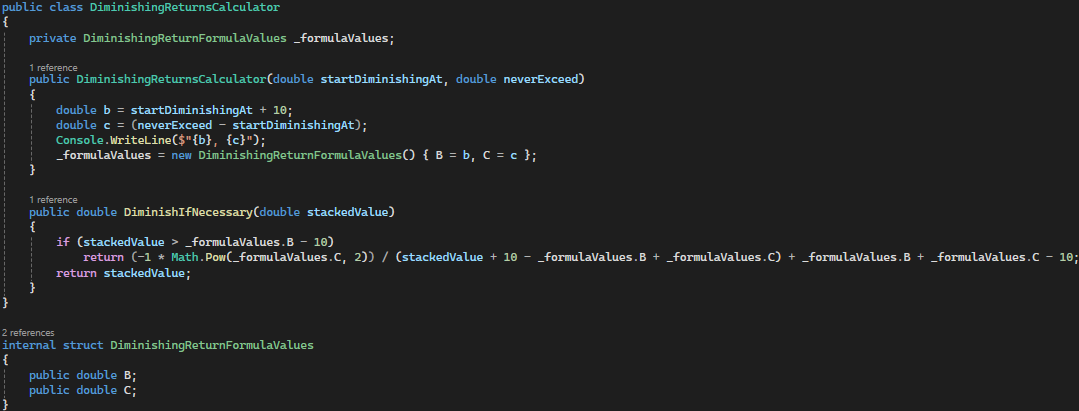
(In this case, we don't raise C to the power in the constructor, so we don't need the square root in the main formula. All we need to do is raise it to the power once in the main formula there instead)
-
@KerJuice said:
Diminishing returns is a terrible idea. It completely removes the fun out of builds. There are bigger fish to fry right now.
Diminishing returns can be absolutely great for the game, but that diminishing should only happen at problematic values, ones that even full healing builds fail to reach, so I definitely agree that the current Diminishing Return mechanic proposed is very bad, the general idea of Diminishing Returns could actually blow back life in certain perk designs, like older 2019 unrelenting, that had to be nerfed because it could be stacked with other perks doing the same thing
A healthy way of doing Diminishing Returns would be: Diminishing Returns & New Perk Keywords — BHVR(Which would leave any realistic healing build alone pretty much, without any diminishing)
-
@redglyph said:
That opinion shows a complete lack of game design sense.
Because?…
-
@Dinadin said:
Regression meta could never be the healthiest, cause its the worst that has happened in all those times.
All a regression meta does is rewarding the killer for playing well and extending the game to give the killer more time to win, while leaving chases healthy, unlike something like an anti loop meta, which would be awful
-
@Rogue11 said:
How does nerfing healing builds help..?
I don't support healing nerf builds; fun fact. (Unless it's possible to reach a critical value where they can heal faster than the killer can m1)
-
@Rokku_Rorru said:
I'm gonna have to disagree with this, I think having strong options in both categories will be fine, diminishing returns doesnt mean at all that chase perks will be weaker, because they COULD buff them to compensate for that and make them enticing as options on their own.
To me it sounds like they want to make these perks strong on their own but be around at their current effectiveness when paired together as the idea develops.
Meanwhile killers who have haste like clown basekit, will get hit harder so they can't overstack said options. I don't think anything will be "Braindead" the consultants will keep them informed.I'm not against the idea of diminishing returns necessarily, like you mentioned with clown. I think it'd be great if they had more liberation designing perks, and not having to worry about a specific killer. However, I do believe a gen slowdown for killer is the most enjoyable META all around. By giving killers rewards to extend how much time they have to play the game all while leaving chases interesting. If our meta starts revolving around anti-loop it's going to become a whole less interesting
-
@Little_Kitten said:
We get it—you have no idea how to play against Blight, and you can’t handle having to actually improve when you can’t just hold W. Otherwise, can we see your gameplay as a survivor, so we can see how you perform?
Sadly, the "Get Good" argument falls flat. In Dead By Daylight's matchmaking, the highest MMR essentially pairs you up with anywhere between Gold players all the way up to Challenger players within the same lobby.
You can be the top 0.1% player, but if your teammates aren't, who can be anything between the top 18% to the best (which is actually still quite bad), and you're playing at an even half decent Blight player, you're simply going to lose. Since the rarity distribution of all players being good in your lobby increases exponentially, and all the half decent Blight needs is to tunnel 1 weakest link player out to win the match to pretty much guarantee the win.
With blight being quite accessible unlike nurse, you can see why that's a big problem. Being the best in pubs simply doesn't help. Being good in pubs and always playing with your small equally really good friends is really the only "get good" advice you can give.
Just getting good against the current Blight achieves nothing in solo pubs, the second Blight chooses to switch targets. -
@mysticecho said:
I just wanted to voice my opinions on the blight nerf. People are saying his nerf is justified because of his high kill rate but if you go online and check the stats that dbd just released, he isn’t even in the top 5 for highest kill rate in top and broad MMR, I thought he may have been considering his high pick rate.
https://us.v-cdn.net/6030815/uploads/5N74SK9WK14K/img-4612.jpeg
If he needs to be nerfed because of a comp player getting an almost 2k winstreak, that same player gets really high winstreaks on other killers like oni and hillbilly so does that mean they need nerfs too?
Sorry, I’m just really frustrated that my main is getting nerfed, I don’t see why he needs a nerf I play him quite fairly and try to spread my hooks as much as possible because of this I do lose at times or I end up with a 2k which is fine I prefer to never tunnel and don’t want to upset other gamers. I do get that people hate him because of the tunnelling 4gen slowdown stereotype that he has.
I play wesker too and they removed and nerfed so many of his techs which really frustrated me and now the blight nerf, I just don’t think I can play this game anymore, everything I enjoy on this game gets removed or nerfed.
The big mistake here is that you trust DBD's "High MMR". The devs don't have real stats on high mmr. Keep in mind that "High MMR" in DBD is the equivalent of any player that's Gold, all the way to Challenger in League of Legends. The difference between Gold and Challenger players is incredibly large. That is why taking the top 18% or so players can hardly be called high mmr.
The top 0.1% is high mmr. The top 18% can literally be any player that somewhat plays this game consistently, leaving the lower brackets to people who hardly play this game or hyper-casually.
Hell, an even better statistic for real killer power would just be to look at winstreak world records. With blight being the highest and nurse being second. That itself more accurately reflects general power level* (with some caveats) than any High MMR stats that are currently shared (and consequently also matches expert tier-lists) -
@kit_mason said:
The HEALTHIEST meta in DBD is where killer regression perks are the strongest and where survivor's chase perks are the strongest.
Anyone that remembers Genkick knows that's not true. Eruption CoB meta was beyond exhausting to play in and it wasn't even around for that long.
That was not a perk issue, but a core gameplay issue, which has been solved with how many times regression can be triggered on the same gen.
-
I think the main choices here are:
1. At the start of the game
2. As the first chase starts
3. After the first hook
Reason for choosing 1:
It's not as bad as you think. Many beginner players were already getting tooltips on who the killer was going to be during the loading screen. Only long term players stopped seeing those. In the past, even hooks used to reveal which killer you played against at the start of the match.
Reason for choosing 2:
After the first chase starts makes the timing somewhat similar to a comp team, meaning those solos in some form gain the same level of information as SWF's, which is a good thing in limiting the gap between solos and SWF's
Reason for choosing 3:
Would allow (at least for solo players) stealth killers to surprise multiple people at the start of the match. Typically the best time anyone, especially beginners, would want to read the power description is when they have time to read it without throwing the game, which would be while they are on a hook, just downed by the killer. Or I guess you could use on first down as well, although they could be more awkward to implement with perks like Plot Twist -
"But why do you need a gradual fall off?"
As illustrated in the last provided example about perk 1 2 and 3, it prevents certain problems that don't have to exist.
Even in cases, like healing speed, where there is a clear tipping point (Exactly the time it takes to "recover" from an m1 attack) that would make it impossible for killers to down a survivor who is constantly being healed (Let's guesstimate that to be 2 seconds), there is still a window where it is pretty much ALMOST completely problematic, like 2.2 seconds, where a killer might hit and is barely able to hit the survivor again. Creating a max cap at 2 seconds (guesstimate) and starting the fall off at 2.5 seconds would be ideal to prevent any value edging too close to the absolute most problematic values, and keep any perk contributions in values valuable, as illustrated in the 1, 2 3 perk example.
Keep in mind that my entire post is nothing more than suggesting a system for a max cap + a gradual fall off. That is quite literally the summary of what I'm suggesting (while of course also providing the exact implementation details on how to do so mathematically)
"Okay, you and BHVR have different goals (I'll get to this more later). That's fine. Their solution also 'solves' the problematic values, it just does other things you don't like."
It in fact doesn't solve problematic values. There is nothing guaranteeing perks not reaching problematic values or going beyond a certain point. Surely for healing speed, they would have to screw up significantly with perks in order to reach those problematic values, but through perks like m1 recovery speed with perks like unrelenting, if they'd keep adding perks around that, they could certainly run into the issue again. For the simply fact that the current solution doesn't perfectly solve the issue, and even creates new ones.
The perfect solution to the problem is very easy, and it's provided in details in the post above."Saying something is easily understood and then getting to square root I don't think is accurate."
Everyone is familiar with an exponential increase or decrease intuitively. Of course, if you use mathematical language, they wouldn't connect the dots as easily, but the point I'm making is, the square root (whether you understand it or not), is in fact the most intuitive exponential decline there is.
A value diminishing at 20%, never reaching above 40% and diminishing harder the more you go beyond 20% is quite easily understood. The more you stack beyond it, the less you get back. It's that simple. And the communication to players doesn't have to be complicated than that. Players never touch any of the math behind it."To be blunt: no, you haven't. It addresses what you consider the issue, but still faces the same problem that any sort of declining returns has - where do they start and how much?"
I evidently have, and the fact that you're denying it shows.
1. My system both avoids random casualties like the Botany Empathic combo. (Current solution by devs doesn't)
2. Makes problematic values impossible (Current solution by devs doesn't)
3. Keeps any value a perk provides add value (A purely flat cap lacking a gradual fall off doesn't)
And then the problem you propose is simply having to define what the problem is? That is just funny to me. That's the lack of a problem. If we can't define a problem, that means a value doesn't create a problem from stacking, and if there is a problem, we should have no problem defining it. (It's kind of magical to me that you're pretending that having to define a flat cap is an issue by itself, as the Devs had no problem doing that back when they capped the luck mechanic. It's rather easy)"Bloodlust (subjectively) improved the idea of killers being caught in chases for too long or having to deal with to powerful of loops. It improved a game element."
Thank you for proving my point. Bloodlust improves a game element, and so does this change improve a game element, just like any other random balance change suggestion. With this change, we have permanently solved any problematic stat stacking forever. But since you're keen on also solving a separate issue unrelated to this post, which is a minimal game length mechanic revolving gen speeds across the match through means of single, multiple survivors working on a gen, gen speeds, skill checks as well as other mechanics, sure we can talk about that too! So let's have a try at it
MINIMAL GAME LENGTH MECHANIC:
Gens receive an overcharge mechanic; There is a hidden bar, from 0 to a 100, that as it fills up, causes people to repair generators more slowly. The bar starts filling up whenever a survivor is contributing more than 1.05 charge per second, through gen speed increase, great skill checks, "unregressable progress" like BNP, etc. The higher it gets to a 100, the more the slowdown becomes. Slowly starts to decay when a survivor is adding less than 1.05 charges per second.
In this example, we'd allow survivors to work up to 5% gen speed permanently without any diminishing returns, to account for normal great skill-checks etc. and could of course refine the mechanic and it's formula in a dedicated post.
But since minimal game-length mechanics are deserving of their own post, I don't see a reason to develop them further on a post that's related to a different mechanic!"So in this hypothetical world, Overzealous is just automatically nerfed after cleansing a hex totem down to 17.7%."
Correct. For a perk like overzealous where there is a significant time investment, it would get punished for being 20% to compensate for that. (As would the dev's solution). However, I'd argue here that if we do not believe the maximum speed to be the problem, (as you argue from it's point of that speed only being achievable for shorter time periods), it would be the longer term progress of the perks with that gen speed that would be the issue. In such a case, it wouldn't be the task of perk stacking values to solve that problem, but that would be tied to a different game mechanic entirely, like the one I just discussed, regarding a minimal-gamelength mechanic, which would be responsible for gen speeds. In such a case, we could be more liberal in what we'd consider the maximum gen speed to be before we'd consider it to be problematic, as the minimal gamelength mechanic would account for over the top gen-rushing, and therefore balance problems like you mentioned with Overzealous, and allow the diminishing stacking return speed mechanic to manage problematic values, where survivors might be able to complete a gen before killers would be able to interrupt it, in which case, the values of it would be significantly more liberal"Based on the stream, they seemed more interested in clamping down on specialized builds meant to do a single thing. The idea of Hope+MFT is also in there, but I don't think that's their only goal."
Like I said it's not their only goal. But the other goal they are trying to achieve they aren't achieving with their current mechanic, and the same goal they don't achieve either, while also creating unnecessary casualties, where as my simple diminishing returns mechanic into flat cap fixes the problematic values problem from stacking perks perfectly and indefinitely, and could revive perks like Leader to affect vaulting speed. Fixes issues stacking perks like Unrelenting had with other perks, allowing them to be buffed again, would allow any healing perks stacking to thrive without an issue and would make any movement speed stacking completely safe, making life easy for the perk design team and creating maximum creative liberation. For that reason it's a no brainer to implement it."If a problematic value is known, we don't need versatility.
If a problematic value is not known, any solution has the issue of negatively impacting the game by choosing the wrong value."
This is the beautiful thing about this system. Let's take movement speed. Clearly survivors being as fast as a 110% killer would be problematic, but exactly by how much might be unknown.
My diminishing return system would both allow them to define an absolute problematic value, as well as create some grey zone through the earlier fall off. That way, they don't even need to know the exact problematic value as the grey zone will already create diminishing earlier. That means whatever they think the problematic value is, whether they're exact or slightly off, it won't be an issue, because nobody will exactly reach it. Some perks allow them to get closer to it, but never there. That's the beauty of using Asymptotes for dealing with diminishing returns. They are the mathematical perfect solution"I think its at worst a very rare thing, thus both solutions create more problems than they solve."
I find that you have rather proposed very few real problems that they cause. And that I have provided a lot of real problems that they solve. The majority of your arguments have been "But then you'd have to define it". Well guess what; the entire system the devs are currently rolling with is letting it be a COMPLETE guesstimate on whether any issue of stacking is remotely solved. But if there is a problem with stacking values, then by DEFINITION it can be defined, and then the only system that perfectly tackles that without creating the most random casualties like the current devs version cause, is literally a system that allows us to exactly define where that problematic value is and making it impossible to achieve it, as well as a gradual drop so that it never edges exactly too close, while also preventing other problems caused by a flat cap.
(And once again, my system is quite literally a defined gradual fall of into a flat cap. It's really not more complicated than that.)"General principles of a discussion forum is that posts made after the initial post"
This is simply an assumption, and is incorrect. Responses are responses, especially with every response from me both quoting and quoting the exact part I'm responding to -
@crogers271 said:
https://forums.bhvr.com/dead-by-daylight/discussion/comment/4069709#Comment_4069709
You posted while I was typing my first response
The difficulty of game design elements on this is not coding. I don't think I ever implied it was. So I'd urge you to look back to my original response on where the problems actually occur because if that's what you think the takeaway was, we need to clarify that first, because otherwise this is just becoming a non-sequitur.
I don't see why you assume that comment is a response to you. I never quoted you in it, so it doesn't require me to look back at any of your responses.
-
@crogers271 said:
https://forums.bhvr.com/dead-by-daylight/discussion/comment/4069674#Comment_4069674
I personally think the answers are quite easy. Let's take healing.Hypothetically with healing - presume there was the possibility of a point where healing exceeds a breakpoint of being able to heal faster than a killer can hit (which would be something like a 570% healing bonus though it gets tricky with the fact that heals rarely start right away) - you don't need the formula for declining returns, you just need a hard stop.
Vaulting is the same thing - if you got to a point where a certain percentage was just too much a hard cap is far clearer for players to understand.
Putting the formula in place creates another potential error point where the game design could get something wrong, when if you have a clear 'this should never exceed X' dealing with just that issue is the better approach.
Correct, such perks would suffer no penalty, and that is in fact something we should celebrate. The fact that they suffer no penalty, if we have set correct B and C values, means they never reach problematic values.That's not the issue, its game balance and goals
Right now perks are balanced around a few different concepts, but one of them is strong effect and nothing vs weak effect with something else.
You're substantially boosting the latter perk design which has a number of balance effects. In turn you are saying a side can have more without sacrificing, while BHVR is taking the approach that any type of stacking will come with penalties. It's not the 'problematic' issue, the principle of the design seems to disincentive stacking. Your design and theirs have different goals.
Simple disagreement. "General balancing issues" will still exist, but problematic stacking values will no longer exist.This part you're responding to is not a 'general balancing issue' so the response is off.
You need to identify what the core of something being problematic is first. For gen progression the concept might be that too much of it makes the game too quick. However if the designed method, yours or BHVR, only identifies one way of solving the issue, you haven't fixed the problem (in this case for example reducing combining perks like Deja Vu and Resilience together, but treating Hyperfocus and Toolboxes as different percentages means the same problem still exists)
It is very much so, as well, that when perks are ran in tandem that they cause many issues. The amounts of damage that big shoulder the burden, reassurance teams can do is completely throw off any balance in this game, which is also what ended the current highest Blight Winstreak with a 4 man out.You're changing the argument structure. You cited comp, I responded based on comp, and now you're going to something else.
If you want to restructure the point okay, but let's be clear about that first.
If they are properly balanced, it won't be an issue that multiple survivors have it or "bump into each other"You're presuming a level of perfection in the design that you can't guarantee will be achieved. You're adding more complexity and variability into the design that advantages a side which has coordination. If we can just skip everything to 'properly balanced' there's lots of gameplay additions that would be easy to put in.
In this case I find it very difficult to believe that expertise as a concept wouldn't be a massive advantage to a SWF who could make the decisions on whether or not running multiple copies of the perk maximizes value.
However, to the player, none of this complexity has to be visible.Players don't like this. They want to know how systems work, even when its 'well, this probably won't happen'.
Even the development of this system is rather easy.Outlining a math solution is easy.
Coding it probably is not too hard.
The issues though remain -
A: Determining the values for lots of issues will be difficult - you look to vaults and heals at an extreme edge, what would be a problematic level of gen progression? Do we base it on all four survivors or an individual? How do we factor in limited use progression of things like toolboxes vs. constants like Deja Vu? Do things like Great Skill Checks and Hyperfocus come into the equation at all?
B: BHVR wants something different than what you do.
C: For the examples you cite, a hard cap more easily deals with the issue
"Putting the formula in place creates another potential error point where the game design could get something wrong"
The beautiful thing about this system is, even if you believe a certain value is better off a hard stop, this system is still superior, because this system is both capable of acting like a direct hard stop, as well as a gradual fall off. Making it more versatile and only needing 1 solution to multiple problems. All a hard stop system would do is you needing multiple systems if another problem was better solved through a gradual fall off.
This system solved all those issues with 1 small-code solution."You're substantially boosting the latter perk design which has a number of balance effects. In turn you are saying a side can have more without sacrificing, while BHVR is taking the approach that any type of stacking will come with penalties."
Correct, the currently proposed diminishing returns effect does serve a different philosophy; it unnecessarily harms build variety and attacks stacking perks, that don't have to form any issue, and have decided to do so for no reason. They are attacking a problem that don't exist. The only problem with stacking perks is the ability to reach problematic values. Their current solution doesn't solve that. It randomly bullies people who run Botany with Empathic Connection, who have a mere 80% total healing speed and punches them in the face to reduce it to 65%. It makes 0 sense. And this problem doesn't have to exist, because we already have the solution in the post above."but treating Hyperfocus and Toolboxes as different percentages means the same problem still exists"
Like I said, random perks and items, like toolboxes, perks that give gen speed as well as hyperfocus not interacting much with neither my solution, nor the dev's solution proves my point. It's unrelated to this topic of stacking values, and simply a separate balancing issue. An issue for sure, I agree. But irrelevant to this topic of stacking values within the same category, which is what the diminishing returns update method targets.
A solution to such an issue, for example maximum overall global gen speeds is solved with ideas that are completely unrelated to how to deal with stacking values. And I do have covered topics addressing maximum gen-rush speeds, but like I said, it's simply a separate balancing issue and it's not relevant to the discussion of stacking values within the same category, neither would such topics have much to do with how we should handle stacking values within the same category.You're presuming a level of perfection in the design that you can't guarantee will be achieved. You're adding more complexity and variability into the design that advantages a side which has coordination.
I'm not assuming perfection. I'm just assuming normal balance. Like I said, saying that survivors bumping into each other would be an issue with Expertise assumes that the lower tiers are improperly balanced and the first tier isn't. There's simply 0 reason to assume that it would be.Players don't like this. They want to know how systems work, even when its 'well, this probably won't happen'.The system is super transparent and easily understood;
Your vaulting speed starts diminishing beyond 20% and can't go beyond 40%. The more beyond 20% you go, what you receive back starts reducing exponentially. (And quite perfectly exponentially for a fact, by a square root amount)
This type of scaling is actually a super common practice in many games, and nowhere is it hated. The formula we use here, fun fact, is inspired by how League of Legends calculates armour % damage reduction. One of the most successful and beloved e-sports games in the world.The issues though remain -A: Determining the values for lots of issues will be difficult - you look to vaults and heals at an extreme edge, what would be a problematic level of gen progression? Do we base it on all four survivors or an individual? How do we factor in limited use progression of things like toolboxes vs. constants like Deja Vu? Do things like Great Skill Checks and Hyperfocus come into the equation at all?This is plainly false. I've shown the issues that were solved. We no longer randomly bully people who run Botany + Empathic Connection for no reason whatsoever. Plus we make it impossible to reach problematic values, yet make any perk always contribute to more power.
You also once again bring up gen progression as a whole through any mechanic. Once again, that is a separate issue, that's not related to stacking values within the same category. For example, the current reduction to doing gens is one of the ways that tackles that, but it's unrelated to the current issue and mechanic being discussed. Hell, we could even have a multiplier that lowers gen speed when multiple survivors work on a generator at the same time. All cool ideas, interesting to overall game balance, yet completely irrelevant to this post and the system proposed by the devs to deal with stacking values within the same category. When we discuss bloodlust and implement an alteration, we don't complain it about not slowing down gens enough as well or trying to solve every other balancing issue in the game; They're simply separate topics
The only part that would be relevant to this post is perk like Deja Vu, Resilience stacking (not hyperfocus), and yes, there easily could be a diminishing return value for it. Assuming 450 total gen time, any speed above 20% would nearly scrape off an entire generator if the whole team ran it, so I'd set diminishing, starting at 15%, never reaching beyond 20%. Imagine you had 21% gen speed, the calculator would reduce it back to 17.72727272%B: BHVR wants something different than what you do.
They don't want to do something different than what I want to do. They want to solve problematic stacking values. Though not only within the same category, but in concept more abroad too. However, that second part they haven't achieved with the current diminishing returns mechanic, and within the same category, they've created unnecessarily harmful sideconcequences of a bad system that doesn't accurately achieve what it's set out to do, which is stopping problematic stacked values (The Botany Empathic Connection example).C: For the examples you cite, a hard cap more easily deals with the issue
My system is literally a hard cap + a gradual slider. It's not more complex than that, though it is more versatile, and for that, it is better. Especially because this versatility avoids more unintended harmful side-concequences, where certain perks just stop completely adding value. My system fixes that issue by allowing any perk to infinitely contribute, however, diminishingly so.
A pure flat cap, at say 100% speed of whatever would have the side concequences of:
Perk 1: gives 80% speed
Perk 2: gives 50% speed + effect 1
Perk 3: gives 20% speed + effect 2Assume a player either wants to run perk 1 and 2, or else perk 1 or 3, in which perk 3 has lesser healing speed due to the second effect being stronger.
A purely flat cap would randomly break and destroy the balancing between the perk 2 and 3's effect. Since player 1 could only have perk 1 and 2 for 100% speed with a weaker effect, or perk 1 and 3 for 100% speed and a stronger effect, removing any reason to ever pick perk 1 and 2.
My system would solve this perfectly, and prevent the random breaking caused by a purely flat cap, allowing perk 2 to still contribute more to healing while preventing problematic values, which is why it's the superior system. -
This is how easy it would be to implement it programmatically:
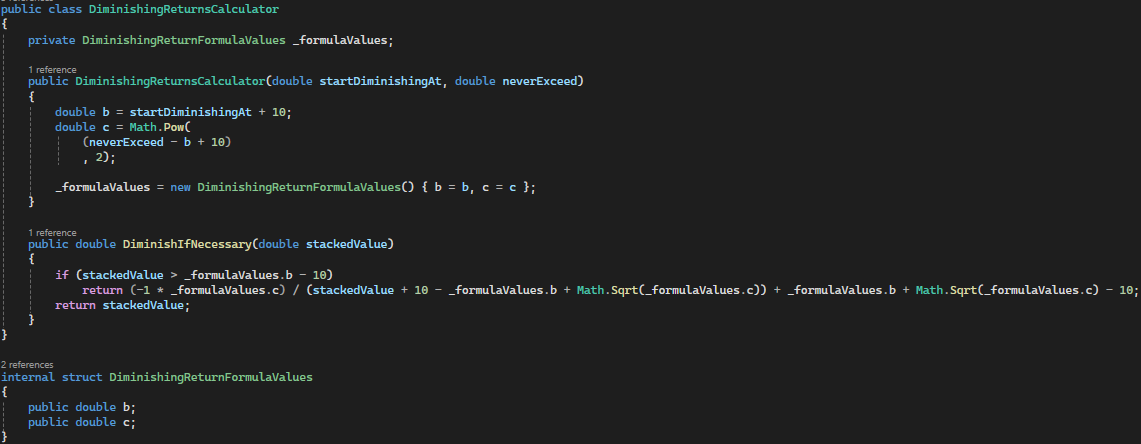
And once implemented, this is how easily it can be used:

In here, we're simply setting vaulting speed diminishing start at 20%, and setting the maximum amount at 40.
Then we can just run the real value the player has, which in this example is 21 and get the slightly diminished outcome (since 21 is slightly higher than 20)
(Assuming we're working with a multiplier, we'd want to set it to 1.2 and 1.4 instead of 20 and 40 in the real code of course, but for understanding purposes we use the % representation) -
@crogers271 said:
https://forums.bhvr.com/dead-by-daylight/discussion/465940/diminishing-returns-new-perk-keywords
You spent a lot of time on explaining the math, but I think there are a couple of issues with this before the math.
For the sake of argument though, let's just say BHVR isn't worried about if the system is to complex to scare off players.
For example, we could determine that any healing speed up to 200% is completely fine, and after that, we'd want it to start diminishing and never reach beyond 300%If we, or BHVR, actually were able to establish a line in the sand where a number goes from fine to problematic then it would actually be pretty easy to solve through a number of mechanisms. However:
1: I don't anyone could really agree on where that line is and I don't think BHVR has any idea either. Its relatively hard to determine, and part of the reason its not just built into the game, because the trade offs associated with taking more of a perk slot come with increased risks.
2: Given that perks can come with multiple effects, putting a formula like this in also really changes the balance equation. Imagine you had two perks that granted a 100% bonus and no special effect, and two perks that granted 50% bonus and aura read. Under your idea the latter perks suffer no penalty, making them now the superior option. BHVR's idea punishes both approaches (which if the goal is to penalize specialized builds its a great idea, they say it isn't, I don't think it should be, but its the result they are currently going to get)
3: There's not enough perks or slots to justify it. If a survivor had 20 perk slots and the perks did a lot of minor things and people realized there was a broken 'hey, here's how you stack the following to make yourself uncatchable', then I could see it. But outside maybe Hope+MFT I don't really see how it exists on the survivor side (I think the idea that healing is even being discussed is wrong), and such a broad based approach isn't necessary if we're only looking at a couple of perk combos.
4: More than one way to skin a cat - both BHVR's approach and yours don't address the idea that there could be a problematic outcome that can be achieved by multiple avenues. Let's say we think gen regression is problematic - we input a line on how much regression can be applied before returns decrease. Instead of taking all regression perks, the killer mixes it up with gen blocking, burst regression, and the max regular regression they can get value out of. The problem still exists, but all that's happened is adding additional coding and complexity while also decreasing build diversity.
Spaces like comp DBD have kind of already solved it by only allowing unique perks across the entire survivor team, meaning so survive can run a perk another survivor has.It's not so much that the perks are strong because they are run in tandem, its that certain perks are viewed in comp as the absolutely strongest perks and so little reason not to run them. Preventing that is a balance and enjoyability factor to create more varied games.
Exclusive: Effect can only be triggered by the first survivor that triggers it.Perks like Shoulder already have a built in limiting factor - it can end up a dead slot. If everyone brings Shoulder yeah someone is probably getting value out of it, but it was a commitment of a lot of resources to ensure that. You don't need an exclusive effect when there is already a detriment to overloading it.
And if BHVR wanted to limit SWFs from running multiple copies of a perk, they could do that by just preventing it from happening. Whatever the merits of the idea, they don't want to, but if they did the solution would be pretty simple.
Expertise: Effect becomes stronger for each survivor that DOESN'T have the perk.This just seems to be setting up SWFs to ensure they can easily get the max value out of their perks while soloq runs into each other.
"1. I don't anyone could really agree on where that line is and I don't think BHVR has any idea either"
I personally think the answers are quite easy. Let's take healing. Though healing already has a built in diminishing return, where the first 100% healing speed saves you 8 seconds of healing and another 440% healing on top of that would merely save 5 extra seconds, there is a genuine issue, where a heal might end up faster than the killer can m1 consecutively. The time that takes (which I guesstime to be around 2 seconds) would be C. And some extra leverage could be added to be B.
For vaulting speed, which in the past would include leader, giving 25%. The developers have clearly decided that 25% + resilience 9% + Spine chill 6% was too fast of a vault, which would be 40%. 25% itself was fine, and we see with Lara's perk that 20% is fine too. That means the right answer for C would probably be around 30%, which is a fine place to start, while starting diminishming at 20%. etc."2: Given that perks can come with multiple effects, putting a formula like this in also really changes the balance equation. Imagine you had two perks that granted a 100% bonus and no special effect, and two perks that granted 50% bonus and aura read. Under your idea the latter perks suffer no penalty"
Correct, such perks would suffer no penalty, and that is in fact something we should celebrate. The fact that they suffer no penalty, if we have set correct B and C values, means they never reach problematic values. Where as if you'd have 2 stronger perks, and they would start to diminish, that means that we have determined, in balancing B and C that at that tipping point lever, they have received disproportionate levels of power as a result of that stacking, which is why those perks will be fine, even if their values have some level of diminishment.
So this is in fact great overall. The only time where it wouldn't be great is where you'd have to assume we picked the wrong values for B and C, but that's an easy numbers change, taking less than 2 minutes."3: There's not enough perks or slots to justify it. "
There absolutely are. Though I agree that there are no healing perk combos currently that I would warrant needing to receive diminishing nerfs, due to my disagreement with stacking healing being a problem (unless reaching tipping point levels), we have already exceeded this when it comes to vaulting speed, back in 2019. And it also effected nerfs to unrelenting stacking with other perks, that too could've benefited from this mechanic. So this system is in fact needed, and would permanently solve all forms of problematic stacking values (within the same category)"4: … both BHVR's approach and yours don't address the idea that there could be a problematic outcome that can be achieved by multiple avenues… The problem still exists"
Simple disagreement. "General balancing issues" will still exist, but problematic stacking values will no longer exist. It's simply a different category of balancing issues that exists, which is completely unrelated to this current issue. This current issue in fact is completely fixed by this system, so that is a misconception. The problematic stacking value issue doesn't claim to solve all balancing issues in the game, but solves this particular one perfectly and indefinitely, due to our ability to determine through b and c exactly where we consider diminishing returns to be necessary, as well as allowing us to strictly define what the exact problematic value is that should never be allowed to by reached."It's not so much that the perks are strong because they are run in tandem"
It is very much so, as well, that when perks are ran in tandem that they cause many issues. The amounts of damage that big shoulder the burden, reassurance teams can do is completely throw off any balance in this game, which is also what ended the current highest Blight Winstreak with a 4 man out."And if BHVR wanted to limit SWFs from running multiple copies of a perk, they could do that by just preventing it from happening."
"This just seems to be setting up SWFs to ensure they can easily get the max value out of their perks while soloq runs into each other."
Like I said, preventing letting survivors pick duplicate perks is unnecessarily restrictive and reducing freedom, and assumes that keywords like Expertise are improperly balanced. If they are properly balanced, it won't be an issue that multiple survivors have it or "bump into each other", because the perks should provide extra value due to multiple survivors stacking it, which is why they were given the expertise keyword to begin with, exactly because of that disproportional stacking power nature. So it'd would indeed by the superior option for balancing, rather than unnecessarily restricting duplicate perks"For the sake of argument though, let's just say BHVR isn't worried about if the system is to complex to scare off players."
I understand why, upon viewing the post originally, due to it covering it in so much detail that anyone could use it to directly implement it, that the mechanic might look intimidating. However, to the player, none of this complexity has to be visible. What is visible to them is rather intuitive:
Each value (like healing speed / vaulting speed, etc.) has a value at which it starts giving diminishing returns and a value it can never go beyond. That's literally all they need to understand.
In communication to players, let's say we want to communicate how vaulting speed diminishing returns work;
Vaulting speed: starts giving diminishing returns beyond 20% bonus speed and never exceeding 30%. Boom. Easy, intuitive, and fool proof, preventing problematic values from ever being reached.
Even the development of this system is rather easy.
1 function that let's you determine where diminishing returns should start (which determines b)
1 function let let's you set where diminishing returns can't exceed (which determines c)
1 function that checks a particular stacked value whether it's bigger or smaller than b - 10. If it's smaller, just keep the value as is. If it's not, use our diminshing formula with our b and c.
That's all there is to it. Both easy for players to understand and easy for the Devs to work with. Once the functions are implemented, all the devs have to do for every potential problematic value is defining where diminishing should start, and what it shouldn't be allowed to exceed, and they solve the problem forever
For example (just guestimated values btw):
Healing speed: Start diminishing at 400%, don't exceed 500%
Vaulting speed: Start diminishing at 20%, never exceed 30%
Lunge recovery Speed: Start diminishing at 50%, never exceed 100%
etc.
And the issue is gone forever -
@Little_Kitten said:
https://forums.bhvr.com/dead-by-daylight/discussion/comment/4069623#Comment_4069623
I do think a solution like that would help waste time for killers who try to tunnel right from the start of the match. After that, it’s also up to survivors to play more stealthily 😊
And when I see how some survivors behave in-game, I can’t help but think there’s still work to be done—but that’s not the killer’s fault 😅
Had you considered that this mechanic could deactivate after a certain point, depending on conditions related to the current state of the game?
I think the mechanic deactivating at a certain point may be too arbitrary and add unnecessary complexity. If the killer is typically in a more hook heavy mindset due to this change, and the game being balanced around 6-12 hooking, instead of 3 hooking, that deactivation wouldn't be needed. Especially since it doesn't matter much for non tunnelling killers anyway. For them it might even be beneficial for survivors to use the feature, as it prevents a quick heal from underneath the hook, and leaves more survivors vulnerable for longer
With this mechanic, the survivors would have to more properly play the game themselves, keeping more stealthy on death-hook, and thinking about the fine lines between safety and applying gen pressure -
"The idea of injuring the unhooker when they choose option 2 could be interesting, but it might also allow the killer to down that survivor too quickly, which could be a bit too advantageous."
Essentially, the mechanic is there, not to injure, but to keep the unhooker occupied at the hook for a while to give the killers more time to make it back to the hook and find a survivor. That's the aim of keeping them there for about 10 seconds. Kinda the reason why I added the injure is so that killers with instadown don't disproportionally benefit from this mechanic, as normal survivors stuck could just take a hit and have a chase, but if the killer had, say, exposed, then it could be preferable to take the injure and run away prematurely. That's the idea behind it kinda
"So maybe we could imagine that, in the case of option 2, there is still a sound notification at the hook indicating that something happened—but that this notification is identical to the usual one."
I may have communicated it badly, but yes I do want there to be a noise notification at the main hook, just not at the hook that the unhooked survivor is sent to, so that the unhooked survivor is at an known location again (stealth), while at least 1 player's location is still known (the unhooker), so I definitely intent there to be a notification at the unhooker, that's a must.
"Focusing a survivor at 5 gens left is just being a jerk. On the other hand, tunnelling when there’s only one generator left can simply be a strategic way to rebalance the game."
I kinda hope that, hell, even if a killer wants to tunnel at 5 gens, it'd still be consider the survivor's fault when it happens, because with these changes, they absolutely had the ability to survive if they used the tools available correctly. Having to play more stealthy when you're death hook, as you often see in comp. Due to how unfair being tunnelled is right now, in your ability to regain stealth after your first hook, people don't really blame it on you when you get tunnelled because they know it's unrealistic to re-enter stealth as an injured player. If a killer managed to take a survivor out of the game at 5 gens with this update, it would honestly be well played by them, which I think is a good thing, because there's no reason for killers to be blamed for how they play, especially when they're playing to win. I think this update has a high chance of achieving that! ❤️ -
No buff to basekit movement speed and no buffs to max capacity please (Aka the areas where survivors can utilize counter play). Buffs to trickster in any other areas is completely fine.
Buffs like 6 knives back per laceration trigger when picking up a survivor, typically leading to 12 knives back per down, reducing how often he needs to visit lockers would be great and make him less vulnerable on low-locker maps, etc. -
The Blight nerfs have been amazing so far. Very fair as well and leaving skilful plays intact and only really removing the unfair downs. Couldn't have asked for more tbh
-
@Rokku_Rorru said:
Honestly I think this is going to get worse before it gets better and that's okay. I'd rather individual perks had more of an impact and I'm ready to go through the journey with the devs and watch the game grow.
A lot of my gripes with this game are to do with stacking perks, so maybe we should wait and see and try it out THEN give feedback.The funniest thing imo is that the main thing in this game that gets stacked is healing perks, but healing perks already have a diminshing return built into it when it comes to timesaves;
First 50% healing speed = 16 -16 / 1.5 = 5.4 seconds saved
2nd 50% more healing speed = 16 / 1.5 - 16 / 2 = 2.6 seconds saved
3rd 50% more healing speed = 16 / 2 - 16 / 2.5 = 1.6 seconds saved
The only time healing speed would actually become stronger from stacking if it manages to outpace the speed at which a killer can reload their m1 attack. Literally at any other value, having stacking healing speed is a self solving problem -
@angrychuck said:
I think something like this would be cool for trickster, although I do feel that built in gen regression might be too far. If something like this were to be implemented more re-works of some addons would also be required, like his iri addon which reloads 50% after main event to prevent him from being 115% for too long.
A 100% agree with you on the Add-ons. The one that gives back blades should be removed. (It honestly serves as a worse implemented version of the current knife-back mechanic), but the Devs got the underlying idea right of adding knife-back mechanics
Though I disagree with the gen regression going too far. It would be one of the healthiest ways to buff Tricksters without destroying or making his chase too overbearing, plus it makes his gameplay more enjoyable overall, since it eliminates a lot of the scratchmarks chasing.
You can watch gameplays of Tricksters are empirically measure the impact of this mechanic. It's nothing too crazy. Sort of like a weaker Hex Ruin but that only works on the gen that you manually push someone off (which for a killer without too much movement isn't too over-brearing, but quite healthily balanced). Plus it synergizes nicely with perks like Grim Embrace -
There should also be an option to turn hooks into large candy canes so the hooks aren't to gory as well
-
I created a video to show what it would look like if the Devs implemented the following buffs:
⸻BUFF: Whenever Trickster picks up a survivor, he gets 6 knives back per laceration he triggered on that survivor. Which means: If he took 2 health states with knives = 12 knives back. One m1 and 1 knife health state is only 6 knives back, and all health-states with knives including endurance = 18 knives back. He also gets 6 knives back when grabbing a survivor from a locker. (Receiving knives back doesn't exceed the 36 max capacity, even if you're running knife capacity addons)⸻
https://youtu.be/Oy5gdcLSVUwBUFF: Whenever Trickster triggers laceration with his knives, increase his movement speed by a total of 0.5%, 1%, 1.5%, 2%, 3%, 4%, 5%, up to a maximum of 5% follow the previous total increase distribution. Upon reloading at a locker, his bonus resets back to 0% bonus. (Increase is meant over the survivor 100%. So the max 5% increase should set it to 115%, not 110% * 1.05, which is 115.5%)Many people have requested extra movement speed as well as extra knives. Which would be problematic as it would destroy proper counterplay from the survivor's side. These changes however are a more fair way to still give access to those features while leaving counterplay on the table
(Buffs are from) ⸻How I'd BUFF the Trickster (A Healthy Buff On Top of the current REWORK) — BHVR -
UPDATE;
https://youtu.be/Oy5gdcLSVUw
I created a video to demonstrate how this Trickster buff would play out in an actual match!This is what it would look like if you would receive 6 knives back per laceration / locker grab, and how high your Buff would be based on your laceration triggers.
The gameplay is a randomly selected video from Wacek, where we demonstrate that in this match, normally he'd have to reload 4 times, but due to his accuracy, he would only have to reload ONCE with our knife receive-back mechanic! To show what you could accomplish with this more healthy way of integrating the movement speed and knife count people have frequently complained about while leaving proper counterplay intact! -
@ThatRyanB said:
One thing I'd love to dig into more here is the discussion around The Trickster's movement speed, as I think the "why" is an important piece of this.
Is there anything specific you've encountered while playing The Trickster that makes the 4.4 m/s speed feel frustrating?
Sadly the reason isn't complex. Trickster being 4.4 and the max capacity being 36 is what's creating real counterplay for survivor.
That doesn't mean Trickster is weak. It means that Veteran Tricksters can win against Veteran survivors, Adept Tricksters can win against Adept survivors, mediocre Tricksters can win against Mediocre survivors and beginner Tricksters can win against beginner Survivors
However, because previous Trickster didn't have proper counterplay and could run down survivors, a lot of Tricksters are a bit Legion brained, and for the first time, we're seeing Mediocre Tricksters complain on the forums that they lost (because they were facing Adept and Veteran survivors, who were better at survivor than they were at Trickster), and thus they are getting countered.
How did those more skilled survivors counter them? With distance and by making them run out of knives. Hence why such Legion-like Tricksters are now complaining about movement-speed and knife max capacity (basically the only counters, which are currently well balanced at 4.4 36). Because mediocre Tricksters can no longer mow down adept and veteran survivors. Only adept and veteran Tricksters can now, which is to be celebrated. Mediocre Tricksters will have to stick to winning against mediocre survivors -
@bunbun said:
- Only the sixth bullet is a projectile weapon.
- If you don't hit the target six times in a row, the fact that you hit it disappears.
- Getting close is necessary to hit the target repeatedly.
It's a mistake to think of her as a Huntress.
The comparison should be with an Unknown, which has the same characteristic of requiring close-range combat. Is the Unknown movement speed 4.4 m/s?
Since Wesker can perform two dash attacks, is his movement speed the same as the Nurse 3.8 m/s?Having only a meager 4.4m/s to approach is the same as a Hag who doesn't use power. If you want to make the 4.4m/s work, you need a dash ability or something similar.
In the PTB, "Cut Thru U" could be used as a way to approach survivors by hitting them from a distance. It fit perfectly with the style rank system and was a great idea.
This is how it should be done as a base kit CTU.
4.4m/s E, D rank
4.5m/s C, B, A rank
4.6m/s S rankThere's a big difference between The Unknown and Trickster.
If the survivor dodges against The Unknown, that dodge saves them a lot of time, and the Unknown will have around a full 7 seconds where they can't do anything more than M1.
Where as when someone Dodges against the Trickster, they'll most likely be hit the second after, making most of their gameplay close to meaningless, unless they can somewhat keep the Trickster at a distance, which is the case when he is at a base-speed 4.4 -
We need it back. It just feels wrong not having it
-
@bunbun said:
Isn't the reason why Trickster is mistakenly thought to be easy to use by those who are unfamiliar with the game because you have to replenish it in large quantities from your locker all at once?
The Huntress, who camps with seven bullets, is in the same situation. She has to stop by her locker to refill them all at once, so she ends up carrying unnecessary ammunition.
The most powerful and easiest dash killer in DBD somehow automatically reloads while moving at 4.6 m/s.Slow killers should reload with the minimum necessary ammo on the spot, like the Clown, while dash killers should restock all at once in a locker.
Killers like trickster simply need to get their 6 knives back upon pickup for each healthstate they take with knives, so they don't lose any if they don't miss, while keeping max capacity capped at 36, so it's still possible for survivors to win a chase if the Trickster screws up badly