
zarr
zarr
About
- Username
- zarr
- Joined
- Visits
- 5,381
- Last Active
Comments
-
The "consider putting a few % of progress on a gen if you're passing by" tip is really good: not only can this trick killers into thinking someone is around and wasting some time searching, but it also makes it easier for fellow survivors to find gens, simply by hearing them in their vicinity, which is particularly helpful on indoor maps of course. And yes, the gen might absorb a Pain Res that could have otherwise retained its token, or a Deadlock that might have otherwise blocked a more important gen. Of course, there is the risk of giving the killer the ability to proc Nowhere To Hide, Oppression, Unforeseen or the like on the gen.
I'll just drop two random little tips for either side:
As survivor, you can drop your item to fake vaulting a pallet or window due to the grunt your character makes when doing so. This is particularly neat against Spirit or Dracula, but it can also be used on tiles where line of sight is broken. Obviously this can only fake a slow vault though, unless you're using Quick & Quiet, so use accordingly.
As Legion, if most or all survivors are already injured, you can still use Frenzy to traverse the map a little more quickly. And to get the maximum possible distance, you want to lunge at the latest possible moment of your Frenzy timer, getting just that slight bit more. Yes you'll have to go through fatigue at the end of Frenzy, but you still cover more distance using it even when accounting for fatigue. Also something a lot of people don't seem to know: You can pick up survivors while in Frenzy.
-
@Sandt1985 said:
https://forums.bhvr.com/dead-by-daylight/discussion/comment/3857139#Comment_3857139
if his cooldown is ever reverted back to 18 seconds, then he will, at a minimum, need to become a 115% killer. 18 seconds is waaaay to long of a cooldown to be spent moving at 110% with now power whatsoever
He wasn't in a bad spot originally at 18 seconds cooldown, they only reduced it to compensate for the removal of scampering without slice-&-dicing. But it turned out that the cooldown reduction was simply too much. I would take the 18 seconds cooldown over 8m/s dash speed any day. Although yeah, to be fair, without 180° flicks, "scancels" and with Rat Poison not being what it was as well as the slight cooldown increase caused by the cooldown now only starting when you swing for the Slice & Dice rather than when you dash, 18 seconds would be too much. 16s is more appropriate. An alternative could be to considerably increase the Hidey-Ho duration, such that Chucky will become more about using stealth rather than only really using power for S&D.
Anyway, my personal preference would be to have 180° flicks again, then perhaps with 9m/s S&D at 1.4s duration and 16s cooldown. Or some other combination of number tinkering (e. g. 10m/s at 1.1s duration). 180° flicks are just so fun, enable players to make hits happen in so many more interesting ways, and also make scampering more relevant again since it allows to actually hit people tucking in right next to the window/pallet.
@JPLongstreet said:
https://forums.bhvr.com/dead-by-daylight/discussion/comment/3857139#Comment_3857139
I thought they got rid of the 180's with Chucky because it couldn't be done with a controller?
I'm not sure what their reasoning was, but there's plenty of killers that benefit from flicking still that are obviously limited on controllers for that reason. We can't expect and shouldn't want for them to make the game function the same way on categorically different input devices.
Chucky used to have some really interesting stuff he could do, much of it has been taken away. He was/is still strong because S&D is just often a guaranteed and easy hit and the cooldown was ridiculously low, but the 8m/s dash feels horrible and between that and the lack of flicks, well, there's little reason not to just play Wesker or Blight.
But I do acknowledge that they can't balance Chucky based on 180° flicks, due to them not being accessible on consoles, so he would have to be in a good spot regardless. I guess the easiest thing for now would just be increasing his dash speed to 10m/s at 1.2s duration again, increasing the cooldown to 16s, and giving him the ability to instantly turn 90° sharp after scampering, such that he can actually more reliably use scampers to convert hits. BHVR will have data on how many scampers actually result in hits, and I can't imagine it's more than 10%, maybe not even that. Again, the reduction in dash speed actually helps with converting scampers into hits, but yeah, that's not a worthwhile trade-off, they should just make scampering more of a threat.
-
@Devil_hit11 said:
https://forums.bhvr.com/dead-by-daylight/discussion/comment/3857174#Comment_3857174
Tru3 here really shows the "power of narrative": He loses Thrill after not checking on it at any point, and spins it into a narrative that it's not OP and that it being overtuned is just something people randomly decided to come up with
are you joking or what. his totem is at shack and he goes to shack gen as his 2nd destination in the match. Your so caught up in your own narrative that your disregarding the most basic actions taken in the video. Later on the video, he questions the perk because he was in near immediate vicinity and wonders why he was not able to stop the cleanse. The chat later reminds him that the perk was weaken and then he re-affirms between 5:20-5:30.
Only in dbd do you get justification where the killer has 4 perks vs 16 perks and destroys perk left & right is like normal. either way, good job killing another perk.
None of hex perk are worth anything because having life-span of 1 minute, 2 minute, 3 minute is near worthless and virtually hex perks require them to stay up for minutes and minutes to gain value. I am not entirely sure at what point do you consider the hex perks for having "high reward". Maybe 5 minutes? They're not even close to getting across 1/2 through finish line.
Strangely enough, the most consistent hex perks end up being hex:pentimento & Haunted grounds simply because the hex totems are so indefensible that only "high value" totems ever receive is them being destroyed/sacrificed. Their native effects seldomly matter.
are you joking or what. his totem is at shack and he goes to shack gen as his 2nd destination in the match. Your so caught up in your own narrative that your disregarding the most basic actions taken in the video. Later on the video, he questions the perk because he was in near immediate vicinity and wonders why he was not able to stop the cleanse. The chat later reminds him that the perk was weaken and then he re-affirms between 5:20-5:30.
He finds a survivor, latches onto them with Victor and then follows them, paying no mind to his totems. Finds another survivor, follows them too, unleashes Victor to latch onto them. He then follows them to shack, where his totem happens to be. Who knows whether Tru3 would have even thought to check on his totems had the survivor not ran there and Victor's killer instinct not literally screamed at him that someone is on his totem. And all of this on a smaller map that is separated into two halves and that most if not all of the survivors can be expected to have spawned on the other side of, where his totems also are. One of them in shack, a spot survivors are likely to spawn at or go to, and the totem in which is impossible to not notice once you do. The fact that he does not check on his totems at latest after the first Victor latch (and then makes snide, trite remarks about "Thrill OP xd" when his totem gets cleansed) speaks to nothing more than his incredibly casual, going-through-the-motions way of playing the game and not thinking much about it.
As others have said, Thrill is not supposed to be a means of making Hexes uncleansable, but making it more reliable to defend them (and making it more of a timesink for survivors to contest them). He could have easily defended his totem(s) here, especially as Twins that can essentially be in two locations at once. Again, that survivor had spent upwards of 30 seconds on that cleanse, had Tru3 simply prioritized checking on his Hexes even just 5 seconds earlier instead of following two different survivors he would have interrupted the cleanse, nullifying all of that time the survivor had spent on it and keeping his totem(s) or at least one of them, with the other becoming Penti (and Penti + Thrill/Ruin is also a really strong setup).
That Tru3 himself acknowledges in the video that Thrill has already gotten nerfed only adds to how ridiculous it is that he uploads this with the intention to demonstrate how "Thrill OP" was some false narrative. Yeah, it's not OP anymore, because it was adjusted accordingly after people pointed out how OP it is… The video in fact if anything supports the argument that it was OP: Had this been 14% Thrill, he would have actually interrupted that survivor on the shack totem, wasting all of that cleansing time, despite never even having thought about protecting it, a survivor literally having to lead him to it and Victor having to yell at him that someone is on his totem… And yet he still 4k'd at 5 gens left… To which the time the survivors spent cleansing, the hit they took for it and the fact that they cleansed at all allowing Tru3 to use Penti will have significantly contributed. That early-game slowdown/pressure is incredibly valuable. Current Thrill even in this match which was basically a worst-case scenario still put in a good amount of value, in many other matches (and with better decision-making by the killer player…) it would get much more value still. And somehow the opinion he comes away with from this is that old Thrill (that was notably stronger still) was falsely made out to have been OP?…
Only in dbd do you get justification where the killer has 4 perks vs 16 perks and destroys perk left & right is like normal. either way, good job killing another perk.
The "4 vs. 16" perks comparison doesn't mean anything. Do you think the game would be balanced if the killer was able to equip 16 perks? Or each survivor only 1 perk? No? Then you already understand that it's not as easy as to say 4 vs. 16. Killer perks work differently and they usually have a much more considerable, consistent and constant impact on matches. Killer perks are also not getting "destroyed left & right". There are incredibly strong killer perks. Ask any good player and they will tell you a top player on a top killer using Pain Res, Grim and DMS is basically unbeatable, even by the best top teams in the world (and you don't have to take anybody's word for it either, this is proven, established fact - I can give you more tournament stats if you want). Doesn't mean I agree with all the nerfs there have been to perks (killer and survivor), or don't think perks should be buffed (tons of them should).
Thrill was actually buffed to be in the state it's in now. Originally it was buffed by 40% (10% → 14%), now it is still 20% better than it had been (10% → 12%). And I much welcome this buff, it's a decently strong perk, take it from someone that enjoys using Hex perks a lot. Having to spend 35 seconds on a totem cleanse instead of 14s is great value. Which perk gives you 21 seconds of pure slowdown multiple times, and the potential of wasting literal minutes of survivor time as you keep interrupting their cleanses? Imagine you interrupt a survivor that has repaired a gen to 40% and it goes back to 0% the second they let go. That's Thrill. And that's not even mentioning the incredible value and threat factor of the Hexes it helps protect.
Go out there and use Thrill + Undying + Penti + Hex of your choosing, play decently and win most of your matches with relative ease. Or try Thrill + Undying + Dominance + Devour. Oppressive, especially on the various killers that have an easy time interrupting totem cleanses. Thrill + Plaything + Pentimento + Ruin/Thana/Blood Favor/Third Seal/Face The Darkness/… on Plague with Black Incense (or just Blight/Nurse/Billy) and you will never lose. And many more Hex builds and constellations that I guarantee 99+% of pub survivor groups will struggle impossibly against if used by a competent killer player.
None of hex perk are worth anything because having life-span of 1 minute, 2 minute, 3 minute is near worthless and virtually hex perks require them to stay up for minutes and minutes to gain value. I am not entirely sure at what point do you consider the hex perks for having "high reward". Maybe 5 minutes? They're not even close to getting across 1/2 through finish line.
This is a way too narrow-minded perspective of what Hex perks do. You can't quantify their value in terms of minutes they are up for, there is this weird obsession with "mathing out" DbD that just always shows how little game understanding the proponents of such ideas have, or how stubbornly they try to push a talking point. If your Devour stays up until you have acquired 3 tokens, the things that perk can and regularly will do to a round are as impossible to quantify as they are to overstate. I have played thousands of matches using Devour, and it's still impressive every time just how hard matches come crashing down for survivors once that third stack is acquired. It's incredible. But even apart from the obviously game-winningly impactful effects of Devour, it's impossible to quantify what, say, Blood Favor can mean for you even if all it does before it's cleansed is allow you to get a very early down. The impact of that too can be game-changing for obvious reasons. And then there's the fact that survivors spend time searching for and cleansing totems, and that the killer can interrupt them doing so, creating a battle for the totems in which the survivors will lose a lot of time, resources, health and hook states and even entire games. Part of the reason why 3-stack Devour much of the time spells catastrophy for survivors is that they then find themselves in a very precarious, often hopeless battle to contest the totem.
Or how about another hint as to how impactful Hexes can be even if they get cleansed in the first minutes of a match: Corrupt Intervention is rightfully regarded as one of the best killer perks in the game, and all it does before it literally disables itself is block 3 generators at the start of the match, slowing down the early game by preventing survivors from being able to instantly hop on gens. Because this slowing-down of the early game is immensely valuable. Hexes can also have this slowdown effect in the early game - on top of course of their respective innate effects - if survivors instead of immediately spreading out to gens sit on totems instead.
Strangely enough, the most consistent hex perks end up being hex:pentimento & Haunted grounds simply because the hex totems are so indefensible that only "high value" totems ever receive is them being destroyed/sacrificed. Their native effects seldomly matter.
I mean, Penti and Haunted Ground add to how good Hex perks are because they allow the killer to capitalize on survivors cleansing totems to begin with, which they would not do if valuable Hex perks didn't exist (and even the global, general threat of their existence can improve Hexes, at times leading to survivors refraining from cleansing totems at the prospect of having to deal with Penti or Haunted).
But regardless, I simply disagree with this argument. Can there be rounds where Hexes get cleansed too quickly for it to have seemed worth it? Absolutely. But over hundreds and thousands of matches, the impact these perks have will be consistent and significant. Especially if you use things like Thrill, Penti, Undying. And actually play around and off of your totems… And there will be just as many matches that these perks will literally carry or decide, contributing majorly. People sleep hard on Devour, and even more so Third Seal. The amount of matches they have handed to me on a silver platter and the way in which they did… Plaything is also pretty crazy. Sure, against highly coordinated full 4-SWFs playing with concise and precise call-outs and whatnot they aren't as crazy. But in 99+% of matches we actually get as killer? Devastation.
How do you explain that Blood Favor and Ruin are among the top 10 most used perks by some of the absolute best killer players in this game, in a tournament where Penti and Haunted aren't even allowed, and in which they face highly coordinated, highly experienced, highly skilled 4-SWF teams that can play around their totems in ways that are unthinkable for any pub group, and in which killers also won considerably more often than they lost? And that's just one example. Hex perks even see common use in restriction-less tournaments. Hex perks are staples in tournament DbD whenever they aren't banned for being considered to be too strong by some of the best, most experienced players in the game. Should be "hint" enough that they're quite alright.
-
It's a non-event for the most part. For newer players it might be fun to mess around and walk around in snowmen and throw around snowballs for some time, but for jaded, disgruntled, battle-scarred cynical veteran Scrooges of the game like myself, those things barely even register. The "event" mode for me is literally just normal DbD with the occasional nuisance of a snowman being in the way, or someone wasting time throwing snowballs at me instead of doing something productive. Obviously there can be a little more to it at times, but overall this holds true.
These events are just a few weeks out of the year, and now we even have a separate queue for them. I really wonder why BHVR doesn't let us live a little and really mixes up the gameplay. The winter event in particular has suffered, with snowmen having been nerfed into what amounts to glorified lockers. And the snowballs have never done anything. And instead of improving on this, they keep recycling these things every year.
It is cool that the snowmen now move around on their own, as that can trick both killers and survivors into thinking someone is in them, and likewise to generally assume that nobody is. Although one problem is that the bot-controlled snowmen move around in a noticeably stuttery and janky way, rather readily distinguishable from real players. So good idea, bad execution.
It is really disappointing how neutered snowmen are from their original iteration, and that despite all of the tools being there to make for a much more crazy and engaging event gameplay without even needing to put in much work:
Make snowmen tank hits again. They used to tank hits when survivors were inside of them, as well as when dodging around them, now they do neither. With snowballs, the perfect counterplay to snowmen has long been introduced, as a survivor trying to use a snowman if the killer has a snowball will result in a guaranteed hit. To compensate, make it so that survivors get Exposed for some 10 or so seconds if within 10 or so meters of a snowman that a killer pops out of. This would lead to survivors also having to have snowballs on them and popping approaching snowmen, or popping them before the killer can use them in a chase.
Snowballs could also slow down killers and survivors very briefly, with the slowdown duration depending on the hit area (legs, torso, head).
-
I like it overall, cool map visually and gameplay-wise, with some interesting pallet setups, sensible gyms, and reasonably well-balanced map-specific structures. I do think they could have gotten a bit more creative with the gameplay design still, and they could altogether be much more ambitious (e. g. more of that "steam trap" Nostromo stuff, interactables or things that change the map as gens become completed and such), but yeah, overall this shows a good direction in their map design approach from a basic layout and structuring perspective. Forgotten Ruins has good ideas and blatant issues, but Greenville is another reasonably well-designed, well-balanced map, and both also look pretty great.
It's unfortunate that they rarely put out maps these days, there's so many more ideas (how cool would the manor from the current lobby background have been, in the context of some cemetery map? Not to mention a castle for Castlevania, a cityscape for Trickster, a swamp visual upgrade with a new pirate ship isle map for the Houndmaster, Chucky's toy factory, …), but for any map to come in the future at least their new releases are showing a good trend.
-
@Equinox_One said:
https://forums.bhvr.com/dead-by-daylight/discussion/comment/3857106#Comment_3857106
Niche, mid, very mid, incredibly mid. BF works well on some survivors but smart folks know how to play around it. It is a godsend on Game at least.
There's a reason BF is not and has never been meta.
The rest of these are kind of a fart.
https://forums.bhvr.com/dead-by-daylight/discussion/comment/3857115#Comment_3857115
And yet you never see it in any sort of top level or tourney play, even where other perks are restricted.
Why do you think that is?
I'm sorry, but you have no real clue what you are talking about. About as much as Tru3.
Blood Favor is usually banned in comp because it is ridiculously strong, and whenever it isn't banned it sees ubiquitous use.
Because I like to speak in facts rather than anecdotes and things pulled out of nowhere, you can look at the most-used killer perks of DbD League's recent All Hallows' League tournament (https://docs.google.com/spreadsheets/d/12AncFXVhL2sEuJMS9s4CgZx3FQkyTNXCrwNujucSP6g), a tournament in which there were much fewer restrictions than usual:
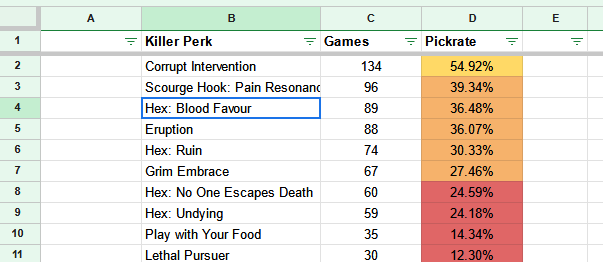
Wait, Blood Favour is the 3rd most-used perk here? …And that's despite Pentimento being banned?!
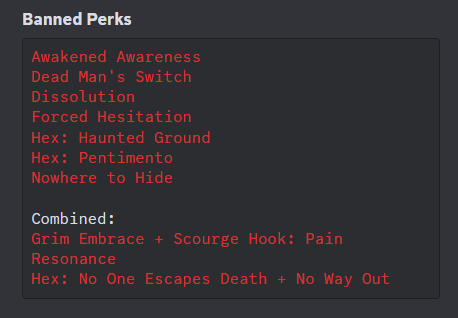
Wait, killers have banned perks too? And even more per-killer perk and add-on bans?!
Aren't survivors infinitely OP and killers can never win if the survivors are barely alright at the game and actually just do gens???
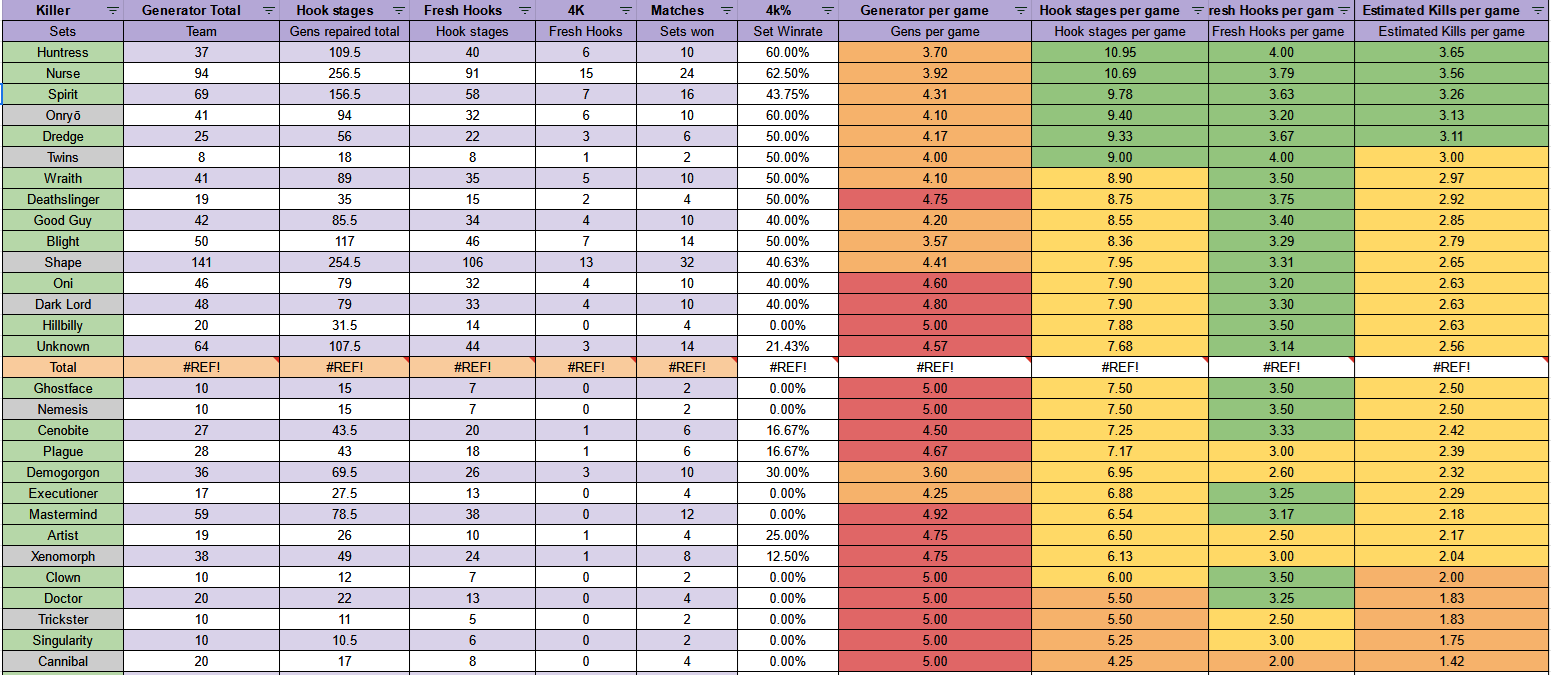
Wait, the vast majority of killers got more than 2 kills per game, overall average killrates being comfortably above 60%, average hook stages comfortably above 8, with some of the killers having 80+% killrates?! And this against death squads on voice comms that have been practicing together for years and are toxic tryharding?!
…
Blood Favor, Devour Hope and Pentimento are extremely impactful and powerful perks, and the ability to fortify them using Thrill with 70% reduced cleanse speed was blatantly problematic. That's not even mentioning Face The Darkness or the various killer abilities, add-ons and perks that could legitimately make it impossible to cleanse.
Ruin is also much better than people tend to give it credit for. The regression is slow, but the fact that gens regress constantly is crazy. Imagine the time you would have to spend kicking all those gens constantly. It's a slow killer, but a killer all the same. Of course, you need to actually create pressure yourself for it to be really impactful, it does not do its job on its own.
Crowd Control is really potent now and not a lot of people have caught on to just how potent it is after its buff. It's another thing you regularly cannot afford to leave up.
Third Seal is also a very underrated perk. Against non-coordinated groups this can quickly cause massive mayhem, people wasting minutes looking for others, bleeding out, transitioning hook stages or dying on hook. Not to mention what it does to perks a lot of survivors (again especially if they are not in coordinated premade groups on voice comms) rely on, such as Windows, Bond, Kindred. People just don't use this much, but trust me, this perk would be up there as the most complained-about, most problematic thing in the game if players were to regularly use it and slug a lot, particularly of course on killers such as Nurse, Blight and Billy. Awful game experience for just about anyone but the best, most coordinated voice-comm 4-SWFs.
He loses Thrill after not checking on it at any point, and spins it into a narrative that it's not OP and that it being overtuned is just something people randomly decided to come up with and tell stories about like they apparently constantly do. …After it was nerfed from 70 to 60%. Because it was clearly OP before. He also 4ks at 5 gens left but doesn't attribute any of it to the time survivors spent cleansing and taking hits for the first cleanse, and the compounded value of setting up Pentimento on the totems the survivors had spent that time getting rid of. Nor does he think about the fact that had he went there even just 5 seconds earlier, he would have interrupted the cleanse, meaning that survivor would have wasted 30+ seconds for nothing, and still taken a hit for it, with him then potentially being able to have Penti + Thrill up (at 5 tokens again, too).
Thrill is in a good spot at 12%. It's still a decently strong perk. Just not overpoweredly so, like it was at 14%.
-
Chucky at 8 meters per second dash speed and 1.8 seconds dash duration catches up the same distance differential to a survivor he did at 10m/s and 1.2s (4m/s catch-up speed * 1.8s = 7.2m; 6m/s catch-up * 1.2 = 7.2m). The difference of course being that it takes Chucky 600ms longer now to do so, which allows the survivor to cover more distance before the hit happens - 2.4m to be precise. So if there is a pallet or window or sharp turn in range, now the survivor might make it into safety whereas they wouldn't have before. Chucky also covers 2.4m more himself now, but that doesn't matter if there's a pallet, window or wall between him and the survivor at that point.
I think it would have sufficed had they simply increased the cooldown back to 18 seconds. Chucky is really strong and really easy to play, but the Rat Poison nerf already helped to make him less easy to succeed with and the slower dash is just unfun to use.
Alternatively, settle for 9m/s and 1.6s duration, perhaps with a 16-second cooldown.
Or better yet, bring back 180° flick such that a survivor making it behind a wall or pallet due to the lower dash speed isn't as detrimental as it is currently.
As a concluding note: The decreased dash speed has actually made it considerably easier to hit people after scampering, as you don't overshoot quite as much. So it's not all bad.
-
Servers have been volatile for months now, with the modifier and event modes struggling particularly. Generally higher and fluctuating pings, frequent rubberbanding, occasional freezes, rare but noticeably more common server crashes.
What's causing it is anyone's guess, BHVR is not transparent at all when it comes to things like this and never even addresses anything of the sort. It could be them squeezing as many matches as they possibly can to be hosted per server, and the servers not handling that load well or at least not consistently well. With the separate queues for modifiers and events, it could be plausible that BHVR simply increased the "matches hosted per server" amount to accomodate them. It could also be that lacking performance and netcode optimization is the culprit, as that will become increasingly troublesome with the modifiers and events having added gameplay interactions and such. It's also possible that BHVR has reduced the amount of servers they want to pay for from Amazon, or opted for a cheaper plan with decreased performance/tickrate.
But it is mostly happening whenever there's a modifier or event going on, so that's sure to have to do with it.
-
Given that reducing her lunge range is what I have long considered to be a good way of balancing her, the creation of this add-on felt like an insult. Her lunge already acts like a sort of "third blink" and enables a player to make up for a fair bit of imprecision in their blinks or nullify survivor dodges, it should be decreased and not increased.
Nurse has a few really decent add-ons, such as Mangled, Undetectable, Nurse's Calling and insta-blink, and then there's back-blink and 3-blink that are pretty busted. The lunge add-on could just become Hemorrhage. I also think blink recharge add-ons could come back, albeit only in a reality where Nurse only starts recharging blink tokens after fatigue has ended and can be pallet-stunned more reliably (then also only recharging after the stun animation ends). They could give her basekit Blindness while charging and holding blinks and during them, but have an add-on that gets rid of this Blindness. Reduced lunge range but the add-on increases it again, if not quite back to normal. Lots of possible basekit nerfs they could moderate with add-ons.
-
Coldwind had been hit with multiple major nerfs (reduced map size, changed map layouts, nerfed main buildings, reduced pallet safety, reduced pallet amount) that left the maps a shadow of their former selves. …And then they went and brought these poor excuses for jungle gyms as the deathblow.
I will say that I do sort of enjoy these gyms, they do have some interesting checkspot and pathing opportunities, it's just that they should never replace actual jungle gyms. These tiles still ultimately boil down to 50/50s at best against a remotely competent killer, and even against a poor player will eventually result in a hit. The safety rating for these should be that of haybale/cart fillers, LT-walls and bracket pallets and spawn randomized against them, never replacing proper jungle gyms.
While Coldwind deserved most of its nerfs, they went a little far or at least didn't account for how the nerfs would compound. With as few pallets as they spawn to begin with, having 2-4 of them be those new incredibly unsafe corn fillers is just not feasible. Those corn fillers should not detract from the tile budget, meaning they should spawn on top of any other pallets, not instead of them. This would also help in the sense that then if you play them well and actually get the stun or some distance, you can reach something else instead of taking a guaranteed hit stranded in the cornfields.
Harvesters offer little to no gameplay for survivors currently and are glorified hills. At the very least, enable survivors to also be able to jump onto the offshoot side's haybales from the ramp again and vice versa. And/Or make it possible to drop off toward the backside of the harvester from the offshoot again. Or even bring back the elevated haybale on the other side's vault that killers without a ranged attack cannot hit survivors on. Harvesters need at least one of these things to provide any play opportunities for survivors apart from using them for Balanced Landing.
Thompson House should never spawn without cowtree. They could just create possible spawns for it and the harvester in the middle and bottom of the map.
The main buildings on Thompson and Rancid also offer almost no gameplay apart from using distance. They could at least have a safe pallet and semi-safe window, like Cowshed and Creek.
-
It's really only good against tunnelling killers to delay the first sacrifice, and even then only situationally. For one thing, the unhooked survivor has to already have been in struggle stage and the unhooking survivor has to have had no stages for it to realistically be beneficial to use, so if the killer isn't hard-tunnelling one survivor from the get-go and stages get spread instead, STB often at best won't be useful and a wasted slot or at worst not there to help should the killer then tunnel whoever gets hooked a second time. Ideally you also want to not instantly die for it, as that's essentially throwing away two health states and landing you on hook in struggle stage and a tunnel target yourself. And tunnelling killers will usually also be camping, and be it proxi-camping, or periodically returning to hook, which makes it difficult to not die for the STB unhook (and if they aren't camping or returning to hook, the tunnel-out threat isn't usually that acute to begin with, given that the unhooked survivor could have hid or been healed).
You would also prefer for this to only be necessary at an advanced stage of the game, with only 2 or less gens to repair remaining, as otherwise the prospect of instantly landing on your own struggle stage hook and the unhooked survivor being in chase is not necessarily all that promising. Additionally, the only really reliably impactful and abusable way to leverage STB is in SWFs, where you not only know that the survivor whose stay in the trial you prolong is good enough for that to make a difference (and has perks to help them not land on hook again shortly thereafter), but where you can also know that yet others potentially have STB themselves and can help you should you become a tunnel target. Hell, in non-SWF scenarios you can't even guarantee being the one to unhook when STB could be beneficial in the first place.
As such, while it's a game-changing perk against hard-tunnelling killers in a coordinated SWF group that ideally also uses multiple instances of it (which we should not underestimate - tunnelling is often almost necessary for around half of the killer cast to be able to consistently compete with good, coordinated SWF groups), it does next to nothing for solo survivors, who already struggle disproportionally against tunnelling. I guarantee we will barely ever even see solo survivors run this as it comes at a huge detriment and risk to themselves, often for fellow survivors that they have no idea are even worth the cost (and regularly aren't).
There are some edge cases where it can be neat to have, such as giving someone back the chance to get Deliverance value or giving up a stage if your stages for some reason don't matter as much anyway (e. g. Rancor, STBFL, being Condemned or having a ticking RBT on). But these don't really make the perk all that much more attractive to bring either, certainly not in a solo-queue context.
I think this perk is another case of BHVR missing the mark, wanting to do something against tunnelling (in a band-aid perk form), but delivering something that's only really reliably helpful where tunnelling is not even all that problematic all that often (coordinated SWF) while doing little to nothing where tunnelling is often devastating (uncoordinated solo/duo groups). My preferred change would be to perhaps reduce the Exposed timer again, and, more importantly, make it so that the killer doesn't get info on the perk having been used. The fact that a tunnelling killer would not know that the unhooker is Exposed and that the unhooked survivor has a stage less than they assume if anything is the perfect way for the perk to punish tunnelers, and it will also encourage anyone to go for the unhooker instead since they might be Exposed, as well as act as a general tunnelling deterrent because your tunnel target might not be as close to death as you assume. In turn, as always, I want them to implement SWF loadout restrictions such that any perk (and item/add-on/offering) can only be equipped once between the members of a premade group. This would alleviate most if not all perk-based balance concerns and generally solve most if not all loadout-related imbalance potentials, drastically limiting the ridiculously stacked and synergistic builds coordinated groups can come with.
Anyway, my posting about this perk again is partly motivated by wanting to share a little anecdote: A bunch of content creators with more than ten-thousand hours each (OhTofu, ZubatLEL, AlbyAround) and one of the top most decorated and experienced tournament players in the game (Xeno) are going on pub winstreaks lately, and they lost one just yesterday (8 rounds in I believe, to a Pig of all killers, on Gas Heaven even). Now there were some contributing factors such as latency benefitting the killer and them being on a Thrill build too, but what really was the deciding factor that match ultimately was Xeno opting to use Shoulder The Burden on a survivor on their first hook, instantly ending up in struggle stage for it himself, and then getting tunnelled out. STB literally made a full voice-comm SWF of some of the most experienced players in the game trying hard to win lose, against a Pig on a good map. Or majorly contributed to the loss, anyway. Food for thought I guess?
-
While the interaction with Gift Of Pain and Floods Of Rage is neat (i. e. any hook being a Scourge Hook for their purposes), I think what's most interesting about the perk is its actual effect of showing the gen with the most progress. Dead Man's Switch's recent change has arguably been a buff, and with Jagged Compass, you will always know which gen it is most beneficial to proc on. This especially goes for killers that can force survivors off gens at a distance of course, such as Artist or Knight, but also killers with teleportation abilities (e. g. Freddy or Dredge), as well as high-mobility killers in general.
Jagged Compass, Pain Res, Grim Embrace and DMS is a really strong build. I would like to fit Gift Of Pain in there, but both Pain Res and Grim are just too good with DMS to justify dropping them. I have also heard that Gift Of Pain is not working properly with Compass currently, its action speed penalty not applying if hooked on a hook that wasn't a Scourge to begin with.
I think they could even go a little further with the perk though and make it so that kicking the highlighted gen incurs an increased continual regression, of 200% base regression.
-
@crogers271 said:
https://forums.bhvr.com/dead-by-daylight/discussion/comment/3848705#Comment_3848705
Balance favors whoever is trying harder (assuming similarly skilled players). And if the loadouts and effort are equal, it still really depends on which killer we're talking about.I definitely think there is something to this argument, but when ever the discussion comes up about both sides playing at their absolute peak, I don't understand why we throw all the killers in there. Players get to choose their killer. If we're going to presume both sides optimizing to the peak, then we should presume the killer is also taking the optimal killer choice.
It really is a bit strange. In other games people have no issue whatsoever accepting the simple reality that there are tiers to the playable characters, and that in high-stakes/high-level competition, most players will gravitate toward a select few characters. Hell, in DbD most people are seemingly perfectly fine with the fact that only a relatively tiny amount of perks are good enough at a high level, much to my dismay because they have no issue eating up the bad "non-perks" BHVR releases 90% of the time. Yet when it comes to killers, people can't seem to get over the fact that not every killer can win every time against the best players, but that as long as there is at least 1 killer that can compete with them, killer is "viable" at that level because you can always play that killer, nothing is preventing anyone from doing so.
What's more, people completely neglect that survivors also have tiers. And I'm not talking about the different characters of course (although there are also clear advantages that some have, such as harder-to-spot cosmetics, lower volume on their cries of pain, breathing or interaction grunts, more surreptitious footstep noises), but about the fact that "survivor" is not simply survivor, far from: first, we have a distinction between solo, duo, trio and quad premade groups, and there is of course a world of difference in strength between all of them; then we can have 0, 2, 3 or all 4 survivors on voice comms; they can all be strangers or they can have been playing together as a unit for years; every survivor can be on the best loadout, including items, add-ons and offerings, or none can be; all survivor loadouts can be fine-tuned in coordination and harmony with one another, or they can be completely disconcerted and even conflicting; all survivors can have the same goal of getting as many survivors out the gate as possible as effectively and efficiently as possible (i. e. to "win" as a team), or they can have completely different, conflicting, even anti-team/win-oriented goals.
To actually get the best possible survivor constellation, you need: 4 highly-skilled and experienced survivors that also have a lot of experience and practice together as a team, coming together as a premade group and all being on voice comms (as well as having a lot of experience and practice in their voice comms, having highly routined and disciplined call-outs and call-out systems), using the best loadouts and coordinating and harmonizing every single slot choice between them as well as their usage thereof in-trial, having pre-conceived strategies, tactics and natural coordination based on past experience together, all playing to "win" to the best of their abilities and all agreeing upon what "winning" means, and that it can very much include giving up their own life to increase the survival chances of the others. Hell, you could even go further and talk about stuff like everyone needing to have experience against and being highly-skilled at facing every killer.
If you look at it that way (that is, look at reality), the idea of what constitutes a high-level "pick" for survivors is tremendously more restrictive than that of their killer counterpart. To represent a high-level killer side, be good and experienced at the game and pick one of the killers that are proven to be able to consistently win even against the best teams survivors can muster, pick the best perks/add-ons/offering, decide to play to the best of your abilities toward whatever goal constitutes a "win", and there you are. You don't have to have other good and experienced players, a team and team cohesion, coordination and communication. You don't have to be on the same page with a bunch of other players about what a "win" is or whether you want to play to achieve it or what the best build or strategy is or anything else. You don't have to have multiple players that all have experience against every killer, and you can even play 1 killer only and never need to learn about the other killers, and you will also pretty much always have more experience playing as your killer than the survivors will have playing against them.
This is also reflected in the reality of the tournament environment that people often invoke for balance arguments. The teams are composed of 4 players that practice together frequently and regularly have played with and known each other for many years, always on voice comms with routined call-outs and call-out systems, pre-conceived strategies even specific to the killer and killer player they are facing (which they know beforehand), builds optimized and coordinated to the last slot, all obviously playing to win as hard as possible and being completely fine with dying on hook if it means increasing the likeliness that more of the others can escape. And yet despite this being such a restricting prerequisite that it would be more comparable to an S++++++ tier killer pick, killers still win more than they lose against these teams in these tournaments. Even in tournaments without restrictions. The strongest killers if piloted by top players still being expected to win pretty much every single time.
I've been trying to make a showcase happen where we get together various tournament players, mix them into PUGs and have them play without voice comms against tournament killers. They also won't know what perks the others are running, and so on. Even considering obscuring who they are so they can't know each other's play patterns and styles and such (the upper-echelon comp community is pretty tight-knit). All to simulate the average solo queue experience that is the overwhelmingly common proposition in the actual game and much more relevant for its live balance. Everybody involved expects that the upper half of killers will absolutely dominate, because we know they already win more often than not even against coordinated teams on comms. Hope this comes about in the nearer future.
-
I agree in theory that Slinger could have a longer range and that it doesn't really make sense for him not to have that when Huntress has a technically unlimited range and can also throw over stuff to make cross-map snipes work. Slinger's projectile is much smaller than hers, so he has to be much more precise, and the required precision of course only increases over distance (and as does the ease of dodging shots, as you point out). The more range, the more obstacles there are likely to be, making it less and less likely Slinger can even get a line of shot on range. And then since Slinger has to reel survivors in to actually hit them, if a survivor is already injured it will be less and less likely to actually get value from far shots since it will get increasingly more likely that they have obstacles (or fellow survivors) to break the chain with. There is something to be said about his shot travelling faster than hatchets without needing to "wind up" and the fact that he can always go for a straight shot whereas Huntress has to account for the curved trajectory of hatchets on distance.
However, there is at least one major issue I see with an increased or unlimited range on Slinger: You are able to pull survivors away from hooks, and with an increased range, you would at some point be able to pull them away far enough such that once you hit them, they can't make it back to the hook without you downing them or even reloading and shooting them again. This means you would always need two survivors to be able to unhook against a range-camping Slinger, which isn't always feasible, much less of course for the majority of players that are not in premade groups with voice comms. What adds to the problem is that the speared survivor obviously cannot unhook or do anything else for the time they are being reeled, time during which the hook timer continues.
That said, I don't think 24m would make this much of a problem, so I'd say go ahead. Albeit without the cooldown reduction that you're calling for (cooldown doesn't increase with distance, where are you taking this from? The shot always travels the maximum distance on misses (unless it hits an obstacle, naturally)). The reeling speed increase (as opposed to increasing the chain durability) on distance is the right way to go about it though.
Instead of increasing the range of his shot, they could also simply increase his movement speed to 4.6m/s. I have been wanting that ever since they removed quickscoping. Hell, they even increased his terror radius to 32m despite being a 4.4m/s killer, and they didn't compensate him for it. The absolute least they could do is make him 4.6m/s whenever his rifle isn't loaded, although I understand that they may want to encourage players to always try and go for shots instead of chasing without reloading. But so again, just make him 4.6m/s base, it will create many more opportunities for shots in loops.
-
I would not be opposed to a Hex meta, I just don't think the game is in an appropriate state for that yet and doubt BHVR really anticipated the impact the 4% increase for Thrill would have.
For starters, anti-Hex perks aren't great at dealing with the threat of Thrill. Knowing where totems are isn't the primary problem, and that's what most of those perks do. Getting benefits from cleansing totems (Overzealous, Inner Strength) also doesn't help. The problem with Thrill is that you often physically cannot cleanse totems as the killer is able to interrupt you before you are through, then also meaning any time you spent trying to cleanse is wasted as cleanse progress resets. Depending on the totem spawns you can perhaps at least cleanse some of them if you attack them simultaneously, but that is of course only realistically feasible for a coordinated SWF group. And even if you do manage to cleanse, none of the totem perks make up for the insane time investment on that, and good luck if the killer is using Pentimento (which could be countered by blessing totems, but blessing totems with Thrill in play is twice as impossible a proposition as cleansing them already is, and the Boon perks themselves also aren't all that great to begin with).
Counterforce is the only perk that appreciably increases cleansing speed, but a lot of people don't know how action speed works in this game. You may think Counterforce's 20% increase in cleansing speed will simply negate Thrill's extra 20% reduction in cleansing speed from this buff, but reductions in action speed will always weigh much heavier because as action speed approaches 0% (-100%) action time approaches infinity, whereas increasing action speed by 100% merely halves action time.
In numbers, this means when using Counterforce the first cleanse will still take 14 / (.3 * 1.2) = 38.9 seconds, still more than 10 seconds more than pre-buff, cleansing speed being increased by a mere effective 6% (from 30 to 36%).
I also think Devour, Blood Favour, Pentimento and maybe buffed Crowd Control are too strong in their current state for it to be sensible to be able to fortify them using Thrill, Undying, Dominance, let alone in combination with the various killer abilities/add-ons that can make it actually impossible to ever cleanse. And personally I really enjoy the "high risk; high reward" aspect of Hexes and would not want them to moderate their effects for a meta in which they can be protected much better, or are much more "cost effective" due to the time survivors spend on getting rid of them. I don't want them to be nerfed, so I'd rather they don't overbuff means of protecting them.
12% per totem instead of 14% would already be much more reasonable for Thrill. Or alternatively staying with 10% but also having a 5% increase in pallet breaking and vaulting speeds or reduction in hit and stun times for every token.
-
It's not nerfed into the ground, but it certainly also isn't nearly what some people make it out to be (the solution to tunnelling (no perk could be - if you were to make DS and OTR basekit tunnelling would be, if not solved, at least infinitely less of an issue, and they of course exist as perks, and yet curiously enough tunnelling is still a major live balancing issue), the new gamebreaking survivor perk everybody will be using (that curiously enough of course almost no one will use), the best perk in the game (?), etc.).
In non-SWF groups, you will struggle to even find people that equip the perk to begin with. It comes at a huge personal detriment to its user, they can go from healthy without hook stages to struggling for their life on hook in 1 often unavoidable hit. Lots of players are not even all that familiar with the concept of using their hook stages as a resource after all these years (i. e. the idea that getting hooked can be part of the reason why you ultimately escape), do not take offensive roles when others have more stages, do not take hits or let alone downs, rather even hide and don't think twice about how different a round could have gone in which they died (or escaped by hatch as the sole survivor) without having been hooked throughout. The vast majority of players certainly won't start using a perk that is literally the embodiment of the "your hook stages are a team resource" concept, let alone when it also comes with a huge drawback.
And then even if they do, it's not like going from a situation in which one survivor would have been in chase on death hook to one where a survivor is struggling on hook and another potentially in chase that will also be in struggle stage once back on hook is strictly beneficial for survivors, giving up two health states in the process. Much less so still of course if the survivor giving up their hook and health states is a better player than the one they gave them up for. And if you use STB on someone that isn't on death hook yet, you went from having someone in chase with unhook Endurance and potential anti-tunnelling perks that will be in struggle stage if they get hooked again, to someone instantly in struggle stage on hook without a chase and without having been able to use any potential anti-tunnelling perks.
The beneficial use cases for the perk are limited. Shifting a stage around doesn't have inherent value, it doesn't undo anything, the only way in which it can be useful is delaying the death of a specific survivor, at the cost of getting others closer to their death, plus the drawback of getting Exposed.
If someone is already in struggle stage and it can reasonably be assumed that the killer is looking to tunnel them out, a fresh survivor exchanging a stage such that the next hook won't take a survivor out of the match can be good, but even then unless you're already in the late game, the instadown and two hook stages the killer gets on the unhooker if they are anywhere near the hook (which a killer looking to tunnel regularly will be - and if they aren't the unhooked survivor could have regularly also hid or been healed, reducing the tunnel-out threat to begin with) can also spell trouble for the remainder of the match. Giving someone back their ability to use Deliverance if they had been hooked before activating it is neat (but again also regularly only really worth it if the unhooker is not instantly dying for it). In the endgame it can be beneficial for a fresh survivor to take a stage such that the next hook isn't a death hook, allowing the survivors to potentially make it close enough to a gate such that the killer can't hook as far away from it, but this obviously also only applies if the unhooker is not dying for the unhook because then the killer can if anything hook even further away from a gate. And then there's some edge cases where a survivor is the STBFL or Rancor Obsession or fully Condemned by Sadako or dying to Pig's RBT and can more carelessly give up their hook stages without it necessarily being as detrimental.
I don't think increasing the Exposed time was warranted, and I'm not even sure the perk having a drawback altogether is, as that will only discourage anyone but coordinated SWFs from using it, and it's uncoordinated groups more than any that need help against tunnelling.
I think on top of removing or reducing the Exposed time (potentially replacing it with some other, less immediately detrimental drawback such as a reduction in hook time or repair speed for the unhooker), an interesting change for the perk would be to remove the notification the killer gets on it having been used. Why would the killer need to know that their tunnel target has a hook stage less than they assume? This tricking of the killer if anything would make for the perfect anti-tunnel value, as it can make them overcommit to a tunnel that potentially isn't time-efficient anymore. It would also punish killers that tunnel so hard that they even forgo hitting the unhooker, as they then won't get the instadown.
That said, I do believe BHVR was right to be cautious with this perk. While tunnelling is not necessary to win in the vast majority of the matches this game will create, in the rare cases where killers do meet tough opposition tunnelling certainly at least for various of the lower-tier killers starts to become more important, sometimes even integral. The ability to delay a tunnel-out by potentially up to 3 hooks is not to be taken lightly, it does change something fundamental about how the game unfolds. I do however hope that as the weeks and months pass, they will realize that STB isn't as gamechanging as it may appear (not least because few players will use it), and if anything deserves to be more gamechanging for solo players.
-
At least this only happens against Houndmaster, I'm pretty sure.
-
@TheSableSimp said:
https://forums.bhvr.com/dead-by-daylight/discussion/comment/3847254#Comment_3847254
The part about being about to go from EW1 to EW3 with Tombstone / Infinite T3 from a single survivor is not true.
The Iridescent add-ons require 20 stalk points to get from T2 to T3, plus 3 points to exit T1.
Survivors have 20 stalk points each.
Since we're discussing Infinite T3, this add-on was nerfed way too hard. On indoor maps, you won't reach T3 with that add-on until the game is almost over. Which is ridiculous.
Anyone who thinks Infinite T3 is even remotely close to Tombstone in terms of strength, doesn't know what they're talking about.
Therefore, making it take 100% more stalk than Tombstone Piece is absolutely absurd.
It should be reduced down to at least 300%
That's true, you do need to get 3 stalk points from someone else for infinite EWIII. Still less than the 5 you needed to get previously, where you had to stalk one survivor to 100% and another to 50%, now only needing a further "15%". The stalk rate increase on distance has made this easier on most maps (again, stalk rate used to drastically decrease scaling with distance, now minimum stalk rate is 4 times what it was and increases with distance), and although indoor maps can indeed make it more difficult, indoor maps also benefit Myers at base, being able to sneak up on people. It also depends on the specific indoor map, Midwich and Hawkins or RPD for instance have lots of corridors and long rooms that once survivors have noticed you still allow you to keep stalking them for prolonged periods as they scramble away.
While I don't think infinite EWIII is as busted as the Tombstone Piece, that isn't really a good bar for comparison because the Piece is simply too busted and has unfortunately not really been adequately addressed with the update (granted, I don't think increasing the stalk needed for it even more is the way to go, more so something like making it so you can only kill survivors that already have a hook stage). Although I would say Tuft is not that far behind. Certainly "remotely close". The Piece has means of counterplay (preemptively jumping into a locker, holding onto a gen), even if they aren't always feasible for uncoordinated survivors. Infinite T3 means survivors cannot unhook if Myers does not want them to (unless they coordinate to sacrifice two downs for it, and even then it's not guaranteed), and is generally very threatening. The fact that you never need to stalk again once you are done also makes the add-on incredibly good, that's a significant timesink gone - 20 stalk points was the equivalent of stalking for 3 EWIIIs (plus getting out of EWI), or 3 minutes of it before you would need to stalk again. Infinite will give you much more than those 3 minutes for the same amount of stalking. It's also notable that being able to get all stalk needed "at once" should usually take much less time than falling back to EWII and needing to find and follow someone again (that also still has enough stalk points on them), so the time spent on stalking gameplay decreases even beyond that.
I think the 20 points needed for Tuft are adequate, particularly because it makes it so that that's all the stalking you will need in an entire match. And I don't believe the stalk rate changes (which overall are a buff if you understand that his stalk rate always scaled with distance, from 100% to 10%, now scaling from 40 to 100%, meaning that even at medium distances you will now stalk at an increased rate from what you used to) being less beneficial/more of a hindrance on (some) indoor maps is significant because Myers excels on indoor maps to begin with.
-
@sizzlingmario4 said:
Maybe they should try 12%. This would be 35 seconds at 5 tokens which is still a buff from what it was before, but not as insane.
https://forums.bhvr.com/dead-by-daylight/discussion/comment/3847609#Comment_3847609
The old notification now would probably be too much in combination with the cleansing speed even if reverted back to 10%/token. Demo's Lifeguard Whistle which just got nerfed for that exact reason is evidence enough of that, so it'd probably still be too abusable on certain killers.
Back when it had the notification the cleansing speed penalty was only 30% at max (it was 6% per token), which is only 20 seconds of cleansing time.
Yeah, unless there's a notable cooldown of 20 or so seconds on the notification, I agree, it'd not be feasible in this day and age where many killers exist that can quickly or instantly return to their totems or force survivors off by other means, as well as with the power level of various Hexes today. Even back in the day Thrill + Devour was broken on Nurse and Billy, people just fortunately almost never used them.
12% would certainly be more reasonable, although personally I would like if "Thrill Of The Hunt" did something for, well, the hunt. So a couple of % faster pallet breaks, window vaults, hit or stun recovery, hell, faster Bloodlust acquisition. Just a neat little something to make it more attractive to run beyond protecting other Hexes that actually do something.
-
Absolutely. Speaking as someone that loves using Hex builds, I think they went too far on this.
4% more per token might not seem like much, but it's 20% in total. Not only that, the cleanse time increase is not linear, since rather than increasing the time to cleanse, it decreases the cleansing speed. So we go from 14 / .5 = 28 seconds with old Thrill, to 14 / .3 = 46.6s now. Blessing a Hex with Thrill on 5 tokens taking a whooping 93.3 seconds, more than a gen.
Between how strong Blood Favour, Crowd Control, Devour, Ruin and Pentimento are as well as the existence of Undying and the - also now buffed - Dominance, I don't think this is healthy. Especially considering that various killers can be oppressively good at protecting their totems (such as Singularity, Demogorgon, Knight, Doctor, Pinhead, Trapper, Hag, Twins, Artist, any high mobility killer, …). Face The Darkness, Pinhead that has the Configuration add-on/knows its spawn logic, Doctor with big static blasts/Interview Tape can make it downright impossible to cleanse totems.
I like that they want to buff Thrill. But I'd rather see something like the explosion notification returning when a survivor touches a Hex totem (albeit with a cooldown of a couple of seconds per totem), or even a slight increase to pallet break, window vault and pick-up speeds or even hit and pallet stun recovery per token.
-
Singularity when played as a chase killer is about strong enough to be able to compete even against good and coordinated groups without necessarily needing to tunnel. That means he is really strong, but not too strong (granted, meeting good and coordinated groups is very rare, so any good Singu player will win handedly most of the time). Since he is fairly challenging to play and not a popular choice, I don't consider this to be particularly problematic. There is also some unique counterplay in chase, such as standing close to pallets and windows to make sure he can't teleport to your side or at least ends up breaking the pallet (sometimes you can also try and delay the pallet vault such that he ends up on your side and has to kick it).
The thing that is actually too strong and highly problematic about Singu is his 3-gen proficiency. A good Singu player 3-genning with the right build for it will basically never lose in pubs. The most coordinated teams you'll meet there still aren't nearly coordinated enough to break a Singu 3-gen. And it makes for an awful gameplay experience.
That BHVR did absolutely nothing to alleviate this issue when they buffed him is crazy to me. But yeah, between the low pick rate and of those few Singu matches even fewer being good Singus and 3-genners (and even fewer good 3-genners), I can't find it in me to complain too much. What I do want to complain about is the fact that you can get stuck in his teleport animation. It will hold you in place for a brief moment if you step onto the "puddle" he emerges from, enough to guarantee a hit. Shouldn't be a thing. And if there could be some general, slight nerf just as a concession for how potent he now is, I would say remove the "contagion/infection" aspect of Slipstream. A bit silly anyway, it's not a virus is it?
For the 3-genning thing, one very useful change would be to make it so that pods get nerfed the closer they are to other pods, and the more there are within proximity of each other. The nerf could be taking longer to Slipstream or teleport out of those pods, or something else.
-
Eh, without map offerings you would very rarely play certain maps that you want or like given how big the map pool has become (and only increasing with every map they release). For casual players that don't play hours every day or other day, that could mean months without seeing a map they like, or a new map they want to see.
The idea that map offerings are something mostly or only survivors benefit from is also a common casual misrepresentation of reality. There are just as many (or these days astoundingly enough even more) killer-favouring map offerings. The many indoor maps generally favour killers, and for specific killers and/or builds they can of course be integrally important (e. g. Mirror Myers), with some often meaning auto-win (e. g. Black Incense Plague with Plaything Pentimento, or Nowhere To Hide/Darkness Revealed Nurse), there's Haddonfield that's more "sided" than any other map (although I suppose with Badham there is an at least comparably as survivor-sided map still), there's the Coldwinds, Red Forests, Borgos, Yamaokas, Dead Dawg, Dvarkas, all of which if the killer is bringing them are foreboding of a bad time (some of the respective maps more others less, of course).
I obviously agree with the sentiment that some maps need attention (in both directions) such that they aren't as clearly leaning toward either side and seeing their offerings isn't as demotivating for as many people, although I don't think any map needs or should be "perfectly" balanced (which, by the way, none are: almost all maps have an above-50% average killrate) - having maps where one side has a bit more of an uphill battle or has to change up their gameplay or strategies a bit to account for map-specific challenges is a welcome change of pace.
I think the status quo where you can bring your own map to counter opposing ones, a Sac Ward to counter any and all, or close your game on loading screen if you really do not want to play a specific map is perfectly alright. As is simply playing on whatever map is brought and enjoying the actual gameplay that they too yield and not caring all that much should you lose in part because of it (and to note: with few exceptions, both good killer and a good group of survivor players are capable of winning on much of any map, certainly against the type of opponents they will usually face in this game).
-
Nonsense.
Moving at 110% in EWI and needing 40% less stalk to get out of it is a massive buff. This was Myers' main weakness against survivors that knew what they were doing, making his early game very punishing for the killer.
Stalking at an up to 90% increased rate on distance is a massive buff. Not only are most maps open and allow for plenty of stalking on distance, with not few maps having vantage points from which you can stalk people across much of playing field, but stalking on distance is actually where you are most likely to be able to catch survivors unaware and stalk them for prolonged periods, because you are just a few pixels somewhere in the distance, sometimes nigh impossible to make out altogether because you're peeking out, over or through something.
Doubling the available stalk points is a massive buff. We went from only being able to get at most 7 EWIII to 15, being able to get up to 4 EWIII from any one survivor as opposed to only 2 (and only 1 from the survivor you stalked to get out of EWI).
This massive buff also benefits the busted Tombstone and infinite EWIII add-ons, as you are now able to go from EWI to EWIII by stalking a singular survivor when using them. One survivor caught unaware? GG. Sure you need to stalk twice as much for these, but not only will you stalk much faster on a distance than you used to, but since you only need to stalk one survivor rather than search for and follow multiple, you will still regularly end up spending much less time to get to EWIII with these add-ons equipped.
There is another notable buff hidden in the less obvious mechanics of Myers: When EWIII ends, Myers loses "100%" of his stalk meter, which however is merely 5 stalk points. That means as the threshold to attain EWIII increases with these add-ons, the amount of EWII you fall back to after EWIII ends also does. Someone forces a locker against your Tombstone Piece? No worries, even if you can't find and kill anyone else and your EWIII runs out, you will already have your EWII 66% full, making it incredibly easy to get EWIII again. With Judith's Tombstone you go back to 75% already done, regardless of killing someone of course.
But wait, there's more: BHVR didn't even increase the amount EW is drained by when you do end up killing a survivor with the Piece. That means the EWII you fall back to on a kill is also doubled, from former 25% to now 50%. So you kill someone with the Piece, stalk someone else for less than 10 seconds and there you have it again. And you only need a handful of seconds of stalk to go back to EWIII on Judith's Tombstone.
Myers has been buffed notably, the problems with the Tombstone add-on(s) have if anything only worsened despite already having been a big problem (at best they create a very boring match where Myers doesn't interact with survivors apart from staring at them and they eventually force a locker and then can't get unhooked, at worst it dooms a match for the survivors as someone gets instakilled early on), not even the silly interaction with Play With Your Food (a problematic perk in its own right) where literally killing someone does not consume tokens has been addressed, and the stalk rate reduction "up close" is much less severe of a nerf than people seem to assume it is - instead of literally capping his stalk rate at 40% for some range, it scales with distance, starting at this 40% minimum but increasing with every bit of distance; at the normal distances you stalk survivors over you'll already usually be at 60+% stalk rate, and that's still only ~10 seconds to go from nothing to EWIII.
I'm not saying he's been overbuffed, but it is disappointing that after all this time, the Tombstone issue has not only not really been addressed but arguably made worse. And while these are notable buffs, it is also disappointing that they didn't do anything more ambitious with the guy than number changes, nor any touch-ups to his visuals or perks (PWYF needing a rework, STBFL deserving a slight buff, Dying Light a notable buff), or to Haddonfield or Laurie's perks for that matter, all of which are also much deserving of touches.
Here's a Myers main testing out the changes: https://www.youtube.com/watch?v=MLhhjJaToy8
-
@Mandy said:
yeah it's not meant to be days I'm afraid, its meant to show the hours. :( sorry to be the bearer of bad news
This display error (days instead of hours) has costed me some of the Halloween event cosmetics. I hope this can swiftly be fixed.
-
I don't understand how it is "unhealthy" or unfair for console/controller players - you are not playing Oni against other Onis, there is no advantage your actual opponents have over you. You can just play to the best of your ability and try to win against the survivors you get and not care that some other Oni player somewhere may be winning more decisively against their survivors. There simply are mechanical differences between these input devices, and controllers are physically limited in some respects that devs cannot always design their games around (and there are also some advantages they have, although mostly on the survivor side in DbD).
It is of course a little funny - but also not unusual - that BHVR had set out to make 180° flicks impossible on Oni as far back as when he left the PTB and yet to this day they are possible still. But most experienced players are of the opinion it is for the better that it is that way. These flicks create more skill expression and outplay potential, and they do so on both sides: if Oni were actually hard-locked to 90° flicks, players would much more often simply cancel the dash and play for boring point-blank strikes; with the existence of 180° flicks on the other hand, they will much more often actually go for flicks, which gives survivors an opportunity to anticipate and dodge. Obviously these flicks still benefit Oni, but they also benefit the fun and skill factor of the overall gameplay. I also don't think they make Oni unreasonably strong nor that he is unreasonably weak without them. He's still strictly weaker than Blight or Billy but more than strong enough to win most of any pub match in the hands of a competent player, controller or otherwise.
Although of course, if there is a way for them to make these flicks accessible to console players (and be it by implementing KBM support), that would be ideal.
-
I'm not a "Myers player", but I play Myers sometimes. Disclaimer: I haven't played Myers on the PTB.
I think the changes are nice and well-guided enough, but ultimately don't change too much about Myers and don't address the glaring flaw that are the Tombstone add-ons, both of which is disappointing after all these years of doing nothing.
First of all, the movement speed increase for Evil Within I is a great change. People know that Myers has a weak early game because he has to spend time getting out of EWI before he can "play the game normally" as it were, but what most people don't really know is that one of the most punishing issues Myers had was survivors abusing structures high enough to make it impossible to stalk them but still low enough to be able to keep track of Michael over. Rocks are an infamous example of this. What this typically meant is that you simply had to leave those survivors and search for others to stalk. With the 4.4m/s movement speed on the other hand, stalking survivors while chasing them around those structures will be much more managable.
Scratched Mirror reducing that movement speed back down to 4.2m/s is fine. You obviously don't actually need to get stalk from people with that add-on, and it should remain an add-on that strictly encourages going for a jumpscare playstyle where you do not commit to chases but hit survivors and dive back under the waves of an indoor map to attack them again at another point. I will say that I think Myers should have a slightly longer lunge in EWI than he does currently, and that Boyfriend Memo should be able to increase that to a normal lunge.
Changing the maximum stalk per survivor to 20 and required stalk for EWII to 3 from 5 obviously means that after stalking to EWII, there's still 77 stalk points to go around, or potentially 15 EWIII activations. While you might still run out of stalk on any 1 survivor, you will basically never run out of stalk entirely anymore. And even running out on 1 survivor will be rather rare, given that any survivor can give you 3-4 EWIII activations alone. I think I like this change, there should never be a point where Myers just does not have the ability to get an actual ability, that would be like limiting the amount of total blood orbs that can be dropped in a trial for Oni.
Making it so that you stalk at the same rate on distant survivors is welcome. I don't necessarily welcome the change that you stalk at a reduced rate if up close, but this depends on what "up close" actually means here. I think this is meant with the idea in mind to do something about much complained-about instances where Myers will simply pop up and pop EWIII on an unsuspecting survivor, but that has more to do with the ability to 99% the stalk meter and won't be affected by this change. What it may help with is instances where Myers is camping a hook and can then get EWIII even from 0 to 100% simply by stalking the survivor running up to unhook. It can also help with making the Tombstone add-on(s) less attractive.
Personally, I think rather than making changes to the stalk rate depending on distance, I would have simply increased the stalk rate significantly across the board but made it so that the stalk meter gradually regresses over time such that Myers cannot 99% it. With that, I would have removed the "stalk points per survivor" limit altogether, at most tying stalk rate to their hook stages (e. g. 100% stalk rate on a fresh survivor, 75% on a survivor that has been hooked once, 50% if they have been hooked twice). This would make for a much more dynamic gameplay flow where Myers is encouraged to stalk and immediately pop EWIII as soon and often as possible in whatever chase or interaction he is currently engaged in, rather than "pocketing" it and only popping it when it seems opportune. We would have a lot more EWIII in trials if this were the case.
I wonder why they are keeping the "only able to gain stalk from 1 survivor at a time" mechanic, but it's not a serious issue.
The Tombstone add-ons are a serious issue. Not only is especially the Tombstone Piece much too strong as it will often lead to an early death of a survivor, but even in cases where the survivors are smart and coordinated and can prevent this by communicating where Myers is and how much stalk he can have and getting ready to jump into a locker before he arrives at best this will still make for an incredibly boring and tired match where the killer will never actually interact with the survivors and only stare at them, eventually following them until they are in a deadzone and either kill them or grab them out of a locker, hook them and camp them because nobody can unhook against Tombstone.
Even if the changes to double the amount of stalk required to get EWIII with these add-ons coupled with the stalk rate reduction "up close" will make them less effective (which is arguable and depends again on what "up close" means), at best this will make any match in which they are used even more boring as it will only get to be an even longer sequence of "trying to stare". I think they should have reworked these add-ons entirely. I do think Myers being able to instakill any survivor is very befitting of his character and should be kept, but there are still ideas that could make this a little less oppressive and boring. Only being able to kill survivors when they have at least 1 hook stage would already make things much better, with Myers having to play a more or less normal match before having access to the gun. Or only when at least 3 generators have already been repaired. Obviously other changes to the add-ons would accompany any such reworks.
There is a risk that these changes will have even made the Tombstones better still. Sure you need more stalk to get EWIII the first time, but now you have more stalk points on any survivor. You can go from EWI to EWIII with Tombstone Piece entirely by stalking only 1 survivor. And this exacerbates another issue with these add-ons that an unaware (or AFK or inexperienced or trolling or out-of-position etc.) survivor can single-handedly doom a round by giving Myers very early access to an instakill. As well as the issue that in groups without communication (i. e. the overwhelming majority of groups) people can't even surmise that Myers may have Tombstone based on how much he has stalked multiple survivors. Additionally, when EWIII ends without killing a survivor, these add-ons will cause his power to go back to a significant portion of EWII already filled up, as opposed to going back to 0%, and this portion stands to also increase with the requirement for the first tier-up.
Play With Your Food plays into the Tombstone issue, and as a perk of Myers that I have long considered to be ill-designed would have been good to see touched in the update that finally changes a few things about the character itself too. That they didn't even so much as rectify the glaring issue that literally killing a survivor is not considered an "offensive action" for the purpose of losing tokens is… disappointing. His other perks could have done with touch-ups too: Save The Best For Last is a great perk and I think it got overnerfed a little when they last changed it. At the very least, hitting the Obsession with a special attack should only lose you 1 token. Dying Light is simply not good enough and could at the very least do with a simple number buff, to 4 or even 5% (or alternatively also apply to vaulting speeds). Laurie's perks also deserve buffs, with Decisive Strike being able to activate on any unhook (so up to two times), Object Of Obsession's periodic aura reveal also working if you are not the Obsession (having an increased duration if you are the Obsession, e. g. 3 seconds normally, 6 seconds if Obsession), and Sole Survivor… well, doing something else entirely that isn't worth expanding upon in this thread (it should have to do with other survivors being in the injured, dying and hooked state and not only beneficial when they are literally dead). Haddonfield certainly needs some serious looking-at as well and it's similarly disappointing that they're not doing anything on that front alongside these Myers changes.
But no, short of the "up close" stalk rate reduction being much more limiting than I assume it is, there is nothing that will really change about how Myers is played or what builds he is played with. But he will certainly be seen more often and will be noticeably stronger. I would have wished for more compelling changes for Myers (as well as some visual upgrades), but he has always been a really sound and fitting design, I don't mind too much him only getting what amounts to Quality-of-Life improvements ultimately, although they are pretty notable improvements.
-
With Nurse, Blight and Billy in the mode (as well as Omega-Wraith with his bugged .5-second uncloak time), it is still entirely possible for two good killer players to win every time. I do think the mode favours survivors to succeed on paper, but in practice it is only even more chaotic for survivors than groups of 4 already regularly are, and this chaos always benefits killers. Instances of nobody going for unhooks ("uncages") because they assume others are, or yet 3+ people going for the same unhooks because they all assume they have to, or people being even less dilligent in doing gens because they assume there's enough survivors around to do so anyway are only some of the most obvious examples of how this chaos skews things. Kill/escape rates from the previous 2v8 iteration also suggest a similar 60/40 killer-sided average as the main game. I think one thing that would improve things a lot is to make it so that looking at other survivors reveals their auras to all other survivors.
Anyway, balance is probably not the issue with the queue times, especially because camping, tunnelling and slugging - the most pressing balance concerns in the game - are not nearly as problematic in this mode. Being able to play killer with someone else is simply a much more intriguing gameplay proposition, and the survivor gameplay in this mode if anything is a dumbed-down version of what people are already familiar with, with more limited ways of expressing skill or having a big impact on the match and less exciting, potentially game-deciding situations to maneuver, less tension or "fear".
That said, while there could definitely be things that make this mode more of an attactive sell for players to go survivor too (for example having special abilities that can for instance help them when being chased by both killers simultaneously, such as some sort of old dash-based Dead Hard in those situations which could be really fun and exciting; more chests that you can loot more quickly and are also more likely to give you a flashlight or firecrackers; or even a gameplay loop change where instead of getting caged, survivors simply respawn upon being downed and therefore have no boring downtime), I don't think the mode has a glaring flaw or anything. It does get to be fairly boring after a while in a way the regular game does not, it's not as engaging as the 1v4 format and yields more samey matchflows with less strategical depth, tactical plays and unique gameplay scenarios to navigate, but this goes for both sides to a degree so it shouldn't skew queues all too disproportionally, and it also isn't like it's boring in and of itself, it still has various of the same thrilling gameplay elements and even some upsides such as not caring so much about killing everyone or escaping because everyone understands that it doesn't reflect too much on the players' abilities as it is a for-fun, chaotic mode the balancing of which is an even more elusive concept…
I would sooner look to other ideas to improve queue times, such as giving people a priority killer queue if they have played as survivor, the more they have played survivor the higher their queue priority. Or giving more soft incentives to play survivor, such as the ability to acquire a special cosmetic for every character you have played in 2v8 (there's obviously a lot more survivor than killer characters in the mode). Hell, they could even make it so that everyone simply queues into the mode and is randomly assigned the killer or survivor role, albeit of course with being able to pick which killer they want to play if they do end up being killer, as well as their chances of ending up as killer increasing with every round in which they hadn't, and an ability to set a preference of whether you would rather want to play killer or survivor. Queueing together as killer with someone else (or as survivors) could still be possible with this, there could be various solutions to that issue.
-
While generally true that killers gain more from concentrating on survivors than generators (a concept I've often brought up with friends when they got so distracted with trying to get value from their builds/powers that they seemingly forgot their actual objective over it and that the "value" these things bring is always merely contributing to the completion of said objective and that therefore if there are other things they can do in certain moments that bring them closer to that completion they should do those things even if they are completely removed from whatever perks etc. they are running), I do think generator-based game strategies are among the most viable.
Of course you don't want to patrol generators across the map merely in the hopes of finding survivors on them instead of employing other means of more quickly and reliably finding survivors, let alone prioritize kicking those gens over being engaged in chases when you have found a survivor, or give up on chases to go back to patrolling gens willy-nilly. In those cases you will indeed lose a lot of time and at most delay your inevitable defeat as you aren't really making progress, survivors simply outpacing you gradually but guaranteededly. But there are various ways that change this equation and make it really attractive and effective to play around generators.
The most obvious one is concentrating on a close-together cluster of at least 3 generators that survivors simply have to contest and that you can defend very effectively. While this strategy has been weakened with the introduction of the regression limit and is much more potent if there are only 3 survivors left, it is still something that can reliably lead to wins. For one thing, you will always find survivors on and around those gens because they have to get at least one of them done. And leaving chases after having gotten a hit or a perk or pallet out of the way and going back to defending those generators will regularly turn the tides in your favour as rather than gradually but surely losing, you are winning the war of attrition as survivor resources dwindle and the area around your gens becomes a deadzone, making it much more likely you will eventually actually be able to down and hook survivors quickly and frequently, as well as snowball those downs and hooks into more and more pressure as they are also happening in your cluster. Certain killers are downright oppressive at employing this strategy and will win most of every time doing so against uncoordinated survivor groups (i. e. non-SWF groups/groups without voice communication). Various gen-targeted perks obviously also help with this strategy, such as Eruption, Pop, Oppression, Surge, Dead Man's Switch.
Hit-and-run strategies also revolve around patrolling gens and are similarly difficult (or downright impossible) for any but the most coordinated survivor groups to deal with if done properly. The idea with these strategies is that you can often get more or less "free" hits on survivors if you catch them off-guard (either getting the hit immediately or at least only having to chase after them for a short time before doing so), and gens are the places where you will most frequently do so. And if those survivors are already injured from previous interactions, "hits" of course become downs and hooks. These strategies do require some sort of means that allow you to get the jump on survivors. Most commonly that will be stealth mechanics (powers, add-ons or perks), but killers with teleportation or transportation abilities can also keep bouncing around and make it increasingly difficult for survivors to be able to leave in time so as to not get hit when interrupted at their gens, as pallets around those gens get depleted and Exhaustion perks put on cooldown and survivors more unsure of whether the killer is chasing around their gen or headed for it, and so on. Of course, here again you don't want to be blindly patrolling any and all gens, you will have to keep track of which gens survivors are or could be doing, and there's also perks and add-ons that will help with this (such as Surveillance or Discordance or Gearhead, or Wraith's "All Seeing" - Spirit/Legion's Fuming Mix Tape). Trail Of Torment and Unforeseen are two more "gen" perks that support these strategies on killers that don't have innate stealth mechanics, but even if you use things like Plaything or Monitor & Abuse and Nurse's Calling or the like, your gameplay loop will revolve around patrolling generators, trying to catch survivors off-guard on or around them.
Nowhere To Hide deserves mention as one of if not the best anti-stealth perk in the game, and it obviously also relies on going to and kicking generators. For the basic gameplay loop of actually leaving hooks and venturing out to engage other survivors, NTH is a lifesaver. Too often players instead of taking a chase will hide as you approach their gen, even if someone is hooked and you not finding anyone else therefore leading to you having no real option but to return to the hook. NTH reliably gives you another chase, and between the 5% instant regression and 5% repair needed to stop the regression, kicking gens before you chase is actually often worthwhile if the survivor is hiding anyway (i. e. if you wouldn't have been able to engage them in a chase immediately or let alone gotten a hit instead of kicking the gen).
I will also say that while Barbecue & Chilli is a really nice perk for the basic "hook it and book it" gameplay flow that you describe where you are aiming to have at least 3 survivors occupied for as much of a match as you can (one hooked, one unhooking, one chased), more optimal perhaps for that approach would be to show you survivors within the 40m range around the hook. That way, you are able to engage the survivor in a chase that would be the closest to the hook and could get the unhook the fastest, thereby then necessitating a survivor further away to leave their gen and spend the time going for the unhook and back again. This is part of the reason why I enjoy playing Doctor so much, being able to find survivors within a large radius around the hook after hooking. An alternative to this is Ultimate Weapon. A Scourge Hook perk that makes any survivor scream and reveal their aura as well as perhaps get Exhausted and/or Hindered for a couple of seconds if they are within a certain range of the hook upon hooking (perhaps tied to the killer's terror radius) would be cool.
-
Due to the low MMR cap (and the rating system potentially not being strict enough, i. e. gaining rating being easier than losing it), "high MMR" covers a range from "yeah I escape sometimes" to "I don't remember the last time I've lost". Beyond separating the very-new and very-bad from the rest, there is little nuance in the bracketing. It fluctuates with some supposed tinkering going on in the background every then and again, but between the low rating cap and the matchmaker prioritizing short queue times over even looking at the ratings much to begin with, there's just no hope for the system to actually match people fairly with any consistency. There's isn't even enough "nuance" to not give someone that has literally won 1000 matches in a row their next hopeless solo random victims after a <1-minute queue time…
Having exceptions for exceptional players would at least be something, giving them more challenging and engaging playing experiences more often and saving the general playerbase from suffering against them all that often. This could be things like having a "high-high MMR" bracket beyond a certain rating threshold that is queued among each other preferentially for some time before the search expands, or just creating separate pools for players with high winrates and winstreaks that they are matched among if a match can be found within a certain timeframe before putting them back into the general queue. Matchmaking could also generally be stricter in the upper realms, spending more time looking for more accurate rating matches the higher the rating is.
Possible reasons why BHVR does not want to have stricter matchmaking: Queue times, meeting cheaters very frequently in the highest brackets, the idea that even experienced and skilled players perhaps enjoy winning easily against mismatched opposition more in this game than having actual competitive challenges, and that the players on the losing end of this proposition at least don't feel as bad about it or are as likely to stop playing over it. These are real problems, although I don't think any of them come close to justifying the status quo where players (especially on killer) can win countless matches in a row, most of them decisively, and still have fast queues feeding them their next foregone conclusion of a "match".
-
I hear you. A lot of Eastern and African regions have no servers to connect to within a sub-100ms range, and the gameplay changes significantly with that amount of latency present (actions and powers are delayed noticeably or behave inconsistently, survivors get hit in more and more ridiculous ways).
Originally when rolling out dedicated servers, BHVR said that in regions where there aren't any data centers near enough, they would keep employing the old, peer-to-peer-based system. So if paying for more servers or creating their own is not a viable option for them, the least they could do is create peer-to-peer pools where if there's enough people queueing in regions further than ~100ms from the nearest servers, they connect to each other again instead.
Another thing they said they wanted to do but didn't is make the servers the authority on hit reg, which would also go a long way to better the gameplay experience on higher ping (for the majority of players anyway).
There's little to no hope that they will do anything major about it however. They are aware of these issues, they have talked about them multiple times themselves throughout the years, but very little has happened in those years with regards to bettering things. They've implemented event-specific server hit validation for pallet stuns and Dead Hard (although that has gotten to be more unreliable with time as well), and I think there's been some undocumented extrapolation improvements, but that's about it.
Something you can do to help yourself apart from making sure your own connection is as good as it can possibly be (wired connection, real-time prioritization for your device/DbD in the router, contacting your ISP about latency improvements or trying different ISPs) is use software like ExitLag or NoPing, which improve the network routing for your game data, decreasing latency and potentially even packet loss.
-
@drsoontm said:
https://forums.bhvr.com/dead-by-daylight/discussion/comment/3836679#Comment_3836679
What are you even talking about. There is only one information available about the kills and it's 60%, from where are you pulling that gaussian? Try to be more explicit.
https://forums.bhvr.com/dead-by-daylight/discussion/comment/3836688#Comment_3836688
I believe you are correct. And I should never use the word "math", it makes it looks way more complicated than what it is.
https://forums.bhvr.com/dead-by-daylight/discussion/comment/3836771#Comment_3836771
It's all about the perception of the game.
Killer wins are defined as seen above. (I'm too tired to repeat all that)
Survivors (plural) win should naturally be the opposite but in practice it isn't. The vast majority of survivors only focus on their own escape: survivor (singular) win. Hence that regular ranting about 60% kill rate. That's why I looked at the win the way they are perceived.
But one of the points is that 50% gives a very low rate of win for the killer, which may explain why a while ago when the kill rate was balance for 50% survivor queues went up: it was high-mmr even at the basic killer level.
Draws are irrelevant because they are not a win. I'm not sure in English but in French it's called a "mach nul", one meaning being "the same as if it never happened" (nul et non avenu). They dont really have an equivalent for singular survivor wins as it's kind of all of nothing on that front. Nothing really interesting to take from that.
Yes, I've seen the 17% too, which is interesting, or would be if survivors cared that much about team wins. It's all about perception. (And I realize I've not updated the web app to also draw that curve, I'll do it if I recall tomorrow.)
We keep speaking about 40% escape rate mind you but the 48% escape rate in high MMR is also intersting (and explains why that level of play can be so frustrating). I know this detail doesn't escapes you and you expect it to be like that, as do I.
I see everything as system, that aside you may have a point directly in relation with mine. Let me think …
Yes, you are right. Hatch escapes are inflating the escape rate somewhat. Win perception on the survivor side may be lower than projected because of that. I'd love to be able to discriminate them out. There is no data about this though. If you can find some BHVR stat about hatch escapes, I'd love to try to include them.
47/37 I presume you are talking about the measured win rate results of the matches. It's about perception here again. I understand not everybody sees it like that but, for me, if it's not a win, its a loss (I guess I'm extremely competitive).
I fully agree opinion may diverge about this. I've simply provided a tool to have a better idea of what these statistics mean.
If other people draw different conclusions than mine and don't see why I'm only focused on win, it's all the same to me. (Once I believe I've explained myself sufficiently, and I believe I did.)
Opinions are subjective after all. I'd not call either of them biased though.
I'm perfectly happy with my survivor escape rate (about 60%*) and killer kill rate (about … a lot, I don't dare to say how high, with my main**), neither of which are matching these stats. But as you probably know, personal observations are hardly representative.
*) and I consider myself pretty average: it's mostly luck and stealth.
**) Nurse, relatively decent at it if I say so myself.
I believe you are correct. And I should never use the word "math", it makes it looks way more complicated than what it is.
@Vishlumbra isn't correct. He's making the same exact false statement you did, only he's not trying to make it seem "scientific".
As I've pointed out, the 40% do not describe the chance of any survivor in any given trial to escape, let alone independent of one another as if the killer is playing a 1V1 one after another. It is simply the amount of survivors that overall escaped in the captured trials. Many of those escapes will come from 3/4-escapes (many more than your simulation predicts), in which case the 40% is not accurate. Many others will also come from solo/hatch escapes, in which again the 40% is not accurate and also not describing what people think of as an actual escape for balance purposes. Either way, any survivor at any point in any match having an average random 40% chance of escaping is not depicting the reality of the game, because the game is not a mathematical system of random chance and because even insofar one would want it to be, it certainly isn't a 1V1, and the escape chances not independent of each other.
With a 50% escape rate, mathematically in a random chance system you would then expect a 33-33-33% split in wins/draws/losses. One doesn't need to be a game intuition genius to realize that real results would certainly not behave that neatly, because some results are simply much more likely than others as per the nature of the game. Specifically, matches where 2 survivors escape are rare because if even only 1 survivor died prior to the endgame, the chances of anyone escaping plummet; and if nobody died prior to endgame, the chances of getting 2 kills aren't high - the game trends toward 3/4-kill and 3/4-escape matches (and between these there is even more weighting, due to hatch and the fact that killers can regularly secure a kill in endgame).
But of course, more than the issue of the model not depicting reality, the issue with this statement also is that draws and survivor winrate is ignored with the bias of presenting misleading results. If we accept the overly simplistic and unrealistic premise that "the killer has to beat the 40% odds three times in order to win", of course the other side of that is that "three survivors have to beat the 60% odds in order for survivors to win" - and what kind of ridiculously low winrate this translates to in your model has been pointed out.
It's all about the perception of the game.
These are the mental gymnastics I was talking about. Even if you genuinely believe a random chance modelling depicts the reality of what happens in this game and its matches, if you were being honest with yourself and others and actually interested in a scientific view, you would simply admit that you deliberately misrepresented the results of that model in order to support your biased narrative that the results are not killer-sided and if anything survivor-sided even with 60% killrates, stating outright false facts ("survivors win about half the time!", "SWF survivors win way more often than killers at high MMR!") and omitting real facts (draws are not killer losses or survivor wins, survivor winrate is ridiculously low in the model).
But sure, let me tackle the gymnastics:
Survivors (plural) win should naturally be the opposite but in practice it isn't. The vast majority of survivors only focus on their own escape: survivor (singular) win. Hence that regular ranting about 60% kill rate. That's why I looked at the win the way they are perceived.
First of all, the assessment that the vast majority of survivors only focus on their own escape and view that as a win is not very scientific. You don't have any objective backing for this and certainly should not use it to evaluate the results of a "scientific" model. More importantly, it doesn't matter what people may or may not subjectively view as a win if we are talking balance logic. That would be game experience discussion (you know, the thing you have to completely ignore to even attempt to mathematically model game results like this). Logically, we can distinguish between killer wins, draws, and survivor wins, and this is what we have to do if we want to objectively quantify balance implications of the results. To discard draws entirely would be absurd. Not only logically, but even from a game experience perspective: I don't actually believe people escaping as the last sole survivor (by hatch or otherwise) actually feel like that's a win, and I do believe in matches where 2 survivors escape neither side will feel like they've lost. Most people view that as a balanced match, and even the game realities that lead to 2 escapes will often make for a rather balanced experience.
Even more notably, this entire line of arguing is you wanting to eat your winrate cake and have the escape rate cake too. But as @crogers271 has also pointed out, you can't look at the one when it suits you and the other when it doesn't: If you actually believe survivors only care about their own escape/that that should be regarded as the "win condition" and that they therefore technically have an average "winrate" of 40%, you have to also acknowledge that they have a lossrate of 60%. Contrasting this to the killer winrate, even if we do entertain the 47% of your model, the lossrate is not 53% because while survivors cannot "half-escape", killers can kill (win against) half of their opponents. That puts the lossrate disparity at 60% for survivors and ~17% for killers. So even when entertaining these gymnastics of killer winrate vs. survivor escape rate, this isn't quite the "balanced" notion you wanted to portray it as. If anything it looks even worse.
But one of the points is that 50% gives a very low rate of win for the killer, which may explain why a while ago when the kill rate was balance for 50% survivor queues went up: it was high-mmr even at the basic killer level.
As per your model, 50% would translate to about an even split between wins, draws and losses for both sides. But regardless, again, I don't remember survivor queue times being bad during that time, or much of any other time in the past 6+ years. Whenever people brought up the queue time bogeyman and I just knew that it didn't agree with my personal queue times, I went and checked out streamers, as well as challenged the people claiming that queue times are so bad to prove it. And the streamers' queue times aligned with my experience (more often than not having longer killer than survivor queue times), and nobody ever took me up on the challenge. Such as here: https://forums.bhvr.com/dead-by-daylight/discussion/comment/2654033/#Comment_2654033
I believed the "infinite queue time" and "killers are leaving" bogeymen had finally been put to rest with the introduction of queue incentives that are on survivor the overwhelming majority of the time (for me, the people I play with and watch, and from impressions of reading around). Of course, the narrative had then shifted to "duh, there are more killers playing because you need 4 survivors for every 1 killer!", which is true, but also means there is no such proclaimed issue of too few players deciding to play killer, more so the opposite.
Draws are irrelevant because they are not a win. I'm not sure in English but in French it's called a "mach nul", one meaning being "the same as if it never happened" (nul et non avenu). They dont really have an equivalent for singular survivor wins as it's kind of all of nothing on that front. Nothing really interesting to take from that.
These gymnastics I already pointed out above. The fact that there is no equivalent for "singular survivor win" in the "overall killer win" metric is not reason to simply ignore a huge chunk of match outcomes, it's reason to question whether drawing equivalence between killer winrate based on team results and survivor "winrate" based on individual results is at all reasonable or logical.
There is something to be taken from the fact that you disregard draws entirely and also pretend they are killer losses/survivor wins: you/your presentation is comically biased.
But if we were to take these gymnastics to their logical conclusion, it would be that killers also "win" against singular survivors by killing them, therefore 60% killrate = 60% winrate.
Yes, I've seen the 17% too, which is interesting, or would be if survivors cared that much about team wins. It's all about perception. (And I realize I've not updated the web app to also draw that curve, I'll do it if I recall tomorrow.)
How you can keep repeating "it's all about perception" and not realize how laughably biased you are being in a thread supposedly concerned with math and logic is beyond me.
No, logic dictates that in order to evaluate game balance based on match outcomes, we can't just ignore any outcome we subjectively don't like or think others don't care about or whatever. 2-kill matches exist, they are balance-relevant. 3-4-escape matches exist, they are balance-relevant. It is balance-logically significant and not irrelevant that survivors according to you only 3-4-escape some 17% of the time, or that killers still kill 2 survivors in the majority of the matches they don't kill 3-4 in.
If it's really all about perception, mine is this: You are using your skewed perception to falsely interpret and present results of a flawed, removed-from-reality model.
But sure, if you want to run with it, do that: add the 17% to your site, edit it into the main post. State that it is "interesting" that survivors as a team only win about 17% of the time. That killers on average only have to worry about not getting 2+ kills in 17 matches out of 100. That's an interesting turn of narrative.
We keep speaking about 40% escape rate mind you but the 48% escape rate in high MMR is also intersting (and explains why that level of play can be so frustrating). I know this detail doesn't escapes you and you expect it to be like that, as do I.
SWFs can obviously be expected to be able to perform much better than solos due to various reasons ("matchmaking" themselves among each other much better than the matchmaking system, build/strategical/tactical/natural coordination, communication), which is why if the balance target for the premise of 4 solos is 40%, we have to accept that SWFs will be more than that. If we wanted 4-SWFs to have 40% instead, the rest would be left behind way too much. Plus full SWFs being able to compete on even terms with killers is reasonable altogether - the overall game experience where the overwhelming majority of the playerbase are solos and duos being on average killer-sided fits its theme and gameplay proposition, but it being a more evenly balanced playing field for 4-SWFs as a team-based tactical multiplayer game fits the more and more competitive proposition the game has also fostered.
And this is ignoring that the escape rates (from a balance purpose perspective) are inflated by the exclusion of matches with disconnects and inclusion of hatch escapes (and sole gate escapes in matches gens had not been finished in, for that matter). And for these high MMR SWF rates specifically, it can also be noted that BHVR (likely) only looked at the survivors' MMR values, and did not filter specifically for the killer also being high MMR, which additionally inflates the rates away from the base balance premise since the matchmaking will often have given them killers of a lower MMR.
I see everything as system, that aside you may have a point directly in relation with mine. Let me think …
Yes, you are right. Hatch escapes are inflating the escape rate somewhat. Win perception on the survivor side may be lower than projected because of that. I'd love to be able to discriminate them out. There is no data about this though. If you can find some BHVR stat about hatch escapes, I'd love to try to include them.
Not everything is a system, or certainly not one that behaves in perfectly predictable, calculable, simulatable patterns. But do let me know if you move on to more important things and figure out, say, the stock market as such a system!
Also pointing out again that "win perception" does not matter if we are logically dealing with balance based on match outcomes. You can't just apply your own feelings of what is a win or not, or your feelings on what other people's feelings are. If we want to objectively quantify balance based on outcomes, we have to look at all outcomes, and also decide on logical, objective terms what they are. For that, win (3-4 kills), draw (2 kills) and loss (0-1 kills) make perfect sense. (Or we can simply do what BHVR does and look at kill vs. escape rate and not concern ourselves with making up emotional win conditions.) And yes, since hatch escapes contribute to the escape rate but almost never the winrate since they typically happen in lost matches where only 1 survivor escapes (or if they happen in won matches the survivor could have usually also simply escaped through the gates), they inflate the escape rate with regards to your flawed way of equating it with escape chances and the derived "winrates".
47/37 I presume you are talking about the measured win rate results of the matches. It's about perception here again. I understand not everybody sees it like that but, for me, if it's not a win, its a loss (I guess I'm extremely competitive).
I fully agree opinion may diverge about this. I've simply provided a tool to have a better idea of what these statistics mean.
If other people draw different conclusions than mine and don't see why I'm only focused on win, it's all the same to me. (Once I believe I've explained myself sufficiently, and I believe I did.)
Opinions are subjective after all. I'd not call either of them biased though.
I'm sorry, but this entire section is a huge cop-out. It's not all about "perception", there are logical incongruencies here, and using these stats (even if we ignore the model being flawed) to make the statements you made and presenting them how you did is nothing but deliberate misdirection or deception. You not only did not explain sufficiently, you intentionally obfuscated crucial aspects to serve a preconceived point. You did not even so much as clarify on your personal (and frankly silly and anti-competition) view that "if it's not a win, it's a loss" (while again ignoring that this would mean survivors lose 60% of the time at best if we biasedly view their escape rate as winrate, or at worst 80+% of the time if we take your model's results and actually compare winrates) and instead made blank false statements such as "killers lose 2/3rds of their matches in high MMR against SWFs!"
Look, I'll lay out my cards: I think what's more likely happening is that you want the game to be seen (by others and yourself) as survivor-sided/not killer-sided even at 60% killrates because you want more killer buffs/survivor nerfs or at least certainly not any killer nerfs/survivor buffs, as well as to be able to tell yourself you are beating the odds if you win because you are good at the game, and game design being at fault if you lose and it not meaning the survivor players played better than you or that you made meaningful mistakes and such. It's a nice bubble to play and experience the game in to think that "not only do I win so much because I'm so good, but the rare times I lose it's not because I'm not good enough", and to not want to be worried that one's "side" or favourite character (especially if that happens to be Nurse) gets changed for the worse. For this, you are willing to disregard reality that 60% is completely obviously killer-sided and sought for by the devs specifically with the intent to make killers stronger, as well as the reality that personal experience with the game indeed does not depend on averages and that the game is in fact abysmally killer-sided for good players (they can win thousands of matches in a row and almost never lose even if they don't streak), with even just competent players winning the overwhelming majority of their killer matches. Not only are 4-SWFs of good or competent players infinitely more rare and will infinitely more often meet a killer that can compete with them (hence survivor winstreaks pale in comparison to killer winstreaks), but some of the killers win most of the time even in tournaments where they exclusively play against good 4-SWFs the caliber of which one would essentially never meet in the actual game.
The reasons why I'm so concerned with threads like this and this narrative at large believe it or not is mostly because I want people to be more competitive, to really evaluate their own gameplay, see and learn from their mistakes, believe that they can improve and do what's necessary to improve. To see the reality that DbD if anything is a game uniquely positioned as one where if you put in the time and effort to improve, you can win against your opponents the vast majority of the time, and that this is all the more so true as killer where you are not at the mercy of the poor matchmaking system or have to find 3 other players around your level that are also just as competitive (playing to win, using the best loadouts to win, etc.) and are willing to play when you do and also use voice chat. The narrative shouldn't be: Killer is so hard and the game so survivor-sided and you can be happy to get 1 kill if the survivors just want to win! - It should be the not-removed-from-reality one of: There is so much room to improve in this game and it's so skill-sided and especially as killer it's so cool and rewarding to see that improvement's effects in any trial because you are always 100% of your side's performance potential, to keep learning and to reach a level where you can beat much of any group you face and become a killer to be feared!
…Anyway, closing yet another entirely-too-long post with saying that I appreciate the work you put into this in and of itself, and that while I do believe even if I were to be more charitable to you and assume that you didn't mean to deceive people and genuinely believed that you were modelling and stating scientifically sound things I still wouldn't see much merit in this way of approaching the stats, I do at least see merit in people putting in more effort to try and understand more things about the game, instead of very anti-knowledge and dismissive reactions like people often have, saying that the stats are "completely meaningless, if not made-up!" and other such nonsense.
-
@PreorderBonus said:
https://forums.bhvr.com/dead-by-daylight/discussion/comment/3839182#Comment_3839182
Billy and Blight are so strong that the existence of crouch-teching if anything is a reasonable balance factor. They not only both have winstreaks in the thousands, but even in tournament play against the best survivor players that are all too keenly aware of when and how to best use crouch techs against them these killers still 4k pretty much any match.
You have a very different perspective on balance if an exploit is deemed "reasonable" simply because the top 0.1% of players can perform well with those killers, especially when the exploit is accessible to literally 100% of survivors. Doesn't quite add up, does it?
There is also some semblance of counterplay to it. Crouch techs rarely work out against Blight to begin with, they are far from consistent or reliable, but for different-elevation crouch-teching specifically, as someone else has already noted, on Blight you can counter this by looking down before you attack.
Not true at all. Only Billy can look down while using his power, and even then, only during the first half-second of his sprint. Any sprint longer than that can be countered by crouching.
It’s also pretty amusing that you acknowledge crouch teching as unfair for Demogorgon, yet claim Blight and Billy should have to deal with it simply because… they’re strong enough? Are we really going to start justifying exploits based on personal preferences or because top streamers and competitive players perform well with those killers? The double standards here are honestly laughable. The whole discussion isn’t whether these killers are strong or weak due to crouch tech, it’s about an obvious exploit that shouldn’t exist, one that affects not only skilled players but also those trying to learn, and which takes literally no skill to execute.You have a very different perspective on balance if an exploit is deemed "reasonable" simply because the top 0.1% of players can perform well with those killers, especially when the exploit is accessible to literally 100% of survivors. Doesn't quite add up, does it?
Different perspective on balance from what, or who? If you're trying to spin this in some "you're a filthy survivor main!" way, let me point out that I also argued against the removal of hug tech from Blight, Wolf and for more hug-techiness for Wesker. Among many other killer techs I have advocated for.
And while the argument was more so that top killer players dominate top survivor players with these killers despite the existence of crouch techs that those players will of course abuse to the full extent, it isn't only top 0.1% of players performing well on Blight and Billy. Far from.
The "accessibility" thing doesn't really make sense to me as an argument either. Techs are always accessible to anyone, theoretically. And even if I do entertain it as an argument to contrast the (also nonsensical) "0.1% of players are doing well on those killers", it's not like becoming good at a killer is not theoretically also "accessible" to anyone.
I also don't consider this an "exploit", but a tech. It's a gameplay interaction with these killers that works because of their unique hurtbox specifics (which more often than not help them get hits they wouldn't otherwise, at that) versus crouching changing a survivor's hitbox (which is intended, of course). Players can crouch under projectile attacks for the same reasons and that's deemed completely sensible, because there is interactive gameplay there - crouching costs you distance and the projectile killer may just hold, delay or cancel their ability and fake you out, or adjust it accordingly, in those cases potentially getting a hit due to you crouching that they may not otherwise have. The same is possible with these killers and crouch-teching, if to a somewhat lesser extent.
But regardless, whether something is an "exploit" or not is just semantics, I judge these things based on whether I consider the gameplay they yield desirable or not, and crouch-teching is a fun counterplay opportunity to two incredibly strong killers that however usually doesn't get you far, has its own counterplay such as holding, cancelling or predicting and preemptively adjusting the attack (head-on attacks will always connect even if the survivor is crouching, unless the survivor is on a lower elevation, but even then these killers can at times play around that), and also requires timings, predictions and risks to be taken by the survivor. It creates more depth to the gameplay.
Crouch-teching is not very reliable at all against Blight altogether, it almost never works out in the open unless the Blight gets flared or spun which however is only possible if the Blight messed up and would have usually not connected regardless of crouching or not. It's only on elevations and at pallets that it can sometimes work, and again, even then usually only delaying the inevitable hit by mere seconds.
Not true at all. Only Billy can look down while using his power, and even then, only during the first half-second of his sprint. Any sprint longer than that can be countered by crouching.
"Not true at all" right back at you: Blight can look down during rushes and before swinging, but more crucially, he can look down before rushing, which is how you will reliably hit someone crouching on elevation. Obviously you need to bump somewhere around them first for that, but it's possible. Plus often you can also simply rush past them, bump behind or around them, and rush at them from the other sides where they can't crouch-tech you.
Billy can also hit someone crouching on elevation by starting his chainsaw attack closer to them while looking down. Obviously you have to delay the attack for that at times, but it's worth pointing out in general because otherwise a survivor would just be able to force an M1 in some cases (such as at the slight elevation differences at shack doors where they can bodyblock him), which would be silly.
It’s also pretty amusing that you acknowledge crouch teching as unfair for Demogorgon, yet claim Blight and Billy should have to deal with it simply because… they’re strong enough? Are we really going to start justifying exploits based on personal preferences or because top streamers and competitive players perform well with those killers? The double standards here are honestly laughable. The whole discussion isn’t whether these killers are strong or weak due to crouch tech, it’s about an obvious exploit that shouldn’t exist, one that affects not only skilled players but also those trying to learn, and which takes literally no skill to execute.
These are just the same points reworded. Yes, I don't see what's so amusing about arguing a counterplay mechanic (call it tech or exploit or whatever you want, these to me are again merely semantic distinctions) existing being warranted if it's not adversely affecting the other side's ability to win, and on the contrary, that side still being favoured to win even against the best players that are utilizing that mechanic (as well as anything else they can do) to the fullest extent of their abilities.
It's again also not only "top streamers and competitive players" that perform well with those killers (and winning most of every time against the best survivor teams in the world and having winstreaks of thousands of matches in a row in the actual game is a little beyond "performing well"). There's countless competent Billy and Blight players out there winning most of their matches, and even on average they have 60+% killrates.
What double standard? It's completely reasonable to me to say crouch-teching is fine because the killers are more than strong enough despite its existence and it therefore if anything constituting needed counterplay. And if it's about Demo, that's not a different standard being applied, but the same standard of comparing the killer's strength to the efficacy of this counterplay, and concluding that it isn't in a reasonable relation for him. Although my solution as I've noted even then is to buff Demo generally (which he deserves anyway), not remove crouch techs. Call it personal preference, but I like crouch-teching because it's fun and adds depth to the gameplay interactions, and does so on both sides at that (while any survivor can crouch, you need to know when and where to do it, time it right, weigh risks, consider the killer's potential of playing around it, know what to do afterwards as it only buys you around two seconds before the killer can hit you again, and do all of that in split-second scenarios against fast and threatening attacks).
I get that you seemingly think anything that can be labelled an "exploit" should not exist no matter what, but not only would we then get into issues with deciding what to label as such as well as the fact that tons of things in the game could be labelled as such, but personally I just don't have that stance: even things presumably entirely unintended by the devs are fair game to me as long as they in my mind enrich the game and are good for it, labelling be damned. This goes for hug techs for one example I brought up, but also flicking on Oni or Pyramid Head, or Nemesis strafe tech, or shift tech on survivors, or the many Wesker techs (who I as I've mentioned even think should be a bit more "slidey"). All of these and more are just cool, game-enhancing tricks to me that increase the skill ceiling and that I readily and gladly use playing both killer and survivor. So if your "double standard" thing is meant to hint at some supposed bias or whatever, thousands of players that I have strafe-teched as Nemesis would like to have a word with you. And even more that I have 180°-flicked as Oni, something BHVR specifically said they wanted (and tried) to remove from the game (i. e. it's basically the closest thing to a confirmed "exploit"), and yet it is well and alive and most people are glad that it is, including myself.
-
Linking an older post of mine on the topic: https://forums.bhvr.com/dead-by-daylight/discussion/comment/3703831/#Comment_3703831
tl;dr: Billy and Blight are so strong that the existence of crouch-teching if anything is a reasonable balance factor. They not only both have winstreaks in the thousands, but even in tournament play against the best survivor players that are all too keenly aware of when and how to best use crouch techs against them these killers still 4k pretty much any match. Demo on the other hand isn't strong enough to warrant having to deal with crouch techs, although rather than try to remove them, they should simply buff Demo, as he deserves buffs anyway and the vast majority of players don't even use or know about crouch techs.
There is also some semblance of counterplay to it. Crouch techs rarely work out against Blight to begin with, they are far from consistent or reliable, but for different-elevation crouch-teching specifically, as someone else has already noted, on Blight you can counter this by looking down before you attack. Generally if you anticipate a crouch tech you can either hold the attack and end up potentially getting a hit due to them trying to crouch it to begin with, or adjust your attack direction, because crouching usually only works out if the attack is not meeting the survivor head-on.
-
@ad19970 said:
https://forums.bhvr.com/dead-by-daylight/discussion/comment/3838258#Comment_3838258
I don't know. Even without camping and tunneling those numbers seem crazy high to me.
I guess I wouldn't mind if slowdown perks were buffed a bit if tunneling and camping got hard nerfed, but not by that much in my opinion.
Thing is that a killer not only can't camp/tunnel someone out from the get-go if they want to get good value from these, but they even encourage killers to go out of their way not to kill someone too early. They could have gotten 2-3 fresh hooks already, hook someone for the second time, and then refrain from tunnelling that person out because they still want to get that last Pain Res/Grim Embrace fresh hook, or more procs from things like Pop or Deadlock. And there will of course also be cases where a killer can't realistically avoid killing someone at some point, and be it 6+ hook stages deep into a match, in which cases the perks also deactivate. So considering that, I think the numbers are fine.
Thanatophobia being 10% per injured or hooked (not slugged) survivor, but disabled once a survivor dies; Barbecue gaining tokens for fresh hooks again, granting some extra movement speed for every token, but losing a token whenever a survivor goes second stage (also showing only the auras of survivors that haven't been hooked yet, without a range limit, until everyone has been hooked, then reverting to its normal behaviour); Call Of Brine and Overcharge increasing kick regression by a lot more again, but reverting to normal regression once a survivor dies; Decisive Strike activating up to two times; …
But yes, I do think base-game rebalancing of camping/tunnelling is also in order, not only perk-based "bandaids" or incentives. Some really easy changes that would already go a long way to change the dynamics/economics of camping and tunnelling would be these:
Unhook Endurance becomes unhook invincibility, extending the unhook i-frames that already exist to the 10-second window. That way hitting a survivor off hook would not instantly get around crucial anti-tunnelling tools like Off The Record and Dead Hard (or more unconventional ones too, like Second Wind and Resurgence), and it would also be impossible for killers to two-tap or "melt through" unhook protection as the invincibility as opposed to Endurance does not wear off: unless you get grabbed, you simply cannot go down in those 10 seconds. As a trade-off, the unhooked survivor would lose collision with other players during these 10 seconds, so as to not be able to offensively leverage their invincibility.
The anti-facecamp mechanic's progress bar is shown to all survivors. This would not only help survivors without communication actually be able to have someone unhook themselves sometimes, but it would also act as a very rudimentary implementation of the "basekit Kindred" idea, because the behaviour of the AFC meter allows some rough inferences as to what may be going on around the hook. The progress also should not be halted if the only other survivor(s) around the hooked is in the dying state.
Things like hiding the aura and hook life bar of a hooked survivor from the killer and removing the unhook explosion notification are thinkable. These things are seen as completely natural because they've always been there, but they are not beyond being questioned, all they really do is encourage and make it easier for killers to camp and tunnel.
The aura of the most-recently unhooked survivor could be shown to all other survivors, until they are healthy or someone else has been unhooked.
Really rather moderate, simple-to-understand and easy-to-implement changes that would already do a lot to improve things. Much more ambitious and radical changes are feasible of course (such as for instance removing hook timers entirely), but I wouldn't even want to change DbD's general gameflow too much and consider camping and tunnelling to be integral part of its appeal.
Of course, these moderate nerfs to camping and tunnelling should go hand-in-hand with moderate buffs to other aspects of killer gameplay, and not only various perks but also aspects of the base game and specific killers. Things like showing per-survivor hook stages to killers (which would also help with making sure you don't accidentally kill someone and lose some perk due to it), increasing pick-up and carrying speeds, base gen regression (1/3rd of a charge per second instead of 1/4th), the ability to cancel breaking and vaulting interactions (up to a certain point, like 50% into the animation) in order to fake out survivors, spawning all survivors together by default, or hell, Corrupt Intervention basekit. Even NOED basekit (albeit with a totem counter for survivors) would be feasible, although more so something as compensation for heavier-handed camp/tunnel nerfs. Lots of simple possible ideas, and lots more for killer-specific buffs too of course.
-
Yep, the game stands to benefit a lot from this concept of making strong killer perks that actively disincentivize camping and tunnelling, spreading the pressure instead of concentrating on getting one survivor out as quickly as possible. And the "this perk is disabled (or significantly weakened) once a survivor dies" clause makes that very easy and obvious.
The only thing is that the respective perks then need to be quite a bit stronger than they are now, to make up for that. Some simple examples:
Pain Res could be 40% (flat) of a gen, but disabled once a survivor dies.
Pop could be 40% (current) of a gen, but disabled once a survivor dies.
Ruin could be 200% base regression, but disabled once a survivor dies.
Deadlock could block gens for 50 seconds, but be disabled once a survivor dies.
Grim Embrace could block gens for 20 seconds for every fresh hook, and 60 seconds on the last fresh hook, but be disabled once a survivor dies.
If the killer cannot camp and tunnel one survivor out, these fairly crazy numbers would actually be totally fine.
-
Absolutely. We need server-sided hit authority, either doing hit reg itself or at least general hit validation on the servers. I suspect big part of the reason why we don't have that is that BHVR just does not want to put in the work to recode the hit reg system and to put that load on the servers/networking budget, where the server would then have to do hit calculations every time, processing, receiving and sending out more info, which would probably cost them more.
But they should at the very least show killer ping in the lobby. If they don't want to show discrete ping because it could allow player identification to a degree, show indicators (e. g. green bar for <50ms, yellow for 50-90ms, red for >90ms). There are already ping indicators for laggy survivors in the lobby, and there used to be one for killers too that they've removed for some reason. Killers can also see survivor characters, items, even profiles, and use them to decide to dodge. But survivor players don't even get to see and decide to dodge based on the killer ping when the hit reg is killer client-sided…
-
@jesterkind said:
https://forums.bhvr.com/dead-by-daylight/discussion/comment/3836817#Comment_3836817
To the point about Solidarity, I'd argue that comparison actually highlights the benefit of a perk like Clean Break, since Solidarity is considerably more restrictive and takes longer overall.
Solidarity requires you to be injured and able to reset with a survivor in order to use it at all, compared to Clean Break that can be charged while healthy and used in situations where the person trying to heal you is themselves healthy. It's a perk you charge ahead of time, giving you more flexibility in how you use it. Not that Solidarity is bad these days with the buffed numbers, but it is more restricted in when you get to use it.
Then, on top of that, the benefit is also stronger on Clean Break. A self heal with Solidarity takes 4.8 seconds (I'm trusting your numbers rather than crunching them myself, ftr) which means that the total time investment is 20.8 seconds, since you also have to heal someone else directly before using it— but you do get two heals from that, to be fair. Even if we only look at the 4.8 second investment, a perk like Clean Break has a 1 second investment, because you only need to tap the button and you're already back in the game, doing gens and getting saves and going on chases and such.
That's why passive-heal perks will, as long as they're balanced properly, always be competitive with medkits. Being able to do anything you want while the heal's happening is inherently far stronger than having to be stuck in place doing the action for almost half a minute— you're able to progress the game with generator repair or altruistic actions, you're much more able to evade the killer and play it safe, and you're even able to go on chases if you're confident. Being ambushed performing the healing action is worse for you than being able to sprint away immediately without losing healing progress.
That's not to say Clean Break is going to be a super appealing meta perk, as it's always simpler to just let the survivor heal you or bring other self-heal tools. People like the simpler tools more than the niche and more complicated tools, that's for sure, but Clean Break has its place and isn't badly designed.
True and fair enough on being able to "prime" Clean Break as opposed to Solidarity (although the person healing you being healthy is not as clear of a distinction between them, situationally you will also "charge" Solidarity without that survivor being able to top you off, another survivor/you yourself then doing so at another point).
The 4.8 seconds for Solidarity refer to the time needed for the other survivor to finish your heal. It's 70% of a heal (if you fully heal someone else, of course), so that leaves 4.8 charges. Since it's two survivors' time, we have 9.6 seconds spent on this heal, as opposed to yeah, around 2 survivor seconds spent on activating Break. But again, I just don't think handfuls of seconds saved in these already not all that regularly-occurring instances are impactful enough to justify spending the perk slots. The most important thing about healing in my mind is to make sure you can do so safely and reliably, which is why I would take Self-Care + Botany Knowledge or better yet a med-kit + Built To Last over any of these perks any day. Well, not any day, some of them are fairly fun or fulfil unique utility in specific builds, but if I'm trying to win as consistently and reliably as possible I'm definitely on a med-kit.
And this extends into the next point too. Yes, passive healing is great, it is obviously very time efficient and can happen mid-chase, it is less prone to be annulled by getting interrupted and not (as) affected by Mangled or Hemorrhage. But the best means of passively healing is a Syringe. Clean Break is just way too unreliable, both due to its activation condition (heal someone else first) and actuation requirement (someone heals you, long enough that you can press the ability button), and its activation time (60 seconds). The Broken status also doesn't help, as this not only makes it impossible for you to heal by any other means during this time, but also signals to the killer that you will be healthy again at a set time, which they can better plan and play around. If you're already finding yourself healing with someone, I think it would most of the time be more beneficial to have simply healed at that point, or the time saving (versus the risk of not being healthy for the next 60 seconds) at least not worth the slot over other perks.
There's also something to be said about active means of healing allowing one to 99% one's heal, which can be incredibly valuable in numerous ways, and Solidarity interplays with this (hell, the one thing I actually really rather like about Solidarity and Resurgence is that they make med-kits better: even a plain old solitary brown med-kit can give you 3 heals with those perks (well, obviously technically only 2 with Resurgence, unless Shoulder The Burden happens to be in play…)).
I don't think the perk is necessarily badly designed, I just think it isn't good enough even in this healing niche, certainly not for me to ever really use it. I do think its effect being cancelled out when entering the dying state is bad design: again, with Moment Of Glory's recent adjustment they have already implemented a perfect solution to this issue (something similar to which I had also suggested they do for Second Wind in the past and still think it too deserves), where they will activate again automatically once you are back in the injured state. I think that would be perfectly sensible for this perk. I would even go further and decrease the time-to-heal, but that's just me.
-
@Firellius said:
It's stupid.
The perk by itself is already a tough sell, since it doesn't really give much value to the survivor team, but they had to one-up it by making a mediocre effect get snowed in with extra drawbacks.
'You scream and become exposed'? Really, BHVR?
So if the tunneller does as tunnellers do, and makes their way back to the hook, they now get a free down on what was possibly a healthy survivor and slap them on the hook immediately. So a survivor just ran in, traded places with another survivor, and just became the new tunnel target, effectively changing nothing.
Kudos.
While the perk is definitely the furthest thing from the "final tunnelling solution" (no perk ever could be, for starters), and while it is in and of itself not giving survivors direct value (moving a hook stage from one survivor to another doesn't undo anything), there are some obvious use cases for this (and others that are a bit less obvious).
The most obvious one is having a survivor in struggle stage and knowing that the killer is likely looking to tunnel them. In this case you can take away one of their stages (and do this up to 3 times if everyone else has the perk). If you yourself did not have any stages yet, this means that instead of the unhooked survivor leaving the match on their next hook, the next hook will be struggle stage again (either with you on hook or them). Plus if the killer should decide to make you their new tunnel target, that can also be beneficial if you are better equipped to deal with that than the previous target, both in terms of experience/skill/etc. but also in terms of perks or items to combat tunnelling (DS and OTR for obvious ones, but also stuff like Camaraderie, Syringes, Styptics, …).
You can also bait a killer into making you their tunnel target by taking a stage from someone that isn't in struggle stage themselves yet, again with the idea that you can better live up to the challenge.
You can give a survivor back the potential of using Deliverance, Wicked or a luck-based self-unhook.
If you are the Rancor or STBFL Obsession or fully Condemned by Sadako or likely dying to an RBT or for some other reason either don't have to care about hook stages or aren't an attractive target for the killer, taking a stage can be done sort of "for free".
In the endgame it can be used to try and make sure that even if the unhooked survivor goes down again you can get another chance at saving them, then also potentially on a hook closer to the gate.
I do agree though that the downsides and especially the Exposed one are too much. The unhooker potentially being healthy if anything is the one direct upside the perk creates: now the tunnel target doesn't start the chase injured. But this is only really relevant if the killer does return to hook, because if they don't the unhooking survivor could simply heal the unhooked survivor for the same benefit. And if the killer does return to hook, the unhooker being healthy might not matter because they are Exposed.
I'm not sure there needs to be any drawback to this perk at all, hell, it could even come with a benefit to encourage anyone but premade groups to ever consider using this to begin with, as it puts the user at a significant personal disadvantage. I think one thing BHVR tends to forget when creating perks is that the perk slot investment itself is already a huge drawback: you only have 4 perk slots and you are forgoing using some of the strongest perks in the game if you opt for something more niche or situational or less impactful. Perks don't exist in a vacuum, they have to compete for perk slots with other perks.
-
@crogers271 said:
https://forums.bhvr.com/dead-by-daylight/discussion/comment/3835749#Comment_3835749
This just seems like such a niche scenario with so many downsides and/or better options.
If you haven't gotten to heal someone yet and the survivor coming up isn't injured, you can't use the perk.
If you haven't gotten to heal someone yet and the survivor coming is injured, solidarity might be a better option (I never expected to say 'solidarity would be a better option').
If you have got a heal in, but then got injured, hooked, and unhooked, second wind would be better.
If the survivor coming to heal you has a heal build, then the time savings are considerably less.
Even if you pull this off, if the killer comes along within the 60 seconds and downs you, it might have been better to take the heal.
So you need a scenario where you get a heal, you get injured, you don't get hooked, another survivor comes to you, you activate this, and your next encounter with the killer is long enough for the heal to trigger. So if you hit a killer using an anti-heal hit and run build I guess it would shine.
This about covers it, but that won't prevent me from yapping a bit myself of course.
Perk is incredibly situational, even Solidarity (an already rather situational perk that like you I have never been a particular proponent of) seems strictly better. And people just overrate the time saving on these heals sometimes. Saving some seconds on heals can be nice, but more often than not what's important with healing is less the time investment and more healing safely without getting interrupted. Less seconds spent healing can help with that, but it won't all that regularly help. A lot of the time and especially when you group up to heal with multiple survivors, you do so at safe, out-of-the-way locations where you regularly won't be interrupted. Sure these perks can then allow for more "risky" reset locations at times, but that's even more situational a proposition. That already puts Solidarity in a niche standing due to its situationalness and not very reliably very valuable effect. Clean Break then doubles down on the "time saving" idea of this, because instead of being healed by another survivor, you passively heal. Only of course this takes 60 seconds instead of the 16 (or 4.8 with Solidarity) it would take for the person you healed to heal you, a lot more time to be found and downed during.
There's also something to be said about the struggle of even getting someone to touch you in this game. Imagine you've healed someone after unhooking them, the killer is approaching, and all you want is for them to quickly touch you so that you may be able to heal passively in the ensuing chase - but starting to heal you obviously being the last thing on that unhooked survivor's mind in that scenario. Even getting to heal someone else in the first place is far from reliable even if they are injured. We have all chased after people while screaming "We'll Make It!" at them. Being self-sufficient is really one of the most important aspects of means of self-healing, with regards to which this perk doubly disappoints.
Being Broken also communicates to the killer that you have the perk, thereby potentially motivating them to commit to trying to down you within those 60 seconds and rob you of perk value. Which by the way is really strange to me: Why if they have wisened up in the case of Moment Of Glory to the fact that losing the perk value alongside its activation investment upon being downed is pretty terrible and made the great change where it will activate again automatically the next time you are in the injured state have they regressed to a "screw you if you die" mindset again with this perk? Moment Of Glory seems strictly better than Clean Break to me, and that's something I didn't think I would say.
I will also echo something I think you've said in another post here, which is that med-kits are just far and away the best means of healing, and if BHVR want to change this they need to bring things able to compete with them. Sure in the odd hit-and-run match having things like Autodidact and/or Solidarity can be really neat, but in most matches a 2-heal med-kit (with the second heal potentially being a Syringe) will be most of the healing you need, and this can obviously be 8 heals between all survivors. I have yet to see a good reason to bring anything but a med-kit for my healing needs, at most bringing Built To Last alongside it if I want more heals for one reason or another. The only times I bring other means of healing is either when I want to use a different item (which isn't that often because only in few builds are other items worth it over med-kits) or in speciality builds like Inner Strength with Head On, or Circle in Boon builds. Some of them do have their unique merits, but most of all of them would require tangible buffs to compete with the king of healing that is "med-kit". Hell, I could envision a complete shift wherein med-kits become much more pointedly about healing others, at most being able to heal oneself 1 time with them (the time-to-heal depending on the type of med-kit), and instead buffing various of these healing perks. I have always thought that Circle enabling self-heals was actually healthy for the game, encouraging people to spend a lot more time running to and from it and resetting, slowing down games but also making them less snowbally, and benefitting solo survivors a lot. I think Circle would be perfectly fine and even healthy for the game if it enabled survivors to heal themselves again, albeit at 32 seconds per self-heal.
-
@RpTheHotrod said:
https://forums.bhvr.com/dead-by-daylight/discussion/comment/3834693#Comment_3834693
It's not 1 to 1 though. A 40% escape rate is per survivor, and there are 4 survivors in a match. You can still lose (you got sacrificed so your escape rate went down) but the other 3 survivors win resulting in a killer loss.
The 40% escape rate is the result from millions of matches. That means over many matches, on average less than 2 survivors escaped. In a match where 3 survivors escape, you have an escape result of 75%. If that were to happen more often than not, the overall resulting rate would be higher than 40%… But if you want to have it in individual terms: in these captured stats, an individual survivor escaped on average 40% of their matches, less than half.
People really have trouble making sense of stats in an asymmetrical game. But it really is as easy as 50% kills/escapes = perfectly balanced. The 60/40% target was chosen deliberately to make killers perform better on average than survivors. BHVR literally said "To ensure the Killer feels like an unstoppable force to be feared, we’re making slight improvements to many aspects of Killer gameplay" when they aimed for the 60% from former 50%.
But I could employ the same mental gymnastics for a 60% escape rate (that the people arguing a 60% killrate is totally balanced and needed and if anything too low would absolutely lose their mind over): since survivor groups are 4 players, more players lose when survivors die, whereas the killer wins against any survivor they kill - so the aim should really be a 25% killrate, because in that case only 1 player loses, 3 players win, and the killer still wins against the player that lost! Win-win! But 40% killrate is alright I guess, because that's still on average less than two survivors dying.
@drsoontm said:
https://forums.bhvr.com/dead-by-daylight/discussion/comment/3834325#Comment_3834325
That's not the point. The point is that there have been many discussions questioning the target escape rate.
This script (and now the app in
) shows a good reason for that choice.https://forums.bhvr.com/dead-by-daylight/discussion/comment/3834354#Comment_3834354
What assumptions?
The chosen default escape rate is provided by BHVR a.ka the most accurate data we can have.
But more t than that, it's also the target chosen by BHVR. (40% escape rate, 60% kills).
It appears you misunderstand the use of the random uniform. A 40% escape rate means that, on average, a survivor escapes 40% of the time. So the program draws a random number between 0 and 100 (and it quite obviously need to be uniform) for each of the four survivors to determines if it has escaped or not. That's quite trivial.
As for the killer win, that's has always been defined like that: 2 kills: a draw, more a win, less a loss. But I'm not working on the survivor team wins, only the escape rate. Note that draws are irrelevant as they are just a "meh" game for both sides.
I'm convinced you don't understand what the program does and I don't know how to help you.
https://forums.bhvr.com/dead-by-daylight/discussion/comment/3834370#Comment_3834370
I'm not talking about the survivor team win rate. I've been very careful speaking about killer wins and survivor escapes.
The whole discussion that pushed for this is all these posters complaining about the 40% escape rate being too low.
The "throwing a bone" you are talking about is part of that target 40% escape rate. That's how BHVR is quite skilfully on that 40% target.
https://forums.bhvr.com/dead-by-daylight/discussion/comment/3834506#Comment_3834506
In this case because a draw seems quite irrelevant. Neither side has won, two survivors are sacrificed. That's a "meh" on both sides.
https://forums.bhvr.com/dead-by-daylight/discussion/comment/3834517#Comment_3834517
The program only shows, by simulation, why the 40% target from BHVR makes perfect sense.
Everything else is out of scope.
https://forums.bhvr.com/dead-by-daylight/discussion/comment/3834693#Comment_3834693
A 60% escape rate would translate to about a 18% win rate for the killer. Nobody would play killer ever (people were already leaving in droves with a 50% escape rate)
https://forums.bhvr.com/dead-by-daylight/discussion/comment/3834647#Comment_3834647
You started well understanding the way computations are made (as simply as I could so anybody could understand …)
Yet you fail to understand what the program does.
You understand that it decides if a survivor escapes by rolling a dice. Right?
So you can understand that doing that for four survivors decide if the match is a win (a.k.a more than two kills) for the killer.
Additionally, I'm assuming you understand the convergence of results for truly random sampling (of which uniform random is a decent approximation)
So if you understand all that then you have to understand the result is accurate. (I'm hoping you understand the difference between survivor escape rate and survivor team wins.)
Do it yourself if you want, you'll get the same results.
As for the arguments about players ruining matches not being counted, it's obviously the one thing to do and … it doesn't even matter.
All the program says is that a 40% escape rate gives about 47% win rate for the killer.
The reason survivors escape at 40% is utterly irrelevant.
The points remains: BHVR targets 40% and, from their own accurate measure, get these results when players aren't rage-quitting.
People have complained about that 40% target and this shows 40% is only giving a 47% win rate for a killer.
Everything else is a moot point.
Note that draws are irrelevant as they are just a "meh" game for both sides.
This statement not only doesn't make any sense (we are looking at whether the game is "balanced" based on match outcomes, we obviously can't just ignore a huge chunk of outcomes because we feel like it, much less say they are "meh" results when they are what most people think of as a balanced match), but just because you think draws are "meh" or "irrelevant" still does not make them killer losses, which is what you implied multiple times.
I've been very careful speaking about killer wins and survivor escapes.
That you have been indeed. Care to enlighten us why comparing survivor escape rate to killer winrate is a meaningful balance measure? As opposed to survivor winrate versus killer winrate? Or again, how would you like if we make it about killrate versus survivor winrate? Which, again, your simulation predicts to fall around 17-20% for a 60% killrate. Survivors are losing 80+% of the time according to your simulation and your logic, yet that "makes perfect sense" from your balancing perspective.
A 60% escape rate would translate to about a 18% win rate for the killer. Nobody would play killer ever (people were already leaving in droves with a 50% escape rate)
Ah, but an 18% winrate for survivors is perfectly fine. Also: The "killers are leaving in droves" and "enjoy your infinite queue time!" bogeyman has never been real. I've played this game regularly on and off throughout most of its lifetime, and there was never a time where survivor queues were prohibitively long. The longest they've been was 5-10 minutes exclusively for SWFs back in 2017. I fail to remember even having had a >5-minute survivor queue since, though possibly with rare exceptions of course.
I do agree with BHVR that 60% killrates are probably better for the game, because the game trending killer-sided fits its theme.
Additionally, I'm assuming you understand the convergence of results for truly random sampling (of which uniform random is a decent approximation)
It isn't truly random though. The escape "rate" does not say the game is a system designed to bring about a 40% chance for any survivor in any given trial to escape. The 40% simply says: in these millions of captured real trials, 40% of survivors escaped. I think you will understand that if you were to actually look at the trials, you would find that the 40% is completely inaccurate for countless of them because the game is not a neat mathematical system where uniformly random chance exists. If two survivors have died in a trial, do the remaining two still have a 40% chance of escaping?… They can use these overall stats to steer rough balance trends within the game, but it does not accurately depict the reality of any trial, and it simply cannot reliably show things such as the winrates.
The fact alone that different survivor group sizes and different killers have different escape/killrates should be hint enough to understand that the overall 40% obviously does not describe the state of the game in any given trial as if it were a logical, consistent system.
And this is even more easily recognized again by looking at real data sets that capture game reality. NightLight shows that in reality, not only is it possible to have above-50% winrates for 60% killrates, but it happens every time, and none of the real results align with your simulated ones. Real results here consistently add up to something that completely contradicts your "model". I struggle to understand how you could be convinced that if BHVR were to actually share data on kill distributions they would be close to your predictions. Just because overall some 40% of survivors escaped does not at all mean these distributions will follow a predictable, simulatable pattern.
Do it yourself if you want, you'll get the same results.
I did, and like @Saiph I saw the "l: 17.79%" and had to chuckle. And I already pointed to this by inverting the implications of your graph. The killer lossrate/survivor winrate is below 20% for a 40% escape rate according to you but this finds no mention anywhere and is apparently perfectly reasonable and benign. Mind you, as much as I would like to take this and run with it to use your "proof" that the game is incredibly rigged against survivors succeeding, this is mindbogglingly low and just another "hint" that your simulation is completely removed from reality; I don't actually think 3/4-escapes only constitute ~17% of real games in DbD (they certainly don't in the real games captured on NightLight). But it's funny that you refuse to mention or acknowledge this result of your simulation. But based on your consistent insistence on distinguishing between individual survivors and "teams" I'm sure you will have some impressive gymnastics to perform as to why survivor group winrates don't mean anything and don't matter at all.
The reason survivors escape at 40% is utterly irrelevant.
Only if you think the game is some mathematical system. Hatch escapes are different in a gameplay sense from gate escapes, most of all of course because they can and regularly do happen in matches survivors had gotten completely decimated in. They skew the idea that "40% of survivors escaped" means that those players had games in which they did well, finished gens, and escaped through gates. Tons of the escapes captured by the "40%" will be hatch escapes in matches they lost, often decisively.
I'm also not only talking about reasons why 40% of survivors escaped in the matches their stats cover, but that the stats don't capture all matches and that it stands to be reasoned that if they did the result would be less than 40%. Or that if you looked at specific subsets of matches they would be (e. g. "high MMR" killers against non-SWFs).
Everything else is a moot point.
Not at all. Pointing out that a killer winrate of 47/37% (even if it would be true) doesn't necessitate a 53/63% killer lossrate/survivor winrate and that comparing escape rate to killer winrate (rather than escape rate to kill rate or survivor winrate to killer winrate) isn't a fair or sensible balance proposition isn't moot. It's crucial to understand the comical levels of bias at play here.
But luckily it ultimately doesn't matter whether you are actually wrong or right about the real numbers, for one thing because I don't personally have a problem with BHVR's 60% killrate target (with the caveat that SWFs should be expected to perform better than solos for obvious reasons and come closer to 50%, and that they should make sure solos don't get left behind too much as a result of only looking at overall escapes), and for another because no matter what we think the numbers are, BHVR knows for sure, and no matter what we think the right approach may be, BHVR does whatever they want anyway.
-
I think it would be neat if Fire Up also applied to successful and missed basic attacks. Sure it would make for a really potent combo with STBFL, but that's two slots you are giving up for an effect that you have to first get stacks to benefit from (and that survivors can counter to an extent by having the Obsession take hits), and that only gets to be really potent in the lategame. Even in general it can obviously be said that killers that regularly use M1 attacks are some of the weaker ones, and they would benefit the most from perks like this. I think STBFL is a very healthy perk as it gives M1 killers the chase strength, snowball potential and endgame threat levels that they otherwise can lack to an extent or another, and this would only add to that.
Alternatively they could indeed also simply buff its numbers, although 5% is still too conservative for my liking. Kid you not even 10% could be feasible, although I know that is much beyond what BHVR (and many players) would be comfortable with. But 8% would be perfectly alright. Yes it would make for a potent combo with perks like Brutal Strength or things that increase window vaulting speeds, but those again are mostly relevant for M1 killers who if anything deserve potent chase combos like this, especially considering they are spending another perk slot on it, forgoing some slowdown perk for it. And again considering that it only gets to be really potent after 3+ gens have been completed, so it has a self-balancing effect of not enabling a killer to snowball too much too early on.
Remember Me could also do with a number increase. Such as 10 seconds per stack, up to a maximum of 60 seconds. Since it's the Obsession that has to lose health states for the tokens, needing 6 would actively discourage tunnelling as you can only at most get 4 if you never let them heal. And letting the Obsession heal and finding and downing them again multiple times in a match is also far from reliable. And you are only using 3 perks for the duration of that. Sure you can use other perks that switch the Obsession around, but then you are investing even more slots into perks that are really not great.
Blood Warden could be buffed by either making it so that it activates if you hook a survivor at any point after the last gen has been repaired (i. e. 99%-ing gates does not play around it anymore, instead upon opening a gate Warden will activate and block said gate for 60 seconds), or making consecutive hooks block the gates again, such as 30 seconds for the second hook, 15 for the third.
Vigil could simply be 40%.
Pharmacy could increase med-kit charge efficiency by 100%.
Wake Up! could at the very least also reveal other survivors' auras to you when they are opening an exit gate, as well as perhaps its opening progress by ways of its aura intensity. Although gate-opening progress is probably something they are looking to include on the survivor activity HUD at some point.
-
S+: Nurse, Blight, Billy
S: Spirit, Twins, Chucky, Singularity, Artist
A+: Plague, Oni, Pyramid Head
A: Unknown, Xenomorph, Lich, Dracula, Hag
B+: Huntress, Slinger, Pinhead, Wesker
B: Wraith, Trickster, Knight, Dredge, Nemesis, Demogorgon, Clown
C+: Doctor, Trapper, Myers, Leatherface, Freddy, Pig, Onryo
C: Legion, Ghostface, Skull Merchant
This would be a rough overall rating, taking into consideration all add-ons. If I were to rate them based on using their best add-ons only instead, most would end up in B+ and above, with A and even A+ becoming rather crowded. Only few would enter into S though (Plague due to her Ultras, maybe Hag due to Shackles and Rag). I'm not too decided on some of these though, like Dracula who could be A+, or Merchant who may not be quite C.
It also always bears pointing out that tier lists like this compare the killers' strength among each other, it does not talk to their "viability" in and of itself. I play a fair bit of Legion for instance and I almost always win. A good killer player can win the vast majority of their matches in this game on any killer, both because of the matchmaking and also because most of any killer is favoured if the survivors are strangers without coordination and communication.
Personally I would like if C and C+ killers were buffed at base, and S+ and S killers nerfed, such that all fit roughly into a B-A+ range, with the strongest add-ons being able to push most killers into what currently constitutes S-tier strength in this list.
-
The fact that your "mathematical model" (which is really just a simulation of rolling dice X times in a row, which has little to do with the game of DbD) predicts completely different outcomes from a real DbD data set (NightLight) is evidence enough that it is flawed, as with the sample size of that data set the mathematical model should at least come close. But it doesn't: With an average killrate of 57.24%, the escape rate obviously is even higher than 40% (42.76), and yet despite that, the killer winrate is still above 50% (51.17). Moreover and even more compelling mathematically, that data set does not suggest a simple, linear trend relation between killrates and winrates, showing various odd instances where killers can have a lower killrate than the average or another killer but a higher winrate, and vice versa. It also shows that all killers within ~1% around the 60% killrate target have above-50% winrates, ranging from 53.1% to 57.15%.
What is also telling is that you simply see everything as a loss that is not a killer win, ignoring tied outcomes. Killers do not necessarily lose if they don't win, there are also draws. Not only does this make statements like "killers lose two thirds of the time against high MMR 4-SWFs" be even more false and biased than the flawed simulation it is based on already does, but it completely ignores the survivor winrate. You know, the equivalent to the killer winrate if we're using winrate as a balancing measure, rather than killrate? And in comparing those, one would then see that certainly, an above-50% killrate will reliably lead to a higher winrate for killers than survivors. In the example of NightLight's overall average, that's the aforementioned 51.17% winrate for killers, versus a 36.26% winrate for survivors. And when looking at killers actually close to the 60% average killrate target it gets to be even more grim, such as with Pinhead: killrate of 60.77%; killer winrate of 57.15% versus survivor winrate of 32.78% - an almost 25% difference in winrates, due to a 10% difference in kill/escape rates.
I really am glad many people have at least stopped claiming "stats don't mean anything", where they engaged in mental gymnastics such as saying survivors give up so much that it skews the rates too much (which we know it doesn't since even for Merchant this was a negligible factor), ignoring instances of killers giving up or letting people escape, or saying they cannot possibly be accurate because Nurse for instance doesn't have the highest killrate, ignoring that that is completely to be expected for a global average given that she has a higher skill floor than any other killer and therefore will be dragged down the most by all the new, intermediate and average players (if you aren't good at using her ability you will lose most of the time, and the same is not true for any other killer where you can always fall back on standard chase dynamics). Not to mention that she is also among the killers most difficult to be played on controller - if we were to look at PC-only stats, I bet she would already be much higher up even on a global average scale.
The next step from acknowledging that the stats are real and carry meaning is to acknowledge the really very simple and obvious reality that a non-50/50 distribution of kill/escape rates is "sided", and 60/40 very simply and obviously killer-sided. As the devs have also stated as their literal intention with balancing the game for that average outcome. It's not to start the new mental olympics where a 60% killrate is somehow "balanced at best, maybe even survivor-sided!"…
The real kicker is that the 40% is not even the "real" escape rate: Matches with disconnects are excluded from the stats, which when included are likely a significant factor and it would not be surprising if they moved the rates by as much as 5%, meaning the escape rate would end up being 35%. Furthermore, hatch escapes are included in the stats, and yet they typically happen in matches survivors have lost. That's countless matches contributing with a "25%" escape rate despite having a 100% killer winrate. And for the "high MMR" stats specifically, it can also be noted that due to presumably only looking at the survivor players' MMR values, there are tons of matches captured where these high MMR survivors faced non-high MMR killers, given that the matchmaking is rather lax. So that further diminishes any such balancing arguments.
Also: How about you turn your own bias against yourself, and graph a "simulation" based on killrate vs. survivor winrate? But wait, we don't even have to do that, we can simply take the inverse from your current graph. If we take the blue curve as the killrate and red as survivor winrate, we arrive at a ~20% survivor winrate for the 60% killrate. Wow, so survivors are losing 80% of the time!
-
@Brimp said:
https://forums.bhvr.com/dead-by-daylight/discussion/comment/3832078#Comment_3832078
Heres the thing there isnt much you can even do to buff trails to make them worth placing. Sure you can make it so people cant crouch over them… but then you get an alternate hook that sends them in possibly a super safe location or inconvenient to go to. You lose out on hook perks for worse versions of regression/pressure while they still get all the benefits of being unhooked like in your idea.
Not being able to crouch through trails would not only make it much more reliable to torment survivors but also make them much more potent as a tracking ability as you can close off areas and always know if someone is entering or leaving, be that certain gens, hooks, the basement, totems, buildings, halves of maps... Add-ons to do with trails could further improve things like I said, afflicting survivors with Mangled/Hemorrhage/Exhausted/Oblivious/Broken/Deep Wound/…, but basekit adjustments are also feasible, such as a brief Hindered effect from trails, or seeing the survivor's aura on top of the killer instinct. There's definitely a lot you can do.
Like I've already mentioned as well, cages do a lot more than you let on. The time saving alone is immensely valuable, and that can be doubly true even precisely because you send them across the map, survivors often having to run there and back again. The fact that hook-based perks do not trigger off cages would remain, and that is not only highly relevant for anti-camping and tunnelling perks such as Decisive Strike, Deliverance, Reassurance, etc., but also things that generally give survivors value but now won't come into play, like We'll Make It, Resurgence, Dead Hard. There's tons of perks survivors commonly use that don't benefit them at all on cages, even stuff like Kindred or Babysitter, whereas you as killer can simply opt not to use hook-based perks, and there are plenty of good options for that. Not having to worry about blind, stun or sabo saves or stuff like Flip-Flop/Power Struggle/Boil Over is also good.
The only things I would do is remove the uncage explosion notification, make it so cages relocate after 1 second of Pyramid being within range rather than 3.5 seconds, and give the uncaged survivor the same i-frames and Endurance that they get on unhooks. That's it. Maybe hooked survivors could also lose torment, but that depends on just how potent buffed trails would be.
-
@Brimp said:
https://forums.bhvr.com/dead-by-daylight/discussion/comment/3832064#Comment_3832064
That still is the survivors choice. They get presented with taking a hit or going through torment for a possibly crippling downside later in the match at the expense of a longer chase. The former is usually better since pyramid head is still an m1 with a mid ranged attack thats a tiny bit hard to dodge. You force the pyramid head to hook giving you access to your unhook perks. The only real threatening part of cages is the mori because if the pyramid head spends THAT long looking around and decides to sit at a cage… well its a free 3 out because if the survivors allow for THAT its on them.
It's all about micro and macro play which a lot of dbd players don't understand or refuse to learn.
I really don't think taking hits/downs to avoid becoming tormented is usually worth it, that's much more of an edge-case argument, but it's fair enough to say that it's at least still a survivor choice. Actually forcing/tricking people into trails without them being able to do anything about it is definitely fairly rare.
Currently the most threatening thing about cages is the ability to camp and tunnel with little there to combat it. And it's problematic. Now (un)fortunately and surprisingly, not a lot of people opt to play Pyramid Head, and of them even fewer go for merciless camp/tunnel cage strategies, so I don't think this is too pressing of an issue. But nobody can look at the little clip I posted there and come away saying "yep, nothing wrong there". It's comically problematic. And I think the idea of "buff trails, nerf cages" is worthwhile even regardless of whether it would be done because cages are problematic - I do think currently it happens too rarely that survivors become tormented, and add-ons that pertain trails would also be much better as a result.
-
@Brimp said:
https://forums.bhvr.com/dead-by-daylight/discussion/comment/3832026#Comment_3832026
Remember caging is (99% of the time because there have been times where this is no physical trail on the ground and I still got tormented) in complete survivor control as THEY have to run into the trail and is very hard to force a survivor into running into one. There would literally be no point in caging if the survivors get exhaustion reset and endurance out of cages. Sure there is the scenarios where there's a flashlight or a pallet but yet again the survivor WONT get tormented unless they want to which even then if you place the trail on the pallet they could crouch walk the extra distance to the pallet to ignore the trail.
I would only agree to giving survivors unhook perks on cages IF that random pyramid head experiment they did went through where he tormented you if he hit you with his m2.Now I won't say it's easy to torment survivors because whenever I have the challenge to cage survivors I find myself having to go out of my way to get people tormented, or just needing to play multiple matches. But saying it's completely in the survivor's control is also not true. You can place a trail at any loop and keep chasing the survivor on it - if they cannot leave the loop, "avoiding the trail" would guarantee a hit most of every time, whether they try to crouch through it or run around it. They are usually forced to run through it if they don't want to take a free hit.
Cages have plenty of utility outside of the lack of Exhaustion reset and Endurance: they save a lot of time that you would otherwise spend picking up, carrying and hooking a survivor, instead not even having to leave your position and being able to instantly go back to doing productive things; you completely circumvent blind, stun and sabo saves; cages still negate tons of hook-based perks, such as Decisive Strike, Off The Record, Reassurance, We'll Make It, Babysitter, Deliverance, Second Wind, Kindred, Dead Hard, and so on; while sending survivors across the map can lead to them ending up next to another survivor that can quickly uncage them, it can also lead to survivors having to spend a lot of time running there while you didn't have to carry them there.
Instead of having that "torment on punishment" mechanic (which I do suspect they came up with because their stats showed them that on average not a lot of survivors are getting tormented in Pyramid matches), I would simply make it so that you cannot crouch through trails anymore. Between that and the aforementioned change where trails remain active until replaced, they would be a much more reliable tool to control areas and track survivors, as well as torment them.
-
Pyramid definitely has problems. Cages enable him to camp and tunnel with almost complete impunity. No Endurance or even brief invincibility after being uncaged, none of the anti-camping and tunnelling perks work on cages, not even Exhaustion resets. He perplexingly enough gets an uncage explosion notification, making it easy to find and tunnel the uncaged survivor, but experienced Pyramids also have no issue extrapolating on the cage spawn location to begin with.
BHVR finally wisened up and increased the range for the cage relocation mechanic to account for the fact that Pyramid has a ranged ability, but he can still facecamp cages simply by standing out of said range and moving in once anybody uncages:
https://imgur.com/a/nBOPpbpCompelling gameplay design.
And that's on top of cages saving a lot of time and having a very potent ranged ability that leads to a lot of chase interactions being coinflips for survivors at best, often not really having any real counterplay.
I think trails should be buffed and cages nerfed, at the very least doing things such as removing the uncage notification, having normal unhook i-frames and perhaps even Endurance on uncages as well, making the cage relocate after 1 second of Pyramid coming within 10m of it. Trails should stick around until replaced, and pose more of a threat. Here's two old posts of mine that outline some quick ideas for nerfs and buffs:
https://forums.bhvr.com/dead-by-daylight/discussion/comment/3606310/#Comment_3606310
https://forums.bhvr.com/dead-by-daylight/discussion/comment/3157800/#Comment_3157800
Another thing Pyramid needs is better add-ons, and that could also be compensation for cage nerfs. Lots of easy ideas for really good trail add-ons, such as trails afflicting survivors with Exhaustion, Mangled/Hemorrhage, hell, even injuring them if they run through them too often, causing Broken or Deep Wound.
-
@JimbusCrimbus said:
It's in the killers favor for a good reason actually. Validation, or "anti lag", can only favor one side in a case like this with how it works. It favors the killer because, unfortunately, and as difficult as it is to here, it's less detrimental to the survivor to get screwed over by ping/lag than it is the killer. You may disagree with that, because you're only thinkin of yourself - but it's not a 1v1 game. It's a 4v1 game.
And don't forget, validation can have the opposite effect. It can deny the killer a hit they should have gotten just as often.
Sorry, but this is plain wrong.
First of all, validation doesn't override hits "just as often" - it only works on Dead Hard and pallet stuns, and even there not as well anymore as it used to; in the open/on window/pallet vaults, there is no validation at all, everything that connects on the killer's screen counts (unless the killer has some outlandish ping of 350+ms). The idea that overruled hits happen just as often as laghits is ludicrous. The ratio is likely a lot closer to something like 1:1000000 than 1:1.
And then, it favouring the killer because it's a 4v1 game makes no sense. Why would you screw over 4 of 5 players in an online multiplayer match due to ping, rather than only 1? Not to mention that the ideal solution would be to simply have the server decide, "screwing over" whoever it is that has the higher ping, instead of the combined pings of both players being to the survivors' detriment. Because contrary to what you said, you don't have to favour one side, you can have the server be the neutral authority and favour whoever player has the lower ping.
There is no "good" reason to favour the killer on hit reg. I think it's mostly still in the game because BHVR didn't want to recode their hit reg system from peer-to-peer days, just too much of a hassle for them and would maybe also put more strain on the servers than they are comfortable paying for or something. But they have given their own alleged reasoning before: they simply think it's worse for killers to not get hits that look like they should connect on their screen than it is for survivors to get hits that look like they shouldn't connect on theirs. So it's plain feelings-based opinion that has them completely bias the hit reg in killer favour. What people are asking for is not even making it favour survivors, but making it fair: Killer client hit reg means survivors suffer from both their own and the killer player's ping; survivor-sided hit reg would mean the killer would suffer from both pings; server-sided hit reg means any player, killer or survivor, only really suffers from their own ping. Currently it's 100-0 killer-favoured, surv-sided would be 0-100 - what is asked is making it server-sided, 50-50.
And yes, that would lead to many more overruled hits/things not connecting despite seeming like they should from the killer's screen, much closer to parity with laghits/things connecting despite seeming like they shouldn't from the survivor's screen, but that is only fair. And the killer player also has means of playing around their ping (and arguably more practical ones than survivors), such as making sure they get a bit closer than they would otherwise need to before they swing if they have a bad ping.
It is possible that BHVR simply think that it's too late to change it, that people have gotten used enough to being screwed over by ping as survivor and that there would be too much of an uproar if they were to make a player's ping negatively affect their ability to land hits now. And that may be true, but it doesn't change the fact that it's completely unfair.
-
@solarjin1 said:
how the hell did scout have the lowest pick rate. That wall hacking it provided was egregiously strong.
Scout gamers rise up. The constant auras if you had multiple Scouts around were crazy, and they also gave you plenty of utility in chase. The Urban Evasion part was also not to be underestimated, it helps a ton against Huntress and is good against Billy too. The Iron Will effect on crouching was good against Nurse and decent in general.
Guide and Medic were really rather lackluster, I think the optimal team composition was 4 Escapist and 4 Scout. Having at least one Medic could still be beneficial (perhaps two if you aren't on comms), but Guide just really lacked impact, as finding gens is more than easy enough in 2V8 and the great skill check bonus is incredibly negligible with the average amount of skill checks survivors are expected to get when teaming up on gens (and that's if they hit greats to begin with).
While it's definitely perplexing to see Guide and Medic outpick Scout (well, not that perplexing either, the average player just isn't great at evaluating the actual effects of the classes and just thinks the "gen" or "healer" class are surely good because those things in and of themselves are very obviously important, whereas "scouting" isn't really an established concept in the game altogether), there is something to be said about the 4-instances-per-class limitation and the Tome challenges skewing the pickrates, as @Dreamnomad points out. Even more, since every survivor could see the class composition of the team, I suspect there also was somewhat of a self-correcting bias where people thought they ought to pick whatever class was underrepresented in a given group.
But yeah, pickrates if every player was myself would be 50/50/0/0 Escapist/Scout/Medic/Guide, or 50/37.5/12.5/0 for a 4-3-1 split. At most 37.5/37.5/25/0 for 3-3-2. Anyway, I would always want to have at least 3 Scout to cover most of the map.
For the remaining stats, nothing is really too interesting. As per usual while Nurse was egregiously overpowered in the mode, the top average killrates fall to killers that are much easier to play for the average player, and as in the regular gamemode this will probably lead to BHVR not reconsidering on Nurse. Well, at least they must have seen the 100+-match slugstreak (achievable only thanks to Nurse) and are implementing basekit Unbreakable. The incredibly low average number of blinds and blind rescues even in matches where a flashlight was brought just further supports how weak of an item flashlights are. Altruistic heals outweighing self-heals is completely obvious as the means of healing yourself are not basekit and severely limited, with med-kits, Self-Care and Circle having been notably nerfed. I also don't know whether they count other means of "healing yourself" in this, such as Inner Strength. If anything self-heals being almost 40% as frequent as altruistic heals is surprising, and likely mostly testament to how often people bring med-kits.
@Devil_hit11 said:
singular stats are trying show that people that play singular use his power a lot but not many people use his Emps a lot. the problem is that you do not need to use his EMP at all in current iteration because the teleport+haste is too low number. he teleport's too far away from the target that the time spent to pick an EMP often isn't worth it because power can be outplayed with no item.
SWF on other hand with coordination can double EMP making his power irritating to use. you'll infect someone, they cleanse, you re-infected someone, the ally cleanses 2nd infection and than the survivor run forward where you can't teleport. EMP nerf his power passively but average survivor doesn't use it and does not need to use it because they nerfed his chase capacity through nerfing soma photo add-on when implementing it into base-kit where there is lack not need to use it. that is why stats for EMP use are low compared # of camera and infections.
EMPs not being used all that frequently on average because Singularity is too weak and needs more buffs is certainly one take.
My take on it is that you need to play coordinatedly and patiently to have a chance against a Singu player that has a clue what they're doing, play the boring slow game where you prerun, hide, wait, heal, get EMPs, and most groups do not and cannot do that, and simply fall apart and die before even having the chance of using enough EMPs to drive up that average.
Singu is a really, really strong killer, the idea that EMPs aren't getting used much because you can just outplay him easily and stay Slipstreamed is ridiculous to me. I think the only thing keeping Singu from having 70+% average killrates is that he's moderately challenging to play. Good Singularity players basically never lose. If someone like Knightlight were to streak on that killer, I don't think any group he encounters would ever beat him (cheaters excluded).
-
@I_CAME said:
Even killer biased content creators like Otz don't say it's survivor sided anymore and will freely acknowledge that the game is at least moderately killer sided in 99% of matches. I assume it's just an ego thing for a lot of people. No one wants to freely admit that they play the "easy" role. What I do know is that my escape rate on survivor (53%) is significantly lower than my win rate on killer.
I was watching a team led by OhTofu trying to break the escape streak record and they got destroyed at 30 games by a LEGION. In another streak the best team in the world lost a streak to a trickster. If survivor is so EZ then why can no one manage to get a huge streak like killers are able to do? Why do they keep losing to "weak" killers that i've been told are not viable against good players? Are they all just bad at the game? If a bunch of 10k hour survivors can't do it then who can? Where are all of these unbeatable SWFs that people love to talk about? You'd think SWFs were escaping thousands of games in a row with the way some people talk about them. Knightlight said it best on twitter. You should never struggle to win against pubs unless you are on a bottom five killer like Freddy or Trapper. Pub matches are absolutely killer sided and there is no valid argument that says otherwise. I don't know why people even use comp as an argument when it's an entirely different game that only exists in private matches.
Pub DbD is decidedly killer-sided, and apart from the stats that prove this there's the fact that any non-4-SWF group is an essentially guaranteed win for a good killer player, and 4-SWFs make for around 5% of the public playerbase. Of those 5%, an even tinier portion are good, coordinated 4-SWFs on voice comms using good builds and trying hard to win, which are the only groups that can really challenge a good killer that is doing the same. This leads to killer winstreaks in the thousands, while survivor winstreaks even of the best teams in the world have recently struggled to hit even just 50, with the records being around 200-300. MomoSeventh (the guy with the almost-2000-match Blight winstreak) is doing survivor winstreaks with some of the best NA players currently, and they have lost one just earlier at like 6 matches in, for the 4th or so time. Against a Blight that was not tunnelling, camping, slugging or even using slowdown perks. There's just no argument, it's not even close.
But more perplexingly, people pretending that the game is survivor-sided also always lie about comp DbD. It can be used to make an argument about what happens when the best players face off consistently (with the caveat as you rightly point out that that isn't really relevant to actual DbD at all, where the matchmaking (and the fact that the best survivor teams almost never play pubs) makes sure such matches essentially never happen). But if you actually look at comp DbD, killers outperform survivors consistently, most of always have. And this holds true even in tournaments where there are no restrictions whatsoever (restrictions mind you that always go for both roles: the comp scene is aware that killers too have imbalanced things). Here's a very recent instance of a no-restrictions tournament (some games can still be found on their YouTube channel: https://www.youtube.com/@DeadbyDaylightFrance):
In the 30 matches available on YT, the average kills came out to 2.3, with an average of 8.5 hook stages per match. What has to additionally be noted here is that the scoring system doesn't even only look at kills, but fresh hooks and stages and gens too, meaning that killers do not even always play merely for kills as hard as they could, regularly even playing to a specific win condition that doesn't require a 4k, then playing it safe for the 0/1/2/3k Xstages result that they need, or yet a wincon that requires a 4k at multiple gens left, therefore needing to adopt riskier strategies that can result in them losing when they could have much more reliably won were they free to employ other strategies, such as 3-genning to 4k at 1 gen left, or tunnelling someone out because you can regularly win in the 3v1 even if it took 4 gens to get that first survivor out… And despite that, they still come out killing more survivors than escape.
Sure you can say Nurse, Blight and Billy do the heavy lifting as far as winrates in this environment, but not only do you have to actually acknowledge that those killers are overpowered (they almost always win even against the best teams on voice comms), but it's not like the other killers here stood no chance, far from: even in the final match between Eternal and Elysium (#1 and #2 teams currently), we have 3 kills on Spirit, and 2 kills on Oni and Twins, with 8 and 9 stages respectively. We can also see 4ks on Chucky, Singularity, Twins, Plague, a 3k on Xenomorph, and various 2ks with 8+ stages, such as on Huntress and Pinhead. And that's just from this limited selection of matches. And this is with the best survivor players on comms and the best builds, using 4 BNPs and Syringes and so on as well. Something you will never encounter in pub matches, ever.
Some killers absolutely do deserve buffs, and I do think restricting SWF loadouts to one copy per perk (and item/add-on/offering) per player is sensible and even beneficial for the game, but there are also killers/killer add-ons that need nerfs, camping/tunnelling needs more balancing, and solo survivors deserve buffs too (although rebalancing camping/tunnelling would already go a long way to help).