
zarr
zarr
About
- Username
- zarr
- Joined
- Visits
- 5,381
- Last Active
Comments
-
Circle is the only Boon worth its slot and time investment, the others are mostly as forgotten as most perks. Nerf Circle more and not only will it too be forgotten, but all you'll see is more and more med-kits (which are better than Circle in most cases mind you), which you then of course would want to be nerfed as well, until survivors don't have any viable way of consistently healing apart from healing each other, and solo queue will be an even more nightmarish place for it.
It is true that Circle is a good perk and that now after the nerfs for Self-Care and other meta perks, its usage is seeing a spike. I do think there could have been better ways to balance Boons as a mechanic in general (which would however have to have come with individual buffs for all of them but Circle), but I also don't see Circle as particularly problematic, not after the nerfs from 100 to 50%. Finding and blessing a totem and traversing the map into the Boon area to heal are still huge time investments, let alone if the killer can snuff it without going out of their way much for it. I guarantee that in many matches where you are upset with Boons, you would be having a worse time if the survivors instead of setting up Boons and healing would spread out and pump out gens every second they have.
If you encounter and despise Boons this much, bring Shattered Hope + Pentimento. Not only will you undo all of the time survivors spent looking for and blessing totems, but you will turn them into something that makes gens take more than 2 minutes to complete each, and at 2 stacks even makes Circle heals take 30 seconds. And the survivor may not even realize where the Penti Hex is, because they only see their Boon get snuffed, they don't get a notification that it got destroyed either, so you can turn that situation which is annoying for you on its head. Granted, I think Shattered Hope is another one of those perk-based band-aid "solutions" for a problem that should have been tackled with base gameplay design instead, and I also think that given how specific its use case is, it should do something more, such as at the very least reveal Boon totem auras when within their range such that killers don't have to spend time searching for them. But yeah, try something along the lines of Shattered Hope, Pentimento, Plaything, Gift Of Pain - I've been using that sometimes, to great effect.
You could also consider playing Plague, who doesn't care about Circle (or Shadow Step really, for that matter).
-
For me, the answer is simple. I don't have fun merely killing survivors, kills in and of themselves are meaningless to me. If there were a killer that could instantly kill all survivors at the press of a button, I would not play that killer because despite "winning" in the sense of killing all survivors, I'm not having fun doing so. Would you? Would you even main that killer just because you can have a 100% winrate? Why aren't you playing Nurse every single time already anyway? Instead, I consider it "winning" if I'm having a good time playing the game. And for the most part, I have a good time playing the game if I am engaged in chase gameplay, regardless of how many kills I end up getting.
Camping is the opposite of chasing, so I don't usually do it, it's rather boring and uninteractive, even if I know I would absolutely kill more survivors doing so. I don't mind tunnelling as long as it isn't tunnelling instantly off hook, but giving the "tunnelled" survivor a fair chase scenario, potentially even time to heal up. What that results in for me more often than not is that I don't really tunnel, but if I have multiple survivors I can choose to chase at some later point in the game, I don't mind making the choice to go after the one that has more hook states. Usually I just chase whoever I happen to find whenever I find them and commit to that chase until I down them. Chases are just the most engaging and exciting gameplay I can get out of the game, so why not play in a way that maximizes my chase interactions. This is what I would suggest to anyone else too: realize that kills do not ultimately mean anything, and consider whether you could not be having a better, more enjoyable time playing the game without camping hooks and tunnelling off hook, even if you don't kill as consistently as you otherwise would.
Mind you, even with my usual playstyle I still average more than 2 kills, because I'm pretty good at chasing and because the average survivor you'll meet even at higher MMR brackets is not super good at being chased. They also aren't usually super efficient at managing their time optimally, to say the least. Which is the other reason why I don't usually camp or tunnel: it makes many matches much too easy, there's is no gratifying challenge in demolishing random, mediocre, uncoordinated players by letting them run into the blender, or tunnelling out someone quickly and making it nigh-impossible for the remaining survivors to accomplish much of anything. And yes, for me personally what also plays into my decision not to usually employ those strategies is also that I know they aren't often enjoyable for the other players in the match with me. I frankly don't understand players that after thousands of hours in this game still go into public matches and camp and tunnel hard from the get-go, slug for the 4k, play Nurse with stacked range and slowdown, and all that, time and time again. The concentrated boringness energy of that is impressive to me.
A few things to note though:
Apart from a few killers like Nurse and Blight, the game is simply not balanced for the idea of consistently getting 10+ hooks (without tunnelling) against equally-skilled/experienced opponents (8 hooks to get everyone on death hook, then 2 more hooks for the balanced 2-kill outcome), which means that if you do meet an actually competent, coordinated and capable group of survivors, you usually have to do at least some degree of camping and tunnelling to stand a fair shot of winning. I think the game should be rebalanced, nerfing camping and tunnelling and buffing other aspects of killer gameplay such that 10+ alternated hooks are feasible in that scenario. However, again, in the public matchmaking environment, a good killer player can win most of their matches even if they go out of their way not to camp or tunnel, and if they don't win or even lose some matches where they actually happen to get an equal group of good opponents, so what? They still had their chases, and should still be getting at least around 6 hooks even then. If they have fun chasing and care more about that than about kills for the sake of kills, they if anything should be enjoying that match even more since they are chasing better players.
I will say that trying to win by all possible means against equal (or better) and coordinated opponents that are also trying to win by all means is thrilling. That's why I enjoy competitive DbD, where as opposed to public matchmaking, everybody knows what they're getting into, which is a controlled competitive environment in which skill and experience levels as well as the levels of "trying to win" are much more equal, creating a more even field in which competing with all necessary means is a much more gratifying and exciting experience, and where camping and tunnelling as such aren't as boring, not least because good and coordinated survivors have much more means to combat them (choosing when and how to contest hooks, contesting hooks with multiple people, using stuff like Deliverance, Kinship and BT much more effectively, taking hits for a tunnelled survivor, etc.). There are 1V1 pure chase competitions too, which I enjoy a lot as well, but the actual 4V1 match scenario is still more exciting and interesting, despite camping, tunnelling, doing gens, and all that, and in large part because of them.
Even in general, camping and tunnelling (and slugging) do have a place in the game and are valuable for it. The game simply isn't a pure chase simulator, there are a lot of other things that go into a match of DbD, and they make the experience richer. Camping, tunnelling and slugging specifically create dangerous, often chaotic or otherwise crazy situations that can snowball out of control and turn the tides of matches within a short span, for a player or an entire group, which is an important factor to keep the game thrilling and exciting, to differentiate match scenarios and the overall gameplay experience from one match to the next, so that things don't get to be too repetitive or "safe", that certain decisions and plays carry more explosive weight and impact. People don't care about skillful gameplay above all, they also care about simply killing and surviving (most probably care more about the latter), and coming out on top of such crazy/dangerous snowball situations can be exciting, whether you kill or survive. Like for just one example, managing to lose and hide from a killer that is trying to tunnel you out - hiding isn't usually seen as very riveting gameplay, but it can be very thrilling and rewarding for people to manage to hide and thereby escape from a killer dead set on killing them. So I wouldn't want to remove these things from the game entirely, just rebalance.
-
While the Mettle Of Man change is definitely a completely uncalled-for nerf of a perk that already got nerfed into obscurity way back, I for one don't think they will go through with the change, not entirely anyway. Hint: Object Of Obession.
I also want to mention that while it is definitely a substantial nerf for the perk, now it will be possible to activate it and take 3 protection hits in a singular chase, if you bring a Syringe (or Styptic, if you can can mend in time to take another hit). The perk loses most of its other use cases, but this one will be more reliable.
I also think the Thana change is very questionable. It was indeed only Legion and Plague who I considered it to be overtuned on, and that's precisely because they reliably can get all survivors injured. Granted, the nerf will still absolutely affect them too, and I never saw Thana as too great a great perk on most other killers anyway, so I do suspect it will fall out of prevalent use... but if anything I would have wanted them to buff Thana such that it is better on most killers, and do so in a way that isn't as oppressive on those two. Something I've always thought would be great for the perk is if instead it reduced the speed of chase actions, i. e. pallet and window vaults, the killer equivalent for Resilience.
I personally have no issue with Pain Res + DMS due to the ability to simply let go of a gen during hooking animations, although they should get rid of gen explosions (and all penalties) upon letting go during a skill check. Mindbreaker + Resonance + Switch will probably become more popular than it's ever been, although the Switch nerf might be too hefty for it to become ubiquitous.
The lack of any word on camping/tunnelling/Decisive Strike is very disappointing.
-
As before, survivors can simply let go of their gen during the hooking animation, then Resonance won't activate Switch, meaning the killer still won't see which gen it affected.
But the change doesn't make a lot of sense for a different reason, or two reasons:
- Since the recent update, Resonance happening in the middle of Merciless Storm led to the survivor facing a lot of skill checks, which if they were to miss one, would cause Storm to block the gen... Now Resonance happening in the middle of Storm will simply block the gen instantly, no matter what. I don't see how this is not a buff for the Resonance-Storm interaction.
- Resonance happening in the middle of Storm is a pretty rare occurrence, and Storm is an underpowered perk because experienced survivors can pretty reliably complete all of its checks. If anything, the existence of this combo is one of the few things Storm's got going for it. That said, given that I argue that this change is actually a buff for the combo, I guess this is a sensible change, only for the opposite reason the devs think.
Personally I'm not happy with the Switch nerf, I think due to the ability to let go of a gen before the hooking animation finishes, the Resonance-Switch combo wasn't all that oppressive. Granted, I think they should get rid of the "mechanic" whereby gens explode if a survivor lets go during a skill check, since that does make the combo obnoxious and is a bad mechanic in general. Mindbreaker/Fearmonger can be used to counter the tactic of letting go of a gen during the hooking animation, and it has gotten better now that Dead Hard isn't the #1 most prevalent Exhaustion perk anymore... but that's already a 3-perk combo, plus people can still let go when the survivor gets picked up.
If they really want to kill the Resonance-Switch combo, I would suggest they rework Switch to only activate if a survivor lets go of their gen while in the killer's terror radius. However, if they let go and trigger Switch this way, it will then block that gen for the entire 30 seconds (the time window within which Switch remains activate after hooking a survivor could still be 45 seconds, or even increased to 60). This not only solves the "issue" with the Resonance interaction, but also the much larger issue that is Artist + Switch.
-
Been a while, but here's two more things, one of which I had already tested quite a while back but never got around to posting, and another which has recently gotten relevant.
1: Flashlight blinds are not based on the survivor or killer client, but seem to be handled on the server.
Here's a laggy killer (red lag icon) being blinded by a non-laggy survivor - the killer looks away in time on their screen but still gets blinded:
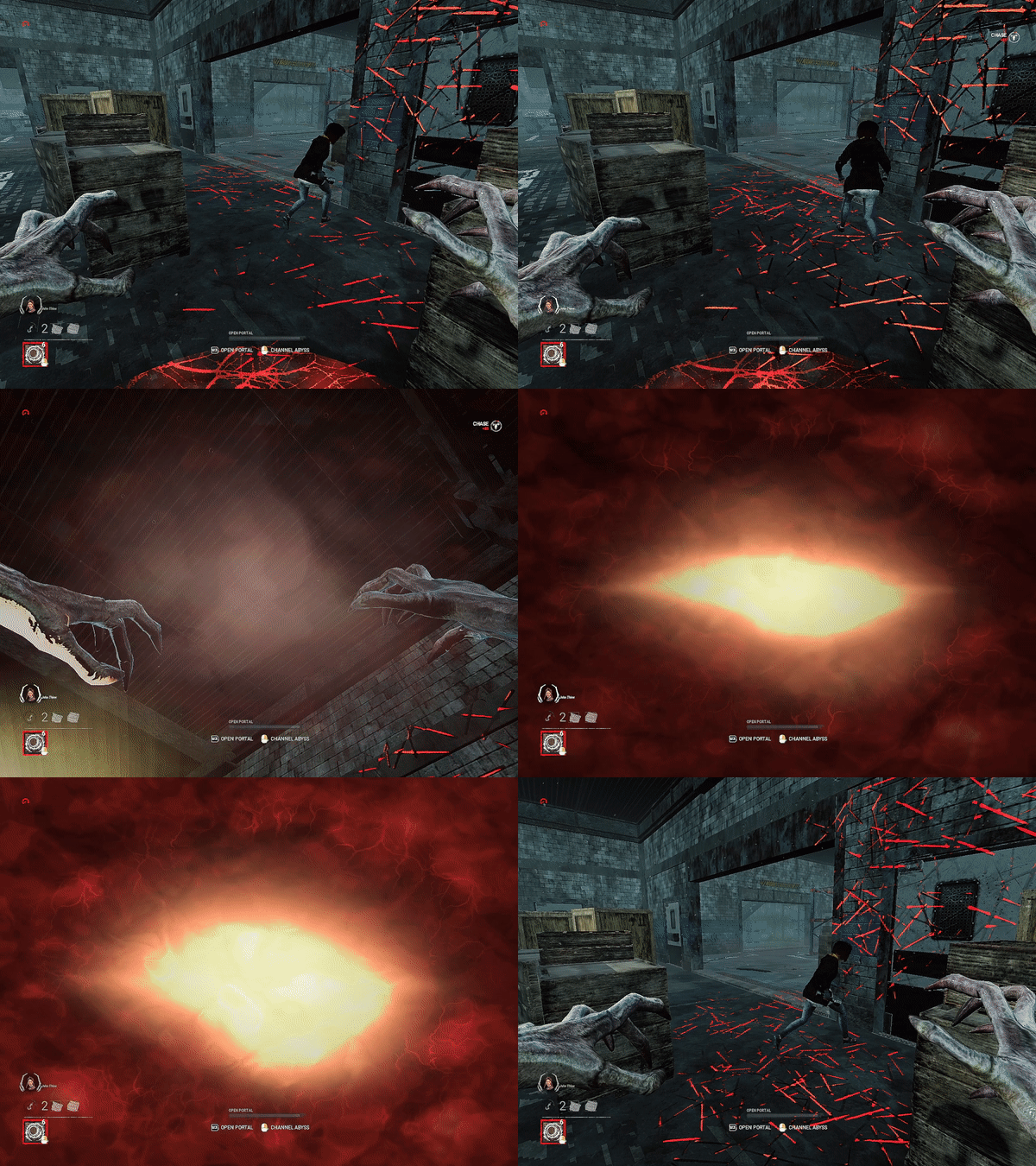
And then here's a non-laggy killer being blinded by a laggy survivor (400+ms as per overlay) - the killer does not get blinded, despite the survivor on their own screen having shone at them for more than long enough:
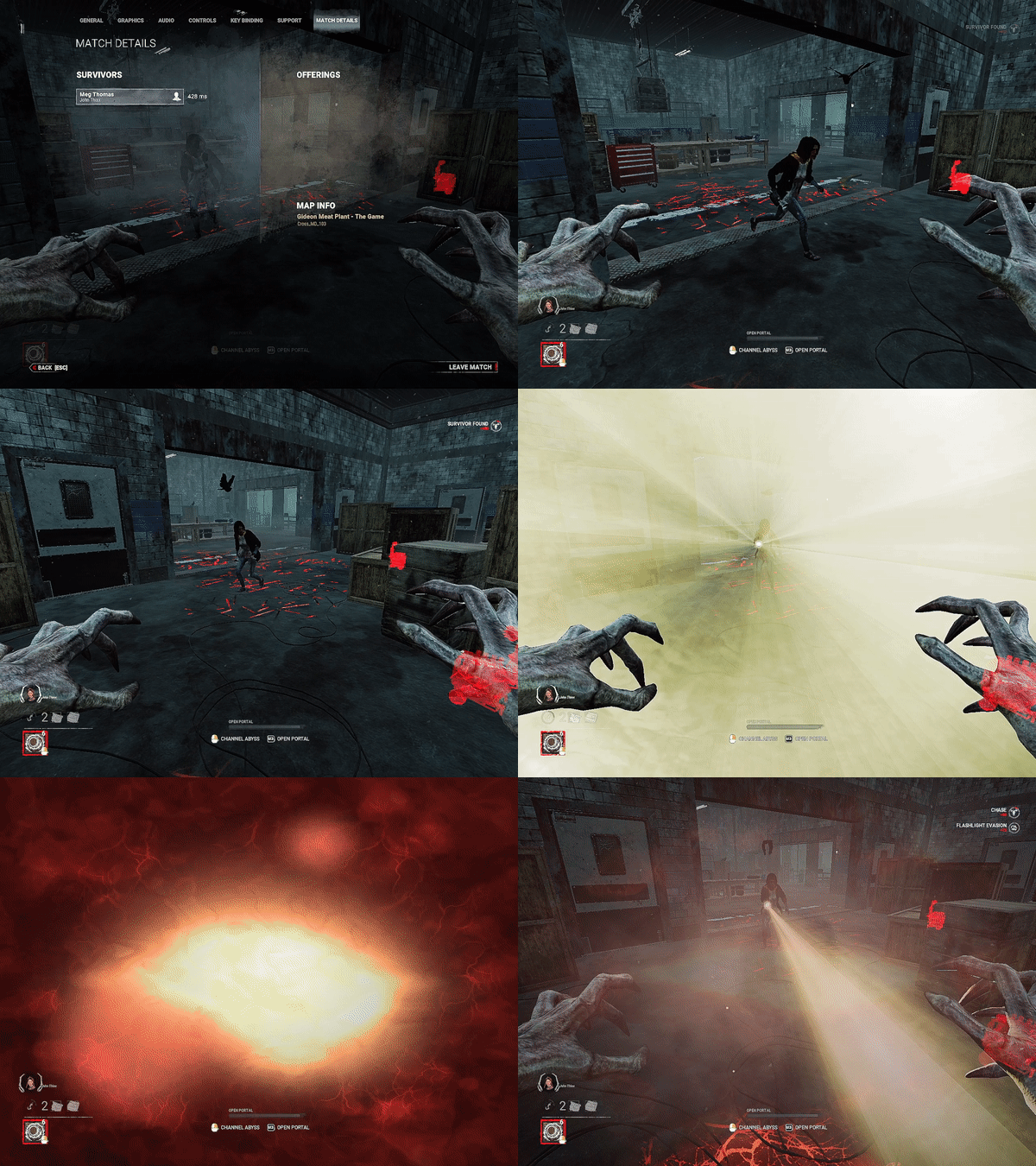
2: Hit validation for Dead Hard still functions after its rework. Laggy killer getting validated on a non-laggy survivor's DH:
-
@Little_Kitten said:
https://forum.deadbydaylight.com/en/discussion/comment/3102490#Comment_3102490
Her post-blink lunge is only effective if the survivor has nothing to put between them and the nurse.
So yes, sometimes the survivor will be in a deadzone where he/she will have no obstacle at his/her disposal, but ... I want to say, it's a bit like the principle of a chase, pay attention to your environment.
If the nurse gets close to the survivor, but the survivor is moving around an obstacle, the range of the blow will not necessarily be enough.
Reducing his post-tp attack range would be too disabling because in case of failure, it would force him to wait for the end of his fatigue + the end of his tp tokens reload time.
With the current post-tp range, if the nurse is not in the right place, range or not, the shot will not go through.
Regarding instadown skills, if a survivor is exposed because of, for example, haunted ground, can't he stay out of sight until the timer ends?
There are some synergies that are more complicated to avoid: I'm thinking of: floods of rage + lethal pursuer + range addons + make your choice.
In this case, this combo allows the nurse to have a great chance, indeed, to OS the survivor who has unhooked (even if it is not 100% sure).
It is a devastating combo, but the victory or defeat of the nurse does not depend only on this combo.
Regarding the fatigue time: in some situations, it is possible to follow the survivor's path, even in a state of fatigue, but sometimes, the fact that the survivor manages to hide is a matter of seconds.
Increasing the fatigue time by 1s (about) could be very penalizing in some situations (the current fatigue time already allows you to "disappear" as if by magic, in many situations)
Her post-blink lunge is only effective if the survivor has nothing to put between them and the nurse.
Are you saying Nurse can only ever hit survivors out in the open? Nurse can swing around obstacles even if there is something between her and a survivor after a blink.
If the nurse gets close to the survivor, but the survivor is moving around an obstacle, the range of the blow will not necessarily be enough.
In the time between end of blink and start of lunge, a survivor regularly cannot get around an obstacle, and if they do because they got there early enough, the point precisely is that the long lunge Nurse has currently allows her to still get them anyway. Making the lunge shorter doesn't make hitting survivors literally impossible, in these or any other instances, it just makes it so there is less leeway. Think of her lunge as a third blink, we can shorten it without taking it away entirely. Surely you don't think shortening her lunge by 0.1% would change much of anything. So clearly there's a spectrum there, her lunge can be shortened without rendering her underpowered, the question is only how much would it have to be shortened by to leave her in a balanced spot.
I have played White Nit Comb Nurse and killed plenty with it, and just out of curiosity I went and looked for videos of others doing so - here are two example VODs from a streamer that used up all of her offerings and played 100+ games of White Nit Comb doing so, and she still won plenty of her games as well: https://www.twitch.tv/videos/1508867579, https://www.twitch.tv/videos/1507982737. And again, this is -50% lunge range, I suggested that maybe -33% would suffice.
It indeed makes Nurse somewhat weaker and more challenging to play since you have to be somewhat more precise with your blinks... which is the point.
in case of failure, it would force him to wait for the end of his fatigue + the end of his tp tokens reload time.
That's already the case.
With the current post-tp range, if the nurse is not in the right place, range or not, the shot will not go through.
With her current ~6m lunge, you can hit survivors within a larger range from your post-blink position than you would be able to with a, say, ~4m lunge. Changing how accurate a blink has to be before it constitutes a "right place" is the point.
Regarding instadown skills, if a survivor is exposed because of, for example, haunted ground, can't he stay out of sight until the timer ends?
So your argument is Nurse should be able to use NOED and Starstruck etc. because survivors can simply stay out of sight? Really getting out the classic "just don't get found" Nurse argument.
Increasing the fatigue time by 1s (about) could be very penalizing in some situations (the current fatigue time already allows you to "disappear" as if by magic, in many situations)
600ms is almost only half a second, 750ms 3/4ths of a second, you'd only get more if you were to stack range add-ons. Plus they could also make it so that the increased fatigue and recharge time only applies if the player actually used the extra range from the add-ons on the respective blink(s), and it could even scale with how much extra distance they used (so if they used 1m more than the default 20 on a given blink, that's obviously only 5% more range, so fatigue and recharge time would also only be increased by 5% in that instance).
Anyway, your points all really seem to boil down to the sentiment that Nurse is totally okay and should not be changed at all. It's fine if that is your opinion, but it's not the opinion of most experienced players, including die-hard Nurse mains. And either way, I'm not here to argue about whether Nurse needs some rebalancing or not, for me it's been painfully obvious for years that she does.
-
@Little_Kitten said:
https://forum.deadbydaylight.com/en/discussion/comment/3102385#Comment_3102385
"Reduce her post-blink lunge range."
And like that, in order to reach a survivor, she would have to perform a 100% accurate tp.
I think you really need to play the nurse a little bit to realize that the perspective of a survivor being chased by her is quite different from her perspective.
"Make her blink hits not count as basic hits"
So it amounts to completely preventing a nurse from using certain skills.
Because I can't see Sally floating around trying to hit a survivor in M1 while being outrun.
"The range add-ons should not affect blink speed, and they should increase the post-blink fatigue duration"
Perfect; this way, the nurse will be able to teleport further away, but in the end, it will be useless, since she will be looking at the ground for a longer period of time, which will allow the survivors, at each tp, to go and hide in a place out of her field of vision.
Guys, really, play nurse, please.
And turning the nurse into some kind of teleporting Oni is just ridiculous.
One of the reasons main nannies play this killer is JUST because she has a movement pattern that isn't the classic "I run, I break the pallet, I run, I go through the window, I run, I go around the wall, I run, etc."
It's that distinctive way of moving that makes many players love playing it, so making it an n-th killer that runs around ... no thanks.
HOWEVER, BHVR could totally, instead of slaughtering the nurse all over the place, create another killer that would be a "teleportation" type, but would be an "Oni-nurse", like what Otz advocates.
Yes, why not.
But leave the nurse alone for a while, it's getting ridiculous.
I agree that the acceleration of her tp below 20m due to the range addons is something to look into.
And like that, in order to reach a survivor, she would have to perform a 100% accurate tp.
That's only true if you take away her post-blink lunge completely, which is not what I suggested.
I think you really need to play the nurse a little bit to realize that the perspective of a survivor being chased by her is quite different from her perspective.
I think you really need to stop making baseless assumptions that serve no purpose but to be contentious. I have played more than enough Nurse, having started playing DbD in 2017. Have you ever used White Nit Comb? I suggest you do that if not, and realize that what you said is not true. That's -50% post-blink lunge range, which still doesn't make her at all unplayable, and which I yet suggested might still be too much of a reduction.
So it amounts to completely preventing a nurse from using certain skills.
Pretty much, instadown "skills" which are overtuned on her. Again, players also don't use them on Blight either and still demolish people.
Perfect; this way, the nurse will be able to teleport further away, but in the end, it will be useless, since she will be looking at the ground for a longer period of time, which will allow the survivors, at each tp, to go and hide in a place out of her field of vision.
I want to reiterate that the fatigue duration would be increased by 600-750 milliseconds. Not sure why you think survivors can do all that in that time. They can't even cover a distance of 4m in that span.
To be fair, maybe increasing both fatigue and recharge time is too much for range add-ons, particularly alongside the lunge range reduction (and with the blink speed bug being fixed). Either/or is probably sufficient, would have to see it in action.
But leave the nurse alone for a while, it's getting ridiculous.
Nurse has been an objectively overpowered design since she was introduced into the game 6 years ago, that most of anyone who puts 100-200 hours into can comfortably win 90+% of their matches with. Calls for her to be balanced are not ridiculous, it's ridiculous she's been like this for years and years, and MMR means at the upper end you face her more and more frequently.
@GrimReaperJr1232 said:
https://forum.deadbydaylight.com/en/discussion/comment/3102385#Comment_3102385
I speak for every console Nurse, please don't do #1. That is absolutely painful.
#1 is the actual substantial balance change though, #2 and 3 are more so circumstantial. IMO BHVR should implement keyboard and mouse support for the console versions anyway, not least due to cross-platform play being a thing.
Just out of curiousity since I have never played Nurse on console: Have you tried White Nit Comb before?
-
It's odd to me that he mentions White Nit Comb as something that can tangibly decrease the Nurse's power level in terms of how forgiving she is, but then doesn't consider that it could be used to balance her very sensibly.
Simplest way to balance Nurse:
- Reduce her post-blink lunge range. With her current lunge, she merely has to blink within the approximate vicinity of a survivor, there's a fairly big margin of error since she can make up for inaccurate blinks or survivor jukes with her lunge. With a reduced lunge range, she still has all the advantages innate to her ability, only players have to be more precise with her blinks to actually hit survivors, and well-timed survivor jukes can actually work out more often. The amount by which her post-blink lunge range should be reduced comes down to experimenting, maybe the -50% of White Nit Comb is a little too much, maybe -33% is better.
- Make her blink hits not count as basic hits. Nurse already has insane snowball potential, there's no reason why she should also be able to capitalize upon the Exposed status effect from perks like Starstruck, Haunted Ground, NOED, Make Your Choice and so on. Blight's rush hits don't count as basics, and he's still a great killer. You can instead add an Exposed effect to the underpowered Matchbox add-on, where any survivor within Xm of the Nurse after she performs a maximum range blink will suffer from the Exposed status effect for a couple of seconds.
- The range add-ons should not affect blink speed, and they should increase the post-blink fatigue duration and blink recharge time by as much as they increase the blink range (e. g. Kavanaugh's Last Breath increases the maximum blink range by 30%, so it should also increase the fatigue duration and recharge time by 30%, which would be 0.6-0.75s for fatigue and 0.9-1.8s for recharge).
-
I don't think it's a great perk on most killers. You have to actually get survivors injured before it does anything, and its impact is really only hefty if at least 3 survivors are injured. At 1 survivor injured, an entire gen takes 5 seconds longer, at 2 injured, 11 seconds. Getting 3+ survivors injured is not something most killers are reliably able to do, let alone do so quickly and keep it that way for prolonged periods of time, and you have to consider that any gen progress survivors put in without being under the effect of Thana (or multiple stacks of it) further reduces its impact (e. g. if survivors repaired 50% of a gen before you were able to injure any or multiple survivors, now the repair speed reduction will obviously only affect 50% of that gen, meaning it will only be half the time slowdown).
Sure, if you have a Nurse or Blight or whatever and you see the red gen progress bar from Thana and get demolished, it's easy to think Thana had a notable impact on that round, but I guarantee that in the majority of cases, you could take Thana out of the equation and it wouldn't have changed much. It's often mostly a nocebo effect, and a "win more" option for these killers that would have most likely won in those instances either way. And personally, I think Pain Resonance is still a much more impactful "win more" option for killers like this than Thana.
Of course, there are some killers it really is very good on. Legion and Plague first and foremost, who can quickly and reliably get most if not all survivors injured, and keep it that way. It can also be decent in hit-and-run strategies alongside Sloppy Butcher and whatnot, on killers like Sadako or Wraith. It can be stacked with stuff like Gift Of Pain, Dying Light and Pentimento, but stacking stuff doesn't actually increase its impact, Thana still only does the % it does, it mostly serves a "win more" role again; Gift Of Paint and/or Penti are plenty slowdown on their own.
So with that said, if I as a survivor see Thana on a killer that isn't Legion/Plague, I feel pretty good about them having spent a perk slot on that. Naturally that doesn't necessarily mean I will survive, with the average level of random survivors, a competent killer can win even without perks altogether.
-
Camping and tunnelling have always been the bane of solo queue, and the patch not only did not alleviate the problems with those strats, but it made them worse.
They did nothing to address camping, no basekit Kindred, no hook relocating à la Pyramid Head, no gen repair speed changes based on proximity to hook, not even the most ridiculous stuff like hook grabs and Bubba facecamping being remedied. Instead, the reduced hit recovery time means downing the unhooker is guaranteed, that is now the worst case scenario, and if you add STBFL on top of that there's little reason not to hardcamp even with M1 killers if you're looking for easy success. Increased gen times also benefit camping. As does the new Monstrous Shrine, for killers that can camp at a distance.
Tunnelling has also gotten worse. 5 seconds of Endurance most of the time does not get you anywhere, and even with Borrowed Time or Off The Record, lots of killers have an easy time downing a survivor quickly after hitting them off hook. OTR is simply not good enough a replacement for Decisive Strike, the distance you used to make with DS was much more impactful, not least because it could even allow for the tunnelled survivor to lose the killer altogether.
There's so many simple and obvious things they could do to make camping and tunnelling less effective, but they never do, they have been the most effective strategies since game launch and they continue to wreck especially solo queue, while at the same time being some of the least interactive and engaging gameplay aspects and causing dissatisfaction and frustration for many players every day. I wouldn't want to remove them entirely, I do think they have their place in the game, they can create chaos and excitement and the danger factor of games potentially being able to turn or end within a short span (for a player or a group) just makes the game more thrilling, differentiates the gameplay experiences from trial to trial more... but they don't have to be the objectively strongest killing strategies in the game for this to be the case, nor do they have to be as oppressive as they are. Directly nerf camping and tunnelling, and buff other gameplay aspects of killer gameplay instead, such as chase strength, gen control, map presence, information available...
For camping, a good start would be to remove hook grabs and make it impossible for killers to use their abilities within 10 or so meters of a hooked survivor, just like you already did for some of the new killers. Bubba, Trickster, Hag, Huntress, Billy, Pyramid Head, Myers (stalking) - these killers have much too easy a time defending hooks. Basekit Kindred could be something, or alternatively a hook relocation mechanic similar to Pyramid Head, where the hooked survivor will be respawned at a different hook location if the killer is within a certain range of their hook for a certain period of time. Only that the range has to be drastically increased for that (and for Pyramid himself too - it's ridiculous to have a 5m "camping" range for a killer with a 8-10.5m ranged attack that can instantly hit both the unhooking and unhooked survivor). Basement hooks could be exempt from all of this. Perks that increase unhooking speed should actually apply to the entire interaction, rather than only a portion of it. There could also be more of such perks, or buffs to the ones that exist now.
Ideally there would also be base game changes to make tunnelling more difficult, but at the very least, DS should be able to activate up to two times. Preferably they up the stun timer again. Base unhook Endurance should be 10-20 seconds (removing collision during this time is a good idea), and unhook Haste 60 seconds, as Haste is only good if you're in a continued chase, a few seconds of it are basically worthless. It would also be beneficial to reveal the aura of the most recently unhooked survivor to all other survivors for as long as they are injured, such that they can take hits for them, lead the killer away from them, heal them, position for save plays on them, and so on.
Also nerf SWF. It's clear solo buffs are not coming, you've been talking about it for years and years and next to nothing has happened in that regard. Plus any such buffs could never even hope to adequately close the SWF-solo gap anyway, not only because voice communcations and coordination are just such a huge deal, but also because any solo buffs would inadvertently benefit SWF as well. Nerfing SWF is the easy and obvious solution. That would then allow to better adjust the killer power levels for both scenarios. An easy and effective way to nerf SWF is to limit their ability to stack perks and items, allowing only one instance per perk and item/add-on in a pre-made group. That would also shake up the meta a lot. Tournaments already go to show that even lower-tier killers stand a perfectly good chance against even some of the most coordinated and best teams of survivors in the game with perk/item limitations in place.
Nerf Nurse and Blight and some select add-ons. For Blight, getting rid of hug tech, reworking Alchemist Ring and slightly nerfing Compound 33 is enough. A simple way to make Nurse a much more balanced character is to decrease her post-blink lunge range (basekit White Nit Comb) and make her blink hits not count as basic hits. Without the huge lunge that allows her to hit anyone even just roughly within her blink location and to correct for a wide range of errors, she is less forgiving and good Nurses are rewarded for their precision. Without blink attacks counting as basic attacks, Nurse won't be able to make use of perks like Starstruck and NOED as oppressively anymore. Also make it so that her range add-ons increase fatigue and recharge time by the same % they increase range by. Some of the add-ons that could need specific looking-at are Rusty Shackles, Tombstone Piece, Iridescent Head, Redhead's Pinkie Finger, Mother-Daughter Ring, Dried Cherry Blossom.
Compensatory killer buffs could be global movement speed increases, increased pallet break and window vault speeds, the abilitly to cancel pallet break and window vault interactions and thereby to fake them, much faster wall breaking action, reduced hit recovery times, seeing their red light, more information on gens (auras indicating progress), basekit Corrupt Intervention, base generator regression being 1/3rd of a charge a second rather than 1/4th, basekit 20% Weasel (-18 seconds) on the gen farest away from the hook with progress on it (highlighted for the killer), gen repair speed increase whenever the killer is chasing the survivor that was most recently unhooked or is within a certain range of a hooked survivor, gen repair speed decrease whenever the killer is chasing a survivor while another survivor is hooked, and whenever they are chasing a survivor that is not the most-recently-unhooked survivor. Also killer-specific ability and add-on buffs of course.
-
I used to be skeptical regarding the wiki as well since they did have inaccurate or outright false information sometimes. But that was years ago - at some point they started getting their info straight from DbD's code base, so you can rest assured that this is most likely how STBFL actually works.
Just to make sure, I looked at a video of Clown using the new STBFL frame-by-frame. I watched for the first sign of health state change on the survivor's player avatar, and then waited until the "Throw Bottle" prompt appeared again. At 0-1 stacks, it took ~2.8 seconds, at 8 stacks ~1.7. While this isn't highly precise, it goes to show that at 8 stacks, roughly 1.1s are shaved off, which is congruent with 40% of 2.7 being 1.08s. If STBFL instead worked by increasing the recovery action speed, it would only reduce the recovery time by ~800ms.
-
While I agree with the general sentiment of "being repeatedly chased is good if you enjoy chases and you should enjoy chases if you play DbD because that is its most exciting and engaging gameplay aspect" and have argued as much myself in the past, I see multiple issues with his take here.
First, he glosses over the fact that being tunnelled right off hook regularly does not provide the tunnelled survivor with an actual chase. He mentions Nurse with stacked range add-ons as if that were the only instance where a survivor can't do much of anything to prevent ending right back up on the hook, but there's a ton of scenarios that result in the same thing, taking much of any agency and interactiveness out of the equation:
- For one thing, the unhooked survivor is injured, which already puts them at a tremendous disadvantage in a chase scenario as opposed to starting a chase healthy. Not only are they leaving pools of blood and sending out cries of pain with which the killer can track them, making mindgames and stealth-jukes much less feasible, but they obviously cannot take a hit without going down, and this absence of having what is usually a built-in Exhaustion perk in the form of the hit sprint and killer hit slowdown as well as just the leeway to take more risks due to having a "free" hit is significant.
- If the tunnelled survivor does not have Off The Record equipped (or the unhooking survivor Borrowed Time), it is often incredibly easy for the killer to simply wait out the 5 seconds of base Endurance and down the survivor then, bodyblocking them to keep them from getting anywhere if need be. 5 * 4 meter is only 20m, that can already be dicey in terms of finding a (safe) window or pallet in general (all the more so given that the killer will be riding your back), but you have to add on top of this the fact that survivors will usually be hooked close to where they went down, i. e. where they likely already used pallets. Then apart from basic bodyblocking, there are killer abilities that can further make these 5 seconds irrelevant, such as Clown's bottles, Slinger's spear, Pinhead's chains. And of course, for the years and years prior to the recent update these 5 seconds of base Endurance didn't even exist.
- If the survivor does have OTR/the unhooker BT, it's also not like the distance gained from that hit will reliably result in a fair chase scenario. Even against a pure M1 killer, that is merely ~14m distance to catch up over. Now consider the killer having Save The Best For Last, which can cut the distance down further by a good 4m. The tunnelled survivor in this scenario is rarely getting anywhere, and depending on the hook location is just guaranteed to go down again.
- Then there's a plethora of killer abilities that will make the distance gained from the Endurance hit matter even less. Nurse obviously doesn't care about that distance whatsoever. Neither does Blight. Spirit can catch up quickly too. Huntress can just hatchet the survivor first, and then M1 them seconds later. Clown can gas the hook, hit the unhooked survivor and then gas them again, also catching up to them in seconds. If Plague has Corrupt Purge, the unhooked survivor is not getting anywhere. Same for Oni in Blood Fury. Leatherface can potentially eat Endurance and down the survivor in 1 chainsaw attack. Trickster melts through Endurance. Legion can use Feral Frenzy to stab the survivor, catch up to them, and cancel Frenzy. Slinger and Pyramid Head can get them on range. Twins just send out Victor. And so on.
So already it is obvious that equating "tunnelling" with "repeated chase scenarios" is dishonest. It's odd that Scott does this so casually here, given that "farming off hook" has been a longstanding meme about one of the worst offenders in terms of bad game design with DbD.
Next, he doesn't consider the fact that you yourself might not and very regularly in fact will not be the player that is getting tunnelled. So by his own argument, if being chased is the thing you should want most out of this game, the killer literally refusing to chase anyone but one survivor until they are dead is obviously not good for the game. But more than that, even if you yourself are good at chases, your random teammates regularly absolutely will not be. And so even ignoring that even a good player regularly cannot do much of anything to prevent going down again shortly after having been unhooked, a not-good player will get tunnelled out very quickly. And if you are left with 3 survivors and only few gens done, the chances of success collapse. Which leads me to my next point:
Losing isn't fun. Scott might actually not care about himself and other players in his survivor games dying, but he does care about killing survivors in his killer matches. So the concept of caring about winning and not liking losing is not foreign to him. Tunnelling is an issue for many people because either they themselves die to it quickly, or their teammates do, which then also often seals their own fate. Tunnelling is a very effective killing strategy, alongside camping it is in fact the most effective killing strategy, it is objectively optimal gameplay if your goal is to kill as many survivors as possible as reliably as possible, and tournament play too makes this very obvious. I'm not sure why Scott pretends like it isn't, surely he is aware of the DoucheBat series, or of course of his own NegaScott thing, where they will camp and tunnel with a vengeance and win even more decisively than they otherwise already most of the time do, 4ks at 4-5 gens galore. The argument then of course is that tunnelling (and camping) is simply too effective a strategy from the public match perspective where random survivors get absolutely demolished by it constantly, most of all solo survivors of course.
Sure you can say "just enjoy the chases even if you die and lose", and sure for some people (including myself, if only to certain extents) that's fair enough, but that's just not what most people want, they actually want to escape, and they get frustrated if they die all the time. Particularly so of course if it's to camping and tunnelling, which often simply do not leave much in the way of player agency or any gameplay altogether for the player on the receiving end. Which is even more understandably frustrating for players that do not play this game for a living and can't just go to their next match in their 8-hour playing session, but where those terrible games are among the few rounds they might get to play at all.
Lastly, he says there's nothing that can really be done about tunnelling that wouldn't upset the basic game balance of the killer being able to secure at least 1 kill on someone. Of course, as he also mentions there could be fundamental changes to the game that do achieve this (such as making it so the killer simply wins by getting X amount of hooks, and nobody getting sacrificed until that amount is reached), but there's absolutely things that can be done to make tunnelling (and camping) less effective of a strategy, and if that does upset the game balance, provide compensatory buffs to other aspects of killer gameplay. Decisive Strike could do something again, for one thing. The unhook Endurance could last 10-20 seconds, and even be replaced with the unhook invincibility, such that a tunnelled survivor has both that and the Endurance from OTR. Unhooked survivors could be healthy. The unhook Haste could last 60 seconds. Gen repair speeds could be increased whenever the killer is chasing the survivor most recently unhooked, and decreased whenever they are chasing anyone else. The aura of the most-recently-unhooked survivor could be revealed to all other survivors for as long as they are injured, enabling those other survivors to take hits for them, lure the killer away from them, heal them, position for save plays (e. g. flashlight/pallet/sabo saves). Remove hook grabs. Basekit Kindred. Increase gen repair speeds if the killer is within a certain range of a hooked survivor, and decrease them if the killer is chasing any survivor while another survivor is hooked, with that decrease in repair speed getting greater the farer away from the hook that chase is happening. Give killers power-ups based on how many survivors have hook states, and power-downs if a survivor is sacrificed with none (or only one) of the other survivors having hook states. These powers could apply to movement speed, pallet breaking and window vaulting speeds, hit recovery times, gen regression, information provided, and so on. As could any general killer buffs shipped to compensate for any of these or other camp/tunnel nerfs.
-
I do think Blast Mine has become more valuable since the recent patch, given that between the base and perk changes, kicking gens frequently is much more worthwhile now. Overcharge, Call Of Brine and Eruption are now good perks that see common use.
However, you have to consider what the value of Blast Mine really is. The killer is stunned and blinded for 4 seconds, but they can simply kick the gen again afterwards, so without doing anything else, Blast Mine would only waste 4 seconds of killer time, which is not very valuable at all. Instead, the idea is that the survivor can use those 4 seconds to get away, making a lot of distance or disappearing entirely, which is particularly valuable now where killers will actually regularly want to kick the gen before chasing after the survivor.
Sprint Burst is a good pair-up with Blast Mine, but you shouldn't be sprinting away instantly - if you already make distance away from the gen and the killer was going to kick it anyway, Blast Mine does nothing but waste those 4 seconds. Instead, you want to walk away from the gen, and then if the killer does kick the gen first, you can sprint away with SB and make tons of distance - or, if they do not kick the gen, you still have SB to prevent giving them a free hit.
More perks that work well with this tactic are Repressed Alliance and Lightweight. With Alliance, instead of running away while the killer is stunned, you can get back on the gen and block it, making sure the killer can't kick it again afterwards, then running away with SB (edit: this doesn't really work currently, since rather than Mine taking priority over Alliance like it is supposed to, they both activate simultaneously). The upside of this over just using Alliance without Mine is that now you are making sure that the killer was even wanting to kick your gen in the first place, rather than blocking the gen for no reason. And Lightweight's synergy here is fairly obvious: it makes it even more likely that the killer won't be able to locate you after getting Blast Mine'd.
More synergies include Prove Thyself and Adrenaline. Prove is just nice to have here because other survivors can see the aura of your generator when you apply Blast Mine on it, and Adren enables you to better go for plays where you finish the last gen in the killer's face while they are stunned.
-
@SlowLoris said:
This is EXTREMELY obvious if you commonly go for beamer saves. I bounce around to different servers to play with people often. West Coast to East Coast. I know there is input lag, to clarify. But the killers actual model will appear one way, and it can be the same exact timing, but the killer will actually be walking away when the blind finishes. If you go by animation at all it's extremely confusing. It lead to me constantly doing VERY early beamers because I was trying to match the animation. To go along with this, I was on someones shoulder the other day (Sadako), and I saw her animation finish early - she did not have fireup, etc. Whereas my duo friend said she didn't dead hard for the save, etc...because she knew she'd make it in time, and right as she started blinding, the killer was walking away. On my end there was no way she was going to make it. This person rarely misses beamer saves if they're possible. There is definitely something off with character desync.
I can attest to this. I am confident in my flashlight save timings, and I have been getting multiple instances where a perfectly-timed blind had the killer simply walk away. It can happen on other interactions too, such as pallet breaks and window vaults, where starting your blind later into the animation can mean that you won't get it despite still having had enough time. And of course, in general the desync means that you are reacting to outdated info, which will also get you hit in ways that don't seem possible even against low-latency players, which I have found to be particularly obvious on pallet vaults (latency hits happen everywhere, but the client desync seems to be affecting animations most of all).
-
You have to keep in mind that BHVR's goal specifically was to make these perks fall out of popular use - DH is not supposed to be good anymore. They outright killed Spine Chill, as well as Self-Care, Decisive and Iron Will (well, it's still usable on Ace, for now). On the flipside, Ruin, Resonance and Weasel are hardly worth using either.
What's really odd though is that now DH cannot be actuated from a stationary position anymore.
If you still want to run DH, here's my tip: Once injured, just keep looping the first pallet you find indefinitely until the killer is close enough to hit you through the pallet, and at that point DH through the pallet. If they hit you you reset Bloodlust and get distance away from the tile, and if they don't swing you get another loop and can then drop the pallet. If the pallet is already dropped and the killer tries to play you on it, you can stand at the pallet and wait for the killer to swing around the tile to try and get you, then actuating DH, again resetting BL and making distance. Keep in mind that you have to "run" against the pallet in order to be able to actuate DH, you can't do so without pressing a movement key anymore.
-
I would not be surprised if they haven't implemented hit validation for the reworked Dead Hard. Meaning that if you and/or the killer has a non-low ping, you will get hit mid-DH.
-
I disagree that the duration nerf doesn't do anything against the other killers. Not only do a whole bunch of them also have abilities that allow them to down the survivor again seconds after regaining control, but the reduced distance against even a pure M1 killer makes DS much less of a deterrent against tunnelling. You will be right back in the chase with them, if there is no window or pallet within ~20m they are still a more or less guaranteed down, and even if there is (and even if it is actually a safe window or pallet), you are spending much less time without first having to catch up, and you are also not in any danger of losing the survivor altogether.
3 seconds is simply too little because a good 50% of that time is already spent in the stun animation before the survivor is even able to move, that's the reason why they had changed it to 5 seconds to begin with. The only reason that they're reverting that now is simply that they want to have perks with other names in the group of the most-used perks, they want to "shake up the perk meta", but mostly only on paper, with no real regard for improving the actual gameplay. Off The Record will take that spot, but it's honestly a worse anti-tunnelling perk, because the killer can just hit you off hook immediately and it's gone, they can still often down you mere seconds after that. With DS in those cases they would at least have to slug you for a minute, which is a lot of time and opens up opportunities to get healed, use Unbreakable, Adrenaline, etc., too.
If they really want to shake up the meta, they should change the game such that camping and tunnelling aren't the objectively best strategies anymore, and that can only work with significant base game changes. Of course, it would have to go along with significant buffs for many of the killers, such that the idea of getting 12 hooks is actually feasible in evenly-matched scenarios for them.
Either way, if they nerf OTR before it hits live, that means the update will actually have improved the efficiency of tunnelling even more, which is ridiculous and the opposite direction of where the game should be heading. At the very least, with this neutered DS, I see no reason why it should not be able to proc up to two times, i. e. after each unhook.
-
I do think the game will never have mass appeal as an "esport", a tournament game, but will always only be appealing as that to a fairly niche audience (of competitors and spectators). That said, for those people it absolutely is just as "viable" of an endeavour as with much of any game, competitors and spectators are having quite a blast.
Balance rules can easily be made and understood by everyone in these communities, and since we have been having a rather consistent tournament cycle for years now, the common rulesets are very streamlined and known by this point. Definitely an issue from a more mainstream perspective, but not actually standing in the way of the proper and enjoyable holding of tournaments within the respective communities (well, there are still issues that arise from this, such as accidental ruling offenses that require restarts and come with point penalties, or generally a little more set-up time required to make sure everything is in order, but this is not at all prohibitive to having well-functioning tourneys).
The usual scoring system is not actually as limiting to the gameplay as you imply. Survivors get points for finishing gens and escaping (with giving away as few hook stages as possible), which is clear and poses no problem. Killers get points for hook stages (usually 3 for the first stage of every survivor and 2 for every consecutive stage). This encourages going for fresh hooks a little and doesn't discourage going for hooks in general, while still of course having the main focus be on getting as many kills as possible, since that automatically means more stages. While a fair few of the "M1" killers are definitely reliant on camping, tunnelling and NOED/NWO to consistently perform, the matches just aren't actually as stale as you make it out. Let's look at some Swish tourney stats:
Hag 1k 3stage, Plague 4k, Demo 1k 5stage, Billy 4k, Plague 1k 5stage, Huntress 4k, Billy 1k 8stage, Oni 4k, Huntress 1k 5stage, Huntress 3k 10stage, Billy 2k 7stage, Blight 2k 7stage, Billy 1k 7stage, Blight 4k, Billy 0k 3stage, Twins 1k 5stage, Twins 4k, Spirit 4k, Twins 2k 7stage, Spirit 4k, Nurse 1k 4stage, Oni 4k, Billy 2k 7stage, Pyramid 2k 8stage, Billy 1k 6stage, Blight 4k, Oni 4k, Pyramid 4k, Billy 4k, Plague 1k 6stage, Blight 0k 4stage, Billy 4k, Blight 4k, Plague 4k, Blight 4k, Blight 4k, Billy 1k 5stage, Billy 4k, Spirit 2k 6stage, Huntress 4k, Oni 4k, Oni 3k 9stage, Pyramid 0k 2stage, Plague 4k, Plague 1k 8stage, Pyramid 2k 7stage, Huntress 0k 0stage
That's 2.55 kills and 9 stages per match on average. This tells us that not only are matches not simply cases of camping/tunnelling out 1 survivor and killing a 2nd survivor in the endgame (which would be a 2k 6stage, a result that is in fact only present a single time among these 47 matches), but also that skills play a definite role here, because the result spread on individual killer characters is affected a lot by who plays them and who they play against, with some players consistently having better results. These results are indicative that the matches are much more competitively interesting and viable than you claim.
Don't get me wrong, I do think the game cannot have a very wide appeal in this tournament mode because it is not at all easy or possible altogether for casual viewers to appreciate what entails good play here, and even for advanced players it is not necessarily always very interesting play (you have to basically be into comp for comp's sake to really enjoy it). There are exceptions, it can lead to some action-packed, nail-biter and otherwise thrilling situations, but the game is just not a great spectator sport (it's fun to watch, but not from a very competitive perspective for most people). On top of this, it's not easy to tell for most people who is winning or what has to be done to win, since the hook stage scoring requires people to do math to figure this out. This is definitely an obstacle to mainstream appeal, because it's difficult to root for or be invested into anything happening if you don't always very clearly know what the standing of the match is. It's not a huge problem because it can usually be figured out quickly and the commentators will usually point it out too, but it would definitely be another thing restrictive to its chances of wider success.
I do want to point out that there have been tournaments without extensive rulesets, but yeah, while they are actually still fairly competitively interesting and balanced and not merely "camp/tunnel 2ks" either, you do get a fest of mostly Nurse and Blight. Maybe there could be much more entertaining custom tournament formats, such as actually making it about hooks (you'd have to force survivors to actually unhook though, as you point out) or chases (everyone spawns into a map and you go for 1v1 chases starting at a designated location, if the player goes down the next player starts their chase at that location - you do this one after the next until all players had their chase, then simply add up the times, afterwards you switch sides), but that's of course something even more displaced from the actual game mode.
The tournament scene is actually pretty healthy, and between things like Swish, DeadbyEsports, DBDLeague and various bigger regional tournaments, there are some such events that actually pull hundreds and thousands of viewers, but yeah, BHVR would have to do a lot more to bolster the game as an esport, and they'll likely never do it (years ago they've said they want to, but nothing much has come of it). Hell, they are not even giving us more spectator options such as free cam, or map seeds as you've said, or the ability to make custom loadout rulesets.
-
@[Deleted User] said:
https://forum.deadbydaylight.com/en/discussion/comment/2792789#Comment_2792789
I just don't agree with your conclusion that MMR doesn't significantly diverge from skill for exceptionally selfish/unselfish players under this system. I also disagree that what differences do exist will just settle out over large sample sizes, when my lived experience is that this isn't the case. The more matches I play, the more pronounced the problem becomes. There feedbacks here are positive, not negative.
Every time I trade with someone on the hook in the EGC, or take aggro for them when they're on death hook and completing the last gen is not in any doubt, or suck it up and go for the basement save at basically any moment in the game instead of letting my teammate do it, I am putting myself at increased risk of dying in exchange for increasing the likelihood of my teammates surviving. The more skilled I am compared to my teammates and my opponent, the more likely I am to be the one sacrificing myself for my teammates. Even setting aside the impact of selfishness, less skilled players are often still afraid of the killer and are less confident to make risky plays, so they'll do less of that regardless of whether or not that play will help the team. As a result, that plays falls to me more and more. There are plenty of additional factors that drive the outcome this way too. Like, if you run a killer for four gens and they finally down you, the odds of you getting camped to death skyrocket. The frequency of this scenario also goes up the lower my MMR gets.
Tournaments are not representative of typical DBD matches, so I don't think they're useful to consider. The skill of the players involved is not typical and tournaments' win conditions are almost always different than kills/escapes, which impacts player behavior.
I absolutely agree that selfish players would naturally end up at diffferent ratings than altruistic players (all else being equal). That should be the case if MMR is working as intended. My viewpoint is that this is a problem, though, it results in worse matches.
Again, I don't think it's a bad thing if I save my teammates, even if they wouldn't do the same for me. I'm perfectly happy with that outcome and wouldn't have it any other way. My frustration is that this outcome destroys the quality of the matches I get going forward. I'll start taking some stats on my survival rate versus the team's and report back once I have a decent sample size, though. I'd be curious to see that too.
I agree that there theoretically should be other players going through the same thing at similar MMR. However, the number of players like that are small compared to the number of players who just aren't very good at DBD. So, for every kindred spirit I get paired up with, I get an order of magnitude more potatoes.
I am completely on board with lowering the MMR of a player who tries to go for some endgame heroics and fails, e.g. trying to save against NOED and dying along with the person who was already hooked. On the flip side, though, successful endgame heroics should raise their MMR. If the tactic itself is not beneficial to the team, by all means, punish it. I can see an argument from people who just want to mess around that they don't want to have bad teammates as a result, but at the end of the day, if you're not trying to win the game, it makes sense that MMR doesn't reward that. I am trying to win when I take on risk to save teammates, though. I just treat DBD as a 4v1 game with a win condition of collective survival, not a game of four concurrent 1v1s with a win condition of individual survival. I know that not everyone will agree, but regardless, I feel encouraging teamplay is very healthy for the game. I find that selfless plays are very rewarding for both sides and bring joy to the game for everyone involved. It's a great way to counter the salt and toxicity that shows up in lots of matches. Discouraging play like that by pushing players to only care about individual outcomes is not a good idea.
Re: endgame scenarios, I keep going back to this in part because it's an easy example to understand and draws a black line between selfish and unselfish players, but also because scenarios like this as easily frequent enough to throw MMR out of whack. If you had to guess, what percentage of your games have at least one hook during the EGC? Maybe 1 in 6? Leaving in every single one of those scenarios versus hook trading in every single one of those scenarios would make a big difference in terms of MMR; 1 extra escape per 6 matches would in theory be a big difference in "skill", especially when you consider the fact that the most unselfish player is the most likely to get left if they're the one on the hook. In practice it's not as simple as 1 in 6, because sometimes both survivors will get out and sometimes it's a situation in which you basically can't trade (e.g. Bubba, injured with no way of healing, NOED and can't find the totem). Even if the actual number is more like 1 in 20 matches, this is just one scenario.
There are many situations in game in which you don't need to show the slightest shread of altruism to teammates in order to escape, but in which doing so would help them survive. These crop up in just about any mid to late game scenario in which the survivors are clearly ahead. At this point, the risk from confronting the killer and being the one hooked and left to die when the last gen is powered, is high enough that there's little reason to even bother. Let your teammates go for the save if they feel like it and just pound gens. There are even fun little extra selfish edge cases, like bringing a key and hatch spawn offering as a backup plan, and hiding near the hatch until your teammates die if you think you have a good chance of losing the match. Hatch escapes don't contribute to MMR, but not using your key and getting sacrificed certainly does.
One last point - I very much disagree with this:
While you and I may prefer the game to be a team game where players can outright win even despite themselves dying, that is not the reality of the game
"Reality" by which definition? The current MMR system? For almost the entire lifespan of this game, the closest thing to a defined win condition in DBD has been whether or not you pip. Pipping of course determines your rank and rank was used for matchmaking for 5+ years, so the clear message was that pipping is what shows you played a good match. Pipping heavily rewards team outcomes and altruistic play. You will have a much harder time pipping if you never interact with the killer and leave it to your teammates, even in a winning match where you could easily get out. You will also have a much harder time pipping if you don't every save a survivor from the hook. The entire team is punished if someone is left to die on the hook too, meaning team escapes were important for individual success. It was also entirely possible to pip without surviving if you did a lot to help the team (ran the killer for a while, did lots of generators, healed and unhooked teammates, etc.). This system still exists in the game and is shown on every postgame screen as a measurement of performance, and unlike MMR it is intentionally visible. Are we meant to ignore the multi-year history of the game, and the conditions in which most people learned to play, and just accept that individual performance is all that matters now, just because we've had a matter of months with a flawed MMR system? I see this as evidence that the MMR system doesn't reflect the reality of the game, not that the reality of the game has changed.
I'm not sure many people would want to 4v1 game in which the survivors are essentially competitors forced into an uneasy truce to overcome the killer, but who will and should turn on each other the second their own escape is assured. Just my opinion, but that sounds toxic and unfun. WIth the popularity of SWF, people clearly like playing cooperatively with their friends, and this also entails helping them whenever possible, because that's what friends do. I'm not trying to argue that players should value their teammates just as highly as themself, because I agree that's not realistic for most players. I just think it should be a clear goal going into the match to get as many people out as possible. No need to trade just to save your buddy, but also don't leave them to die when you could easily save them.
Definitely looking forward to the MMR changes they've been murmuring about, if and when they come. I just hope it weights all escapes evenly rather than just making a small adjustment for team performance, or something.
---
I remember your name from some past posts that I thought were really well done, and I appreciate the time you put into responding to me. I'll try to put together some stats on my match outcomes too.
I just don't agree with your conclusion that MMR doesn't significantly diverge from skill for exceptionally selfish/unselfish players under this system. I also disagree that what differences do exist will just settle out over large sample sizes, when my lived experience is that this isn't the case. The more matches I play, the more pronounced the problem becomes. There feedbacks here are positive, not negative.
We'll just have to disagree on that then, because I really don't see (in theory and my lived experience) that the people at high ratings (the most skilled at consistently personally surviving) aren't also some of the most generally skilled players, including teamplay skills. The system of course is not about skill in and of itself, let alone teamplay skills, so an argument would increasingly become about whether it should be. I for one have no issue with the system being about seeking 50% personal success rates for everyone, even if that contrary to my conviction would not correlate with any skill or teamplay skill whatsoever. Well, I would likely not be as welcoming of the system in that case, but still more welcoming than of a system that actually tries to define, detect and weigh various different "skills" and pairs people based on them with no regard for success. The Emblem system gave me enough of a taste of what that's like.
I see your point, and I empathize with your worse-than-it-used-to-be playing experience, but I don't think your personal experience is very representative of the system. As I've said, I suspect (and you do too) that rather than any detrimentally-selfish players actually having climbed to your rating by consistently surviving, it's more likely you have just fallen due to consistently dying more often by taking risks (that may very well not consistently be beneficial for group survival either, who knows), or stuff like playing for BP. So rather than it being indicative of selfish players rising in rating, I think it's more so just... that you're being paired with simply worse players at lower ratings, not few of which may also just be making bad decisions and plays that can be seen as "selfish" but are really not deliberate decisions but just expected tendencies of worse, inexperienced, scared players that regularly don't even know much better.
Every time I trade with someone on the hook in the EGC, or take aggro for them when they're on death hook and completing the last gen is not in any doubt, or suck it up and go for the basement save at basically any moment in the game instead of letting my teammate do it, I am putting myself at increased risk of dying in exchange for increasing the likelihood of my teammates surviving. The more skilled I am compared to my teammates and my opponent, the more likely I am to be the one sacrificing myself for my teammates. Even setting aside the impact of selfishness, less skilled players are often still afraid of the killer and are less confident to make risky plays, so they'll do less of that regardless of whether or not that play will help the team. As a result, that plays falls to me more and more. There are plenty of additional factors that drive the outcome this way too. Like, if you run a killer for four gens and they finally down you, the odds of you getting camped to death skyrocket. The frequency of this scenario also goes up the lower my MMR gets.
With regards to all of this I really can't say anything else than I have been saying, which is that such risky/teamplay plays that actually result in consistently increasing the survival chances and rates of the group (lead to a greater-than-neutral return in how many survivors escape through exit gates) will over many matches also be reflected very accurately in the personal survival chances and rates of the individuals employing such play. Even in cases where the last gen is guaranteed to get finished if you keep working on it instead of helping another survivor that is on death hook (and here again we are in a very late stage of the game, so how detrimental can the selfishness really have been if we take this as a consistent occurrence which it'd have to be in order to be systemically relevant), an endgame with 1/2/3 survivors is objectively still much more dicey than one with 2/3/4, every time. Or if you go for risky basement saves, that is actually only a good teamplay if it actually results in you saving them, and it also leading to more people escaping than otherwise would have. If you die trying to rescue in that case, it was a bad teamplay and will result in more people dying than otherwise would have, and if you successfully save them but get hooked yourself for it, it was a bad teamplay if it doesn't lead to more survivors surviving than would otherwise have (so if you merely trade your life for theirs, that is not a good teamplay risk to take, it's not a correct play from any perspective in that case but your own preference of going for risky plays and other survivors surviving instead of yourself).
There's countless scenarios you can come up with where selfishly refusing to help might lead to one's own survival at the cost of a decreased group survival, but none of them are clear-cut and far from guaranteed, and in most of even these cases there's definitely room for argument that personal survival is still more likely in the case of helping, and will over many matches accordingly have the impact on the rating even when looking at such scenarios exclusively. Same for general skilled plays, where I think you are falling back into the mistake of looking at outliers. The person capable of running a killer for four gens won't always do so, won't always then get camped, won't always then not get saved, etc. Rather, since they are good at running, over many matches that will much more frequently positively affect their survival rate, in the endless different scenarios where that is of obvious benefit.
Regardless of all of that, even if you were right and rating would not correlate with certain skills such as teamplay skills (or any skills at all), even if plays that actually consistently lead to increased group survival rate could possibly consistently lead to decreased personal survival rate, it is still not the goal of the system to select for skills or team results. If a player dies more often than they survive, the assumption is that most players in that position would not be very satisfied, and should therefore be matched such that they have a greater chance of survival in the future. Even if that player deliberately sacrifices themselves for the survival of others, it stands to be reasoned that they don't actually want to die, so why not put them into a place where they can potentially rescue fellow survivors without themselves being as likely to die doing so? Of course, this could lead to such players ending up at ratings where they otherwise might not "belong", but if their chosen playstyle actually leads to them consistently dying, the system cannot and should not make some complicated exception, it has to assume that player is simply having trouble not dying and doesn't actually want to die. Yes, the group-based metric will "account" for teamplay skills more (they will have a more consistent impact on the rating, leading people to appropriate ratings faster than the current metric and stabilizing them around those ratings more), but there are still tons of scenarios where selfish play can lead to increased group survival and selfless play to decreased group survival, and there's plenty outlier scenarios that make as little intuitive sense to us as with the current metric, such as the Meghead dying in the first minute of a match but getting an increased rating if her "team" manages to do it without her.
Tournaments are not representative of typical DBD matches, so I don't think they're useful to consider. The skill of the players involved is not typical and tournaments' win conditions are almost always different than kills/escapes, which impacts player behavior.
The only reason I used tournaments is to say that even if the 3 remaining survivors are some of the best, most coordinated, most win-oriented players (and in most tournaments they actually do win by getting kills/escapes above all), the 1v3 scenario dramatically shifts the power balance in the killer's favour, even at very advanced stages of the game (including the endgame), and dramatically decreases the survival chances of everyone. Players that are anti-altruistic in principle from the get-go or just awful at teamplay, will much more often have fellow survivors die earlier than players that are altruistic and good at teamplay, and the dynamics of 1v3 scenarios are one highly compelling argument (of various others) for the idea that such anti-altruistic play results in decreased personal survival rate. At any level of play. I just can't see that low group survival rates in the matches of a player are anything but a great predictor for low personal survival rates of that player, aligning with each other ever more closely the more matches you look at.
I absolutely agree that selfish players would naturally end up at diffferent ratings than altruistic players (all else being equal). That should be the case if MMR is working as intended. My viewpoint is that this is a problem, though, it results in worse matches.
Again, I don't think it's a bad thing if I save my teammates, even if they wouldn't do the same for me. I'm perfectly happy with that outcome and wouldn't have it any other way. My frustration is that this outcome destroys the quality of the matches I get going forward. I'll start taking some stats on my survival rate versus the team's and report back once I have a decent sample size, though. I'd be curious to see that too.
But if those players with time are bound to end up at different ratings, they are less and less likely to be paired with each other in order for that scenario to arise to begin with. Particularly if that scenario does arise consistently in cases where they are paired (altruistic players dying, selfish surviving). Gradually, the system should lead to more alike players being paired more often, since they'll have comparable survival rates and therefore ratings if and insofar their playstyle (such as self-sacrificial altruism) actually has a consistent impact on their survival rates.
Very cool if you'll actually take stats. I'm not playing a lot at all lately, but hell, I'll record my stats too (we can just take screenshots of the tally screen and collect them for a while, then evaluating after 100 images or so).
I agree that there theoretically should be other players going through the same thing at similar MMR. However, the number of players like that are small compared to the number of players who just aren't very good at DBD. So, for every kindred spirit I get paired up with, I get an order of magnitude more potatoes.
This is definitely the big problem, though I'm not sure any matchmaking system could better deal with that, at least not without creating prohibitively long queue times (although I think at least at higher MMR brackets there's still merit in increasing queue times in favour of making closer pairings). But I do think that the group-based metric by virtue of leading players to the appropriate ratings more quickly and stabilizing them around those ratings more will obviously also lead to a decrease in pairings of players that would over time even with the current metric settle around different ratings, so you could very well see a tangible difference in matches even on the personal, "lived experience" level. We'll see soon enough, hopefully.
I am completely on board with lowering the MMR of a player who tries to go for some endgame heroics and fails, e.g. trying to save against NOED and dying along with the person who was already hooked. On the flip side, though, successful endgame heroics should raise their MMR. If the tactic itself is not beneficial to the team, by all means, punish it. I can see an argument from people who just want to mess around that they don't want to have bad teammates as a result, but at the end of the day, if you're not trying to win the game, it makes sense that MMR doesn't reward that. I am trying to win when I take on risk to save teammates, though. I just treat DBD as a 4v1 game with a win condition of collective survival, not a game of four concurrent 1v1s with a win condition of individual survival. I know that not everyone will agree, but regardless, I feel encouraging teamplay is very healthy for the game. I find that selfless plays are very rewarding for both sides and bring joy to the game for everyone involved. It's a great way to counter the salt and toxicity that shows up in lots of matches. Discouraging play like that by pushing players to only care about individual outcomes is not a good idea.
While I for one agree that the game is better as a team game and would even want BHVR to push more for that, there's a few things here.
For one thing, as you yourself point out, the game is not strictly a team game, people may disagree that pushing teamplay is desirable. From a designer's perspective, the concept of a multiplayer game where a group has the same objectives and conditions that have to be met in order for them to achieve their objectives but are still individuals with personal objectives and personal motivations that may choose to cooperate and coordinate but aren't strictly forced to in order to achieve objectives (personal and otherwise) can be very interesting. As opposed to a more strictly team-based game where people can and indeed must cooperate and coordinate to achieve team-based objectives that they either succeed or fail to achieve only as a team-entity (i. e. you only win if 3 survivors escape), the "group of multiple individuals" format allows for a different type of player agency, more meaningful personal decisions (or rather more personally meaningful decisions), and an overall interesting dynamic that one could very well would argue is more fitting for the horror gameplay type (everyone out for themselves but alliances may be made; outrun the other survivors not the killer, or throw something (yourself) at them) and creates rewarding gameplay interactions too (in a way of "game theory", where players have to decide for themselves much more whether they deem it worthwhile to help others, whether it is at a given point worth risking themselves for it). Who knows, maybe if BHVR were to fundamentally re-orient the game and outright tell players they only win as a team (e. g. tally screen giving them a fat "you failed" if less than 2 survivors escaped total) it would be less successful than it has been, because players like that tension of everyone potentially being out for themselves but implicitly and explicitly able to help each other.
For another, I really don't think endgame heroics are worth it from a team survival perspective either. Over many matches, I suspect they decrease group survival, with at-best-net-neutral survival outcomes being the most common result, and instances where more survivors die than otherwise would have outweighing comfortably such where more survivors survive than otherwise would have. Even from a "team" perspective, the only reason you would regularly go for such plays is still the gameplay it yields, the thrill and fun of it, not actually it being a viable risk/reward team survival play.
Beyond that, the system doesn't really encourage or discourage playstyles. The rating is invisible, many people don't even know about it and those that do are free to not care about it. The only effect the rating has is that people that died more often than they survived at previous ratings will meet opponents that failed to kill more often than they killed at those ratings. There's no downside to it conceptionally, so if you like going for (even unreasonably) risky and (even not-beneficial-to-the-group) self-sacrificial plays, you have no reason not to do so, the system doesn't discourage you from it or punishes you for it, on the contrary, if you actually consistently die more often than you survive due to playing in such ways, you should eventually arrive at a level where you can survive more often again, and surely such a player does not actually want to die, they just want to go for such plays. Can you imagine having fun going for risky and self-sacrificial plays in the tutorial match to try and protect your bot teammates? I've done it, it's actually pretty fun, and of course, even the lowest MMR levels of actual players are still much more fun and rewarding than that, so even if a risky, self-sacrificial playstyle would lead a player to eventually sit at the lowest of ratings, they could still have fun and success playing as they are.
I for one do agree that the game is better as a team game where everyone is on the same page about playing "for the team" and the team result (though that may be because I like competitive DbD - I do actually suspect most players in pubs enjoy the "chaotic", "individualistic" gameplay experience more), and I welcome the addition of the group-based survival metric. I just don't think the matchmaking system is really the point of interest to yield more such type of play, it should have to be actual gameplay changes, and actually designing the game around the "team" in general more (with clear and clearly-communicated in-game win conditions based on the group result for starters).
Re: endgame scenarios, I keep going back to this in part because it's an easy example to understand and draws a black line between selfish and unselfish players, but also because scenarios like this as easily frequent enough to throw MMR out of whack. If you had to guess, what percentage of your games have at least one hook during the EGC? Maybe 1 in 6? Leaving in every single one of those scenarios versus hook trading in every single one of those scenarios would make a big difference in terms of MMR; 1 extra escape per 6 matches would in theory be a big difference in "skill", especially when you consider the fact that the most unselfish player is the most likely to get left if they're the one on the hook. In practice it's not as simple as 1 in 6, because sometimes both survivors will get out and sometimes it's a situation in which you basically can't trade (e.g. Bubba, injured with no way of healing, NOED and can't find the totem). Even if the actual number is more like 1 in 20 matches, this is just one scenario.
It's just not very meaningful because in order for those scenarios to have an appreciable impact on ratings, they would have to not only be frequent enough in numbers themselves, but also arise frequently to begin with, meaning such "selfish" players would first actually have to consistently lead games into endgame scenarios. Either that does not consistently happen because their selfishness prevents matches from getting there often to begin with, or their selfishness doesn't have a very negative impact on matches overall because only once it comes to the endgame do they lead to other survivors being less likely to survive.
Either way, as I argued earlier, I think it on average would also have a negative effect on a player's MMR if they went for such plays in a team-based environment. It's just not a "correct" play from the survival perspective, personal and group, and in tournaments you will also see players ditch the last survivor 99.9% of the time. The MMR has to be based on success in order to function as desired (and at all), which means in any case, personal or team success, these plays would not be "encouraged" in an MMR system, rather they would always be something players are free to go for if they personally like the gameplay they yield, the thrill and fun and adrenaline, if they don't mind dying due to this often or enjoy enough to make up for this the rare instances where they are actually successful and get more players out. Obviously I have no hard numbers for this, but I really am convinced that if you took group survival stats from equal players one of which goes for endgame rescue attempts consistently and the other does not, you'd see that the latter actually has higher group survival rates too.
There are many situations in game in which you don't need to show the slightest shread of altruism to teammates in order to escape, but in which doing so would help them survive. These crop up in just about any mid to late game scenario in which the survivors are clearly ahead. At this point, the risk from confronting the killer and being the one hooked and left to die when the last gen is powered, is high enough that there's little reason to even bother. Let your teammates go for the save if they feel like it and just pound gens. There are even fun little extra selfish edge cases, like bringing a key and hatch spawn offering as a backup plan, and hiding near the hatch until your teammates die if you think you have a good chance of losing the match. Hatch escapes don't contribute to MMR, but not using your key and getting sacrificed certainly does.
First of all, I want to again highlight the fact that we have to distinguish between merely-altruistic plays and altruistic plays that actually lead to increased group survival. If we look at the former, then there is no reason to go for them from either perspective, because you are not helping the "team" doing so. You yourself are part of the team and risking your life for no numerically-greather-than-your-own-life return is a bad teamplay. If we look at the latter, I really have a hard time seeing that there are many situations in which what you say is true, and on the contrary, see many more situations in what I suspect is true. That is to say, if in such a mid to late game scenario there are plays you can go for that actually result in an increased group survival chance (and consistently do so, as in leading to an increased group survival rate over many matches), not going for those plays will regularly result in decreased personal survival chances (and rates over many matches) too. Doesn't mean you actually always die if you go for them, or always live if you don't, but I just don't think there are very clear consistent routes of play to personal survival from a non-open-gates-endgame perspective that consistently come at a detriment to group survival. Even if you're on the last gen, having someone else be taken out can be a huge problem, and in cases where it isn't, helping them instead of finishing the last gen immediately would regularly also not have resulted in huge problems.
These are obviously less clear arguments and they revolve more around the specifics and complexities of the gameplay, we may not agree on them (and dev stats on group survival vs. personal survival rate ratios would be cool to have for an a little more objective look at this), but then ultimately, I would have to come back to the standpoint that even if we do assume that there are a lot of clear, consistent routes to personal survival that come at clear, consistent detriments to group survival, the system does not have to care about that - as long as it works to instate around 50% personal and therefore also group survival rates on average overall (it does), it's working as "correctly" as it possibly can, since that is its only goal, giving people more even chances to succeed and actually more even success rates. The gameplay experiences then may be more undesirable for some people (at least until they settle at different ratings due to playing in other ways and not succeeding as often as a result), but that is something that should have to be changed in the gameplay design rather than attempted to be worked around with a matchmaking system, set actual hard, gameplay incentives for people to go for and benefit from teamplay.
"Reality" by which definition? The current MMR system? For almost the entire lifespan of this game, the closest thing to a defined win condition in DBD has been whether or not you pip. Pipping of course determines your rank and rank was used for matchmaking for 5+ years, so the clear message was that pipping is what shows you played a good match. Pipping heavily rewards team outcomes and altruistic play. You will have a much harder time pipping if you never interact with the killer and leave it to your teammates, even in a winning match where you could easily get out. You will also have a much harder time pipping if you don't every save a survivor from the hook. The entire team is punished if someone is left to die on the hook too, meaning team escapes were important for individual success. It was also entirely possible to pip without surviving if you did a lot to help the team (ran the killer for a while, did lots of generators, healed and unhooked teammates, etc.). This system still exists in the game and is shown on every postgame screen as a measurement of performance, and unlike MMR it is intentionally visible. Are we meant to ignore the multi-year history of the game, and the conditions in which most people learned to play, and just accept that individual performance is all that matters now, just because we've had a matter of months with a flawed MMR system? I see this as evidence that the MMR system doesn't reflect the reality of the game, not that the reality of the game has changed.
You could refer to the things @knell is stating for this. The only clearly-defined win condition for this game has always been to kill or survive. Just that. This is not at all controversial. When you ask people what a survivor has to do in DbD, they don't say "interact with the killer, go for unhooks, be in the killer's terror radius for a while, hit great skill checks, take hits, heal often, cleanse totems, try to get chase state a lot, try not to unhook other survivors if they are likely to be downed within 10 seconds after the unhook, and do a whole bunch of other stuff and get a so-called pip which allows you to get a better rank/grade"... they say "you have to survive". This win condition has always been very clear from the basic game description, as well as clear in most of anyone's mind that thinks about the game where survivors flee from a killer - they want to escape alive. (And almost nobody automatically extends this to "you have to survive but at least 1 other survivor has to also survive, and 2 or 3 others if you actually want to win".)
The Emblem/rank system was awful at making good matches happen, the disparity in skill and performances couldn't have been much more drastic. Average kill rates of 70+% in red ranks? Ludicrous really. A system that looks at actual success of players in terms of absolute (yes/no) and diametrically opposed win conditions (which MMR has to be) is just better at creating more even matches, and killing/surviving are definitely what most players in this game consider success. On top of that, most people definitely care the most about their own survival, more than about that of others. We could argue whether this is actually the case, I of course have no objective evidence of this, but I find it to be completely common sense. So having the system make matches happen where people specifically personally have more even chances and rates of success (personally surviving) is desirable to increase overall satisfaction levels. Mind you, I don't actually think the system would yield very different results with the group-based metric, and I would welcome even switching to it entirely, but the devs most likely have reasons why they aren't doing this, and will at most be switching to a hybrid metric of both personal and group survival. One reason for that I suspect is that they do not want scenarios (rare as they may be, little as they may affect the overall system's functioning) where individual players can have loss streaks of dying a lot but not being adjusted to a rating where they can survive more often because their "teams" are surviving a lot.
I'm not sure many people would want to 4v1 game in which the survivors are essentially competitors forced into an uneasy truce to overcome the killer, but who will and should turn on each other the second their own escape is assured. Just my opinion, but that sounds toxic and unfun. WIth the popularity of SWF, people clearly like playing cooperatively with their friends, and this also entails helping them whenever possible, because that's what friends do. I'm not trying to argue that players should value their teammates just as highly as themself, because I agree that's not realistic for most players. I just think it should be a clear goal going into the match to get as many people out as possible. No need to trade just to save your buddy, but also don't leave them to die when you could easily save them.
Well, I don't think the game is one where survivors are essentially competitors, and where turning on each other can consistently assure personal escapes. Teamplay is integral to the game precisely because it correlates closely with personal success. The question would more be about whether players should be free to decide for themselves whether they prefer altruistic even self-sacrificially altruistic gameplay, or whether they only care about it to the extent that it enables their own survival, or yet that they don't care about it at all and only want to be a lone wolf. The game does not dictate this, functionally teamplay is absolutely beneficial, but not absolutely necessary to "succeed" in terms of playing the game "correctly", with the personal escape goal or indeed any other goal. You may not mind dying in order for other players to survive, but someone else may well not mind others dying for their own survival, or not mind dying themselves by playing a lone wolf style, because they only want to survive "by themselves" as much as possible. And so on. Although I do think for the vast majority of players, the teamplay aspects of the game are obvious and something they naturally gravitate toward, and not only opportunistically (for personal and group survival) but even from a truly-altruistic place of motivation, such as trying to contest Bubba facecamps because they just feel bad for the person on hook and don't want them to have a bad experience, feel obligated to try and help, even if the chances of saving are slim.
Definitely looking forward to the MMR changes they've been murmuring about, if and when they come. I just hope it weights all escapes evenly rather than just making a small adjustment for team performance, or something.
Yeah, hopefully they'll share more on just what the "hybridization" of the metrics entails.
I remember your name from some past posts that I thought were really well done, and I appreciate the time you put into responding to me. I'll try to put together some stats on my match outcomes too.
I remember you too, after all you are one of the main reasons why I ever even started looking at and contributing to these forums at all again. Cheers!
-
@[Deleted User] said:
https://forum.deadbydaylight.com/en/discussion/comment/2791749#Comment_2791749
I don't disagree that the impact of that specific scenario is low playerbase-wide, and I'm not trying to argue that the "selfish" play is always the wrong one. That example was just meant to make the logical point. It can be extrapolated to many more in-game situations, though, like refusing to take chase for a teammate on death hook when the survivor side is ahead.
I think you're 100% right that I'm stuck in low-mid MMR. I don't have stats on hand, but I think I'm actually dying in way more than 50% of my matches. If I had to guess I'd say it's been more like 80%. It's pretty much the exact situation that Scott Jund calls out in this [video], except I think I get more tilted by having useless teammates than he does and I also don't get better streaming content out of it, so I'm having a worse time. It feels like the only way to get out of this situation is to fundamentally change my play style, but that would also hurt my enjoyment of the game. I very much do get satisfaction out of helping my team escape, even if they're potatoes who wouldn't do the same for me! So, it's sort of a damned if you do, damned if you don't situation.
Your suggestions about trying hard to escape for a bit to boost MMR and then playing normally could buy me some time, and I think it's worth a try, but I don't think it would be a permanent solution. So long as I'm more unselfish than the average player, my MMR will be lower than similarly skilled but more selfish players. As far as I can tell, that means that anyone with a similar playstyle to mine will necessarily have less skilled teammates and opponents on average. And, once that imbalance is present, my experience has been that it's a bit of a positive feedback loop that just makes things worse and worse.
It's good that you're actually getting competent teammates, but in theory that would also be the case in a team-escape-based MMR system. I can't think of any major downsides to a team-escape-based system. From my perspective it's just a flat upgrade over the current system, since it will more reliably match players together who will make the same contribution to the entire team's survival. In a 4v1 game that requires a cooperation, that seems very desirable.
As for your point about the existing MMR actually reflecting who helps the team most, I'd expect it to correlate, but not nearly as tightly as a team-escape-based system. A team-escape-based MMR system is pretty much directly measuring this, albeit in a simplified way. Let's take the hypothetical of a player who is usually willing to trade with teammates in the EGC. That player will have a much lower MMR than their skill would suggest. Conversely, let's imagine the hypothetical player who is sometimes saved by these trades, but who never reciprocates. That player will have a higher MMR than their skill would suggest. This hypothetical is useful because it's easy to understand and specifically isolates the impact of unselfish play, but again, it's far from the only situation where this comes into play. There are tons of similar situations that arise over the course of a game. That exact hook trade scenario is a possibility in many games, though. If a player like me is willing to go for it just about every time for those sweet WGLF stacks and for a fun, friendly exchange in the postgame chat, but most of my teammates are not, it doesn't matter how much I carried the team for the rest of the match. My outcome per MMR will usually be worse than my teammates' outcomes.
So, in other words, my exact experience, of being a solid player with ~1300 hours on record who is mired in low MMR with no end in sight, is evidence that the existing MMR system does not do a good job of evaluating a player's contribution to the team. For players with average levels of selfishness, I'm sure it does just fine. Anyone towards either extreme will not be placed well, though.
I don't disagree that the impact of that specific scenario is low playerbase-wide, and I'm not trying to argue that the "selfish" play is always the wrong one. That example was just meant to make the logical point. It can be extrapolated to many more in-game situations, though, like refusing to take chase for a teammate on death hook when the survivor side is ahead.
But if we extrapolate it beyond the specific endgame scenario where a person can actually secure an escape play to the clear detriment of the group, detrimental-to-group-survival selfish play will again negatively affect a player's personal survival chances and therefore rates as well, because there is regularly no secure play to their own gate escape that comes at a detriment to the group. Take the example of not taking a hit for another player that may be on death hook - sure, now you might say a selfish player that refuses to take aggro/a hit obviously has a higher chance of survival because they are literally not putting themselves in harm's way... but if that person on death hook dies, harm is often definitely coming their way anyway, and not seldomly indeed greater harm. Same for hook trades and on and on. "Selfless" plays that increase the survival of other survivors regularly also increase personal survival. There are exceptions, but over many matches the correlation is just too strong for actual selfish players that actually refuse to help and are to the consistent detriment of the group survival chances and rates in their matches to actually personally consistently survive more than they die.
I find this to be too compelling a relationship, especially if I look at tournaments where despite having some of the best and most coordinated survivors, killers can still regularly secure 3-4ks if they manage to kill 1 survivor before the endgame, even if it takes them 4 gens to get there. The 1v3 scenario is just such a huge shift in power dynamics of matches, and that's with the 3 remaining survivors still being coordinated teamplayers, whereas in the case of a selfish survivor at least one of them would still not be helping, making these rounds fall apart even faster from there on out. I can't at all see that outright selfish play that is to the detriment of group survival can lead with any consistency to anything but those selfish players dying at least as often as their groups.
But even regardless, ultimately the question would again just be, are these selfish players surviving comparably as often and against comparably as killy killers as altruistic players are? Because if they aren't, these players would generally settle at different ratings, and be less and less likely to meet in the long run. If you really think selfish players survive more often than altruistic players (all else being equal), and particularly so if they get paired together, you have to see that they would naturally end up at different ratings.
I think you're 100% right that I'm stuck in low-mid MMR. I don't have stats on hand, but I think I'm actually dying in way more than 50% of my matches. If I had to guess I'd say it's been more like 80%. It's pretty much the exact situation that Scott Jund calls out in this [video], except I think I get more tilted by having useless teammates than he does and I also don't get better streaming content out of it, so I'm having a worse time. It feels like the only way to get out of this situation is to fundamentally change my play style, but that would also hurt my enjoyment of the game. I very much do get satisfaction out of helping my team escape, even if they're potatoes who wouldn't do the same for me! So, it's sort of a damned if you do, damned if you don't situation.
While I understand that it sucks, I think the dilemma is also to an extent of course your own fault. In an MMR system, it just kinda isn't possible to have your escape cake and eat it too, so to say, like you could in the old matchmaking system. That is, if you aren't succeeding consistently, you should not be getting into games with players that are, that would lead to conditions like we've had them in the past, of even average kill rates being able to reach 70-80%, particularly in red ranks. What this means is that while you personally may not care about your own survival as much and don't even mind dying for BP and risky rescue plays and such, we can't apply this to the larger system without screwing up the very thing it is meant to achieve (more equal success rates for everyone).
If your plays are actually consistently leading to increased group survival in your matches, why do you mind that you yourself are dying, or that the players it helps survive are "selfish" players? If you care more about playing for the team than your own survival, you should be glad regardless as long as it actually works out. Unless you want to eat your escape cake too, meaning you want to help your team in risky ways that are often to your own detriment (and get BP and whatnot), but you also want your team to help you and increase your survival, and if both consistently happens, overall survival will exceed 50%.
Maybe you should really take some stats on your matches, see what your personal survival rate is and what the group survival rate in your matches is. Maybe you are simply already at the spot where your not-very-win-oriented playstyle can function given your overall abilities, leading to roughly 50% personal and group survival rates on average.
Your suggestions about trying hard to escape for a bit to boost MMR and then playing normally could buy me some time, and I think it's worth a try, but I don't think it would be a permanent solution. So long as I'm more unselfish than the average player, my MMR will be lower than similarly skilled but more selfish players. As far as I can tell, that means that anyone with a similar playstyle to mine will necessarily have less skilled teammates and opponents on average. And, once that imbalance is present, my experience has been that it's a bit of a positive feedback loop that just makes things worse and worse.
The idea is that you shouldn't be endlessly dying, but eventually arrive at a rating around which you stabilize by actually being able to survive roughly as often as you die playing the way that you are.
It should systemically be a positive feedback loop that benefits you: if anyone with a similar playstyle to yours will necessarily die more often at similar levels of play, they are likely to settle around similar ratings as you do, so you should find more like players in your matches more often with time.
Of course, the system cannot function perfectly because the game has its own myriad of complexities that may prevent such trends from being able to have the impact they ideally should (and the player pools vs. matchmaker algorithm relation also skews things), which creates the concept of the "Elo hell" where a player that may very well be able to compete at higher ratings is stuck fighting the game-specific dynamics and interactions in lower-level play that may prevent them from actually consistently gaining rating. While that concept is debated, in your case it could be a bit of that effect, since you are not even trying your hardest to gain rating.
It's good that you're actually getting competent teammates, but in theory that would also be the case in a team-escape-based MMR system. I can't think of any major downsides to a team-escape-based system. From my perspective it's just a flat upgrade over the current system, since it will more reliably match players together who will make the same contribution to the entire team's survival. In a 4v1 game that requires a cooperation, that seems very desirable.
While I agree that it is desirable, I only do so because I think it will increase the system's efficiency and stability a bit more, not because it will lead to players ending up settling at very different ratings.
There are just as many "issues" (that ultimately also aren't really standing in the way of the system's desired and desirable functioning though) in a group-escape-based environment. You brought up the scenario of people going for rescues in the endgame - it is very possible and even likely that endgame heroics actually more often than not lead to decreased group escape rates. The risks are just very high, and the return often is merely neutral from the group survival perspective. Ratings in that reality might be just as likely to correlate with "selfish", secure endgame behaviours. Or you bring up the great player that carries their team but loses rating due to dying in the end with the current metric, but what about the terrible player that dies yet gains rating due to their team carrying themselves to escapes in the 1v3 with the group metric? You say you don't care about your personal survival if your teammates get out, but what about the many players that do care about their personal survival and aren't happy even if 2-3 other survivors make it, but now are stuck in their own "Elo hell" of potentially consistently dying but not getting rating adjustments because their "team" is doing well? There is a pendant "problem" to most of the stuff people assume pose problems with the current metric (and in either case they aren't actually problems, the system still functions to achieve its goal, which numbers also show, and the numbers are actually so close that to whatever extent the incorporation of the the group-based metric will improve things, it can only possibly do so rather slightly).
As for your point about the existing MMR actually reflecting who helps the team most, I'd expect it to correlate, but not nearly as tightly as a team-escape-based system. A team-escape-based MMR system is pretty much directly measuring this, albeit in a simplified way. Let's take the hypothetical of a player who is usually willing to trade with teammates in the EGC. That player will have a much lower MMR than their skill would suggest. Conversely, let's imagine the hypothetical player who is sometimes saved by these trades, but who never reciprocates. That player will have a higher MMR than their skill would suggest. This hypothetical is useful because it's easy to understand and specifically isolates the impact of unselfish play, but again, it's far from the only situation where this comes into play. There are tons of similar situations that arise over the course of a game. That exact hook trade scenario is a possibility in many games, though. If a player like me is willing to go for it just about every time for those sweet WGLF stacks and for a fun, friendly exchange in the postgame chat, but most of my teammates are not, it doesn't matter how much I carried the team for the rest of the match. My outcome per MMR will usually be worse than my teammates' outcomes.
Looking at endgame scenarios is just not very useful for the argument here, and I think you realize as much yourself because you keep going back to it and say its logic should also apply to the rest of the game, which I'm sure means you've actually tried to think about players that refuse to unhook others and such over the course of a match, and realized that there isn't actually usually a clear line of play to their own survival with that behaviour at all, certainly not with any consistency. But that on the contrary, in most cases plays either increase group and personal survival chances, or if they don't increase personal survival chances, they regularly also do not increase group survival chances, and vice-versa. Hook trades for instance aren't at all always the right play from a group survival perspective either, it can absolutely be true that simply sticking to gens will result in more survivors escaping the match, particularly of course once we consider that hook trades aren't necessarily successful, but may end in the would-be-trader getting grabbed or otherwise downed, or at least prevented from being able to unhook, which is a huge waste of time. And this actually is clear even when looking at the "unfair" endgame argument: the player willing to trade in endgames might very well often also fail to trade and simply die trying, which means now the whole group is getting a lower rating than they would have if the player simply left.
So, in other words, my exact experience, of being a solid player with ~1300 hours on record who is mired in low MMR with no end in sight, is evidence that the existing MMR system does not do a good job of evaluating a player's contribution to the team. For players with average levels of selfishness, I'm sure it does just fine. Anyone towards either extreme will not be placed well, though.
Well, it would be evidence of that if you actually died more than half of the time, and actually died for those team contributions consistently, and if those team contributions actually led to increased group survival rates in those matches. These are things you could take stats on. If you die around half the time, that means the system is already "evaluating" you properly, because that's the goal; if you die more often but don't die strictly due to those team plays but stuff like trying to get a lot of BP, then the system is not failing to evaluate your team contributions because they simply aren't the correlative for your consistently sub-optimal survival rate; if your team contributions aren't actually leading to increased group survival rates (above 50%) in your matches, then you likewise shouldn't be gaining rating for it and wouldn't in a group-based system either.
And regardless, the system is of course not even meant to evaluate skills or let alone specific skills, it only does so correlatively if and insofar they coincide with increased personal survival rates. Personal survival skills, which teamplay skills certainly are part of by the nature of how the game functions, but they are not integral to the game's or system's functioning. While you and I may prefer the game to be a team game where players can outright win even despite themselves dying, that is not the reality of the game, and there can be arguments for the benefits of the game as a solo survival multiplayer with merely opportunistic cooperation and rudimentary coordination but no strictly "team"-based goal. While I'm convinced that the different metrics wouldn't actually ultimately lead to very different player standings and results, to that end the personal metric would obviously still be preferable, if only since it doesn't allow for edge-case "dying streaks" where players often die but don't decline in rating due to their fellow survivors surviving. I think it's obvious that most people do care about their personal survival more than that of random other people, and I would be lying if I said I didn't generally also.
I really suspect you are kinda soft-stuck at an MMR you do not belong at due to compounding issues, such as perhaps not having played so much since MMR implementation, playing in risky, "greedy" and self-sacrificial ways that aren't even always necessarily to the benefit of the group, potentially player pool issues in your region and the times you play at, and with matchmaker issues probably contributing too. I think you could absolutely play to increase your rating and then fall back into a more relaxed playstyle without consistently dying more often than you survive at that point. But either way, the devs are looking to implement a hybrid metric that looks at both personal and group survival, so if that actually has the desired effect for you, you can look forward to that.
-
@[Deleted User] said:
https://forum.deadbydaylight.com/en/discussion/comment/2790824#Comment_2790824
A useless survivor doesn't need to be consistently surviving for this to be a problem. They just need to be surviving more often than they should given their contributions to team survival. Simple logic says that this is necessarily the case now. Imagine two identical players, except one will go for a save in the EGC once in a while and the other won't. The one that never goes for the save will have a higher MMR. This is because the one who goes for the save will occasionally die as a result, and it doesn't make any difference to their ranking if they saved their teammates. This effect must be present given how the system is set up. The only question is the extent of the impact it makes.
I am arguing that this impact is big enough to be felt, and big enough that it should be addressed. If you disagree with that, I can't dispute that. I'm only basing this off my experience, and my experience is probably more extreme than average because care more about team results than individual results and I am whipped for BPs. I can say that the game has been pretty terrible to play lately, though, and worse than I remember it over my ~1300 hours.
I disagree with your point about it not being an issue for players like me to be routinely paired with useless, selfish teammates. It's not as simple as 2k = 2k. The reality is frequently playing matches against weak killers in which everyone should have survived, but watching your moronic teammates essentially throw the match by refusing to unhook, refusing to pick up slugs, refusing to take chase for someone on death hook, refusing to take a hit for someone, etc. It's a terrible, frustrating experience, and worse than what it was with the pip system.
You seem to be misunderstanding my gripe with the current system. I'm not saying survivors are boosted in the confines of the existing MMR system. In theory they're ranked right where they should be. I'm saying they are boosted with regard to their actual skill at playing the game. It might be easier to understand this point if I reiterate what I feel an MMR system should do.
In most cases MMR systems do show actual skill. Imagine classic Elo systems in 1v1 games, like chess, or AoE. Your rating will be directly determined based on your ability to win. In Dead by Daylight, though, MMR models outcomes as four independent 1v1s against the killer. This is fundamentally incorrect, because these 1v1s are heavily influenced by each other. This is because it's actually a 4v1 game. My view is that players whose actions increase the odds of success over all four of these 1v1s are actually more skilled, and that they should have a higher MMR. Players who are very skilled at winning their personal 1v1 but whose actions make it less likely for their teammates to win theirs are who I'm referring to as "boosted". My view is that their MMR should be lower because they are succeeding because they are being carried by less selfish players, not because they are actually a better player.
I like SBMM as a concept. I just fundamentally disagree with individual kills/escapes as a proxy for skill (I do think this is the goal btw - I recall hearing the devs say as much). I would like to be matched with other survivors who will, on average, contribute as much to the team as I do. I also want to be matched against killers that are as good as me. That should be what is reflected in MMR. This could be accomplished by an MMR system based on team kills/escapes instead of individual kills/escapes. In the current system, my altruistic tendencies result in my playing with and against players who are disproportionately weaker than I am. This leads to a disproportionate amount of bad matches. I don't care what my MMR is. I just don't want to have to try to carry teams full of potatoes against legions of baby killers for the sins of valuing the collective over the individual.
A useless survivor doesn't need to be consistently surviving for this to be a problem. They just need to be surviving more often than they should given their contributions to team survival. Simple logic says that this is necessarily the case now. Imagine two identical players, except one will go for a save in the EGC once in a while and the other won't. The one that never goes for the save will have a higher MMR. This is because the one who goes for the save will occasionally die as a result, and it doesn't make any difference to their ranking if they saved their teammates. This effect must be present given how the system is set up. The only question is the extent of the impact it makes.
I am arguing that this impact is big enough to be felt, and big enough that it should be addressed. If you disagree with that, I can't dispute that. I'm only basing this off my experience, and my experience is probably more extreme than average because care more about team results than individual results and I am whipped for BPs. I can say that the game has been pretty terrible to play lately, though, and worse than I remember it over my ~1300 hours.
The impact of EGC-specific scenarios like this is very low. First, groups including those players have to have gotten to the EGC to begin with of course, meaning that taken as a consistent occurrence that could affect ratings meaningfully, those players have to at least be pulling their weight to lead rounds into endgames. And then once in it, it can often be argued that simply leaving is actually the correct "teamplay" as well, as the risks regularly are much greater than the likeliness of getting more survivors out than you would otherwise have. In that sense, if you actually care about teamplay and your "team" surviving, you can if anything not seldomly be grateful that you have randoms competent enough to make the call not to go for endgame parties. Obviously there are degrees to this, very "selfish" players might bounce first chance they get even though they could have easily helped someone else also escape at no real risk, but I highly doubt among the players that regularly lead matches to endgames at these levels there are many that don't actually stick around and at least help in low-risk ways. My experience (at presumably high MMR) definitely hasn't been that people are more keen to just leave now, most will stick around. They just won't usually go for gambly rescue attempts on far-away or otherwise difficult-to-contest hooks, which is fair, and something competent players had not usually been doing in the past either.
But I can appreciate if you have been having worse experiences with MMR now than in the past. Depending on how much you've played in recent months, it's possible you are stuck in low MMR brackets and have to first fight your way out of them to get more competent teammates more regularly. Other than that, you could record your survival rate over a period - maybe you are already surviving around half the time playing for BP and risking yourself for teammates, and much as it may seem really bad, maybe you are just "coming down" from things having been much easier in the past where you as a competent player could play like that and still escape more often than not?
I disagree with your point about it not being an issue for players like me to be routinely paired with useless, selfish teammates. It's not as simple as 2k = 2k. The reality is frequently playing matches against weak killers in which everyone should have survived, but watching your moronic teammates essentially throw the match by refusing to unhook, refusing to pick up slugs, refusing to take chase for someone on death hook, refusing to take a hit for someone, etc. It's a terrible, frustrating experience, and worse than what it was with the pip system.
If you are routinely being paired with such players, I have to assume you are somehow stuck in low-mid MMR. Not saying this can't at all happen at high MMR, not least due to matchmaker issues, but it's not nearly as frequent an occurrence for me anymore as it used to be, nor for the players I know and watch. I routinely get comp players in my matches now, something that was a one-in-a-hundred matches occurrence in the past, if that. I will say that the pairings we get in duo queue are noticably more often worse though, so if you are duoing, that could be contributing.
I totally understand your frustrations, I know them all too well. It's just that a drastic decrease in the frequency of having morons in my matches is genuinely one of the precise reasons why I'm all for MMR. A few suggestions: Maybe for a while, try a little harder to actually consistently escape, up until you get to a level where you do see more competent teammates, and then you can settle into a more relaxed playstyle again, as long as you are able to maintain a roughly even win/loss ratio at that rating. I don't know what region you are in, but we could duo too to make that easier. Playing at different times or trying the crossplay off queue could also change your experience.
In most cases MMR systems do show actual skill. Imagine classic Elo systems in 1v1 games, like chess, or AoE. Your rating will be directly determined based on your ability to win. In Dead by Daylight, though, MMR models outcomes as four independent 1v1s against the killer. This is fundamentally incorrect, because these 1v1s are heavily influenced by each other. This is because it's actually a 4v1 game. My view is that players whose actions increase the odds of success over all four of these 1v1s are actually more skilled, and that they should have a higher MMR. Players who are very skilled at winning their personal 1v1 but whose actions make it less likely for their teammates to win theirs are who I'm referring to as "boosted". My view is that their MMR should be lower because they are succeeding because they are being carried by less selfish players, not because they are actually a better player.
My argument is that precisely because the 1v1s are heavily influenced by each other, the players whose actions consistently increase the odds of success over all four of them will also consistently have higher personal survival rates (and therefore ratings) than players who actually consistently make it less likely for other survivors in their matches to escape. I'm convinced group survival rates correlate with personal survival rates (and vice-versa) very closely over many matches, such that players who see an average of X% survival rate for players in their matches will personally also be very close to that % over those matches. Actual data on this would be interesting, but the correlations here are just so compelling that I really doubt those selfish, detriment-to-their-groups players are at the same rating brackets that altruistic, beneficial-to-their-groups players are.
But yeah, while I can understand it is frustrating to have selfish players in one's games, even if those players somehow arrive at ratings to play with better, more altruistic other players, those matches would still only regularly happen if they do average out to around 50% group survival rates too, and so while it may not be much of a comfort, you could perhaps still find some satisfaction in the fact that your contributions at least still lead to players escaping, even if they may not always "deserve" it. Although my suspicion is still that you are just currently at MMR levels you do not belong at, and that those others players you frequently meet (if you do frequently meet them and aren't biased in your perception of it, which I don't assume) aren't "boosted" there, but that you've kinda sunken yourself to that level by playing for BP, taking gambly risks more often, and such. If you actively try and increase your escape rate for a while, I'm confident you could arrive at a more bearable level and largely fall back into your preferred playstyles without dropping out again.
I like SBMM as a concept. I just fundamentally disagree with individual kills/escapes as a proxy for skill (I do think this is the goal btw - I recall hearing the devs say as much). I would like to be matched with other survivors who will, on average, contribute as much to the team as I do. I also want to be matched against killers that are as good as me. That should be what is reflected in MMR. This could be accomplished by an MMR system based on team kills/escapes instead of individual kills/escapes. In the current system, my altruistic tendencies result in my playing with and against players who are disproportionately weaker than I am. This leads to a disproportionate amount of bad matches. I don't care what my MMR is. I just don't want to have to try to carry teams full of potatoes against legions of baby killers for the sins of valuing the collective over the individual.
They are proxies for skill, just not skill in general, but the skill specifically of all the things that consistently lead to kills/escapes. In my experience that works out really well, my matches and those of top players I know and watch have been notably more competitive ever since the implementation of MMR. Don't get me wrong, really good players still have lopsided success rates, there simply aren't that many players at such a level (although the MMR cap and matchmaker strictness could be increased still too), but it's still blatant how much more frequent tough and challenging matches at that level are now, how often top players meet each other that in the rank-based MM past at most met once in a blue moon. For such players it may still be a thing of like 1 really competitive match every 10 matches, but that's still something of a 10-fold increase over conditions of the past, where good players (particularly on the killer side, but also 3/4-SWFs) had a really challenging match maybe once every 100 matches.
Don't get me wrong, I do actually want the devs to use the group survival metric (and they will, at least partly), I just don't think it will actually lead to different players overall ending up at different ratings at the end of the day, rather get players to the appropriate ratings faster and keep them there more stably (which will still spare us all some more bad matches, but I don't expect it will be a sweeping change in the experience whatsoever).
I really do think the primary issues for good players are that there simply aren't that many good players to be matched with to begin with, and beyond that, that the MMR cap exists and that the matchmaker favours short queue times over consistently accurate rating matches (it gradually extends the eligible rating range to at least +/-400, probably within the first 5 minutes, which is significant if we consider that the "soft" cap is at around 2000 last we heard, so no matter how good and how far beyond the 2000MMR "soft" cap you are (how consistently you are winning), you can still always be matched with and against players that are a good 20% away from even reaching the cap, not few of which might also very well even be unable to reach it).
In your case, I do suspect you are in somewhat of a personal little "Elo hell" currently. I suggested some stuff to try and get you out of it and hope it'll work out for you. If nothing else, maybe once the devs do incorporate the group metric into the system your average experience will change without you yourself having to change.
-
General note: The devs are planning on a hybridized metric for the MMR system, still looking at individual survival but also incorporating group survival to an extent. This of course has little to do with the basic game premise and its "win condition" (which is just killing and surviving in general, attached to no further specifications), but it does go to show that even if one were to take the MMR metric to be indicative of how the devs see the game, they are still saying individual survival concerns are at least equally as integral as group survival concerns. (Still not like that matters for the desirable functioning of the system though.)
-
@[Deleted User] said:
https://forum.deadbydaylight.com/en/discussion/comment/2768561#Comment_2768561
This perspective is too individualistic. A useless survivor should not be given a higher skill rating on the grounds that now they'll be more likely to die. This is ignoring the fact that survivors like that will forever have a boosted MMR, which destroys the experience of their teammates at their MMR.
In the current system, rather than each 50th percentile MMR lobby containing four survivors of average skill, it could just as easily contain a mix of survivors with 10th percentile actual skill who prioritize their own survival at all costs and survivors with 90th percentile actual skill who are extremely altruistic and are willing to die to save their teammates. Boosting the skill rating of useless, counterproductive survivors is an awful idea because it impacts the in-game experience of those more skilled teammates. They will have endless strings of matches where they run the killer for 5 minutes and then get left to die on their first hook, and the like. It makes no sense to build a matchmaking system that punishes skilled and altruistic players by saddling them with a disproportionate amount of useless and selfish teammates.
In a +/- style MMR system, even one just based on team escapes and nothing else, a useless player's ranking would be hurt if they were only survivor to escape a trial. This is a good thing. Now they're playing with teammates that won't be able to carry them and against killers that aren't very good. This will incentivize them to come out of the bush and actually play the game, for one. It also doesn't punish the killer, since this survivor will only stay in low MMR so long as they're not helping the team. In other words, even if they escape a lot, they'll be basically paying off that escape by gift-wrapping the other three kills for the killer. If this survivor actually starts working to help the team, their match outcomes will start to improve, and their MMR will increase. They'll then be matched against stronger killers who are able to counter their increased productivity.
See my previous comment in this thread for more about this system, but it would wipe the floor with the current system. There is no reason to have an MMR system for matchmaking if the ratings don't do a good job of showing player skill. Currently they don't. Players are being evaluated as individuals in a team game, which makes no sense.
This perspective is too individualistic. A useless survivor should not be given a higher skill rating on the grounds that now they'll be more likely to die. This is ignoring the fact that survivors like that will forever have a boosted MMR, which destroys the experience of their teammates at their MMR.
The thing is that a useless survivor will not be consistently surviving, and as such not be getting a higher rating. Singular rounds where they do survive against killers they should perhaps not have survived against due to being carried by other players are negligible, because they are statistical outliers and have next to no effect on their rating.
Such players do not consistently survive even at low ratings. I don't see why they would have a "boosted" MMR, let alone forever. They will totally die sometimes (most of the time, really) and lose rating, eventually arriving at around an MMR where they can survive around half the time playing as they are (the goal of the system/the MMR target value around which it systematically stabilizes), and that MMR certainly won't be high.
In the current system, rather than each 50th percentile MMR lobby containing four survivors of average skill, it could just as easily contain a mix of survivors with 10th percentile actual skill who prioritize their own survival at all costs and survivors with 90th percentile actual skill who are extremely altruistic and are willing to die to save their teammates.
Those survivors would only end up at the same ratings and therefore in the same matches if they have comparable survival rates against killers of comparable ratings. You really think average-skill, selfish survivors survive as often and against as good (at consistently killing) killers as "actual-skill", altruistic survivors?
And if they did, they would have to see 50% average survival rates in those matches where they are paired together, meaning all of them would stand equal chances to survive, matches on average still attaining the 50%/2-escape balanced results, and the altruistic players could still be happy either way, because their "team" is doing well. If you on the other hand assume the "actual-skill", altruistic survivors would die disproportionally more often in such matches consistently... they would decline in rating, settle elsewhere, and not be in matches with selfish players as often to begin with. And gradually this would lead to higher ratings being full of average-skill, selfish survivors who increasingly alongside each other face killers that are better and better at killing consistently, and yet they would still have to survive around half of the time (2 per match), or they wouldn't be there in the first place. Which means either selfish play of all survivors is actually the right play (and "teamplay") because it consistently leads to better overall survival results against better killers... or it's an absurd thought to even assume selfish players consistently survive and climb to high ratings.
Boosting the skill rating of useless, counterproductive survivors is an awful idea because it impacts the in-game experience of those more skilled teammates. They will have endless strings of matches where they run the killer for 5 minutes and then get left to die on their first hook, and the like. It makes no sense to build a matchmaking system that punishes skilled and altruistic players by saddling them with a disproportionate amount of useless and selfish teammates.
This is one of the major points OP tackled. Useless, counterproductive survivors are not being "boosted" in rating. Their rating scales with how consistently they actually survive. And I'm sorry, but the idea that useless, counterproductive, low-skill, selfish players consistently survive and do so against killier and killier killers and alongside other useless, counterproductive, low-skill, selfish players that would likewise be at those ratings is just absurd. That would be the logical end result of the system with your line of thinking.
In fact, nobody is being "boosted" in rating (unless they play in an SWF with other players way better at surviving than they are that carry them to escapes all the time), people gain and lose rating exclusively in proportion to how often they actually survive. If counterproductively selfish play (i. e. such which decreases group survival) actually leads to survivors surviving more consistently (it doesn't, again, it would lead to absurd scenarios to assume so), then it simply means it is the right play for survivors, and the system doesn't care how someone plays, only whether they survive consistently, and whatever they are doing is objectively the best (most "skilled") thing in terms of achieving the win condition of surviving the most consistently.
I want to give a few general pointers here as to mistakes I think you are making that have been addressed by OP and other people already:
The system is not actually meant to rate players based on skill. It is meant to rate players based on their performances in terms of success (killing/surviving). It is not meant to match players that are similarly skilled, but players that are succeeding similarly as often and against similarly-as-often-succeeding players. Kills/survivals are not used as a win condition to say the players that win are also the best (most skilled) players in general, just that they are the best (most skilled) players specifically at killing/surviving consistently. The end goal of the system is not to make matches happen where everyone is equally skilled, but matches where everyone has equal chances to succeed (kill/survive). The thing that is deemed desirable is for players to have more even win/loss experiences such that ideally nobody is winning too much at the cost of someone else losing too much. Whether the matches in which players have equal chances to succeed are also matches in which all players are similarly skilled in general is not important, it is only important that they do have equal chances and average out to equal success rates (50% kills/survivals). That matches that average out to equal success rates contain players of similar prowess at succeeding (so not skill in general, but specifically the skill of consistently killing/surviving) is only a natural assumption and correlation, since if players are paired based on ratings that are in turn based on success rates (killing/surviving performances), and if the matches such pairings yield consistently result in equal average success rates (50%), there has to be something that correlates, otherwise it would be magic. That correlative is the "skill" of those players - skill meaning the level of prowess at everything one can do to consistently succeed (kill/survive).
All "skills" are relevant for the system insofar they correlate with one's ability to consistently kill or survive. If being a good runner or teamplayer correlates with (contributes to) increasing one's survival rate consistently, they will over time (many matches) increase one's rating; if they correlate with decreasing one's survival rate consistently, they will over time decrease one's rating. Since the rating is only used to pair players with and against other players such that all players in those matches have more equal chances of success, gaining or losing rating is not a "reward" or "punishment", but something that leads to desirable outcomes in both directions for all players involved.
As opposed to what people have been arguing based on singular match scenarios that are rare in the grand scheme of things, things like being a good runner or teamplayer do in fact correlate with increasing one's personal survival rate. Leading killers on long chases creates time for gens to get finished, which allows gates to be opened, which in turn allows survivors to escape, including those that are able to lead killers on long chases. Keep in mind that they don't actually have to lead killers on 5-gen chases for this to be true, or that they will always be chased for 5 gens, or in fact chased at all, it is only about the fact that long chases help bring about the conditions necessary for survivors to be able to survive, and that survivors good at leading killers on long chases therefore will on average (over many matches) survive more often than survivors not good at this (all else being equal).
Helping other survivors helps oneself too, because if you can help other survivors, other survivors can help you. In general, it is important to realize that since all survivors have the same conditions that have to be met in order for them to be able to personally survive (escape through gates), survivors playing for their own survival (e. g. running from the killer, repairing generators) are also playing for that of every other survivor automatically. And that since every survivor is 25% of the overall group, survivors playing for their own survival are also playing for group survival automatically. Beyond that, I think it is easy to see that leaving survivors on hooks or the ground for no reason, not healing them, etc., will not lead to success in DbD. If you refuse to help others (be altruistic, employ teamplay) in principle, it is very unlikely you will be able to consistently escape through exit gates yourself. That is because the overall escape chances for everyone in matches decrease dramatically if even just 1 survivors dies, for various obvious reasons. It is also because if survivors do not help each other, they are themselves also being left to die on hook and such. And this is even easier to understand if you again remember that even survivors playing for their own survival are still also automatically playing for that of other survivors - that means helping other survivors stay alive allows them to keep playing for everyone's survival, including yours.
Having said all that about runners and teamplayers actually being players that more consistently survive over many matches and gain rating as a result, it is again important to keep in mind that even if they wouldn't be, that would not be a problem. If being a good runner or teamplayer actually consistently led to players dying, they would not be "punished" by the system for this, but gradually trend toward a rating level where they can actually start surviving more often in their matches. Nothing else. This is not a punishment, but something that should be desirable for everyone. Such players want to survive too after all.
And of course, good running or team-playing skills alone might not be enough to survive consistently. There are many more things that contribute to (correlate with) success chances, ranging from macrogame decisions pertaining loadouts and in-game strategy and tactics (which can sometimes also mean not taking a chase or not healing or attempting to unhook someone (not being altruistic) because it can lead to more survivors dying (i. e. cases where altruism is in fact not the right "teamplay")) to microgame stuff like the mechanics of playing around a killer power or even something benign like hitting great skill checks. The point is that the players that win the most consistently are the best at the things that correlate with winning consistently, and of course, the very best would be the best at as many of these things as possible.
The high MMR realm is not supposed to be a place of the most desirable, best, most impressive, or whatever gameplay. Since ratings are only meant to match players such that they have more even chances to succeed, based on their overall performances in terms of success rates, it is clear that the high MMR realm is by design filled with players that care the most about succeeding and do everything to do so the most consistently, and are the best at that. This begins with the loadout choices of characters, perks, add-ons, etc., and extends to every single thing that can possibly be done in the game itself in order to increase kill/survival chances. It is by definition systemically supposed to be a place of tryharding and sweating. Nobody is supposed to want to get into the high MMR realm for any reason, there is no reward, people are not even being told they are there. Players can and should play however they want, only, the players that care about winning consistently will have to try and sweat ever-harder if they want to keep doing so, and they will be the players automatically ending up in higher MMR brackets if they actually consistently succeed. Everyone else will be at lower ratings, where things are gradually less tryhard/sweaty. And matches at all skill levels ideally trend toward 50% success rates for everyone on average (in higher MMR brackets this becomes increasingly less likely because less players that are that good at consistently succeeding exist, so the best players at consistently succeeding are the most likely to still have lopsided success rates due to the matchmaker giving them more lopsided matchups lest queue times grow too long).
In a +/- style MMR system, even one just based on team escapes and nothing else, a useless player's ranking would be hurt if they were only survivor to escape a trial. This is a good thing. Now they're playing with teammates that won't be able to carry them and against killers that aren't very good. This will incentivize them to come out of the bush and actually play the game, for one.
Either the scenario of a useless survivor escaping a trial through the gates by themselves where 3 other survivors died for them to be able to do so is statistically irrelevant enough to where it won't actually affect that player's rating non-negligibly, and as such not a problem of the system... or that player is actually good at something that consistently leads to this. Which is an absurd thought because that would have to be something like hypnotizing other players to somehow sacrifice themselves for their survival (which itself is already something that seems impossible to consistently be able to happen, in as much as even if 3 survivors would try to do everything and even throw their lives at the goal of making a fourth survivor survive by themselves, it would not consistently happen), but either way, if that is the case that a player is surviving consistently like this, they should be gaining rating, because otherwise they will be even more consistently surviving doing this because they get worse and worse opponents. The system is meant to give individual players 50% survival rates, this player would be exceeding this, that would be a system failure, they should be corrected toward 50%. And since 50% individual survival rates translate to 50% group survival rates, such a player would never end up in a scenario where they can consistently be the only survivor escaping from the groups to begin with, since other survivors would also have those chances and rates on average in them.
It's an absurd thought to assume useless players would consistently be paired by the system with non-useless players that carry them. How would they end up at the same ratings to even be matched with each other? The useless players would die much too often before ever even getting to these rating brackets where they could in theory be carried to sole escapes against stronger killers. Over many matches, the likeliness of that happening is very low and ever approaching 0, because they would not be together in the first place for the useless players to be carried to escapes which puts them at these higher ratings. Not only that, as explained earlier, if such useless players would be at those same ratings, they would naturally also be paired with other such useless players at those ratings, and the non-useless players if they actually consistently died here to even allow for this scenario to be relevant, would decrease in rating and not be there anymore to carry useless players. And even if it were still absurdly the case that somehow 1 useless player gets matched with 3 non-useless players consistently, the next absurdity of this assumption is that the useless player somehow consistently manages to survive through gates here, while the others die.
In reality, these players will be in completely different rating brackets and not frequently be matched with each other (if the matchmaker half of the system works).
It also doesn't punish the killer, since this survivor will only stay in low MMR so long as they're not helping the team. In other words, even if they escape a lot, they'll be basically paying off that escape by gift-wrapping the other three kills for the killer. If this survivor actually starts working to help the team, their match outcomes will start to improve, and their MMR will increase. They'll then be matched against stronger killers who are able to counter their increased productivity.
But this would not be nice for those other three survivors? If a player consistently somehow is able to play in a way that consistently somehow leads to the other survivors dying in their matches but to their own gate escape, having that player decrease in rating for those matches would mean they can only do this more and more easily to other players, and more and more survivors in their matches suffer. Instead, if it would actually be possible to consistently play in a way that somehow consistently leads to such a scenario, the player should be gaining rating such that they meet tougher opponents that can at some point hopefully prevent them from being able to do this, ultimately arriving at a rating level where they die around half the time rather than keep surviving and ruining matches.
See my previous comment in this thread for more about this system, but it would wipe the floor with the current system. There is no reason to have an MMR system for matchmaking if the ratings don't do a good job of showing player skill. Currently they don't. Players are being evaluated as individuals in a team game, which makes no sense.
The reason to have an MMR system for matchmaking is to match players such that they on average have more equal chances of success (killing/surviving) in their matches, because that is deemed desirable. And that makes sense because most people like succeeding (killing/surviving) and don't like failing (failing to kill/dying). It is the most sensible, greatest-good goal. This automatically also leads to more even, balanced matches, and it does lead to players being matched based on skill too, but specifically their skill to consistently succeed (kill/survive). "Skill" (general or specific) is not the reason why MMR is used, it's not the goal, it merely correlates.
The game is not a team game strictly, players are free to play for their own survival. As I have pointed out, playing for one's own survival not only implicitly means playing for that of others, but helping others explicitly is also part of playing for one's own survival, since teamplay is necessary to consistently be able to oneself survive. Either way, the game is not strictly a team game, players do not win strictly as a team (they are not being told "you lost" if they survived and other survivors died, they are not being told "you won" if they died and other survivors survived), team-oriented plays and decisions are optional actions and skills, and people are matched in accordance to how much they employ them and how good they are at employing them based on their success rates, which correlate (positively and negatively) with such choices and skills. I for one find it very obvious that teamplay skills and teamplay-oriented plays that actually lead to increased group survival rates (i. e. are actually good plays from a team perspective) in the matches of the players that have and employ them also lead to those players themselves having increased personal survival rates on average, but even if this weren't so, it would merely mean they end up in matches at arbitrarily lower rating levels where they can actually survive more often themselves playing this way. It is not necessary to select for teamplay and teamplay skills specifically, because the game is not strictly a team game, and because those plays are optional and are selected for if they do contribute to increasing success rates. And if they don't increase success rates, the players that die due to them suffer no ill consequences from their decisions to play in those ways by the system, they will benefit from the system putting them into matches where they can actually survive despite their playstyle preference/decision. It will also not hurt match balance from a "group" perspective, because no matter how any single player plays, once they stabilize around a rating, they approach 50% personal survival rates; if 4 survivors in a given group have 50% survival chances each, 2 survivors of that group will on average survive in their matches, and therefore it doesn't matter how individual players arrive at their personal 50% survival chances, even if they do so by playing very "selfishly", if they all have them (which at similar ratings they by definition of the system's functioning do) and you put them together into matches, the matches will have the desired (50%) survival rate outcome on average from the group (or "team") perspective too.
If you meet a lot of subpar survivor players in your matches, that may be because you are a very good player with a high MMR, and the system has issues finding players similarly as good as you are (and in your region and at the times you play). The matchmaker also has confirmed issues, such as backfills all but ignoring ratings, a soft MMR cap, a +/-400MMR range for players from the get-go.
The rating system based on killing and surviving (and even personal survival) as win conditions works very well to achieve its intended purpose of making matches on average approach balanced outcomes, and numbers show this very clearly. High MMR results are still likely to be the most out-of-whack, but they too are much more even than they had been in the rank-based MM past. I personally also find the frequency of meeting more equal players on both sides has increased notably even in terms of general skill, and I see the same being true for all the top players that I watch, who are also having tougher matches notably more frequently than in the past. I'm seeing more tournament players in my matches than I ever have prior to MMR, it's a very blatant thing for me. We don't need a different rating system that tries to evaluate player skill in highly complicated ways, we need them to iron out matchmaker issues, and maybe make the matchmaker more strict in general as well, favouring queue times over rating similarities less. That said, with the limited amount of players at high levels, queue times there will always be fairly long if they were to remove the "soft" MMR cap and make the matchmaker more strict (although I do personally believe there is still room to make it more strict at least at high MMR without it leading to prohibitively long queue times, but then again, this means different things to different people - I for one would not mind 5-minute queues much if it actually resulted in much more consistent high-MMR matches, but the same is not true for everyone).
-
@Kalinikta said:
https://forum.deadbydaylight.com/en/discussion/comment/2787933#Comment_2787933
- You actually talked about it, but frankly with your lack of understanding of the math model I am not surprised that you missed it. When you talk about how impactful things are on the numbers and claiming that they are insignificant, you are technically speaking of the volatility. All I did was use the correct verbiage.
- You speak of the killer being able to lose MMR while 2king, yet they can also gain MMR while 2king as it all is about the relative level of the survivors against their own. Additionally the system can still form the killers MMR to account for all of this even if a group metric is applied to the survivors or balance it out more easily by using averages and making that outcome less volatile.
- The fact that you do not understand that the ability to negate a negative and positive score for the other party based on whether you do escape or not by the door, impacts the mathematical outcome of the system. Taking the hatch isn't always an alternative to the gates, it might be the alternative to dieing. In either case this reflects back on the opponent you are facing as well as your own rating. These thing have a bigger impact on the numbers than you might think.
You like hammering on the so called flaw of thinking that both sides can win in the current system. It is a 4v1 game, the meaning of versus is that they compete against each other. If at the end of a match a victor emerges on both sides of that v sign - they are versus, both sides shouldn't be able to have a victor if they are versus each other and that is not flawed logic, that is quite simple actually. This isn't a bad line of thinking, it is viewing the entire match and looking at the result of it. Then claiming that the MMR should look at who hit the win condition and who didn't.
To bring it back into the team sport analysis that was used, it is stating that the highest scorer of the opponents team won, even though their team lost. In sports they don't care who scored or not, all they care about is which side scored more... nobody cares whether it was 0-1 or 25-300 in the end one side wins. In DBD this equivalent it shouldn't matter if it was a 0-4, a 1-3, a 4-0 or a 3-1 there is a clear victor at the end and the only draw is a 2-2. The team that scored 25 don't have an individual win, they lost. It is literally the same issue as comparing it to hooks, whether or not the killer got many hooks the survivors escaped. It doesn't matter that the opponent made 25 points, you made 300 and won. It doesn't matter how the survivors or killer played, 3 of them are dead.
You even by admitting that switching to the group metric it would be an improvement. Therefore all that hiding you do behind the math model is invalidated as we agree it would become better. We both state that the current system mathematically still makes sense which means an improvement is about the accuracy and quality of the result (which is reflected in the volatility). Now you can argue how significant of an improvement it would be and we simply do not have the answer to that and I never claimed we did. You however want me to make up numbers to showcase this, while you refuse to do it yourself and I argue that it doesn't matter as those would be all fictional anyway.
Then we go into the game design aspect and you have even conceded on this front:
"I even agreed early on that the soft factor of the group metric perhaps kinda-sorta encouraging more self-sacrificing or at least risk-taking teamplay is an upside and another reason why switching would be good (although far from the primary reason, for me anyway)."
Whether this is a primary reason for you or not, that is literally purely subjective. It however does also implicate that all that I have been stating is accurate and correct. Therefore my line of thinking again isn't flawed. The reason why this is my primary motivator is actually because the mathematical improvements are one thing and I don't believe it is that significant and is why for the majority I focused on this aspect. You don't care about it, yet I believe the main outcry against this system is exactly due to the consequences of these soft factors.
Sorry, but you might want to call on your companion here to step in, because frankly you are out of touch with the actual discussion that I am having and the feedback I am giving. You pretty much conceded on each front without noticing, while we might value them differently on their importance yet that is a pure subjective take on it anyway and judging someone for it as you do is flat out arrogant and out of line. You can try and hide behind another persons professional experience, but he isn't the only one with that type of experience. You think I can draw up a graph like I did without any experience? If you want to act like an authority, show your own credentials as those of someone else don't actually mean you know what you are talking about.
- It wasn't about the "verbiage" of volatility, it was specifically about the volatility index. Here https://www.macroption.com/vix-calculation is a simple step-by-step guide on the math of that.
- Ah, so you did mean the thing I have shown with numbers and you never before stated. Gotcha.
- You are great at avoiding talking about actual points. The point of me bringing up hatch was only, simply, to indicatively highlight that I don't see that people care about rating as you claim. Again, even in cases where the hatch was right by a gate, I have yet to see anyone choose to take the gate escape over the hatch escape.
You like hammering on the so called flaw of thinking that both sides can win in the current system. It is a 4v1 game, the meaning of versus is that they compete against each other. If at the end of a match a victor emerges on both sides of that v sign - they are versus, both sides shouldn't be able to have a victor if they are versus each other and that is not flawed logic, that is quite simple actually. This isn't a bad line of thinking, it is viewing the entire match and looking at the result of it. Then claiming that the MMR should look at who hit the win condition and who didn't.
If you look at it in the way that the system actually does, there can be no instance of both sides of the equation gaining rating. You simply aren't understanding that doing it 1v1 leads to no such issues you were claiming it does. The only issue "both sides winning" leads to is more and more people climbing ratings with time, invalidating them. The 1-escape scenario does not lead to this, because it is statistically irrelevant overall, and statistically even more irrelevant for a given player. And for any player it would not be statistically irrelevant for, they should be gaining rating, because otherwise they would be able to do what they do, somehow consistently escape through gates the sole survivor, exceed the 50% success rate target, but yet get worse and worse opponents, getting less and less likely to ever approach the target that the system solely exists to seek.
But even regardless, even when looking at it 1v4, how do you not get that both "sides" do not win if 3 survivors do not gain rating, and that a 50% survival rate is based on the 1v4 perspective because from the 1v1 perspective the only sensible survival rate would be 0%?
To bring it back into the team sport analysis that was used, it is stating that the highest scorer of the opponents team won, even though their team lost. In sports they don't care who scored or not, all they care about is which side scored more... nobody cares whether it was 0-1 or 25-300 in the end one side wins. In DBD this equivalent it shouldn't matter if it was a 0-4, a 1-3, a 4-0 or a 3-1 there is a clear victor at the end and the only draw is a 2-2. The team that scored 25 don't have an individual win, they lost. It is literally the same issue as comparing it to hooks, whether or not the killer got many hooks the survivors escaped. It doesn't matter that the opponent made 25 points, you made 300 and won. It doesn't matter how the survivors or killer played, 3 of them are dead.
DbD is not a team game in the sense sports are. Even outside of the context of you overblowing the analogy that was used and what it was used for, using team sports to apply to DbD logic is flawed. I've explained this at length (little reminders: people regularly play alone, having actual set teams is the rarest exception; everyone in DbD may only play for their own survival; everyone in DbD "scores goals", shooting themselves over the exit gate line, so to say), and the system may well be designed like this because as opposed to you, BHVR understands that most people care about their personal survival more than any stranger's, and that most players would not be happy dying 10 times in a row just because 2+ other players survived each time. Not least because they often may not even be around to see this outcome, having left the trial after their death. That is likely big part of the reason why they'll keep looking at individual survival rates too.
And it is still not the same issue that looking at hooks would lead to. You have to think about what it systemically means that the 1 lone survivor that lives gains rating, and realize that as long as it does not lead to more and more players gradually climbing rating by consistently doing so, it poses no such issues. And nobody is consistently escaping through gates in matches where 3 people died. And if they were, they should be gaining rating, because they must be doing something that leads to this consistently, it is statistically impossible for someone to be consistently more lucky than other players. And they should not be individually escaping constantly either way, not even the sole survivor, but approach 50% escape rate, as that is the system's only purpose, and increasing the rating of such players as such necessary for its functioning toward achieving its goal.
You even by admitting that switching to the group metric it would be an improvement. Therefore all that hiding you do behind the math model is invalidated as we agree it would become better. We both state that the current system mathematically still makes sense which means an improvement is about the accuracy and quality of the result (which is reflected in the volatility). Now you can argue how significant of an improvement it would be and we simply do not have the answer to that and I never claimed we did. You however want me to make up numbers to showcase this, while you refuse to do it yourself and I argue that it doesn't matter as those would be all fictional anyway.
I only asked for actual math because you brought up the volatility index, saying it would show how the group metric mathematically reflects on the MMR system. And I only did because I was interested, not because I was claiming the group metric would have no such effect of decreasing "volatility", as I have from the beginning myself said and later explained with numbers, stabilizing ratings more around desired outcomes, cutting away some fluctuations.
The things I argued were not about whether the group metric would improve the system in this way, but whether it would in the other ways you claimed it would, the ways in which you claimed the current system is flawed or not functioning desirably, such as "both sides winning", "star and team-players not climbing in rating as opposed to safe and selfish players", "the system not working from the 1v4 perspective", all of which is still just as wrong as it was then: both sides of the equation are mathematically unable to win; if you look at more than singular exceptional matches like you have to with the system, star players and team-players that have increased group survival rates (i. e. are actually good at what they do) will also have increased personal survival rates, and as such climb rating (but even if this weren't the case, it would pose no problems since it would still lead to all players eventually settling at ratings where they can personally survive more often, so what if these or any players aren't at the highest ratings); 50% survival rate works out to be balanced both from the personal and group perspective, and is indeed based on the 1v4 perspective because no player could ever realistically survive a 1v1 in DbD. If DbD were a 1v5 game instead, you could easily understand that not 2.5 survivors can escape in any given match, and that therefore a balanced 50% survival rate can never lead to balanced results in singular matches, that you would always have "wins" for either side with at best 2 kills vs. 3 escapes or vice-versa, yet still the 50% balance target would work on average over many matches and when looking at players individually. You just fail to understand this for the reality of the game where a 50% balance is possible from both perspectives and can in any given match lead to a balanced overall result too (2 kills, 2 escapes), but likewise also works with all other combinations over many matches (0, 1, 3, 4 kills vs. 4, 3, 1, 0 escapes). Well, conveniently it doesn't matter, it comes out to the same end result, the system will work to achieve its desired and desirable goal with 1v1 math just the same (only I suspect it will do so faster with 1v4 math).
Whether this is a primary reason for you or not, that is literally purely subjective. It however does also implicate that all that I have been stating is accurate and correct. Therefore my line of thinking again isn't flawed. The reason why this is my primary motivator is actually because the mathematical improvements are one thing and I don't believe it is that significant and is why for the majority I focused on this aspect. You don't care about it, yet I believe the main outcry against this system is exactly due to the consequences of these soft factors.
I did not say your thinking is flawed in the sense that such side-effects of the system can and do exist to extents (otherwise I would not have agreed with it...), but that it is flawed in the sense of making it out to be something objectively desirable for the system to encourage such self-sacrificing/risk-taking teamplay behaviour. Because opinions may very well and do differ regarding whether it is desirable to risk and give one's own life for that of others in the game rather than mostly play for one's own, whether the gameplay it yields is desirable. That means if and insofar the personal survival metric "encourages" "selfish" play, and the group survival metric "selfless" play, using either of the two is not objectively an improvement over the other, but a game design consideration that has to be informed by subjective considerations. And I for one do very much assume BHVR still thinks of the game more as a solo survival horror type, where 4 individual players happen to have the same objectives and may work together (in rudimentary ways; there's a reason BHVR is rejecting the idea of implementing in-game voice chat that most actual team games these day have), but are not strictly a team and may play "selfishly" and for their own survival above all too, and do not personally "lose" if they survive just because the other survivors may have died. And again, this is also because they probably realize that most people mostly care about their own personal survival, are satisfied most of all (or in many cases indeed only at all satisfied) if they themselves survive.
Sorry, but you might want to call on your companion here to step in, because frankly you are out of touch with the actual discussion that I am having and the feedback I am giving. You pretty much conceded on each front without noticing, while we might value them differently on their importance yet that is a pure subjective take on it anyway and judging someone for it as you do is flat out arrogant and out of line. You can try and hide behind another persons professional experience, but he isn't the only one with that type of experience. You think I can draw up a graph like I did without any experience? If you want to act like an authority, show your own credentials as those of someone else don't actually mean you know what you are talking about.
The nerve to call me "arrogant" after saying something like "call on your companion here to step in". You are pretty hilarious dude.
Here I am repeating the very basic arguments that we have been circling around from the very start. This absolutely would not ever lead anywhere. Go ahead and have the last word, I'm ditching out of this "discussion" with you.
-
@Kalinikta said:
https://forum.deadbydaylight.com/en/discussion/comment/2787599#Comment_2787599
You clearly haven't a clue what you are talking about.
1. Me making up numbers can result in anything I want it to, as it has no foundation for it. Therefore doing so and acting like it would is completely delusional. Go do it yourself and prove me wrong, you claim to understand it so much better than I do... so do what you ask from others else simply stop demanding numbers.
2. Killers even out on 2ks affecting them, you love throwing it at big numbers and the diversity of going up and dow goes both ways. The current system is more volatile because of it as the min and max are further apart.
3. Hatch does affect MMR as it removes a loss and a win from the equation, either the killer or survivor. It is literally the only way a survivor can draw at this point in time. Making the sum for the killer reliant on 3 outcomes instead of 4.
You try to tell me that I don't understand the system and use it against me... yet somehow when it comes to the math you want to limit it to a single scenario, while if anyone uses it to showcase risk/reward balance in the game you go... but that will level out. The hypocritical arguments, the personal deflection and trying to unjustified act like an expert is so transparent.
You act like I am presenting my suggestion as gospel, but I already admitted they have more options to improve the system and it needs to consider group performance. You state they want to make a hybrid approach, literally meaning that all the points I brought forth are aspects they are considering... because guess what that is the reason people dislike the current. You are the one white knighting for the current system, while the developers by your own accord are not sticking with it. They have the numbers, and are adding team performance into the MMR!
- Dude, you were the one starting to talk about volatility indexes, I said feel free to use a functioning MMR system with example values because we don't know the real ones to actually showcase what you mean. That graph you drew isn't actual math, it's just... results randomly trending towards a mean. How does it relate to the actual math of an MMR system, let alone to a difference between personal and group survival metrics in an MMR system for DbD? Mind you, I never said the group survival metric would not have the effect of reducing fluctuations within the rating developments, I pointed out as much myself, I just wanted you to show what you mathematically mean with the volatility index function relating to this.
- The min. and max. in both metrics are 0ks and 4ks, 0% or 100% survival, both per-player and per-group... But the group metric allows for more granularity, since 25%/75% group survival results have a more predictable impact. What do you mean "even out on 2ks affecting them" - that they can be rated +/-0 in draws if using the group survival metric? Literally my point, and not one you brought up before.
- Not the point. Escaping by hatch gives +0 rating for the survivor, as opposed to escaping by gate, so if they cared about rating, they would always want to go out of their way to avoid hatch if they can get a gate escape. This is not behaviour I have noticed, which I used indicatively to say players don't even seem to care enough about rating to simply not jump into hatch.
I specifically pointed out flaws in your understanding of the system. Like, you can't just say stuff like "both sides win, same problem as if it were based on hooks!", or "1v1 metric doesn't work from the 1v4 perspective", or "star players don't 'climb in ranking'!" and then act as if you didn't make objectively wrong assertions. What do you mean I want to limit the math to a single scenario? What scenario? Which part of the math specifically?
I've always said I think switching to the group metric would be an improvement, what is your point? I didn't contest what you presented on the basis of it being gospel, I contested the things I did contest on the basis of them being false. The OP of the thread that has professionally worked with such systems had already told you you have no clue what you are talking about in your original posts, and pointed to the flaws in your thinking, I merely went and further tried to explain the flaws in your thinking to you. Doesn't mean everything you've said is wrong, or that you ever said the system would not work at all, you didn't... that was never the point.
-
@Kalinikta said:
https://forum.deadbydaylight.com/en/discussion/comment/2787231#Comment_2787231
You just proven that you have no idea what you are talking about while acting like some kind of expert. You keep trying to tell me that my reasoning and manner of thinking is incorrect, yet when I throw at you the actual manner in which the system functions from the theoretical math model you try to hide behind you state you don't know what you are looking at.
The graph that I show you is how a mathematical model of a MMR system would look like and is known as an average volatility graph. You have the minimum end return value and the highest and then run a ton of games over it, within the industry the standards are like simulations of 1,000,000,000 games played to determine a volatility accuracy. The desired result if everything works accordingly is what we then call in the mathematical model the nominal. Therefore the reduction in fluctuation that you speak of is pretty much the area between the upper bounds and the lower bounds. The lines you see in my quickly drawn graph pretty much represent the two boundaries which one could experience to eventually end up at the correct nominal (50% escape rate).
I cannot put in the numbers, because we don't have the numbers and to actually calculate these properly you either need to put in a bunch of data into it either by simulation or having actual data on it. Therefore I cannot tell you whether the angles I showcased are accurate and me making up numbers doesn't change the manner in which it responds compared to me just winging it like I did, as I would be the one making up the numbers. Applying the calculations would take far more time and that is totally not something I am going to do to prove a point on a forum. You state yourself that the effect on the system isn't up for debate, so me showing this on the hand of actual numbers is quite pointless and time intensive, while an illustration does the exact same.
You state that my logic is backwards by stating that the developers defining a win influences the players. That the hatch is a perfect example of it. Yet in my model the hatch would be considered far more a win, corresponding with what the game pretty much indicates as a win than it currently does. In the case that the game ends up in an overall loss, the final player still has a chance to get a draw just for themselves. The killer is hardly affected by this, as they are still judged on the overall games result. It is why I don't try and address the MMR system from their perspective, while they are naturally influenced by the manner in which survivors play. The whole goal of my suggestion is to have both sides of the versus to be judged on the same criteria.
I have stated time and time again that the game design implications and the metrics used in the system aren't aligned to create the best game and experience. Looking at the overall outcome of the side that you play as is done with killer would result in a better system and you have conceded this fact multiple times.
Frankly speaking, you can believe what you want. You have admitted that it has an effect and yet because we cannot quantify how big it is you don't care. The quality and how good the system is as long as it works is irrelevant according to you. While that is exactly what I am addressing, the quality of the system and I have never claimed the current system doesn't work. I am discussing improvements to a system, while you are trying to have my prove that the current system doesn't work while making no such claims. We aren't having the same discussion, because you don't want to understand where I actually stand.
You just proven that you have no idea what you are talking about while acting like some kind of expert. You keep trying to tell me that my reasoning and manner of thinking is incorrect, yet when I throw at you the actual manner in which the system functions from the theoretical math model you try to hide behind you state you don't know what you are looking at.
What part of your reasoning and manner of thinking does the graph support, in any way? I didn't say the graph made no sense, it's simple enough, just that the curves you input are random, and that the graph doesn't actually provide anything supporting any arguments you've made. How does it show that the group metric would reduce volatility, and how does it relate to the volatility index?
The lines you see in my quickly drawn graph pretty much represent the two boundaries which one could experience to eventually end up at the correct nominal (50% escape rate).
Yes, and this would true regardless of which metric you look at results from. The graphs would just be expected to be somewhat more extreme in their aligning at the nominal with the group metric, or so I suspect, which is obvious if it is true, but not mathematically proven to be true with your graph.
You state yourself that the effect on the system isn't up for debate, so me showing this on the hand of actual numbers is quite pointless and time intensive, while an illustration does the exact same.
I do think it has that effect, but I've explained why I think it does (using numbers, I showed that with the per-survivor survival metric, killers could lose rating in "draws" against mismatchedly-rated groups, or gain a lot of rating if they kill all survivors due to weak links in such groups; if you look at the overall result (and use group average ratings), you can much more easily stabilize players around balanced outcomes by simply leaving everyone's ratings unchanged in them, and not have rating disparities within survivor groups cause as much of a potential shift on both ends - there are still things that skew ratings with that metric too, you'll still need many iterations to arrive at stable ratings and more even matches, but it should take less iterations). I just don't see how your graph/explanation of it demonstrates this.
You state that my logic is backwards by stating that the developers defining a win influences the players. That the hatch is a perfect example of it. Yet in my model the hatch would be considered far more a win, corresponding with what the game pretty much indicates as a win than it currently does. In the case that the game ends up in an overall loss, the final player still has a chance to get a draw just for themselves. The killer is hardly affected by this, as they are still judged on the overall games result. It is why I don't try and address the MMR system from their perspective, while they are naturally influenced by the manner in which survivors play. The whole goal of my suggestion is to have both sides of the versus to be judged on the same criteria.
Currently, the hatch doesn't factor into MMR at all, it is the only "true" draw state we have because neither the killer nor survivor rating is affected by it. I only used this to showcase that people care more about surviving (like they've always done) than they do about ratings, because I haven't seen anyone refrain from taking the hatch in favour of leaving through an exit, even in cases where they were completely free to choose between the two. I also haven't heard of players saying they feel less good if they escape through hatch now, or as if they hadn't truly "survived".
Either way, you bring up an interesting point, namely how to deal with the hatch in a group survival metric environment. Should a hatch escape count toward everyone's rating, making all survivors lose less rating than they would in a 4-kill match, or should it treat the match as a 4k for everyone but the survivor that did escape through hatch? I'm honestly not sure, but here I do feel like your argument that people care about rating shows itself to be relevant: if players knew that their hatch escape can "benefit" the entire team's rating, they might be more thrilled to play for and succeed in getting a hatch escape, and who knows, this might also lead to dead players sticking around more often spectating, rooting for remaining players.
I have stated time and time again that the game design implications and the metrics used in the system aren't aligned to create the best game and experience. Looking at the overall outcome of the side that you play as is done with killer would result in a better system and you have conceded this fact multiple times.
I didn't "concede" that fact, I purported it myself, and agreed with you about that aspect once it came up. It was the other stuff I argued against.
Frankly speaking, you can believe what you want. You have admitted that it has an effect and yet because we cannot quantify how big it is you don't care. The quality and how good the system is as long as it works is irrelevant according to you. While that is exactly what I am addressing, the quality of the system and I have never claimed the current system doesn't work. I am discussing improvements to a system, while you are trying to have my prove that the current system doesn't work while making no such claims. We aren't having the same discussion, because you don't want to understand where I actually stand.
My arguments weren't about your entire standpoint, certainly not after the first few replies, but about the specific things I addressed. I even agreed early on that the soft factor of the group metric perhaps kinda-sorta encouraging more self-sacrificing or at least risk-taking teamplay is an upside and another reason why switching would be good (although far from the primary reason, for me anyway). I just later pointed out that just because we both consider that to be a desirable effect, not everyone has to or does. Maybe one of the reasons why the devs are going for a hybrid approach specifically is that they are afraid that with an exclusively group-based metric, there could be more frequent edge-cases where players can go on dying streaks, and they want to still factor in personal survival to avoid this because they speculate/know that ultimately, players on average care much more about their own survival than that of others.
-
@Kalinikta said:
https://forum.deadbydaylight.com/en/discussion/comment/2786374#Comment_2786374
I have now proven and showcased my point using a mathematical model in a more clear fashion, you don't care about the graph... but that is the math model you speak of. You ask why I state it as 1 or 0 for the survivors as that is the definition of a win or loss in a mathematical or computer science situation. You do not care about the graph, because you are disingenuous in actually caring about the math behind the system. You complain about not using numbers, while I did not run any simulations or numbers and simply showed the theoretical outcome of a system like this. I can state over 10 billion games played, but it doesn't really matter as they are numbers that I pull out of a hat. The hypocrisy is that you have not once used any math yourself to strengthen you argument on why it would be better, while even admitting that a group view would likely result in a faster result. Which I showcased within the math analysis of what that means.
Additionally even with my drawing it out for you and explaining it from a math model point of view, you still make inaccurate statements about what I am talking about. There is no use talking to you, as you clearly are not interested in listening or understanding what I am stating and just want to uphold some inaccurate imaginary idea of what you believe I believe... instead of speaking about what I actually believe and state. No matter how I try to clarify and rectify the assumptions you made about what I wrote, you just tell me that you know better what I believe than myself. You might not believe me, but I do think having a MMR system was a good decision for the developers to invest in. I just don't think they are using the best metrics to make the best game.
You claim why would someone care about their invisible rating, while I am not stating that they do. I state that people care about winning and the wins defined by the developers are as I stated. What is defined as a win or a loss influences how people play and acting like people don't want to win or shouldn't is so unrealistic. Therefore by proxy they do care about their rating, as it is defined by how often you win against how often you lose.
As you accurately point out if you are in the exit gate with 3, the safe choice would still be to leave and in many cases would still be done with the improvements I stated and I am not trying to deny people from making that choice. Their team can make the more risky move and go for the 4 man out, try to save them however a 3 escape would be considered a win and therefore the risk isn't really worth it. It could also be that they are with 2 in the exit gate with 1 person on the hook. Then the decision would be to go for the safe draw or risk it all for the win, maybe it is now worth the risk? If they manage to pull it off, the team that went back are the ones that should be rewarded, but as it currently stands that isn't the case.
A game design and the underlying systems should aim to reward those that take risks and succeed. If you cannot even comprehend that this results in a better overall game and system you simply don't want to understand my perspective. My goal is to provide feedback to have the game be the best version of itself, not to excuse it because it works if you ignore everything else and the ripple effect it has within the game.
These are not my assumptions, these are the assumptions you impose on me and while some are accurate just because they are objectively true not all of them are.
Assumptions 1: This is a team game.
This is a 4 versus 1 game according to the game description, therefore it is a team game and a solo game based on which side you play. Claiming the survivors are not on the same team is simply inaccurate. You don't have to be in a pre-made to be on the same team, the game allows you to join a team and the MMR system seeks one for you. Those on the same side are on the same team, they simply are even if they are made up of individual solo players. It is a game of Survivors Versus Killer.
Assumption 2: People care about their rating.
The rating is the result of winning or losing, people that play games try to win and therefore as a result care about their rating, as explained before it is a derivative of the fact whether you win or lose.
Assumption 3: Teamplay leads to increased survival rates
This is a well established fact, the more coordinated a team is the more powerful and higher likelihood they will win. There is a reason why SWF's are the strongest type of team within the game, as they play together to get the match win. You are to focused on the individuals survival rate, while the game should look at the groups survival rate to establish a win for all.
Assumption 4: Rating changes are a "punishment" or "reward"
It is not about rating, if you read the actual post you would have seen that it is about rewarding those that take a risk.
Assumption 5: Different metrics lead to different results, such as different players ending up in different matchups and killers rising in rating disproportional to survivors
This is based on the data mined information that was made available and multiple people discussed and showcased. This is not an assumption, this is directly pulled out of the game by a specific group. I indicate one of the factors to why that is the case and how different metrics lead to different decision making.
Assumption 6: You assume 1-escape and 1-kill matches stand in the way of the proper functioning of the system
Once again, just showcases that you don't want to actually understand what I am stating regardless of what I stated and are purely reflecting on some imaginary belief. Not once have I stated that the system isn't functioning, I am stating that it can be improved and be adjusted to improve the overall game.
Assumption 7: Many more issues in your perception, such as whether the system selects for "skill", what that "skill" is, whether the system has to select for "skill", misperceptions (or deliberate misrepresentations) regarding what arguments I am making...
The use of " marks to indicate that "skill" is some arbitrary aspect that one can fill in. The fact of the matter is that skill can be very well established if one would expand on the premise of the metrics used to account for that. If you read my posts you would see that I barely touch on it and speak far more on playstyles, overall decision making and their potential outcomes and not the skill that is involved in achieving them.
There is literally nothing wrong with my perception, you simply don't want to understand it. I look beyond the does the system function in a vacuum as I have stated many many many times now. You ignore that aspect completely and state that it is the only thing that matters, but it does not. The MMR system is a single piece of the overall product namely the game, my goal is to provide feedback to create the best game! What is the ripple effect that the MMR system does by defining a win and loss in the game and what impact does that have within the game itself.
I have laid out clear examples on what effects occur based on the current system, how the suggestions would reflect and change. You however have not once showcased any consideration for any of the concerns others bring up that they have with the system and what it promotes. The math works, what is the issue? Well, the gameplay it promotes and how it defines a win condition! I am not one of those that advocates for a total different mindset either, I still use the same metrics of kills and escapes just in a different manner.
I have now proven and showcased my point using a mathematical model in a more clear fashion, you don't care about the graph... but that is the math model you speak of.
What point did you prove and showcase, specifically? The graph shows little of real value, it's just 4 curves randomly approaching 0 and 4 kill results. Your explanation of it truthfully didn't make much sense to me, and I'd be glad if you could try and explain more clearly, but the conclusion you came to is still wrong. It doesn't matter whether you attach a 50% survival chance to every single survivor or put together 4 survivors each of which have a 50% "group" survival chance for survivors in their matches, it doesn't matter how you "approach" it, it will still be the same outcome, coalescing around 50% survival rates per-player and per-group in matches on average.
Either way, I asked you to showcase how the volatility index function relates to an MMR system. You know, the function that measures volatility on stock markets, using actual math? And I only asked you to do this because you brought it up and I was interested, it's not like it's making any point we have been discussing - if it shows that the group metric would reduce "volatility", that'd be dandy, I would like to see that, but I already said from the beginning that I expect the group metric will reduce fluctuations, that was never subject of discussion.
You ask why I state it as 1 or 0 for the survivors as that is the definition of a win or loss in a mathematical or computer science situation. You do not care about the graph, because you are disingenuous in actually caring about the math behind the system. You complain about not using numbers, while I did not run any simulations or numbers and simply showed the theoretical outcome of a system like this. I can state over 10 billion games played, but it doesn't really matter as they are numbers that I pull out of a hat. The hypocrisy is that you have not once used any math yourself to strengthen you argument on why it would be better, while even admitting that a group view would likely result in a faster result. Which I showcased within the math analysis of what that means.
Again, I only asked you to show the actual math because you were the one bringing up the volatility index and I was interested whether you were actually able to demonstrate how that is relevant, but you weren't. I used math in an earlier post modelling a rudimentary MMR system and showed that the group metric would probably lead to some better results in terms of stabilizing ratings more quickly. But that is not relevant to the argument, the mathematical parts relevant to the argument were: you falsely assuming the system would skew its math due to "both sides winning" with the 1v1 rating calculations, and you thinking singular matches are significant for a system that by design works over many matches, where singular match outcomes are statistically and functionally insignificant.
Additionally even with my drawing it out for you and explaining it from a math model point of view, you still make inaccurate statements about what I am talking about. There is no use talking to you, as you clearly are not interested in listening or understanding what I am stating and just want to uphold some inaccurate imaginary idea of what you believe I believe... instead of speaking about what I actually believe and state. No matter how I try to clarify and rectify the assumptions you made about what I wrote, you just tell me that you know better what I believe than myself. You might not believe me, but I do think having a MMR system was a good decision for the developers to invest in. I just don't think they are using the best metrics to make the best game.
I always quoted what I argued against. You claiming you did not make the arguments you did is still not leading anywhere.
You claim why would someone care about their invisible rating, while I am not stating that they do. I state that people care about winning and the wins defined by the developers are as I stated. What is defined as a win or a loss influences how people play and acting like people don't want to win or shouldn't is so unrealistic. Therefore by proxy they do care about their rating, as it is defined by how often you win against how often you lose.
Surviving and killing have always been what people consider winning in this game, it's literally in the game description. People at large have always cared about their survival more than anything else, that didn't change just because now an invisible rating used for matchmaking purposes looks at these things.
As you accurately point out if you are in the exit gate with 3, the safe choice would still be to leave and in many cases would still be done with the improvements I stated and I am not trying to deny people from making that choice. Their team can make the more risky move and go for the 4 man out, try to save them however a 3 escape would be considered a win and therefore the risk isn't really worth it. It could also be that they are with 2 in the exit gate with 1 person on the hook. Then the decision would be to go for the safe draw or risk it all for the win, maybe it is now worth the risk? If they manage to pull it off, the team that went back are the ones that should be rewarded, but as it currently stands that isn't the case.
Again, there are scenarios where the group metric could "encourage" certain risky plays more, but there's also others where it can do the opposite. Take the 2 in exit 1 on hook case - if they just get out, they will secure at least a draw for everyone's ratings, risking a rescue attempt is not regularly worth it here because endgame saves that don't result in a hook trade (or worse) are fairly rare. But regardless, now if we look at it with the personal metric, a player might very well be more willing to go for the risk, because if they die doing so, the worst that happens is that their own rating decreases, they are not risking anyone else's; the second survivor is free to leave if they want to secure their own rating increase, and the survivor on hook would have lost rating either way, so the worst case scenario is the same for them. In the group metric scenario on the other hand, you are "responsible" for everyone's ratings and might not be comfortable taking risks putting that on the line in scenarios such as these. If the survivor dies taking a risk in such a case, with the group metric they will have caused not only their own but everyone's ratings to drop.
And this is all from the perspective that a non-negligible amount of players actually irrationally care about their rating and base decisions and actions on it, which I still can't see to begin with.
A game design and the underlying systems should aim to reward those that take risks and succeed. If you cannot even comprehend that this results in a better overall game and system you simply don't want to understand my perspective. My goal is to provide feedback to have the game be the best version of itself, not to excuse it because it works if you ignore everything else and the ripple effect it has within the game.
It does not "reward" anything, the actual rewards for taking risks and succeeding are blatant and plenty, and have been long before we've had invisible ratings.
It's fair enough if your feedback is "with the group metric more players will feel more like a team, which is nice because I like teamplay and consider a more teamplay-oriented gameplay experience to be desirable", and I would agree and would even want for BHVR to outright tell people in the game that they are being rated based on group survival, but the arguments were about the proper functioning of the system, not subjective preferences, the things I argued against were criticisms of the system such as it leading to the "wrong" players "climbing ranks", the 1v1 metric not leading to the right results from the 1v4 perspective, the 1v1 rating adjustments skewing the math because "both sides can win", all of which is just objectively false.
Assumptions 1: This is a team game.
This is a 4 versus 1 game according to the game description, therefore it is a team game and a solo game based on which side you play. Claiming the survivors are not on the same team is simply inaccurate. You don't have to be in a pre-made to be on the same team, the game allows you to join a team and the MMR system seeks one for you. Those on the same side are on the same team, they simply are even if they are made up of individual solo players. It is a game of Survivors Versus Killer.
It's not strictly a team game. People can care about and play for their own survival more than anything else, and that is not a "wrong" way to play the game. The basic game premise is just playing for survival, most of all your own, there is no implication that you should risk your own life for that of others. I agree that it is better if played as a team, and would even welcome if the game told players something along the lines of "you won" or "you tied" if 2/3 other survivors escape despite the respective player dying, but that's just not the reality of the game, and BHVR is making a deliberate design choice not treating the game strictly as a team game, not implementing voice chat, etc.
Assumption 2: People care about their rating.
The rating is the result of winning or losing, people that play games try to win and therefore as a result care about their rating, as explained before it is a derivative of the fact whether you win or lose.
That's backwards logic. People care about winning and always have, they don't need an invisible rating to care about winning. Again, people don't feel like they've "not survived" if they take the hatch, and I have yet to see anyone refuse to jump into the hatch in order to get a gate escape instead, even if the hatch was literally in front of the gate. People care to survive, they don't care about the rating.
But sure, there are definitely some people that care about the rating somewhat, I just highly doubt it has much of an actual effect on the game overall.
Assumption 3: Teamplay leads to increased survival rates
This is a well established fact, the more coordinated a team is the more powerful and higher likelihood they will win. There is a reason why SWF's are the strongest type of team within the game, as they play together to get the match win. You are to focused on the individuals survival rate, while the game should look at the groups survival rate to establish a win for all.
The point is that teamplay that leads to increased group survival rates also leads to increased personal survival rates of the players employing such teamplay. You said "safe" players would climb the "ranks", not teamplayers, implying teamplay would consistently lead to the teamplayers dying.
Assumption 4: Rating changes are a "punishment" or "reward"
It is not about rating, if you read the actual post you would have seen that it is about rewarding those that take a risk.
But rewarding how? The rating is not a reward in and of itself. And the effect of the rating is simply that players are matched such that they have more equal chances to succeed. Why would a teamplayer that actually consistently dies (loses rating) not want to be put into matches where they can survive more often. They want to help their team survive, they don't want to necessarily die doing so.
Assumption 5: Different metrics lead to different results, such as different players ending up in different matchups and killers rising in rating disproportional to survivors
This is based on the data mined information that was made available and multiple people discussed and showcased. This is not an assumption, this is directly pulled out of the game by a specific group. I indicate one of the factors to why that is the case and how different metrics lead to different decision making.
Again, the mined data was not actually based on the MMR matchmaking system, there were a lot of killers with inflated ratings due to the game having been doing calculations in the background while the rank-based MM was still active. And even if there were now, that would not be due to the metric used for survivors. As I've said, if anything encouraging risky plays (and particularly in the endgame) would lead to inflated kill rates.
The metrics leading to different decision-making of players that care about their rating is well and all, but even to whatever extent that actually happens, it's still not a flaw of the system, not least because "selfish" decisions if it were to encourage them are not objectively negative. But the point of contention here wasn't about that, it was about whether team-players and "skilled" players would end up at the same ratings, because you argued they wouldn't, that the current metric would select for "safe" and "selfish" players, that team-players and even generally "skilled" players would not climb "ranks". I argued against that from the very beginning.
Assumption 6: You assume 1-escape and 1-kill matches stand in the way of the proper functioning of the system
Once again, just showcases that you don't want to actually understand what I am stating regardless of what I stated and are purely reflecting on some imaginary belief. Not once have I stated that the system isn't functioning, I am stating that it can be improved and be adjusted to improve the overall game.
You said with the per-survivor survival metric, 1-escape matches would be instances of "both sides winning", which is simply an error in thinking and not understanding the system's functioning. Both sides of the equation cannot win, and the issue that non-diametrically opposed win conditions would lead to by the way of "both sides winning" does not exist with this metric, it does not lead to everyone gradually climbing ratings.
Assumption 7: Many more issues in your perception, such as whether the system selects for "skill", what that "skill" is, whether the system has to select for "skill", misperceptions (or deliberate misrepresentations) regarding what arguments I am making...
The use of " marks to indicate that "skill" is some arbitrary aspect that one can fill in. The fact of the matter is that skill can be very well established if one would expand on the premise of the metrics used to account for that. If you read my posts you would see that I barely touch on it and speak far more on playstyles, overall decision making and their potential outcomes and not the skill that is involved in achieving them.
The "skill" argument was a more minor point of contention, but it was still just something you were wrong about, starting from the first post and the false assumption that skilled players ("5-gen runners") would not climb ratings based on singular exceptional match scenarios, and later developing into you saying the devs are wrong to use the word "skill" in the way that they are, but they aren't, it's not a wrong use of the word to refer to players good at consistently winning.
There is literally nothing wrong with my perception, you simply don't want to understand it. I look beyond the does the system function in a vacuum as I have stated many many many times now. You ignore that aspect completely and state that it is the only thing that matters, but it does not. The MMR system is a single piece of the overall product namely the game, my goal is to provide feedback to create the best game! What is the ripple effect that the MMR system does by defining a win and loss in the game and what impact does that have within the game itself.
I have admitted at every step of the way that the argument of the ratings being soft (irrational/emotional) incentives for people's playstyles/decisions/actions has merit. I have doubted whether it actually has a notable impact on the game, but I have not said it doesn't matter what side-effects the system may have as long as it functions. But I have also pointed out that even if it were to encourage more selfish playstyles/decisions/actions for every single player, that would not objectively be a flaw, since that is preference.
As long as the system functions to instate more even win/loss ratios for players, approaching 50% (which it does), it functions just as well in principle with the per-survivor metric as it will with the group metric, only that I suspect the latter will make players approach those ratings that lead to more even ratios faster, and/or stabilize them around those ratings more. Either way, everyone is still free to play however they want, and if their chosen playstyle preference (and even if it would be "informed" by the metric) leads to them dying often enough to fall in rating, that only means they will be more likely to be able to survive more often as a result at those lower ratings. There's nothing bad about it, it's not a viable criticism of the system.
I have laid out clear examples on what effects occur based on the current system, how the suggestions would reflect and change. You however have not once showcased any consideration for any of the concerns others bring up that they have with the system and what it promotes. The math works, what is the issue? Well, the gameplay it promotes and how it defines a win condition! I am not one of those that advocates for a total different mindset either, I still use the same metrics of kills and escapes just in a different manner.
I did address your main argument of the personal survival metric "promoting" certain gameplay, and I acknowledged that you as opposed to others are not entirely unreasonable/unfair in your treatment of the system. I also admitted that I came on a little harshly at first, since you weren't actually making some of the ridiculous arguments others are. But that doesn't change anything about the flaws in thinking that I did explicitly reply to and try to explain.
-
@Kalinikta said:
https://forum.deadbydaylight.com/en/discussion/comment/2784800#Comment_2784800
My concerns have never been about whether the current system can work from a mathematical standpoint and I have stated it many times. The fact is you don't even understand the mathematical implications of the improvement you yourself speak. The fact that you state that there would be an improvement, means that the mathematical model will improve as well.
https://us.v-cdn.net/6030815/uploads/A3EZTMFBLY9D/image.png
Here have a visual representation (horribly drawn in paint) of what I am speaking of, the goal is to achieve a 2 kill/escape ration for a match (this is how it looks like over many many games). Meaning that over the long run they should approach the 2 kill/escape line. The current system views this from a 0 to 1 line one per survivor, that evens out at a 0.5 ratio and applies those 4 charts in the match to the killer to from their outcome to be the sum of them all and creating the above graph in essence. While that might mathematically create a similar table to represent the whole match, it doesn't do this for the survivors. If the metrics are improved as we both claim, the line moves as displayed in the graph above as the green line regardless of which way it is approached, as the goal of the system itself doesn't change.
If an individual improves and starts over/under performing compared to those lines, their MMR will drop or rise accordingly to try and match that once again, so the quicker and more efficient it is as detecting that the better and more accurate your rating will be determined. The lines do not hit the 2 mark, as people consistently fluctuate between the upper and lower boundaries (volatility) as they keep winning and losing, a range based on the accuracy of the system that it deems acceptable.
You love throwing the math at me, but I understand how it functions. You did not explain any of this, you did not adjust my perception on how the system functions. All you did was tell me that the devs are seeking to adjust the metrics to improve the system, while considering a more hybrid approach to make the team and sum of the results play more of a role.
You claim that my perspective is wrong, but from a game design perspective all that I have stated is simply true and please feel free to illustrate exactly would be wrong with the above graph. I look beyond the system in a vacuum and its mathematical model, clearly something you are incapable of and don't even try to attempt. Therefore we are having very different conversations, as I am not disputing the fact how the MMR system functions from a mathematical standpoint. The current system punishes risk plays that might result in the overall result improving or staying equal and it only favours safety ones from a personal perspective for survivors. This is what I consider a dire flaw with it and this would be addressed by viewing it from a team perspective, the sum of the total.
From a math point of view it is simply this:
If you escape you get +1 a win, if you die you hit are a 0 and lost.
- If you make a risky play for the teams overall outcome and are successful, you personally were already set to escape so it remains a +1 and all that changes is someone else however also now achieves a +1. Yet as this is a random stranger, why would anyone care under the current one?
- If you make a risky play for the teams overall outcome and make a 1 for 1 change, now you personally are now set to 0 instead of +1, while someone else is set to +1. While this does not affect the overall numbers of the graphs, it does affect yours negatively.
- If you make a risky play and fail, now the teams overall outcome goes down, your +1 changed to 0 and that of the other remained a 0.
This is how it functions in the current system. There is no incentive to put your own neck on the line to improve the teams overall outcome. It even incentivizes you to ditch anyone that does in any situation where you can see a line of play where you personally can escape. Nothing you have stated has addressed this concern, just tried to excuse it as irrelevant. While that is how the system promotes and favours certain playstyles. They mathematically achieve the same goal, but what it promotes are very different achievements and actions.
Naturally as a result if one person is taking a risk, means that everyone on that side is affected and should be invested in supporting and making it a success or at least a neutral outcome. You might consider this undesirable, but my argument is that it is better than the current system that promotes no risky play to be done instead or concern for the survival of others. It is a game after all where you are supposed to be 4 against 1, wouldn't it make sense of it to promote the 4 to work together to make their side win - at the moment it just goes for personal victories and that is the main complaint? It is about winning and losing, but the detail lies in what is to be considered a win or a loss!
The system as it is now in promotes to not work together as long as you can escape. If someone is taking a risk for the sake of someone else, it promotes just ditching them and lowering their chances to succeed or trade evenly for your own gain. Which in turn reflects positively on the killer and make them overperform more often and raising in rank, they get an extra kill making their losses less negative, they get the risk takers more often to die and boosting them positively. Regardless of the path taken it can cause friction within the group of survivors, there is no set path to take and yet the system removes the higher risk/reward scenario for the people that would need to take the risk to begin with. The guy on the hook isn't the one making the choice after all, it is the others that are. They can still secure the X escape by running out, but they could also consider the +1 escape at the risk of a bigger loss. It is a game, it should reward those that take the risk and succeed, not just even out at best.
If you view the data that was mined, it showed that killers raise significantly faster in rank to the soft cap than the survivors did, this might contribute to that? If killers disproportionally are raising their MMR compared to survivors, as they are far more likely to benefit of the selfish behavior the survivor metrics promote. This results in matching similar MMR to create a more balanced match becomes more difficult and results in more uneven match ups to avoid extreme queue times, the longer you wait the wider the search becomes speed over quality. There are significantly more survivors complaining about long queue times than for killers, which means that it widens and they are more likely to be paired with a killer at higher ranking then themselves as there are more high ranked killers awaiting a match themselves - since there aren't enough survivors up there with them.
Now, where is my wrong perception here? People are playing a game, many people will take unnecessary risks because as you stated, it gets the adrenaline pumping, it is fun, it is a game... yet the system doesn't promote or reward this at all for the individuals and I would argue at the detriment of its own quality. You keep telling me to prove my point with numbers and the math behind it, well here you go.
It is about more than just does the system make it a 50% chance to escape or not, it is about the ripple effects it has. Like if this doesn't make you understand what the hell I am talking about... you are just a hopeless case.
Talk about brick walls.
No, it doesn't make me understand, because it doesn't make much of any sense, due to the reasons I've been pointing out all along. Let's start once again...
The fact that you state that there would be an improvement, means that the mathematical model will improve as well.
I never said the mathematics of the system would not improve. I explicitly highlighted the way in which I assume they would improve - the equations would more quickly lead to the ratings where survivors actually settle around 50% escape rates. Less matches to arrive at the same ratings. Of course this is an improvement of the mathematical model, but our disagreements pertained stuff like you saying people would end up at different ratings with the different metrics altogether, that the current metric would lead to problems of "both sides winning", and other things, that I quoted verbatim whenever I responded to them.
While that might mathematically create a similar table to represent the whole match, it doesn't do this for the survivors. If the metrics are improved as we both claim, the line moves as displayed in the graph above as the green line regardless of which way it is approached, as the goal of the system itself doesn't change.
This is bogus. It doesn't matter whether you look at a match from the "perspective" of the killer or the survivors, if each of the survivors in a match has a 50% chance of surviving, on average 50% of them will survive. As long as the metrics arrive at that 50%, there is literally no difference in the achieved end result of the graphs you look at over time, no matter whether you looked at individual survivors with a 50% chance to escape themselves, or at whether 50% of the survivors overall escaped in their matches. I argue (and have argued from the very beginning) that a graph would more quickly arrive at those same ratings that yield a 50% chance per-survivor (automatically also meaning per-group/match), have a steeper incline. But your argument went the way of saying such graphs would look different between the metrics altogether, lead to different players settling at different ratings, lead to issues of "both sides winning" and as such more and more players ending up at high ratings, which would skew the results more, and more stuff.
If an individual improves and starts over/under performing compared to those lines, their MMR will drop or rise accordingly to try and match that once again, so the quicker and more efficient it is as detecting that the better and more accurate your rating will be determined. The lines do not hit the 2 mark, as people consistently fluctuate between the upper and lower boundaries (volatility) as they keep winning and losing, a range based on the accuracy of the system that it deems acceptable.
Yes, indeed, it will be quicker, there will be less matches needed to arrive at the appropriate ratings (the same ratings we arrive at with the current metric), less potentially uneven, fluctuating match results to get there... which is what I've been arguing from the get-go. That is not what I contested at any point. I contested things such as you claiming different people would end up at different ratings altogether.
If you make a risky play for the teams overall outcome and are successful, you personally were already set to escape so it remains a +1 and all that changes is someone else however also now achieves a +1. Yet as this is a random stranger, why would anyone care under the current one?
Why would anyone care about the "+1" is the question you should instead be asking yourself in order to realize the flaws in your thinking. The only reasons for it would be irrationally caring about one's invisible rating, whereas the reasons to go back into the map to help someone else in a scenario where you could otherwise just escape are plenty and more rational, such as seeking gameplay, thrill, the feeling of success if you manage to rescue them, the feeling of solidarity, and on.
If you make a risky play for the teams overall outcome and make a 1 for 1 change, now you personally are now set to 0 instead of +1, while someone else is set to +1. While this does not affect the overall numbers of the graphs, it does affect yours negatively.
But you still have no reason to care about your "graph", there is no negative effect no matter how it behaves if it actually behaves according to your survival over many matches, if your actual chosen playstyle actually consistently leads to those graph changes. If you personally actually die due to sacrificing yourself for others and do so so consistently that your graph is affected to trend more toward 0 than it otherwise would, you want the system to reflect this with a lower rating because why would you not want to be matched such that you can survive more often rather than constantly keep dying at the ratings where you have shown you will keep dying with your playstyle? Even disregarding that in matches with a 50% overall survival chance any survivor is likely to escape around 50% of the time on average and that no one player is likely to consistently more often be among the two that die, even if that were the case, the system seeks more even personal success chances for individual players, and this is desirable for pretty much everyone, because most of everyone wants to succeed and not constantly die, not least because players in this game most of the time aren't in actual "teams" but queue up individually. And for the few people that actually prefer to die in order for their teammates to survive, and don't mind constantly dying, falling in rating to a point where they can survive while still helping their teammates to survive in the same ways is still not a negative effect, unless they are a "masochist" and for some reason want to actually constantly die helping their teammates rather than only die/survive half the time helping their teammates. At that point we'd basically be arguing the system insofar it "encourages" playstyles due to people caring irrationally much about ratings, "hurts" people that have yet other psychological oddities on top of this, such as outright wanting to die. And even on multiple levels of absurdity of this, it doesn't really matter, as I'm sure such players would still find reckless risks to take for their teammates that lead to their demise even at the lowest levels (hell, BOT Trapper from the tutorial can kill you if you take silly risks).
If you make a risky play and fail, now the teams overall outcome goes down, your +1 changed to 0 and that of the other remained a 0.
And this is how even with the group survival metric, even if you irrationally care about rating changes, risky altruistic plays are not encouraged. In any case where you die for the survival of 1 other survivor in your stead, the risk was actually not worth taking from the group survival perspective, because you risked 25% of the team (yourself) for a net-neutral return, in what could have also ended in a net-negative return. In these scenarios the group survival metric would also regularly dictate simply leaving because the risk is not worth it (if you irrationally care about rating changes).
This is how it functions in the current system. There is no incentive to put your own neck on the line to improve the teams overall outcome. It even incentivizes you to ditch anyone that does in any situation where you can see a line of play where you personally can escape. Nothing you have stated has addressed this concern, just tried to excuse it as irrelevant. While that is how the system promotes and favours certain playstyles. They mathematically achieve the same goal, but what it promotes are very different achievements and actions.
First of all, you have to manufacture very specific scenarios where you can actually see a "line of play" that leads to your own survival without helping other survivors. Such as when you are literally in the exit gates and would have to decide to go back into the map for someone else. In most of any other case, you helping fellow survivors increases your personal chances of survival. And again, in scenarios where you can actually secure your own survival without risking anything for the survival of others, the group metric would still regularly "encourage" (if you irrationally care about rating changes) simply leaving, because that is the most secure play from the group rating perspective too. Only in scenarios where you can very safely rescue at least 1 other survivor with it actually not leading to you yourself dying is it at all "worth it" to go for such plays from the "I care about rating" group metric perspective, and I guarantee that people do not refrain from making such plays with the current metric either, even if they know about the metric and care about their rating.
On the other hand, you can manufacture specific scenarios where people that like to go for risky plays are discouraged from doing so from the group metric "I care about rating" perspective. Say someone is on a hook and 3 other survivors are in an exit gate. Now one of those 3 players might be inclined to go and try to rescue that survivor... but they've already won, all they need to do is leave. Them going back into the map is risking their rating increase, regularly at best leading to the same outcome, while at worst leading to a decreased rating for everyone due to them dying. These risks are simply not "worth it" from the group metric perspective either, that's why you see actual teams in tournaments leave the last survivor to die 99.9% of the time. If people go for rescue attempts in these scenarios, they have to do so in basically throwing away rational risk calculations to begin with, in either metric and without caring about ratings at all, and do so for the gameplay, the fun, the thrill, etc.
Naturally as a result if one person is taking a risk, means that everyone on that side is affected and should be invested in supporting and making it a success or at least a neutral outcome. You might consider this undesirable, but my argument is that it is better than the current system that promotes no risky play to be done instead or concern for the survival of others. It is a game after all where you are supposed to be 4 against 1, wouldn't it make sense of it to promote the 4 to work together to make their side win - at the moment it just goes for personal victories and that is the main complaint? It is about winning and losing, but the detail lies in what is to be considered a win or a loss!
You might consider it desirable for survivors to be concerned about the survival of others just as much as their own, or even more, but you do not have to consider it as such. I have repeatedly pointed out that even if it were true that the people that irrationally care about their rating play in more selfish ways than they would otherwise, that is not objectively a flaw of the system from a game design perspective either, because the game is not strictly a team game and may very well be seen as a solo survival game.
Regardless, I can only repeat that playing for one's own survival automatically leads to playing for that of others, and that playing for the survival of others automatically leads to playing for that of oneself. Sure there are exceptions to this, just like there are exceptions where selfish play can increase group survival and altruistic play can decrease group survival, but overall, the correlations here are such that there is no difference in distinguishing between personal and group survival. Absolutely not in the results of the functioning of the system to achieve its intended goal because 50% per-survivor is 50% per-4-survivors, but also not by the nature of the game or indeed the "I irrationally care about ratings" perspective, because not only is teamplay (and at times risky teamplay) that increases group survival necessary for one's own survival, but for every case where it is not, there are cases where avoiding teamplay (and especially risky teamplay) is necessary to increase group survival.
Even if you irrationally care about rating, and even if you accept the argument that playing for the team is desirable and how the game should be played, there are only exceptions where the personal metric would actually "encourage" different plays from the group metric, and these exceptions exist in both directions, as there are instances where the group metric would "discourage" teamplays that come at a risk to oneself.
The system as it is now in promotes to not work together as long as you can escape. If someone is taking a risk for the sake of someone else, it promotes just ditching them and lowering their chances to succeed or trade evenly for your own gain. Which in turn reflects positively on the killer and make them overperform more often and raising in rank, they get an extra kill making their losses less negative, they get the risk takers more often to die and boosting them positively. Regardless of the path taken it can cause friction within the group of survivors, there is no set path to take and yet the system removes the higher risk/reward scenario for the people that would need to take the risk to begin with. The guy on the hook isn't the one making the choice after all, it is the others that are. They can still secure the X escape by running out, but they could also consider the +1 escape at the risk of a bigger loss. It is a game, it should reward those that take the risk and succeed, not just even out at best.
First, your assumption that this would overall make killers overperform is again based on not understanding that the system works out to instate 50% survival rates in both cases, and that it doesn't matter whether you look at individual survivors or groups of survivors for this, as it is the same average outcome of 2 kills/2 escapes. It does not "positively reflect on the killer".
Secondly, even if we do say teamplay is desirable (which is not objectively the case, players and designers may well prefer more "selfish" approaches to the game) and assume people irrationally care a lot about their ratings, the group metric does not regularly "encourage" risky play any more than the personal metric, and there are instances where it outright discourages it, especially once we consider that people now can also be affected by irrationally caring for their teammates' ratings, which risk-taking behaviour can put in peril since one's own death now directly negatively affects everyone's ratings.
If anything I could argue that if the group metric would actually "encourage" risky altruism more often where the personal survival metric does not, that would actually play into the killer's hand because that gives them way more opportunities to get more kills than is otherwise the case. I could argue risky teamplays (and particularly in the endgame where players can see an actual "selfish" line of play to their personal survival) are way more likely to result in decreased overall survival than they are to result in increased overall survival. (This would of course still not matter for the functionality of the system since it trends toward 50% overall in the matchups it creates in either case, with simply the people taking the right risks and avoiding the wrong ones climbing ratings either way... but even if you do go into "irrational" arguments of the system encouraging certain playstyles in players that otherwise would play differently, it is not as clear-cut as you assume it is.)
If you view the data that was mined, it showed that killers raise significantly faster in rank to the soft cap than the survivors did, this might contribute to that? If killers disproportionally are raising their MMR compared to survivors, as they are far more likely to benefit of the selfish behavior the survivor metrics promote. This results in matching similar MMR to create a more balanced match becomes more difficult and results in more uneven match ups to avoid extreme queue times, the longer you wait the wider the search becomes speed over quality. There are significantly more survivors complaining about long queue times than for killers, which means that it widens and they are more likely to be paired with a killer at higher ranking then themselves as there are more high ranked killers awaiting a match themselves - since there aren't enough survivors up there with them.
The data was mined at the very beginning of the system's implementation, which means the numbers were a result of the old matchmaking system where killers were matched against survivors based on rank. It is obvious why there were disproportionally more killers at high MMR at that point because we know the ranking system led to high kill rates on average, and especially in red ranks.
Both the assumption that this is still the case and the queue time assumption are merely that, assumptions. We have no idea what the distribution now is, what queue times globally are actually like, and even if we did, that could indicate issues with a ton of things rather than the system, the system would most likely just be highlighting certain issues, which it would in either case no matter which metric.
And again, functionally the system would trend toward 50% kill/survival rates regardless of which of the two metrics is used, which is its purpose, and so the metric switch would definitely not help alleviate any issues that may lead to killers rising in rating faster, or the like. If such problems actually do exist due to the system, they can only be found at other parts of it, the metric change would not change anything about it.
Now, where is my wrong perception here? People are playing a game, many people will take unnecessary risks because as you stated, it gets the adrenaline pumping, it is fun, it is a game... yet the system doesn't promote or reward this at all for the individuals and I would argue at the detriment of its own quality. You keep telling me to prove my point with numbers and the math behind it, well here you go.
Disregarding that you used no numbers and math to actually prove your points, your perception is wrong in the following regards:
- You assume the game is strictly a team game and people should be encouraged to play it as such. This is not objectively the case, and it is also not objectively the case that self-sacrifical teamplay makes for more desirable gameplay. Subjective opinions on this can and do differ.
- You assume people care that much about their ratings. I highly doubt this, because not only is it most likely only a portion of the playerbase that even knows about the rating and personal survival metric, but of those that do, they still have a ton of other, much more tangible things to care about that inform their plays. How often since MMR implementation have you seen a player come across an open hatch but actively refuse to jump into it and run to the gates instead? I basically never see that. This should be an indicator that people do not care about the rating much at all.
- You assume teamplay that leads to increased group survival chances/rates leads to the teamplayers themselves having reduced personal survival chances/rates, which is wrong because of the correlations between the two. Likewise, you assume the group survival metric would encourage risk-taking/self-sacrificing teamplay where the personal would not, but it can discourage such play just as much, and there are instances where it if anything discourages it even more so.
- You assume rating changes are a "punishment" or "reward", not understanding that getting a decreased rating is not a punishment and does not lead to ill effects. All it does is put players into matches where they stand a better chance to survive if they did not stand a 50% chance to do so on average at higher ratings.
- You assume the different metrics lead to different results, such as different players ending up in different matchups and killers rising in rating disproportional to survivors. This is wrong because regardless of which of the two metrics you apply, kill/survival rates average out to approaching 50%. It may do this faster with the group metric (I think it will), but it will not ultimately end up creating different matchups.
- You assume 1-escape and 1-kill matches stand in the way of the proper functioning of the system, by way of creating instances where "both sides win", not understanding that the mathematical logic of 1v1 creates no such instances where both sides of the equation gain rating, and leads to none of the issues that "both sides winning" would (more and more players gaining rating and all ending up at the same levels, or the "soft" cap).
- Many more issues in your perception, such as whether the system selects for "skill", what that "skill" is, whether the system has to select for "skill", misperceptions (or deliberate misrepresentations) regarding what arguments I am making...
It is about more than just does the system make it a 50% chance to escape or not, it is about the ripple effects it has. Like if this doesn't make you understand what the hell I am talking about... you are just a hopeless case.
The rating system itself literally only is about creating more even success chances/rates overall, approaching 50% for "everyone" on average. If it works to do that (which it does, notably more so than the old system, and despite matchmaker issues), it works, and the metric change would change nothing about this (other than probably make players approach those 50% more quickly, which is my assumption). The "ripple effect" it may have of "encouraging" more selfish play of people that irrationally care about their rating is not objectively a negative effect, and can even be seen as a positive effect. And regardless, it does not stand in the way of the proper functioning of the system, and teamplayers even if they would consistently die and fall in rating despite having higher group survival rates in their matches (which I'm convinced is not at all the case, those players consistently survive more often themselves too), suffer no ill consequences from their lower rating - the only thing it does is put them into matches where despite their playstyle, they have higher chances to stop dying that often, eventually arriving at a place where they too should be able to survive as often as they die playing in this way.
And I've explained all of this in various ways various times, and would likely have to keep doing so indefinitely if we keep going.
-
@Kalinikta said:
https://forum.deadbydaylight.com/en/discussion/comment/2782320#Comment_2782320
The fact of the matter is you are not discussing with me the premise and actual standpoint that I have. You are simply using me as a medium for some imaginary idea of my opinion. You clearly don't want to have a discussion and an exchange of perception. You act as if I stated that the system didn't work at all while this entire time I have stated this would be an improvement. For someone that puts down so many words to say very little, you really have difficulty understanding those of others.
You already admitted that it would improve, but clearly you don't know how that is reflected in the numbers based on your response. You claim it would not do what I stated, just shows you never seen the results of such systems.
The fact that you also ask me to show that the current system will not create (a more volatile yet) similar result just shows that you are not engaging with me in discussion nor understand what I am speaking of.
I don't falsy assume that teamplay by default will lower your survival ratings, I stated it can be one of the effects of it. Once again twisting what I am stating to fit your false narrative. Some team plays and risks taken can get you killed while simulationsly providing an on par or better result for the team. The system should not punish people for playing in that manner if that is the result. It should use metrics that account for a more versatile playstyle if it is a positive for the side that they are on. Short cuts are fine, even my improvement suggestion is a shortcut. It is the quality that I am addressing.
Running a killer for 5 gens is teamplay, they fulfill the role of distraction while others do the gen. If the other people dont work on gens, then it won't be a 5 gen chase. The idea that teamplay still means individual actions are taking place, each at their own skill level and role. That is the whole idea of a team.
I have shown that objectively a survivor and the killer the 2 opposing forces at the end of a match can both have a winning result. It is a 4v1 game, not a 1v1. No matter how you want to twist it, the survivors are on the same team.
Short cuts means systems are not perfect. The question is whether the flaws of it are better or worse with the improvements suggested. You already admitted it would be quicker, faster and by result more accurate.
For someone that likes to use so many words, you really have difficulty reading those of others. I have stated from the beginning that the system overly favours safe plays and doesn't account for riskier ones even if it results the team a net positive. That is why if you want to not expand the criteria it would be better to at least view it from a team perspective. Nothing you have stated has altered or informed me of anything I didn't already knew.
The fact of the matter is you are not discussing with me the premise and actual standpoint that I have. You are simply using me as a medium for some imaginary idea of my opinion. You clearly don't want to have a discussion and an exchange of perception. You act as if I stated that the system didn't work at all while this entire time I have stated this would be an improvement. For someone that puts down so many words to say very little, you really have difficulty understanding those of others.
I think you are the one not actually discussing with me nor wanting or being able to hold an actual discussion, you still don't (want to) get that my argument wasn't about the change being an improvement, but the reasons it would be an improvement for, and that your thoughts on why it would be an improvement were based on misunderstandings of the system. It ended being a "discussion" because all I did was keep on trying to explain to you how you were making mistakes in your thinking regarding the system (and game) - the same ones I highlighted in my original reply already - and you kept saying the same things without ever actually addressing my points or substantiating yours.
I never said you made it out as if the system didn't work at all, I explicitly (with actual quotes of what you said) responded to the ways in which you made the system out to not work properly, the specific flaws it would have, highlighting that those weren't actually the flaws you mistakenly thought they were.
You already admitted that it would improve, but clearly you don't know how that is reflected in the numbers based on your response. You claim it would not do what I stated, just shows you never seen the results of such systems.
I don't know what you mean with never seeing the results of such a system, but I invite you again to show with actual maths (of a functional MMR system for DbD with values of your choosing) how the volatility index function relates to the personal and group survival metric in its effect on the mathematics of the system.
I didn't "admit" it would improve with the group survival metric as if I had to be convinced of it, I argued it would be an improvement even before ever responding to you; the reason I responded to you with regards to that was, again, that you were wrong about why it would be an improvement, claiming it would solve issues with the current system that aren't actually issues.
The fact that you also ask me to show that the current system will not create (a more volatile yet) similar result just shows that you are not engaging with me in discussion nor understand what I am speaking of.
This is more of that "gaslighting" stuff, still just as unsuccessful because the things you were "speaking of" are literally quoted in my responses to those things, and they were absolutely not about the systems creating the same end results.
I don't falsy assume that teamplay by default will lower your survival ratings, I stated it can be one of the effects of it. Once again twisting what I am stating to fit your false narrative. Some team plays and risks taken can get you killed while simulationsly providing an on par or better result for the team. The system should not punish people for playing in that manner if that is the result. It should use metrics that account for a more versatile playstyle if it is a positive for the side that they are on.
If you assume teamplayers would not "climb" in rating (which you did, it's there in your posts and in my quotes of those posts), you are stating it has to have the effect of lowering your survival rates, because with regards to the system that's literally the only effect that's relevant. And if it doesn't consistently do so, over many matches, the instances where it can have such an effect are irrelevant, because singular matches' effect on the rating are negligible by design, the rating only changes in non-irrelevant fashion over many matches.
The system does not "punish" people, you keep saying this word without ever answering what the "punishment" would be. A number change is not an actual punishment in and of itself. And the effect that number has is not either, on the contrary. Why would a player that actually dies more than half the time in their matches not want to be put into matches where they can start surviving more often?
And even if you irrationally care about the rating and consider rating changes "rewards" or "punishments", there are just as many ways for things to afftect the ratings that don't intuitively make sense to us in a group survival metric environment as there are in the personal survival metric one, such as literal anti-teamplayers (e. g. people that kill themselves) or players that contribute next to nothing to the "team" (e. g. in cases where they quickly die early on, or just hide all game and die late) being "rewarded" with rating for their ""teammates'"" survival.
Running a killer for 5 gens is teamplay, they fulfill the role of distraction while others do the gen. If the other people dont work on gens, then it won't be a 5 gen chase. The idea that teamplay still means individual actions are taking place, each at their own skill level and role. That is the whole idea of a team.
If running a killer is a "teamplay", your definition of it and indeed reason for wanting to distinguish between the metrics should reveal itself to you as absurd. A survivor running from the killer is literally running for their own life, it's not like a player that doesn't play for the "team" but only their own survival would... choose to stop running from the killer and go down.
Everything that contributes to your own survival would be a "teamplay" from that perspective, and that is a crucial realization for you to come to: If you realize that since all survivors have the same conditions that have to be met in order for them to be able to personally survive (in the context of the system, so disregarding hatch) their fight for their own personal survival is also implicitly one for everyone else's, you will come closer to understanding why personal survival correlates with group survival and vice-versa, and why distinguishing between the metrics does not lead to different end results in this regard. And the same is true for actual altruistic teamplay (rescuing others in various ways, directly helping others with heals, etc.), or so I argue, because helping your team survive is helping yourself survive, since the team helps you survive, implicitly (if they survive longer they contribute to meeting the conditions necessary for your survival even if they merely play for their own survival), and also explicitly (fellow survivors that are alive are also able to altruistically help you, rescue you, etc., and they are also more likely to do so if you helped them).
And of course, the thing is that even if there were a difference in the ratings players end up at with the different metrics, there is the next step in understanding the system, and realizing that since its only purpose is making matches happen where people can on average survive around half the time regardless of their playstyle, distinguishing between the metrics is still not relevant in this regard.
I have shown that objectively a survivor and the killer the 2 opposing forces at the end of a match can both have a winning result. It is a 4v1 game, not a 1v1. No matter how you want to twist it, the survivors are on the same team.
And it doesn't matter how much you keep stating this, it is still a failure to understand the system. The problem with MMR systems where both "sides" can win at the same time is that all players involved in a match can gain rating, which will lead to more and more players ending up at the same ratings, defeating the purpose of a matchmaking system based on such ratings. In the 1v1 math that the system works with, there can be no instance of both sides of the equation winning/gaining rating; in a 1-escape match, the 3 survivors that did not survive lose rating, their "side" doesn't gain rating. Once you understand that the system trends toward a 50% survival chance for individual players, and that a 50% survival chance of every individual player on a group of 4 players translates mathematically to a 50% survival chance of the group, you will come closer to seeing why the system even when looking at 1v1s does over many matches trend toward average 50% survival rates, per-player and per-group (2 survivors surviving, 2 dying), and that 1-escape and 1-kill matches pose no functional problem for the system whatsoever.
Short cuts means systems are not perfect. The question is whether the flaws of it are better or worse with the improvements suggested. You already admitted it would be quicker, faster and by result more accurate.
MMR systems are about winning vs. losing, in players competing to achieve diametrically opposed win conditions against each other - they are (and indeed have to be) by their very definition about the "shortcuts", insofar wins (whatever the system defines as a "win") are seen as "shortcuts", because they are about winning. People think the MMR system has to be about "skill" and matching people of similar "skill" and wins are merely being used as a "shortcut" to that end, a proxy for "skill", but that is the complete backwards understanding of the system: the system is about winning, wins are the ends in themselves, the only purpose it serves is instating a matchmaking where people have more equal chances/rates of winning in their matches on average, they are matched based on their wins. That wins indicate (are "shortcuts" or proxies for) "skill" (in this context strictly meaning: one's ability to win consistently) is merely a correlating side-effect, that can be used to make the neat assumption/statement that players matched based on their chances to win are also matched based on their "skill", but this is merely a collateral to the actual reason why players are matched based on wins, which is just wanting players to have more equal chances to suceed and more even win/loss experiences, since that is as a basic premise deemed desirable. As I've said, even if you would have to pair killers and survivors of different "skills" (or ratings) in order to be able to achieve 50% average survival/kill rates, that is what the system would want to do (although this does not seem to be the case according to BHVR, and if it were, the ideal solution would of course be to change the actual gameplay mechanics to achieve a more balanced state, not the rating system).
One "problem" could be that different killer characters are not able to reach rating levels that other killer characters are, or that their average rating levels are very disparate, and this should definitely be looked at if it is the case (and should have always been, since there are clear, stark differences in strength between the different killer characters). It's not a functional problem of the system because the players playing the killer characters will simply be matched with the respectively appropriately-rated opponents, but it is a problem in the result, which is that survivor players beyond a certain rating are much more likely to see certain killer characters in their matches. But yeah, the different killer strengths have always been something that should be brought into line more, closer to an average between them, because that way the game overall can be better balanced according to the strength of all killer characters (and the same is true to a lesser extent for perks, items, add-ons, maps, but at that point you get into game design considerations that people actually enjoy disparate gameplay experiences and don't want everything to be closer to an "average", even if that objectively makes it easier to achieve "balance").
For someone that likes to use so many words, you really have difficulty reading those of others. I have stated from the beginning that the system overly favours safe plays and doesn't account for riskier ones even if it results the team a net positive. That is why if you want to not expand the criteria it would be better to at least view it from a team perspective. Nothing you have stated has altered or informed me of anything I didn't already knew.
I mean, I have informed you of various things you objectively did not know about, such as whether the current system actually leads to more balanced overall average outcomes, and whether the devs are actually planning to change the metric to include group survival.
But regardless, you are still repeating the very same errors I have been responding to and trying to explain from the very beginning. You are the one with the difficulty reading and understanding my words (which, fair enough, it's a lot to read, but it could have ended with the very first few posts already). The system does not "favour" any plays, and it already accounts for all plays - a higher rating doesn't mean the system thinks of those players as "better", it is not intrinsically "favourable" to be at a higher rating, it just means the players there factually survive more often against other higher-rated players; and it already accounts for everything with regards to the kill/survival win condition, because everything is accounted for insofar it actually affects the rate at which players achieve or fail to achieve the win condition. For instance, it "accounts" for self-sacrifical teamplay by lowering the rating of players employing such play if they actually consistently die more often due to it, and this is not somehow not "favouring" them, since all it does is put them into matches where they can in theory and on average survive more often despite their playstyle.
-
@Kalinikta said:
https://forum.deadbydaylight.com/en/discussion/comment/2780839#Comment_2780839
You keep on showing that you don't actually understand the math and the principles I am talking about. It will be just faster reflects on the volatility index of the system and improving that is important as it ensures that the players themselves actually experience the effectiveness of the system and create a more consistent experience. You claim it doesn't promote gameplay just once again means you are clueless on how game design works. Even in your examples there are clear signs of this that you flat out ignore. If the game allows you to take risks to improve the teams outcome, then if that risk is successful that should reflect positively upon those that took it and that is one of the most complained aspects of the system as it is purely set to punish those plays at no potential reward. Naturally it is a risk and therefore it isn't the safest play, yet a game shouldn't promote only taking safe choices because it is a game.
I have already stated multiple times that the current system isn't broken or faulty and it functions to a degree. I am discussing improvements and you admitted that what I stated would result in a faster, more efficient and better system. Therefore you already conceded and are purely arguing because you believe that the quality of the system is irrelevant. The improvements I have stated would make the system better, it would be more accepted and would account for a larger spectrum of gameplay types therefore appease a larger audience.
You keep acting like big data is the only metric that should be used in design choices, yet that is wrong. Players don't experience it that way and is not always the most accurate reflection of the actual product in place. This is not some holy grail that you can fall back on that is undisputable, while data is important it is far more nuanced than that.
You keep on showing that you don't actually understand the math and the principles I am talking about.
Hm?
It will be just faster reflects on the volatility index of the system and improving that is important as it ensures that the players themselves actually experience the effectiveness of the system and create a more consistent experience.
Uh, this is the first time you use the term "volatility index" in our discussion, so not sure which discussion you think you have been having. If you want to do and show some actual math in which you apply the principle of a "volatility index" to ratings in an MMR system, you are welcome to though, I for one would find that interesting to see. I doubt the function does what you think it does there though, as if changing to a group survival metric would "reflect" on this.
That players do not experience the effectiveness of the system with the individual survival metric is also just a baseless assumption. You are again to free to show this with actual math (which is of course impossible for you, given that you don't actually know what numbers the system is working with), but even if you now agree (and pretend like you've always agreed...) that the different metrics don't actually change what ratings players arrive at but merely the pace at which they do, there is no reason to assume the pace will be that much increased that players tangibly experience the system's effectiveness, or indeed that it isn't already fast-paced enough with the individual survival metric as it is for players to do so.
You claim it doesn't promote gameplay just once again means you are clueless on how game design works. Even in your examples there are clear signs of this that you flat out ignore. If the game allows you to take risks to improve the teams outcome, then if that risk is successful that should reflect positively upon those that took it and that is one of the most complained aspects of the system as it is purely set to punish those plays at no potential reward.
With how often you make reaching claims regarding tenets of game design, I have to wonder whether you are an actual game designer. Because if you are, I kindly suggest going back to school, your idea for an implementation of a "chase metric" was laughable from a game design perspective. Like, I guarantee you if a dev actually reads it, they will laugh.
I asked you in clear and simple terms "How does the system "punish" certain playstyles? What is the actual punishment? Please answer clearly, and keep in mind that a number change is not an actual punishment in and of itself.", and rather than give an answer, you have continued what you have been doing all "discussion" long, you just keep on saying the same things without substantiating them. How does the system reflect positively or negatively on anything?
What I did admit is that there's the vague psychological aspect of people irrationally, emotionally caring about their rating despite not seeing it, and I have already laid out various reasons why that aspect of the system "promoting" certain playstyles is not a "game design" issue or "flaw" of the system, and may well be argued to be a positive effect from a perspective other than your own subjective one that taking risks for the team to the detriment of oneself should be encouraged. I have also shown that even with a group survival metric, such risk-taking is not actually much more "encouraged" (if you irrationally care about rating) than it is with the individual survival metric, if at all. In many scenarios such risky plays are to the detriment of the group survival just as much as they are to one's own, not least because oneself is part of the group.
Nothing in my proposed improvements would btw restrict or limit players to playing in ways if that would net a positive outcome for their team, yet players on the survivor end if they want to climb the ranks would have to simply consider their sides overall outcome and selfish plays might be totally justified in that approach. The fact is that it would widen the acceptable plays as long as it ends up in the overall survival rate of the survivors.
You could use a metric of how many bananas survivors eat in a trial and the system still wouldn't "restrict" or "limit" players in the ways they play. You are not getting this, the system is not "promoting only taking safe choices", you are completely free to play however you want, it does not make any play more or less "acceptable", and there are actual, tangible gameplay and personal incentives that can lead to players making risky plays, or making much of any other play, regardless of the invisible rating. And again, much of the time, risky plays that actually increase group survival increase personal survival just as much precisely because of it. Players often take risks for other players because they know they most likely or definitely won't survive themselves if they don't help.
Yes, some players irrationally care about the rating, but I'd wager even of them most players don't actually care enough for it to substantially change their play, if they care about their personal survival they most of all do because they want to survive, not because that increases their rating. I have not noticed a dramatic increase in "selfishness" personally at all, the only thing I've noticed more consistently (at higher ratings where I presumably am) is people not taking reckless, overly-altruistic risks, which are risks that more often than not lead to decreased group survival as well and as such would not be "encouraged" for people that irrationally care about their rating in a group survival metric environment either.
With regards to widening the "acceptable" plays under this assumption, so the plays players are comfortable going for in caring about the rating, I could argue that the personal metric is actually much more liberating, because if everybody is only "responsible" for themselves and their surviving or dying does not in itself impact the rating of others, they will feel more free to play however they want without worrying about it directly negatively impacting the team rating. I gave you the example of players not approving of a teammate going for risky endgame plays "for fun" in an already-won game, so how would this reflect on an individual player, and how "acceptable" they feel it is to do something like that, how "discouraged" they are from going for risky plays by the group metric?
Tons of players don't even know about the metric, nor the workings of the system at large. If anything I could argue of the people that know about the personal metric and care about their rating, the system may well also encourage many to take more reckless risks than they otherwise might have, because they want a lower rating instead. Either way, if you really think a notable amount of players in this game aren't taking risks anymore that they did before, or care more about their personal survival than they didn't already anyway, I just think that's pretty unrealistic. ...And even if it were that way, again, it is still only your subjective opinion that self-sacrifical altruism is more desirable gameplay than self-preservation, it would still not be an objective "flaw" of the system, changing it not an objective improvement.
Additionally acting like lower ranked killers are trying less hard to get kills is misrepresenting what the system is trying to achieve, as it wants these killers to also get a 50% kill rate in their games. The whole concept of the MMR is a 50% escape, rate which means that killers will get a 50% kill rate and be just as Killy on all levels. By your own logic these type of statements that you make are complete bogus and doesn't align with the math you are so keen on falling back on.
You are again portraying a severe lack of understanding the system. They are less killy in the sense that they have shown that they only consistently achieve that 50% kill rate at lower ratings, i. e. against survivors that also do not manage to survive consistently against other, higher-rated killers. They are not as good at killing (due to lack of killing skills or just due to their chosen playstyle preference) as players at higher ratings because they simply didn't consistently kill at those higher ratings. That's literally what the ratings you care so irrationally much about are there for, exclusively: signifying the killiness of killer players and surviviness of survivor players, their average kill and survival performances, such that they can be matched accordingly to be able to even out to 50% kill and survival rates against each other, rather than get below-50% rates against higher-rated players, or above-50% rates against lower-rated players, where killiness and surviviness levels would be in disproportion.
I have already stated multiple times that the current system isn't broken or faulty and it functions to a degree. I am discussing improvements and you admitted that what I stated would result in a faster, more efficient and better system. Therefore you already conceded and are purely arguing because you believe that the quality of the system is irrelevant. The improvements I have stated would make the system better, it would be more accepted and would account for a larger spectrum of gameplay types therefore appease a larger audience.
I have since the very beginning and indeed before even replying to you said I think switching to the group survival metric would improve the system by making it reach the same ratings faster, that is literally what I explained to you multiple times when you were clearly doubting the functioning of the system and claiming it would function in a flawed way. Now you make it out as if I agreed with your explanations that the system actually functions correctly already? You are still talking about it "accounting" for a larger spectrum of gameplay types with the metric switch, thereby showing you are still not understanding that it already does "account" for everything. If those altruistic gameplay types you personally find desirable would actually lead to decreased personal survival rates (which I have explained I'm convinced they don't, which you vehemently disagreed with, saying players with such playstyles would end up at ratings where they shouldn't be with the current metric), the system "accounts" for that by those players having a lower rating, which does not harm them, on the contrary.
This honestly seems like some odd way to "gaslight" your way out of this discussion. But luckily the posts are saved, so now we are at a point where I seemingly have to repeat not only the things I've said, but those you did too. Literal quotes from yourself:
and yet the star player of the team goes down in ranking?
Here you showed that you didn't understand that the system looks at many matches, over which the "star player" would not go down in rating consistently if they actually are a "star player".
The idea that the contribution to the team is insignificant for your standing is false.
Here again, claiming contributions to the team would not lead to an appropriate standing with the current metric, implying they are not significant for the rating.
Let the other person run the killer, do the gens and let them hang on the hook to die while you escape. You claim it doesn't matter to climb the ranks, but that is also false as the goal is to be teamed up with others around the same level of play and now the individual that was the star can get placed in worse teams rather than better ones?
Here you imply teamplayers and "stars" would not "climb ranks", clearly claiming the current metric prevents them from doing something outright that the group metric wouldn't, again neglecting that when looking at more than 1 match in which they happened to die for one reason or another, they would actually "climb ranks" due to these things. You further showcased not understanding that as per the functioning of the system, if players of the same "level of play" actually consistently personally died due to their play, they would end up at similar lower ratings and get into matches with each other, and the only difference the change in metrics would make for that is that they would meet at arbitrarily different ratings, against the same level of killers against which they stabilize out to 50% survival rates.
As it currently stands, they aren't identifying skill in survivors to climb the ranks, they are identifying safe players. If you are the first to be found, you are more likely to die than being the 3rd person to be found within a match? Regardless of whether that first person ran the killer for longer or not.
Here again you are outright claiming different players would "climb the ranks" with the different metrics, again outright in disagreement to the idea of the metric only making the same players reach the same ratings faster. You are also again showcasing not understanding that the system logic works over many matches, in which no player is more or less likely to be found than another player in principle. Or, if they only hide, that will be to their team's detriment, which will be to their personal detriment, which will over many matches prevent them from "climbing ranks". Or yet, if they would actually be able to consistently escape through exit gates playing that way, it would be a playstyle the system should select for. You were showing you don't understand the system and indeed the game by thinking that "safe" and "selfish" play that actually leads to decreased group survival chances leads to increased personal survival chances, and that "altruistic" and "risky" play that actually leads to increased group survival chances leads to decreased personal survival chances, based on exceptional, singular matches, which is not true in principle and all the less true over many matches, where personal survival rates of a player will correlate with the group survival rates of the matches they're in. And in any case, this would then make a difference with the different metrics, leading to different players ending up at different metrics, again going to show you did not argue the metric switch would lead to the same players simply ending up at the same ratings faster.
"The fact of the matter is that the overall MMR system for teams does not reflect upon the individual"
"being a star player doesn't move you into a better team"
"The system inherently promotes selfish plays in a team, as that is what is rewarded instead of skillful plays and teamwork."
Here you even go beyond saying it doesn't only not let teamplayers gain rating, but make it out as if skillful play is teamplay strictly, as if someone running a killer for 5 gens is somehow a teamplay. And of course, again neglecting that proper teamplay and survival-oriented skillful play leads to increased personal survival rates over many matches too, alongside increased group survival rates.
As OP asked you to, prove that the best players (and at this point you were not even saying the best teamplayers, just skillful players, "star" players) are the ones that consistently die, more often than worse players. And then, demonstrate how even if that were the case, this would be bad for those players, that this would "punish" them, or harm them, derive them of rewards they would otherwise get, that this would be "unfair" as you say. Rather than just... an invisible number change, that results in matchups where they can actually survive more often.
This is also one of the examples of you failing to distinguish that in the context of the system, "skill" means being good at consistently surviving, measured by a player's actual survival results over many matches, so if what we usually understand or want to take as "skilled" play doesn't lead to consistently surviving, but yet other play does, it simply means in the context of the system that other play is actually the "skillful" play that has to be selected for because it actually leads to surviving consistently, even if someone might not subjectively like that type of play or considers it to be less skillful. If having selfish survivors on a group (and even 4 of them) would more consistently lead to more of the survivors surviving against higher-rated killers, it is simply those players that will be and should be at higher ratings, and teamplayers will and should be at lower ratings where they can more often survive. Of course, I don't think this is the case, but if it were, there's no issue with it, it's still exactly what should happen, what the desired and desirable outcome of the system is, because players should be having roughly even success chances/rates regardless of their playstyles, which this ensures on average.
Provide the numbers that showcase that skilled players are rewarded
Here you go claiming skilled players are not "rewarded" by the system, failing to understand that "skilled" in the context of the system literally just means "winning consistently", which by definition means they are gaining rating (are being """rewarded"""). The rating itself is literally the number that showcases that "skilled" players (players that consistently win) are "rewarded" (gain rating), because... players gain rating for winning.
You falsely assume only teamplay is skilled and that the system has to rate based on teamplay. You falsely assume that teamplay leads to decreased personal survival rates. You falsely assume any however-skilled player is meant to gain rating, rather than literally just players that survive/kill consistently (are skilled at consistently winning). You falsely assume that gaining rating is a "reward" rather than just something used to put players into matches with other players of similar rating, such that they can on average kill/survive 50% of the time.
does not promote the 4 that are supposed to be a team
Claiming they are supposed to be a team, which they aren't.
The match result would result in your increase or decrease in MMR and how you got there is irrelevant as more skilled players would win more of their matches, yet that is not how the system works as they sort of want to evaluate you individually even though you are on a team and don't bother however looking at what you contributed towards the final result of a match.
Again claiming such contributions that lead to team wins would not result in players personally also winning over more matches, and that the system does not work to do so and with a different metric would. Clearly saying there are functional differences between them, and clearly showcasing that you don't get that the game is not a team game, and starting to show that you don't get 50% per-survivor is also 50% per-4-survivors.
This is supposed to be a skilled based matchmaking system in a 1v4 game, if the developers want to take short cuts to judge people on the end result. They should do as most systems do and use the end result, else it is by design flawed.
Outright calling the system flawed, and not understanding that the 50% survival per-survivor end result is the same as 50% group survival end result.
I will spare us the rest because I have of course literally addressed all of these things in great detail over the course of the discussion already, but just to include one more thing:
This is a 4v1 game, yet you are creating a situation where both sides of the versus can be winning at the same time. By their own accord situations where everyone wins creates weird math and does apply to these situations as much as it would to the extreme cases of 4 escapes and 8 hooks resulting in a win for everyone. The current system ignores the fact that the killer wins overall in the match when only one survivor escapes and still hands the win to the survivor as well.
You claim the current metric creates situations where "both sides" can win, which would indeed be a flaw if it were true, but it is objectively false and objectively you claiming the system doesn't function correctly with the current metric, based on not understanding the mathematical logic behind it.
You keep acting like big data is the only metric that should be used in design choices, yet that is wrong. Players don't experience it that way and is not always the most accurate reflection of the actual product in place. This is not some holy grail that you can fall back on that is undisputable, while data is important it is far more nuanced than that and you claim what I state will improve the accuracy and speed of the data achieving it desired results. If the sum of all the aspects to consider and the shift in the metrics based on those reasons would result in a better system... why are you trying to disprove the concept while admitting that you do not care about them nor want to go into them. The fact that you claim I didn't explain this, means you really aren't reading what I have stated. It is like talking to a brick wall.
You "explained" this? Much of what you did is make false and flawed statements based on a lack of understanding how the system works, what its purpose is, and a lack of understanding the game in certain regards. I was the one to explain to you what the system is meant to do, that the system actually works to do that, and that it does so from the "1v4 perspective" as well (instating on average more even success (kill/survival) chances/rates, per-player, which automatically means per-match (or per-"team", if you will)). I also showed you that even if your 1 true argument would actually be significant (people irrationally care about rating and this changes their playstyle to be less self-sacrificial), this would not be an objective flaw of the system whatsoever, and is only your subjective opinion regarding what desirable playstyles are (which I happen to share, but not everyone has to and not everyone does, and anyway, you never really realized that with these self-sacrificial playstyles, we are actually talking about stuff that can also be detrimental to group survival, and would as such not necessarily be "encouraged" (if you care about rating) with a group metric either, and that altruistic teamplay that does lead to increased group survival also often leads to increased personal survival, and is as such not necessarily "discouraged" (if you care about rating) with the personal metric).
This is a funny section anyway, because you go off about "nuance" and whatnot claiming I would only look at "big data" or let alone think it is the only thing that should be used in design choices, neglecting that the group survival metric the argument is about... is still completely a "big data"-based metric. You won't suddenly get the appropriate ratings after a single match, the scope which your flawed reasoning continuously could not move away from. I parodicly presented you an example case where a baby Meg can die early on but get a higher rating due to the rest of ""her team"" besting the killer 3v1 without her "contributions". Please just stop dude.
-
@Kalinikta said:
https://forum.deadbydaylight.com/en/discussion/comment/2780727#Comment_2780727
Dude, what I state isn't false nor does this mean I don't understand how the system functions, it is from the perspective you claim not to care about and therefore you want to view the system in a vacuum unrelated to the game that it is being applied to. This is a 4v1 game, you wanted to know why people dislike it and what the impacts they have on the game... but clearly you don't all you are trying to do is act like what you state is gospel and that anyone coming from a different angle is by default false.
I have not stated that the current system is a total failure or isn't functioning to a certain degree. The fact that you state that you should be lowered in rank so you don't have to take risks, meaning that over time the system is to remove all risk from playing. Just shows that you don't understand the concept of game design. Risk/Reward is a vital part of having a fun game, if you never have to take risks that results in the game becoming stale and boring. It is literally part of the desirable result, if people seek these type of scenarios to occur in their games and want to play them out... the system shouldn't try to punish your playstyle. The 50% survival rate is about all survivors in a match, the fact that you want to approach the game from a 1v1 perspective, but it isn't. You go but big data and yet when it actually applies you now want to go: to on an individual base. Even if you die 100% of your games, if your actions would result in the rest of your team getting out 100% of the times, it means your side won the match. It means that for those games you would be involved in would have a 75% escape rate and not the 50% that you claim to want to achieve and yet that survivor would be placed against lower ranked killers to bump them up to 100%. Ones playstyle can still result in a higher overall escape rate for all players in the match, yet you don't want to account for these plays.
This is of course an exaggeration of the point, but it is something that happens each time someone makes those plays and they are more common than some edge case scenario. You claim this evens out over a long course of games, but that is now shifting the goal posts again from a single survivor to the entire collective. For individual players that might not be the case, even if the escape rates are 50% across the board as the playstyle of trying to get your team out is as far as I remember not one that is undesirable or should be punished; just in the same way that self preservation isn't something that should be taken out completely and with what I suggest wouldn't as you point out self preservation will also impact the rests survival rate.
Risking your own life is not the same as throwing the match, it is just seeking as you say the adrenaline in the match, which tends to be done by the more experienced and better players in the game. If they are good they will most likely also only do this in a situation where the game already is going to be a win for their side and there in lies the problem. They would have won if they didn't take any risks, but because they did and even if the overall result remains the same. Those that benefit from it change and that skewers the math.
You want to ignore these facts, because mathematically the system works over the large amount of players and games. You don't care about how it reflects upon the gameplay of the game, which gameplay it promotes under the less experienced players or how it punishes those that seek a more thrilling match by taking higher risk plays because they know they can. You don't look at the system to see what playstyles are of note within it or how it shifts the mindset of people. Looking the overall result of a 1v4 is how the approach I suggest is more truthful to the games premise of an asymmetrical PvP game.
So... you can " mark all you want on other peoples perspectives, but frankly you are just becoming rude and dismissive. You are arrogant and entitled to believe that a MMR system like this can be seen only from one view point. I am not viewing this from a mathematical theoretical point of view, as I view this from a game design one and that isn't false, wrong or bad. There is no use in my explaining it as you have no interest in anything beyond your own point of view and the only way I could appease you is by looking it from a mathematicians view point and I won't. I understand what you are stating I just look beyond the mathematical model and at the product as a whole. I view the MMR system as part of the base and foundation of the game and believe it should be designed to promote the desirable results.
You are wrong to believe that game design and development can only be viewed from one angle and every other one is false, wrong and inaccurate because of it. I admitted from a mathematical point of view it can work, but I don't believe it promotes the desirable results and it limits the accessibility to a larger audience because of it. That is why people are angry about it, that is why people are leaving because of it and that is why if the developers would want to improve the system they need to look beyond the does it mathematically make sense. If they truthfully are looking at a more hybrid system as you claim... it means they too have acknowledged that.
This is a 4v1 game, you wanted to know why people dislike it and what the impacts they have on the game... but clearly you don't all you are trying to do is act like what you state is gospel and that anyone coming from a different angle is by default false.
The system works as intended from the 4v1 perspective too...
The fact that you state that you should be lowered in rank so you don't have to take risks, meaning that over time the system is to remove all risk from playing.
That's not what I said at all... You will less often have to take risks such that you won't die as often doing so, or you simply won't die despite doing so because the risks aren't as high, but that doesn't mean you won't ever have to take risks again, or that the risks can't sometimes be as high.
The 50% survival rate is about all survivors in a match, the fact that you want to approach the game from a 1v1 perspective, but it isn't. You go but big data and yet when it actually applies you now want to go: to on an individual base.
50% individual survival rate per survivor translates to 50% survival rate of all survivors in a group of 4...
Even if you die 100% of your games, if your actions would result in the rest of your team getting out 100% of the times, it means your side won the match. It means that for those games you would be involved in would have a 75% escape rate and not the 50% that you claim to want to achieve and yet that survivor would be placed against lower ranked killers to bump them up to 100%. Ones playstyle can still result in a higher overall escape rate for all players in the match, yet you don't want to account for these plays.
The survivor dying 100% of the time would have a 0% survival rate... The system would gradually move them to a place where the killer does not as often put them into a situation where they have to help the group this much to be able to survive, a place where they can survive around half the time themselves (50%).
And that's ignoring that the scenario of a survivor dying 100% of the time in their matches while the 3 others survive 100% of the time is not a reality that happens or can realistically happen in the game over many matches.
I think the individual survival rate does account for plays that increase the group survival rate, over many matches such plays will also lead to a higher individual survival rate of the player making those plays. But even if it didn't, the players making such plays and consistently dying more often than they survive due to it do not need higher ratings for doing so, they need lower ratings in order to be able to survive roughly as often as they die, the ratings don't matter for anything but that...
This is of course an exaggeration of the point, but it is something that happens each time someone makes those plays and they are more common than some edge case scenario. You claim this evens out over a long course of games, but that is now shifting the goal posts again from a single survivor to the entire collective. For individual players that might not be the case, even if the escape rates are 50% across the board as the playstyle of trying to get your team out is as far as I remember not one that is undesirable or should be punished
Looking at many matches does not shift "goal posts" from a single survivor to the collective, whatever that even means in this case, it's shifting the perspective from looking at singular matches to many matches, which is what we have to do in order to understand the system...
For individual survivors this should be the case, because at lower ratings, against less killy killers, they will less often have matches where they "need" or even get the opportunity to sacrifice themselves in order for others to survive (if this even were something you could consistently do, at any level).
I'm not saying that playstyle is undesirable, but it is also not strictly how people should or have to play, and some people may prefer to play differently, and either way, the system does not "punish" anyone for playing how they want. If a survivor actually somehow manages to die 100% of the time (without literally going out of their way to deliberately die of course) and somehow actually helped the 3 others escape 100% of the time doing so... I'd wager they don't mind dying and are happy to be achieving the thing they die for, otherwise they would and indeed can at any point decide they want to stop sacrificing themselves for others. They have no reason to care about their rating, if anything being at the lowest possible rating makes it more likely to achieve the impossible and actually somewhat-consistently try to carry a team that hard. Try the bot tutorial match sometimes, you can carry those bot survivors over the exit line against the bot killer more often than you ever could in matches with players any better than them. It's a fun challenge if you enjoy that type of gameplay, and it would likely be even more fun and of course much more emotionally/psychologically rewarding at a very low rating.
just in the same way that self preservation isn't something that should be taken out completely and with what I suggest wouldn't as you point out self preservation will also impact the rests survival rate.
Yes, indeed, even if we look at group survival, individual survival rates will logically scale with them over many matches, correlatively by the nature of how the game works and mathematically because individual survivors make up groups, and if over many matches of a player the average group survival rate in them is 50%, their personal survival rate will most likely and most often also be around that... It will take as little away from self-preservation motivations as the individual survival rate metric currently does from the team motivation. Not only because 4 self-preserving survivors with a 50% survival chance still combine for 50% of the group surviving on average, but also because the individual and group rates correlate with one another by the nature of how the game works, with teamplay increasing every single survivor's survival chances in a group.
Risking your own life is not the same as throwing the match, it is just seeking as you say the adrenaline in the match, which tends to be done by the more experienced and better players in the game. If they are good they will most likely also only do this in a situation where the game already is going to be a win for their side and there in lies the problem. They would have won if they didn't take any risks, but because they did and even if the overall result remains the same. Those that benefit from it change and that skewers the math.
Here you are getting dangerously close to actually arguing the system should account for what is essentially smurfing...
If you consistently take risks in the endgame, let alone in situations where the game was already going to be a win, you will most likely lead to a decreased group survival rate just as much as you do a decreased personal survival rate (not least given that you yourself are 25% of the group, of course), while often at best taking such a risk for a net-neutral change in group survival/personal survival. That means neither metric accounts for such risk-taking.
And it still wouldn't matter either way, because at worst you are your own enemy: You are already in a winning position but risk your life for the fun of it, while you could simply not do so, survive, gain rating, and get tougher opponents against which you will more often actually have to take risks because they are necessary for success, rather than merely for fun, which can also be all the more thrilling, engaging, and rewarding...
And endgame scenarios where you are actually "called for" to try and not be the lone survivor that match and go back in to try and get at least 1 more other survivor out in order to achieve a higher-than-1 group survival, in a group survival system you are also not strictly encouraged to do so, because you are risking turning a 3k into a 4k, decreasing group survival by 25%, which will decrease rating more for all survivors including your teammates, whereas simply escaping would have saved all of you some rating... So even if you care about rating, a group survival-based system is not necessarily encouraging you to take risks for other survivors to survive even in endgame scenarios either, it regularly actually only does so if the risk for you to die is small and the result is either likely to get 1 additional other survivor out, or realistically getting more than 1 other additional survivor out. Both of which are rare, and already instances where most survivors won't just ditch even with the current personal survival metric.
You want to ignore these facts, because mathematically the system works over the large amount of players and games. You don't care about how it reflects upon the gameplay of the game, which gameplay it promotes under the less experienced players or how it punishes those that seek a more thrilling match by taking higher risk plays because they know they can. You don't look at the system to see what playstyles are of note within it or how it shifts the mindset of people. Looking the overall result of a 1v4 is how the approach I suggest is more truthful to the games premise of an asymmetrical PvP game.
Again, apart from the psyche thing of people caring about their matchmaking rating (which people cannot see and which plenty of people don't even know about, let alone that it is based on personal survival), there is no functional way in which the system "promotes" any type of gameplay, nor "punishes" anything. What it functionally does is lead to players with more similar gameplay and levels of skills/performances/success ending up in matches with each other more often, and that is also literally what it was designed with the intention to do.
You are just not demonstrating how the things you say are actually true within the reality of the functioning of the system.
You are arrogant and entitled to believe that a MMR system like this can be seen only from one view point. I am not viewing this from a mathematical theoretical point of view, as I view this from a game design one and that isn't false, wrong or bad. There is no use in my explaining it as you have no interest in anything beyond your own point of view and the only way I could appease you is by looking it from a mathematicians view point and I won't. I understand what you are stating I just look beyond the mathematical model and at the product as a whole. I view the MMR system as part of the base and foundation of the game and believe it should be designed to promote the desirable results.
This is well and all, and I would definitely agree with other points of view that are relevant to game design... but you are failing to demonstrate that the individual survival metric actually does the things you say it does. The only argument I see merit in is that of the rating affecting people psychologically, in knowing that only their personal survival increases their personal rating, and caring about that despite not seeing the rating and not being rewarded or punished by changes to the rating... and for that I can only keep repeating that it encouraging more "selfish" playstyles (in however far it does) is not objectively something bad for the game, and could even be argued to be good.
But I have already agreed with you long ago that the soft argument of the invisible rating being based on group survival and thereby affecting people's psyche to be more willing to take risks to save others in scenarios where they otherwise could more safely escape themselves, or at least to think of the game more as a team game in general, is valid. I've also mentioned that I for one do actually want the devs to embrace the game as a more strictly team-centered game, even with actual according gameplay changes, and as such agree that the psychological encouragement of the MMR metric (to whatever extent it is that) is a reason why switching to a group survival metric is desirable. As opposed to the devs I would even go for group survival all the way, not a hybridized system, and while they may well have their reasons for doing what they do, that should go to show that I'm not just defending the current metric/paradigm in a biased way - I want it to change too, even more than the devs will change it!
I would even go for more: Show people their ratings in the game, tell them clearly it is based on group survival in the game, base the killer's rating adjustments on the group survival metric too, and even base the rating calculations on the group average rating, for the killer and for each survivor in the group!
I think that would be an improvement. (Though I can also see some arguments against it, and ultimately I have no clue what their MMR system programmatically looks like, maybe they have some really good reasons to go for a hybridized system, to not show/tell anything about ratings and metrics in the game, to not base killer rating on group survival and rating calculations on group averages for everyone. I would love for them to educate us on this stuff in more detail.)
You are wrong to believe that game design and development can only be viewed from one angle and every other one is false, wrong and inaccurate because of it. I admitted from a mathematical point of view it can work, but I don't believe it promotes the desirable results and it limits the accessibility to a larger audience because of it. That is why people are angry about it, that is why people are leaving because of it and that is why if the developers would want to improve the system they need to look beyond the does it mathematically make sense. If they truthfully are looking at a more hybrid system as you claim... it means they too have acknowledged that.
I don't actually believe game design/development can only be viewed from one angle, but regardless, let's leave it at this: for whatever our discussion will ultimately have been worth, if someone else (and perhaps a dev!) is/was/will be reading it, the perspectives you shared might very well influence their thinking and decisions. If contrary to my conviction you have a valid angle and the criticisms are fair, then perhaps your arguments will lead the devs to reconsider on some aspects. That's of course especially true if people are leaving at significant rates and there can be a causal relationship established between it and the system/its metric. Maybe instead of working on a hybridized system, they will actually go a step further and switch to group survival, or maybe at least favour group survival much more starkly in the rating calculations.
I also want to note that I do think I have perhaps been a little unfair in certain ways of wording things or might have come off as condescending which I did not wish to, and that was in part indeed based on not continuously keeping in mind that you as opposed to others are not actually one of the people completely memeing on the system and acting like it has no rhyme or reason at all. To that end, I want to again stress that my "devil's advocate" section of "arguments" was not meant in parody to yourself, but sentiments that could be read elsewhere, of people that may have similar concerns as you, but aren't as fair/reasonable about it as you are.
Like I don't think you actually understand what I am talking about, because the fact that you state it would be more accurate and quicker means you concede, as it is exactly what I am stating. The fact that you point out it won't rate players very differently or that the match ups would maybe be still similar showcases this fact, because you are applying my metrics and is why I used them to begin with. You literally are stating what I have been pointing out consistently: It would be an improvement on the current system, while still using the same metrics of Kill/Escapes. Where did I state it will create totally different metrics to analyze. The fact you believe it would lead to only self-sacrificial altruism and rainbows in high rank based on what I stated and those that throw the game for trying to do so... just shows you don't understand what I am talking about.
You consistently argued the individual survival metric would "punish" altruistic play, not "account" for it, lead to such players being at ratings where they do not "belong"... you are/were clearly not of the opinion that switching to a group survival metric would merely speed up the process, but that it would change the process.
I have repeatedly pointed out that it speeding up the process is the main, actual reason why I also want them to switch to group survival, but the argument did not end there. I don't remember you at any point agreeing with that, let alone explaining that it is the main thing you think it would change functionally about the system.
People are less likely to get angry if they go up in rating while not playing to well and their team winning than the other way around where they lose rating while their team wins the match. Unless you are really petty and are to busy with what ranking other people get..
Well, people can be plenty petty. What about people getting upset because another survivor on their group recklessly takes risks (such as in an endgame scenario, and all the more so in an "already-won" one of course), putting their rating in peril because that survivor counts toward how much rating they'll get.
Ultimately I just don't think people actually care so much about their rating...
If you always escape, but the rest of your team always dies... I think that is worth more of an evaluation than if you always die and the rest always gets out. It is more desirable. High ranked players should be able to keep not just themselves, but also the majority of their team alive. To even out at 50% escape rate, where the games aren't just a stomp one way or another.
Well, both of those scenarios have the same issue (which ultimately isn't one, not least because the scenarios themselves are more than rare enough to be statisically irrelevant): In the one where the 1 "selfish" survivor escapes, if we assume that their selfish play actually contributed substantially to the other survivors dying... you have 1 player moving up to where they "shouldn't be", and 3 down to where they shouldn't (they got "sandbagged" into dying to an extent); in the other where 1 "altruistic" survivor dies, if we assume their altruistic play actually contributed substantially to the other survivors escaping... you have 1 player moving down to where they "shouldn't be", and 3 moving up to where they shouldn't (they got "carried" into escaping to an extent) - it doesn't matter whether you look at these instances from a group survival or individual survival metric perspective, in both you have similar "issues". With the group metric, in the first scenario all survivors lose rating, so the 3 still fall "unfairly", and the 1 at least doesn't fall as much as they would have and "should" have; in the second scenario, all players gain rating, so the 3 still climb "unfairly", and the 1 at least doesn't climb as much as they would have and "should" have.
It will lead to much of the same rating developments over many matches (for which such scenarios won't be statistically relevant anyway so it's whatever), with the same implications for any matches the respective players may end up in due to those developments.
Functionally, I'm convinced the system will effectively be the same, just "faster".
-
I've actually hit the character limit for the forum, I'll consider that an achievement...
@Kalinikta said:
https://forum.deadbydaylight.com/en/discussion/comment/2779792#Comment_2779792
"...What is your actual problem with the matchmaking system? That your rating is possibly not high? What's it matter?"Read my posts, the fact that you even state this means you literally are not acting in good faith and not even bothering to read what I have stated, while my posts are far shorter. It has literally nothing to do with my personal rating. The issue I have is that it punishes certain play styles for no reason at all, which in return means it favors and promotes others. That is the long term effects of such a system whether you see it or not.
Also, the next time you try to fill in my motivations and why I am so upset. Consider the fact that one can have an opinion about a subject and it doesn't mean it is because they are salty about what it did to them. Criticism is not bad if you care about actually improving a product. Having multiple points of view and seeing what others have to say, can help improve it.
"Personally I really don't see that the system has had a big impact on player behaviour overall."Good for you, yet for some reason people are consistently complaining about sweatier games. Guess everyone is delusional and your statements that people indeed care more about their personal survival are just flat out misleading.
"It's leading to more even matches giving people fairer chances to succeed and more balanced win/loss experiences overall, which I'd wager most people desire because most people like winning and don't like losing. Aiming for a 50/50% win/loss ratio for "everyone" is aiming for the greatest good in that regard, since every % above that on one player is a % taken from another player. Obviously doesn't mean everyone is actually at that ratio, but we know from hard numbers that overall things are notably closer to it now."Is it though, according to the developers themselves the match making is knows that it is creating matches that are unfair. Those that play the game for a living consistently says that it isn't and that , even the ones like OhTofu that is totally in favor of the MMR system states that it is a total mess. So... who exactly is making any such claim?
"It's also pairing more similar players, in their abilities but also their game approach to extents. Obviously not an exact thing, but it's easy to see that higher rating brackets select for players using certain playstyles and strategies that as such get filtered out more of the brackets below it, and vice-versa. If you enjoy endgame fiestas for example, you will likely more consistently meet people at non-high rating brackets that go for that kind of stuff, so you shouldn't mind that your rating goes down if you die taking risks to save others, on the contrary."Don't you see the issue with this, if you enjoy doing end game fiestas as per example, while you should be placed higher based on the rest of the game... you will now be in a low bracket facing low level killers, so you can demolish them? Would that make my own games more enjoyable, sure but isn't the goal of the system to also make the game fairer for the other side? This is a pretty good summary of the issue I described; you are good, most of your team gets out, but because you like to play the end-game to get someone else out... you now face lower ranked killers. Clearly a prime example of a more fair and skill based match up?
It's you that wants it both ways here: you say the killer won since they killed 3 survivors, and the 1 survivor won because they escaped, but that is only true if you look at the killer from the 4v1 perspective and the survivor from the 1v1 perspective. If you look at both from the same perspective there is no issue here, because the killer actually lost against the one survivor from the 1v1 perspective, they did not both win. From the 4v1 perspective on the other hand, you of course have to look at all survivors, and 3 lose rating, clearly meaning the survivors lost more rating than they gained in that match.You got this the wrong way around though, the current system wants to have it both ways. The killer needs to simultaneously be able to win and lose within the same match.
Remember that "winning" and "losing" from the system's perspective is literally just looking at whether someone gains or loses rating, and you can mathematically resolve this player-by-player without any issues of having both sides "win" in the equation.Yet they still only played one match? Stating that there are 4 matches being played in one is inaccurate. It is a 4v1 game, there is one match and the individuals in the the team of 4 side have an impact on each others outcome. Therefore from a system point of view for a single game, the killer has 4 different outcomes. That means they rise and drop at significant different rates than survivors do and as the OP correctly pointed out, it is about where you relatively stand on the scales compared to others. Yet as you can climb 4x as fast or drop 4x as fast... it skewers the system. Survivors will be far longer within their brackets in comparison, as they play 1 match per evaluation instead of 1 match for 4.
"Skill referring to being good specifically at winning the game"BHVR has consistently gone out of their way to not define a win. The idea of a versus match is that at the end you either win, draw or lose compared to the other side. It might be hard to grasp for you; if two sides face off and one side wins, why would one then state that the other side also wins or a portion of them did. It has literally little to do with the asymmetrical nature of the game why people go up in a ruckus about it. A win is a 3/4k for the killer and a 1/2k for the survivors... yet somehow both sides can win, because the 1 escape is also a win. Which means the killer now also lost... but they won? The survivor won, but their side lost? Now they are defined as skilled?
This is a wrong use of the word.
From a game design point of view, sure, but then with regards to actual changes to the base game to functionally promote more desirable gameplay wherever deemed necessary or possible.I would argue that the matchmaking system is part of the base game, it is the foundation on which it runs even: It determines: Who do you face? What is considered a win?
The idea that only mechanics in the match should work on making more desirable gameplay is once again showcasing how you want to view systems in a vacuum, yet games are the sum of its parts and MMR is one of the parts. All parts need to try and promote more desirable gameplay.
Btw. I agree this is not a casual game, it might not be an e-sport game. It is a PvP game, where 4 players face off against 1 player and that by definition is competitive.
As OP has done before, and as I did, I encourage you to actually demonstrate how you would objectively, mathematically, in a working system that assigns clear, diametrically opposed win and loss states, account for any of this stuff, such as "when was a survivor actually more skilled than a killer in chases, when did they "win" chases against them?"To answer your query on a chase: To determine whether a chase was a win is not as difficult as you make it out to be; you can create parameters for: How long a chase needs to be to provide enough time to help the team progress, they have that type of data and it would result in a formula similar to (A seconds + B seconds for each pallet used) * (pallets/startAmountPallets) =< seconds chased is a win.
Meet that parameter or exceed it is a win, the point of the chase is not for the survivor to escape it is to occupy the killer and a good executed chase is simply a longer one. If the chase is lost, initiate a time frame that if it exceeds that the killer dropped chase and therefore you won it, else the timer continues running. Don't meet these parameters and you lost that chase, based on the value achieved you can even state by how much. You would need to keep track of how many pallets were used compared to the overall availability on the map, the less you use the higher your score, the less available to you the lower the chase duration would need to be, etc. Like it isn't easy, but impossible no.
Not that I think they should do this for the MMR system, but claiming it is impossible is untrue; you can determine whether someone did a good or bad chase purely based on numbers. It would be quite extensive, you would need to assess the actions done by a survivor in a % based on the entire match duration and see how effective they would be - as efficiency is extremely important if you wanted to account for all types of skill meaning a breakdown would need to be made for multiple elements, etc. Then compare that to the result at the end, to determine a final MMR rating and voila you have a true Skilled Based Match Making System.
However what I have sated from the get go is that they should consider: How many of the survivors escaped? You could have some weighted values based on whether you were the first to die or the last and stuff like that, but that is pretty much it. Be evaluated based on your sides performance against that of the killer. One team versus another, who won, who lost. That simple, it is still a system based on proxying for skill and yet would be more truthful to the nature of the game of 1v4.
Honestly now you are just kinda raving. These two have nothing to do with each other. Both players in a game can be skilled and playing in skilled ways at the same time, the system being skill-based is not the reason why both sides being able to win at the same time is an issue. The issue is that if both sides can win at the same time, you cannot clearly decide who should gain or lose rating, and if you cannot clearly decide this, eventually everyone will gain rating and the entire purpose of rating-based matchmaking goes out of the window. A single survivor gaining rating in a 1-escape is not an issue of "both sides winning" because the killer loses rating for that survivor, and the other survivors also lose rating.And again, the system does not fall flat in selecting for skill, it selects correlatively for skills that consistently lead to wins (killing/surviving). If you feel better with it, think of them as kill and survival skills that correlate with killing and surviving consistently (over many matches, with and against many different players), not just "skill". Kill/Survival Skill-Correlated Match-Making doesn't have quite the same ring to it though.You are trying to justify the system looking at it from a 1v1 perspective, in a 1v4 game. While I am using the exact same logic and explanation of the developers of judging MMR based on hooks causes issues, is doing the exact same thing here. Having a 1 escape and 3 dead or 8 hooks and 4 escapes, still means your side lost. It all comes down to what is the definition of a win, you throw that term around loosely and claim a 1 escape is a win, but that means both sides at the end of the game win at the same time and as Patrick stated: Once everyone can win, the math becomes weird. The killer isn't facing off in a 1v1, they are facing off in a 1v4 and the same applies to the survivors.
Also do I have to repeat myself, just because a system can function, doesn't mean that it is the best version of itself or is adding as much value as it could to the product as a whole. You are talking as if I am stating, that the system cannot work at all.... but that has never been my argument. It does fall flat in accounting for all types of playstyles in scenarios, where high risk/rewards for the team are in play or allowing playstyles and choices that might net the overall teams out come to be the same, meaning the system is limiting the game.
You can keep stating but don't care about MMR than what does it matter, just drop in MMR and you can keep doing these plays. But that is a problem for the system, as that means skilled players are dropping in rating and that means the number they have isn't correlating to the level they should be playing at.
"It was not meant to be a suggestion to statistically-significantly demonstrate something, it was just a suggestion for you yourself to try and see how strong your conviction holds that altruistic play leads to higher group survival rates but lower individual survival rates, and selfish play lower group survival rates but higher individual survival rates. 100 games should be enough to get a better personal feeling for that. Mind you, selfish play doesn't only mean not going back into the map in the endgame, it basically means you are only ever on gens or hiding, taking chases to teammates if you're found, ditching as soon as you can."Wooow you really did not understand the point at all. It isn't about extreme cases of pure altruistic plays or selfishness. It is about the point that there is zero incentive or reward for playing one way over the other in many cases. The many many many situations that the only correct path for the system is to take the safe approach regardless of the effects on the team. You have a high risk play, that at best has no positive impact on the player that takes the risk and any other case is they drop in value.
Why should one type of playstyle be punished, if the result for the survivor team at the end is the same? That is a flaw in the system.
White knighting? This is just a discussion, and I'm not doing anything but arguing I actually believe the system is good. If me pointing out that people are misunderstanding the dev analogy and indeed the system at large in pretty ridiculous ways is white-knighting, then so be it.You believe it is good, but you admitted and conceded that it would be better if it considered team results. That is why you are white-knighting. My conclusion was A, you said YES! but NO! SYSTEM GOOD!
The rest of your argument is honestly irrelevant to me. The system works to its intended, desired purpose regardless of "player types, human nature and other aspects of game design", and I for one consider the purpose of creating more even matches where players overall have more equal chances of being able to succeed by playing to the best of their abilities desirable regardless, and if it somehow encourages certain play more often through players' psychological and emotional response to it, and if there are issues with that type of play, then changes to the actual gameplay are in order, not however a different system that somehow absurdly tries to account for this.That is funny, because if the game wants to appeal to more people, it needs to consider these aspects.... but you don't really seem to care that it pushes people away. Just look on the feedback and the amount of people stating MMR is why they are leaving, totally irrelevant ofcourse and the system is clearly working as intended and eliminating parts of the games appeal to certain players. Job well done I guess.
I think we've gone on quite long enough. This is not interesting for me anymore.Wooow... what a way to dismiss other angles on a topic. Such a disrespectful way to end this. I wish I read this part sooner... than I knew you don't actually care about a discussion, just want to 'win', 'be right' and not actually care about anyone else's input. You had no intent in actually having a discussion in good faith or an actual discussion - that is why you tend to be so long in your posts, you just like to hear yourself speak so to say.
You can keep stating but don't care about MMR than what does it matter, just drop in MMR and you can keep doing these plays. But that is a problem for the system, as that means skilled players are dropping in rating and that means the number they have isn't correlating to the level they should be playing at.
Why is it a problem that players skilled at sacrificing themselves for the team's benefit (or indeed skilled at anything) are dropping in rating? If they actually die more often than they survive, then they are not at the rating level they should be playing at, because the rating level is literally only meant for them to be matched such that they can on average survive as often as they die. There is nothing else the rating is for!
Even regardless of the fact that I think players skilled at teamplay that have high group survival rates in their matches will have high ratings because those skills predict personal survival rates too, even if this wouldn't be the case at all, it would not be an issue, those players would just personally die more often, lose rating, and thereby arrive at a rating where they can play like they do and be able survive roughly as often as they die, which is literally the rating they should be at because the rating is only supposed to make that happen!
The only real argument you have brought forth in this entire thing is that the existence of the personal survival metric has an effect on people's psyche, and that despite the rating not mattering at all and being something that players objectively have no reason to care or even think about, they irrationally do and this changes their gameplay. And I have agreed that it probably has a non-0 effect on non-0 players. I doubt it's a big effect, but it is something.
However, to that argument I can only again say that your opinion that the game should be played for the team and with the team in mind and that playing for one's personal survival is not desirable, is just that, an opinion. One could very well argue that the fact that some players care somewhat about the rating and thus play more "selfishly" is actually a positive effect of the system, because one might prefer for people to think of and play the game as a solo survival game as one individual player among others, rather than a teamplayer strictly of a team of players. I'm not saying I necessarily am of that opinion, but your argument does not principally hold anything against the system.
Beyond that, I will remind you again that even for someone that prefers strict teamplay, the system is not actually functionally detrimental to their playing experience: if people that play strictly for the team actually die more often doing so than people that do not, the people that play like that will meet other such teamplayers more often in their matches, because they will by definition be at more similar ratings, more separated from other players that do not play for the team and survive more often.
Wooow you really did not understand the point at all. It isn't about extreme cases of pure altruistic plays or selfishness. It is about the point that there is zero incentive or reward for playing one way over the other in many cases. The many many many situations that the only correct path for the system is to take the safe approach regardless of the effects on the team. You have a high risk play, that at best has no positive impact on the player that takes the risk and any other case is they drop in value.
Why should one type of playstyle be punished, if the result for the survivor team at the end is the same? That is a flaw in the system.
The playstyle is not being "punished"! I don't know how to explain this anymore to get it through to you.
You have no reason to play for your rating, or to care if you lose it. If you don't mind dying risking yourself for the survival of others, and even prefer playing like that, if that is your own personal decision and perference, why do you mind that you get a rating decrease if you actually die in such cases? It doesn't actually determine your "value" as a player, it won't do you any harm! Even if you consistently die playing like this and eventually meet killers below your actual skill levels, that will only mean you will survive again more often in those matches, gradually you will arrive at some rating point where you can on average survive around half the time playing as you do. And you will probably meet more survivor players that play similarly as you do and have similar skill levels at such a rating point. What's so bad about any of this?
You believe it is good, but you admitted and conceded that it would be better if it considered team results. That is why you are white-knighting. My conclusion was A, you said YES! but NO! SYSTEM GOOD!
I don't think the term white-knighting is very appropriate here. I didn't senselessly defend the system, nor did I do it in defence of anyone else, I just genuinely am convinced the system is good and that people such as yourself are genuinely not understanding it and applying flawed, false criticisms.
Yes, I do agree that the system could probably be improved by looking at group survival rather than individual survival, but I have more than once explained to you that I do not think the system will lead to any other results than it does now in that case, it will only lead to those (more-or-less) same results more quickly. I disagree with the reasons why you think the system would be improved by this, I do not think the system is flawed or dysfunctional with the individual survival metric, not even from the "1v4 perspective", I do not think switching to the group metric is strictly necessary. I think they are conceptionally the same. In that sense, from my perspective, switching to the group survival metric is an improvement for the game precisely because the system is good - I suspect the group metric will make the system work as it now does but work faster.
That is funny, because if the game wants to appeal to more people, it needs to consider these aspects.... but you don't really seem to care that it pushes people away. Just look on the feedback and the amount of people stating MMR is why they are leaving, totally irrelevant ofcourse and the system is clearly working as intended and eliminating parts of the games appeal to certain players. Job well done I guess.
There are hundreds upon hundreds of thousands of players monthly, the feedback (positive and negative) is a drop in a bucket. As I've argued before, I think giving players more even win/loss ratios will overall increase satisfaction levels much more than anything else the matchmaking system could possibly do. Sure, there may be people playing less or not playing at all anymore due to now having more even, hard-fought matches and averaging less kills/escapes than they did before, but I don't think that is a significant amount, especially when compared to the amount of players that could possibly be leaving without MMR and now aren't because they have a more balanced experience, killing/surviving more than they used to, playing against more equal opponents. I cited the numbers that prove it is the case that matches see more even outcomes, over millions upon millions of matches. And BHVR can see all this in detail, and they can also see global retention rates and compare them to those from before MMR too.
And sure, there may be a transitionary period where some people leave, due in part to MMR, but BHVR may well see this as an investment into the longevity of the game, retaining more of the newer players, which I guarantee they have been getting tons of recently, due to Epic, RE and Covid. I will go as far as to say that it is no coincidence that we are getting MMR now, after the game has experienced the biggest surges in player numbers in its history. If anything, I suspect that non-satisfactory player retention rates are one major reason why MMR has been implemented to begin with.
Player number developments have been in the reds on Steam in recent months, but this is to be expected given the aforementioned huge surges in numbers the game experienced with the RE chapter and Covid affecting things. And this is obvious because the biggest decline so far after that happened in August, before the implementation of MMR. The decline since then has been fairly slight given that it had to come down from an almost doubled average in July. We of course don't know how the Steam player population would have developed had MMR not been implemented, but I suspect we could very well be seeing higher rates of decline.
Either way, I don't think the actual rates of decline are alarming by any stretch; the average decline on Steam has been 4.7% since September (implementation of MMR), at most hitting 10%, and the game has frequently had monthy declines as high as 10-20% in its past.
Wooow... what a way to dismiss other angles on a topic. Such a disrespectful way to end this. I wish I read this part sooner... than I knew you don't actually care about a discussion, just want to 'win', 'be right' and not actually care about anyone else's input. You had no intent in actually having a discussion in good faith or an actual discussion - that is why you tend to be so long in your posts, you just like to hear yourself speak so to say.
I would not have repeated myself as often and engaged with what you and others have said as much as I did if I didn't care about discussion. I ended my post as I did because our discussion has been going in circles for many posts now, and you keep bringing up the same points that portray the same flaws in thought and failures to understand that I responded to in your original post and have been trying to explain.
This is just about a matchmaking system in a game, I don't care to "win" the argument, I gain nothing from that. The system is already in the game, I've already "won" and stand to gain nothing from explaining it to you or convincing you of its functioning, so why would I be doing this if not to engage in a discussion? But yes, I also do it because I like talking about benign DbD stuff at length sometimes, takes my mind off other things for a while.
I see various issues with the system (effective rating cap, perhaps ratings not being harsh enough for losses, the matchmaker not being strict enough), I'm not defending it blindly. I just genuinely see that its workings make sense, that the goal it is designed to work towards is desirable, that the numbers suggest it works to achieve that goal, that BHVR literally says it does work, and that my experience has been more consistent since its implementation, for both roles, getting less lopsided matches (not like they don't happen at all anymore of course, and particularly in duo queues we are getting suspiciously many blatantly subpar survivors).
Let me try another approach, and play devil's advocate and assume your position against your own argument:
You say looking at group survival is better because that way teamplayer skills are more "accounted for" by the system. And while the system does not reward them for this, it will still lead to teamplayers feeling better about themselves because they care about the invisible rating, and this will lead to more players being teamplayers, which is desirable because the game is better as a team game.
Now I say: "Yeah sure, the Meghead that died in the first 10 seconds of a match, killed herself on hook and """"wins"""" because the other two players and I actually play so well that we escape the 3v1 is """"skilled"""" XD Sure devs, great system, you totally know what skill is!"
And I say: "Wow, bad players can die all the time, but they can totally be in matches where despite them dying, 2 or 3 other survivors escape all the time! So now this player that's dying all the time is being rewarded for this, unfair tbqh!"
Also: "Wow, I die all the time, I hate dying! But just because somehow the other survivors in my matches keep surviving, I keep climbing in ratings, getting even better teammates that are more likely to survive and killers that are more likely to kill me!! I want to survive, stop putting me in matches where others survive so often!!! Decrease my rating if I die!"
More: "I don't really care about my teammates' survival, I play to survive myself and I enjoy the solo horror survival game experience, so why am I punished just because the other players keep dying! I don't even have any control over their skill, I couldn't help them survive if I wanted!! I want the system to acknowledge how skilled of a lone wolf survival master I am, I want it to reward me with a higher invisible rating because my invisible rating is important to me!"
Also interesting: "So what if my rating actually already puts me into matches where I can succeed in achieving my interests more often, I want the system to also select for my interests and increase my rating so that I can feel psychologically better about them, and for other players to be psychologically encouraged to play just like me, because I want for myself and them to meet in high-rating brackets, not meet them at some other rating point!"
How about: "Uhm, actually, players that take risks to rescue their teammates often lead to ######### hitting the fan and everyone dying; altruism kills, stop putting overly altrustic players in my matches, I want people that do gens and don't all hover around a camp trying to "help", plsthx devs."
Note that all of these are still fallacies/failures to understand the system and don't have any bearing on the proper functioning of the system to achieve its intended, desired and desirable purpose. They are not strictly the reverse of your positions, but they represent some of the logic behind them.
And mind you, again, I agree that the system would be improved by looking at group survival as opposed to individual survival. But not because the game is strictly a team game, nor because the system will then or should necessarily encourage teamplay, not because it will rate players very differently and make very different matchups, nor because then the high MMR bracket will be place of self-sacrificial altruism and rainbows... But just because it will come to the appropriate ratings more quickly. I'm convinced much of the same players that are in similar rating brackets now will be then as well and we will see much of the same gameplay in matches involving such players, they will just get there earlier, and will have to go through fewer potentially uneven, undesirable matches (for themselves and/or the other players in them) to do so.
-
@Kalinikta said:
https://forum.deadbydaylight.com/en/discussion/comment/2779792#Comment_2779792
"...What is your actual problem with the matchmaking system? That your rating is possibly not high? What's it matter?"Read my posts, the fact that you even state this means you literally are not acting in good faith and not even bothering to read what I have stated, while my posts are far shorter. It has literally nothing to do with my personal rating. The issue I have is that it punishes certain play styles for no reason at all, which in return means it favors and promotes others. That is the long term effects of such a system whether you see it or not.
Also, the next time you try to fill in my motivations and why I am so upset. Consider the fact that one can have an opinion about a subject and it doesn't mean it is because they are salty about what it did to them. Criticism is not bad if you care about actually improving a product. Having multiple points of view and seeing what others have to say, can help improve it.
"Personally I really don't see that the system has had a big impact on player behaviour overall."Good for you, yet for some reason people are consistently complaining about sweatier games. Guess everyone is delusional and your statements that people indeed care more about their personal survival are just flat out misleading.
"It's leading to more even matches giving people fairer chances to succeed and more balanced win/loss experiences overall, which I'd wager most people desire because most people like winning and don't like losing. Aiming for a 50/50% win/loss ratio for "everyone" is aiming for the greatest good in that regard, since every % above that on one player is a % taken from another player. Obviously doesn't mean everyone is actually at that ratio, but we know from hard numbers that overall things are notably closer to it now."Is it though, according to the developers themselves the match making is knows that it is creating matches that are unfair. Those that play the game for a living consistently says that it isn't and that , even the ones like OhTofu that is totally in favor of the MMR system states that it is a total mess. So... who exactly is making any such claim?
"It's also pairing more similar players, in their abilities but also their game approach to extents. Obviously not an exact thing, but it's easy to see that higher rating brackets select for players using certain playstyles and strategies that as such get filtered out more of the brackets below it, and vice-versa. If you enjoy endgame fiestas for example, you will likely more consistently meet people at non-high rating brackets that go for that kind of stuff, so you shouldn't mind that your rating goes down if you die taking risks to save others, on the contrary."Don't you see the issue with this, if you enjoy doing end game fiestas as per example, while you should be placed higher based on the rest of the game... you will now be in a low bracket facing low level killers, so you can demolish them? Would that make my own games more enjoyable, sure but isn't the goal of the system to also make the game fairer for the other side? This is a pretty good summary of the issue I described; you are good, most of your team gets out, but because you like to play the end-game to get someone else out... you now face lower ranked killers. Clearly a prime example of a more fair and skill based match up?
It's you that wants it both ways here: you say the killer won since they killed 3 survivors, and the 1 survivor won because they escaped, but that is only true if you look at the killer from the 4v1 perspective and the survivor from the 1v1 perspective. If you look at both from the same perspective there is no issue here, because the killer actually lost against the one survivor from the 1v1 perspective, they did not both win. From the 4v1 perspective on the other hand, you of course have to look at all survivors, and 3 lose rating, clearly meaning the survivors lost more rating than they gained in that match.You got this the wrong way around though, the current system wants to have it both ways. The killer needs to simultaneously be able to win and lose within the same match.
Remember that "winning" and "losing" from the system's perspective is literally just looking at whether someone gains or loses rating, and you can mathematically resolve this player-by-player without any issues of having both sides "win" in the equation.Yet they still only played one match? Stating that there are 4 matches being played in one is inaccurate. It is a 4v1 game, there is one match and the individuals in the the team of 4 side have an impact on each others outcome. Therefore from a system point of view for a single game, the killer has 4 different outcomes. That means they rise and drop at significant different rates than survivors do and as the OP correctly pointed out, it is about where you relatively stand on the scales compared to others. Yet as you can climb 4x as fast or drop 4x as fast... it skewers the system. Survivors will be far longer within their brackets in comparison, as they play 1 match per evaluation instead of 1 match for 4.
"Skill referring to being good specifically at winning the game"BHVR has consistently gone out of their way to not define a win. The idea of a versus match is that at the end you either win, draw or lose compared to the other side. It might be hard to grasp for you; if two sides face off and one side wins, why would one then state that the other side also wins or a portion of them did. It has literally little to do with the asymmetrical nature of the game why people go up in a ruckus about it. A win is a 3/4k for the killer and a 1/2k for the survivors... yet somehow both sides can win, because the 1 escape is also a win. Which means the killer now also lost... but they won? The survivor won, but their side lost? Now they are defined as skilled?
This is a wrong use of the word.
From a game design point of view, sure, but then with regards to actual changes to the base game to functionally promote more desirable gameplay wherever deemed necessary or possible.I would argue that the matchmaking system is part of the base game, it is the foundation on which it runs even: It determines: Who do you face? What is considered a win?
The idea that only mechanics in the match should work on making more desirable gameplay is once again showcasing how you want to view systems in a vacuum, yet games are the sum of its parts and MMR is one of the parts. All parts need to try and promote more desirable gameplay.
Btw. I agree this is not a casual game, it might not be an e-sport game. It is a PvP game, where 4 players face off against 1 player and that by definition is competitive.
As OP has done before, and as I did, I encourage you to actually demonstrate how you would objectively, mathematically, in a working system that assigns clear, diametrically opposed win and loss states, account for any of this stuff, such as "when was a survivor actually more skilled than a killer in chases, when did they "win" chases against them?"To answer your query on a chase: To determine whether a chase was a win is not as difficult as you make it out to be; you can create parameters for: How long a chase needs to be to provide enough time to help the team progress, they have that type of data and it would result in a formula similar to (A seconds + B seconds for each pallet used) * (pallets/startAmountPallets) =< seconds chased is a win.
Meet that parameter or exceed it is a win, the point of the chase is not for the survivor to escape it is to occupy the killer and a good executed chase is simply a longer one. If the chase is lost, initiate a time frame that if it exceeds that the killer dropped chase and therefore you won it, else the timer continues running. Don't meet these parameters and you lost that chase, based on the value achieved you can even state by how much. You would need to keep track of how many pallets were used compared to the overall availability on the map, the less you use the higher your score, the less available to you the lower the chase duration would need to be, etc. Like it isn't easy, but impossible no.
Not that I think they should do this for the MMR system, but claiming it is impossible is untrue; you can determine whether someone did a good or bad chase purely based on numbers. It would be quite extensive, you would need to assess the actions done by a survivor in a % based on the entire match duration and see how effective they would be - as efficiency is extremely important if you wanted to account for all types of skill meaning a breakdown would need to be made for multiple elements, etc. Then compare that to the result at the end, to determine a final MMR rating and voila you have a true Skilled Based Match Making System.
However what I have sated from the get go is that they should consider: How many of the survivors escaped? You could have some weighted values based on whether you were the first to die or the last and stuff like that, but that is pretty much it. Be evaluated based on your sides performance against that of the killer. One team versus another, who won, who lost. That simple, it is still a system based on proxying for skill and yet would be more truthful to the nature of the game of 1v4.
Honestly now you are just kinda raving. These two have nothing to do with each other. Both players in a game can be skilled and playing in skilled ways at the same time, the system being skill-based is not the reason why both sides being able to win at the same time is an issue. The issue is that if both sides can win at the same time, you cannot clearly decide who should gain or lose rating, and if you cannot clearly decide this, eventually everyone will gain rating and the entire purpose of rating-based matchmaking goes out of the window. A single survivor gaining rating in a 1-escape is not an issue of "both sides winning" because the killer loses rating for that survivor, and the other survivors also lose rating.And again, the system does not fall flat in selecting for skill, it selects correlatively for skills that consistently lead to wins (killing/surviving). If you feel better with it, think of them as kill and survival skills that correlate with killing and surviving consistently (over many matches, with and against many different players), not just "skill". Kill/Survival Skill-Correlated Match-Making doesn't have quite the same ring to it though.You are trying to justify the system looking at it from a 1v1 perspective, in a 1v4 game. While I am using the exact same logic and explanation of the developers of judging MMR based on hooks causes issues, is doing the exact same thing here. Having a 1 escape and 3 dead or 8 hooks and 4 escapes, still means your side lost. It all comes down to what is the definition of a win, you throw that term around loosely and claim a 1 escape is a win, but that means both sides at the end of the game win at the same time and as Patrick stated: Once everyone can win, the math becomes weird. The killer isn't facing off in a 1v1, they are facing off in a 1v4 and the same applies to the survivors.
Also do I have to repeat myself, just because a system can function, doesn't mean that it is the best version of itself or is adding as much value as it could to the product as a whole. You are talking as if I am stating, that the system cannot work at all.... but that has never been my argument. It does fall flat in accounting for all types of playstyles in scenarios, where high risk/rewards for the team are in play or allowing playstyles and choices that might net the overall teams out come to be the same, meaning the system is limiting the game.
You can keep stating but don't care about MMR than what does it matter, just drop in MMR and you can keep doing these plays. But that is a problem for the system, as that means skilled players are dropping in rating and that means the number they have isn't correlating to the level they should be playing at.
"It was not meant to be a suggestion to statistically-significantly demonstrate something, it was just a suggestion for you yourself to try and see how strong your conviction holds that altruistic play leads to higher group survival rates but lower individual survival rates, and selfish play lower group survival rates but higher individual survival rates. 100 games should be enough to get a better personal feeling for that. Mind you, selfish play doesn't only mean not going back into the map in the endgame, it basically means you are only ever on gens or hiding, taking chases to teammates if you're found, ditching as soon as you can."Wooow you really did not understand the point at all. It isn't about extreme cases of pure altruistic plays or selfishness. It is about the point that there is zero incentive or reward for playing one way over the other in many cases. The many many many situations that the only correct path for the system is to take the safe approach regardless of the effects on the team. You have a high risk play, that at best has no positive impact on the player that takes the risk and any other case is they drop in value.
Why should one type of playstyle be punished, if the result for the survivor team at the end is the same? That is a flaw in the system.
White knighting? This is just a discussion, and I'm not doing anything but arguing I actually believe the system is good. If me pointing out that people are misunderstanding the dev analogy and indeed the system at large in pretty ridiculous ways is white-knighting, then so be it.You believe it is good, but you admitted and conceded that it would be better if it considered team results. That is why you are white-knighting. My conclusion was A, you said YES! but NO! SYSTEM GOOD!
The rest of your argument is honestly irrelevant to me. The system works to its intended, desired purpose regardless of "player types, human nature and other aspects of game design", and I for one consider the purpose of creating more even matches where players overall have more equal chances of being able to succeed by playing to the best of their abilities desirable regardless, and if it somehow encourages certain play more often through players' psychological and emotional response to it, and if there are issues with that type of play, then changes to the actual gameplay are in order, not however a different system that somehow absurdly tries to account for this.That is funny, because if the game wants to appeal to more people, it needs to consider these aspects.... but you don't really seem to care that it pushes people away. Just look on the feedback and the amount of people stating MMR is why they are leaving, totally irrelevant ofcourse and the system is clearly working as intended and eliminating parts of the games appeal to certain players. Job well done I guess.
I think we've gone on quite long enough. This is not interesting for me anymore.Wooow... what a way to dismiss other angles on a topic. Such a disrespectful way to end this. I wish I read this part sooner... than I knew you don't actually care about a discussion, just want to 'win', 'be right' and not actually care about anyone else's input. You had no intent in actually having a discussion in good faith or an actual discussion - that is why you tend to be so long in your posts, you just like to hear yourself speak so to say.
Read my posts, the fact that you even state this means you literally are not acting in good faith and not even bothering to read what I have stated, while my posts are far shorter. It has literally nothing to do with my personal rating. The issue I have is that it punishes certain play styles for no reason at all, which in return means it favors and promotes others. That is the long term effects of such a system whether you see it or not.
I'm asking you directly now because all I've been doing is explaining over and over again that the things you think you dislike the system for are simply false, and yet you keep going on saying the same things again. You are still not understanding at all, and I will have to repeat myself for the nth time going through this. Here goes...
First: How does the system "punish" certain playstyles? What is the actual punishment? Please answer clearly, and keep in mind that a number change is not an actual punishment in and of itself.
Also, the next time you try to fill in my motivations and why I am so upset. Consider the fact that one can have an opinion about a subject and it doesn't mean it is because they are salty about what it did to them. Criticism is not bad if you care about actually improving a product. Having multiple points of view and seeing what others have to say, can help improve it.
Nowhere did I say you are upset or "salty". I am saying your criticism is based on simply not understanding the system.
Good for you, yet for some reason people are consistently complaining about sweatier games. Guess everyone is delusional and your statements that people indeed care more about their personal survival are just flat out misleading.
In a system that matches people such that they have more equal chances to succeed, "sweatier" games are literally what has and is supposed to happen, especially the more you care to and do succeed. The players that do and try everything to win existed before too, they just didn't meet as consistently as they do now, which is what I explained in the section you are quoting. Anyone is still as completely free to play as "non-sweaty" as they wish as they've been before MMR... they just can't expect to also win as frequently and comfortably while doing so as they might have done in the past, which is a good thing, because there are always players on the receiving end.
Is it though, according to the developers themselves the match making is knows that it is creating matches that are unfair. Those that play the game for a living consistently says that it isn't and that , even the ones like OhTofu that is totally in favor of the MMR system states that it is a total mess. So... who exactly is making any such claim?
Refer to this post https://forum.deadbydaylight.com/en/discussion/comment/2778178/#Comment_2778178 where I quote official numbers given by BHVR that prove it is creating overall more even matches. You have consistently been demonstrating issues to distinguish between singular instances and overall averages, so I'll point this out clearly: not every single match and every single player has to have 50% winrates in order for the global, average to be around 50%.
BHVR is making this claim, based on actual numbers and actual insight. They are also saying the ratings predict match outcomes very accurately.
Don't you see the issue with this, if you enjoy doing end game fiestas as per example, while you should be placed higher based on the rest of the game... you will now be in a low bracket facing low level killers, so you can demolish them? Would that make my own games more enjoyable, sure but isn't the goal of the system to also make the game fairer for the other side? This is a pretty good summary of the issue I described; you are good, most of your team gets out, but because you like to play the end-game to get someone else out... you now face lower ranked killers. Clearly a prime example of a more fair and skill based match up?
It is good that you are finally getting closer to realizing that you yourself aren't being punished or are otherwise suffering if you die and lose rating due to your chosen playstyle, rather now you say your opponents would suffer from this... but no, this is a pretty good summary of you still not at all understanding how the system works. Those lower-rated killers are still matched such that they will have 50% kill rates on average, which means the other survivors in those matches will also be worse at surviving, so you won't regularly be "demolishing" the killer.
You got this the wrong way around though, the current system wants to have it both ways. The killer needs to simultaneously be able to win and lose within the same match. Yet they still only played one match? Stating that there are 4 matches being played in one is inaccurate. It is a 4v1 game, there is one match and the individuals in the the team of 4 side have an impact on each others outcome.
No, if the killer side wins, that means they gain rating all in all. But if 1 survivor escapes, they gain less rating than they otherwise would have. They won, but they didn't win decisively, and this is naturally something you would want to account for a in a group survival-based system as well, with 3ks increasing rating by less than 4ks.
Either way, this is still you not understanding that the system works over many matches. You are still looking at 1 match and think "how can this person "win" if the team lost, the system can't function then", but if the system looks at every player individually and applies ratings based on whether they survived or got killed, moving them around in the matchmaking such that they get matches where their rating stabilizes, they will end up at around a 50% survival rate overall. If every individual player in a match has a 50% chance of surviving, matches will on average end in 2 kills and 2 escapes. This is the goal of the system, and it does mathematically work to achieve this even if you look at individual player survival, even despite the existence of 1-escape and 1-kill matches.
I'm sorry, I'm not the right person to explain the step from our intuitive understanding to the mathematical functioning of the system any more easily comprehensible than I have been. It is definitely an a bit difficult concept to understand, but I implore you to think about this and read what the OP and devs have said on this as well, and consider whether the people that do this math and program these systems don't actually know what they're talking about when they say the system works. If you look at 1v1s for the rating adjustments, you never have an instance where both sides of that equation gain rating, and since these adjustments lead to 50% kill/survival outcomes for both players of that 1v1 equation over many confrontations, it will also lead to 50% kill/survival outcomes in the overall matches with them, because 4 survivors with a 50% survival chance each on average comes out to 50% of survivors dying and 50% surviving, 2/2 per match (on average).
Yet as you can climb 4x as fast or drop 4x as fast... it skewers the system. Survivors will be far longer within their brackets in comparison, as they play 1 match per evaluation instead of 1 match for 4.
Why are you assuming that the killer rating increase is actually the same that survivors get? You could simply use "/ 4" on the individual rating results for the killer to prevent this.
Sure, it may be possible that the devs did not think about this and killers rise in rating much faster than survivors due to that... but I highly doubt it. And it would still not be a problem inherent to the system, it would just be an oversight regarding something that can easily be solved.
BHVR has consistently gone out of their way to not define a win. The idea of a versus match is that at the end you either win, draw or lose compared to the other side. It might be hard to grasp for you; if two sides face off and one side wins, why would one then state that the other side also wins or a portion of them did. It has literally little to do with the asymmetrical nature of the game why people go up in a ruckus about it. A win is a 3/4k for the killer and a 1/2k for the survivors... yet somehow both sides can win, because the 1 escape is also a win. Which means the killer now also lost... but they won?
BHVR in the context of the system we are talking about here has absolutely defined a win. Killing vs. surviving. That you don't understand that the system does not have to look at the 4v1 result in order for this to function since 50% of every individual player scales to 50% of all players is the precise problem.
The survivor won, but their side lost? Now they are defined as skilled? This is a wrong use of the word.
You are again looking at a single match. I went out of my way to specify in very simple terms that the "skill" that is "defined" (correlates) in the context of the MMR system is being good at winning consistently (over many matches, with and against many different players). The logic of the system is tied to many matches and averages, please try and understand this and stop looking at individual results trying to argue against its logic on that basis, your thinking here is deepy flawed and you are not beginning to understand.
And yes, If a player actually manages to consistently survive despite their team constantly dying (impossibly unlikely to happen of course), they are absolutely still good at surviving consistently, and they are doing something well, they have some skills that lead to this consistently being possible... and that still doesn't matter for the functioning of the system, it doesn't care about this "skill", it only matters if they survive, and if they do survive more often than they don't, they systemically move up in ratings such that they ideally arrive at some place where they cannot do this as consistently anymore due to facing killier killers, and approach a 50% escape rate.
I have laid out the objective definition of skill and demonstrated that it absolutely can be used in the way the devs did (definition: being good at something; dev use of the word: a player that is good at consistently winning), yet you keep contesting it with arguments that amount to "no". That is the problem here, you keep not understanding and repeating the wrong, flawed thoughts over and over again.
I would argue that the matchmaking system is part of the base game, it is the foundation on which it runs even: It determines: Who do you face? What is considered a win?
Oh joy, now the time has come to get into semantics, huh?
By base game, I mean actual mechanical gameplay aspects. A "base game" can function with bots, it can function if you play with a predetermined group in custom matches. Matchmaking is certainly part of the game, but not of the basic game functioning.
It also doesn't determine what a win is in general. The MMR system has clearly-defined win conditions that serve its function, but those do not necessarily have to be the ones players play for, and indeed some players play for other things, such as hooks, or Bloodpoints, or anything else they may care about. That said, the basic win condition of killing vs. surviving has existed since DbD's very inception, I quoted BHVR's official description of the game for you earlier.
The central idea here was just that problems (if they are actually problems) such as Bubba's facecamping interactions are infinitely more sensible to be addressed on a mechanical base-game basis than somehow worked around with a matchmaking design. I think for many of such things it's at best absurd to try and do the latter, and at worst impossible.
The idea that only mechanics in the match should work on making more desirable gameplay is once again showcasing how you want to view systems in a vacuum, yet games are the sum of its parts and MMR is one of the parts. All parts need to try and promote more desirable gameplay.
I never said only base-game mechanics matter, I specifically referred to base-game changes vs. matchmaking changes. I didn't even say matchmaking can never in effect change anything about gameplay, I just said base-game changes are much better suited for remedying some of the issues people are trying to fault the matchmaking system for.
I also told you that I believe the MMR system is already conceptually the best it can be in my opinion (functioning on the premise of making players on average approach 50% success chances). Doesn't mean it can't be improved upon in its actual working, but the concept behind it, its goal, is "correct" for a competitive game, and that's why so many such games use MMR/Elo systems.
Btw. I agree this is not a casual game, it might not be an e-sport game. It is a PvP game, where 4 players face off against 1 player and that by definition is competitive.
I'm glad there are things we firmly agree on. It irks me whenever people talk about it being a "casual" "party game", when its reality is, as you say, by definition competitive, it being a PVP game where players compete to achieve their objective against their opponents, and do so literally by preventing their opponent from achieving theirs, with players on one side literally being thrown out of the game if they fail to do so. And people are pretty fervent in their desire to win in this game.
To answer your query on a chase: To determine whether a chase was a win is not as difficult as you make it out to be; you can create parameters for: How long a chase needs to be to provide enough time to help the team progress, they have that type of data and it would result in a formula similar to (A seconds + B seconds for each pallet used) * (pallets/startAmountPallets) =< seconds chased is a win.
Meet that parameter or exceed it is a win, the point of the chase is not for the survivor to escape it is to occupy the killer and a good executed chase is simply a longer one. If the chase is lost, initiate a time frame that if it exceeds that the killer dropped chase and therefore you won it, else the timer continues running. Don't meet these parameters and you lost that chase, based on the value achieved you can even state by how much. You would need to keep track of how many pallets were used compared to the overall availability on the map, the less you use the higher your score, the less available to you the lower the chase duration would need to be, etc. Like it isn't easy, but impossible no.
Yeah, sorry, but this works about as well as my argument predicted it could: not at all.
To start with, you fail to define what even a "chase" is.
Next, as pointed out in the post I referred you to, you have to find a way to detect a "chase". The chase state mechanic does not do this, you can and do lose chase state frequently while being in an active chase, for various reasons, and there are even reasons why intentionally doing so is beneficial. You can also be in chases without active chase state for prolonged periods, and this too can be intentional. So, how do you technically define and detect what a "chase" actually is, and when a player is in a proper chase?
The next issue you run into is that you have to define an endstate to a chase and decide whether the killer or survivor "won" the chase. If the killer leaves a survivor intentionally, did the survivor actually "win" the chase? Maybe the killer is playing a hit-and-run playstyle, or maybe they have a thousand other reasons why they are not committing to a chase, all of which may very well be leading to game wins (kills) ultimately. So, did the killer really "lose" the chase if they intentionally break it off?
Do chases end when a survivor goes down? What about the countless instances where survivors die outside of proper chases? Such as when they go for a calculated hook trade. Did they now lose a chase in 10 seconds?
Another issue is that maps, map spawns, perks, items, other survivors and more play into chase duration. Survivor used DH, Storehouse window 3 times, a Styptic, 5 pallets, and 3 times a teammate took a hit for them... did they play a good chase, as good as someone that got the same chase duration without using all of this? (Although for this I will say that you can assume that it will be the same for all players over many matches, so it's not a real problem if you just look at it comparatively between players. But it will definitely give a lot of fuel for people to falsely make fun of the dev's concept of skilled chases.)
Determining what the right chase duration is "to help the team progress" is not actually easy at all, and it can be completely different in different matches. As far as I can tell, it would just be an arbitrary value no matter what.
There are different killers with different chase mechanics, they would all need different chase duration values to determine what a "won" or "lost" chase is. Various of the abilities also make it much more difficult to decide what a "chase" is.
I'm sure an actual dev could go on and on here, but I hope you understand that your idea for an implementation does not even begin to be functional at objectively defining chases, detecting chases and differentiating proper chases from things that aren't, deciding what a won or lost chase is, how this applies to every killer, ...
Not that I think they should do this for the MMR system, but claiming it is impossible is untrue; you can determine whether someone did a good or bad chase purely based on numbers. It would be quite extensive, you would need to assess the actions done by a survivor in a % based on the entire match duration and see how effective they would be - as efficiency is extremely important if you wanted to account for all types of skill meaning a breakdown would need to be made for multiple elements, etc. Then compare that to the result at the end, to determine a final MMR rating and voila you have a true Skilled Based Match Making System.
I hope someone better than me at explaining how ludicrous this idea is will at some point do so.
I will say this: I myself actually did want them to look at "chase duration" averages for a "skill-based player rating" when we first started hearing about SBMM being in the works, and while I understood from the beginning that it cannot be used in an MMR system because you cannot define actual win and loss states for chases (I wanted them to just use average chase durations of players to somehow factor into their ratings... I didn't really think about it further though), I had to realize that it's just impossible to actually define and detect chases, there are tons of scenarios in the game that may look like a "chase" but aren't, and yet others that are a "chase" but may not look like it.
Simply looking at killing vs. surviving does the trick, even regardless of whether it would correlate with any skill at all, because the goal is just to reach 50% kill/survival chances/rates on average in more matches, which the system can achieve by rating players based on killing vs. surviving...
However what I have sated from the get go is that they should consider: How many of the survivors escaped? You could have some weighted values based on whether you were the first to die or the last and stuff like that, but that is pretty much it. Be evaluated based on your sides performance against that of the killer. One team versus another, who won, who lost. That simple, it is still a system based on proxying for skill and yet would be more truthful to the nature of the game of 1v4.
You say it would be more "truthful" to the nature of the game as a 1v4, but what does this actually mean?
As I told you, 50% in 4 1v1s is 50% in 1v4 too, it does not need to make that distinction to achieve its goal from both perspectives. It does not have to rate based on 1v4 results in order to lead to the desired 4v1 results, it already fits the reality of the game mathematically and achieves the state of balance in matches on average that it was implemented to seek.
And with regards to your point that the solo survival metric "promotes" selfish gameplay in players' psychological and emotional respone to it, even if that were the case for every single player playing this game, I will tell you again that the game is not strictly a team game. You and I may prefer it to be, but there are arguments for keeping it more in the spirit of a game of 4 individuals with the same basic objectives that however may well play for their own survival first and foremost. Are you in favour of implementing in-game voice chat for survivors? You must be, because that makes the game a lot more team-centered, and most team multiplayer games feature in-game voice chat. I think BHVR is strictly against that precisely because they want survivors to be lone actors that may choose to be more selfish, or only opportunistically altruistic, with merely rudimentary means of coordination and communication. They want this to be more of a player choice rather than the game dictating that they have to play for and as a team.
You are trying to justify the system looking at it from a 1v1 perspective, in a 1v4 game. While I am using the exact same logic and explanation of the developers of judging MMR based on hooks causes issues, is doing the exact same thing here. Having a 1 escape and 3 dead or 8 hooks and 4 escapes, still means your side lost. It all comes down to what is the definition of a win, you throw that term around loosely and claim a 1 escape is a win, but that means both sides at the end of the game win at the same time and as Patrick stated: Once everyone can win, the math becomes weird. The killer isn't facing off in a 1v1, they are facing off in a 1v4 and the same applies to the survivors.
This is again the problem of you not understanding that mathematically, win and loss of 1v1 and 1v4 are the same thing over many matches, and it works out, it does not lead to any scenario where "both sides win" because in the 1v1 rating equation of killer vs. survivor, the survivor can only have survived or died, either the killer gains rating against this survivor or the survivor gains rating against this killer.
I've already admitted I'm at my wit's end in trying to explain this to you. Maybe OP can do it more pellucidly. I dunno, maybe this helps you bridge this gap of understanding: In a match, a survivor player can only either live or die, correct? Then the "survival rate" of any 1 survivor in any 1 match can only ever be 0% or 100%. ...So how could this survivor ever have a "balanced" match outcome if they can only win or lose? How can the system ever give them any 1 match in which they actually somehow half survive and half die? Of course, it cannot! It can only give them an actual survival rate of 50% over more matches, and this explains how a survivor can potentially live in one match (such as one where 3 others died) or die in another match (even one where the 3 others escaped) but still be in a balanced scenario where they achieve a 50% survival rate over many matches, and where all matches taken together can have a "balanced" average outcome from the 4v1 perspective of 2 survivors living and 2 dying, without the actual matches actually having 2 survivors live and 2 others die, but sometimes 0 or 4 or 3 or 1. Or indeed they can have have a higher-than-50% survival rate over many matches, despite sometimes dying where 3 others survive, or a lower-than-50% rate despite sometimes surviving where others die, and then they would be gaining/losing rating accordingly over those matches and arriving at a place where they will move closer to that 50% rate. The win rate over many matches is what matters and makes the system work to achieve a more balanced outcome, from the 1v1 perspective of individual players, and in turn the 1v4 perspective of the matches they play in.
Also do I have to repeat myself, just because a system can function, doesn't mean that it is the best version of itself or is adding as much value as it could to the product as a whole. You are talking as if I am stating, that the system cannot work at all.... but that has never been my argument. It does fall flat in accounting for all types of playstyles in scenarios, where high risk/rewards for the team are in play or allowing playstyles and choices that might net the overall teams out come to be the same, meaning the system is limiting the game.
I know what the argument is about, and you are saying the the system does not function from the 1v4 perspective, based on a failure to understand how the system works.
You say it "falls flat in accounting for all types of playstyles", but you are never clarifying what this functionally even means. It accounts for everything, respectively to the degree that those things increase or decrease personal survival chances/rates over many matches by. If your playstyle includes risking your life in order for others to be able to escape, and if this playstyle means you consistently do not survive more than you die at whatever rating you are, then you should lose rating because the system wants you to survive around half the time, whatever your playstyle is. You need easier opponents against which you don't have to take such risks as often/don't die as often taking such risks in order for you to be able to hit 50% survival rates if you aren't doing so at a higher rating.
-
@Kalinikta said:
https://forum.deadbydaylight.com/en/discussion/comment/2778465#Comment_2778465
Game design is about more than just, is the system functioning. One has to evaluate how people respond to it. Therefore you acting like it is irrelevant is the whole difference in view point. You can state people should just change, but that is not something that BHVR has any control over. The question is whether the system is having its desired overall result. I am not opposed to the MMR system, yet I don't think that all results are desirable due to how the win is defined. You like using the big number analogy, but it also applies to a small % of players changing their behavior is still a ton of people.
Stating that the system evaluates is on a survivor basis, but then when I point out that the killer wins overall the match as well as a survivor. To then fall back on the 4v1 overall aspect is the whole point of that argument, as it only applies to the killer. In a single match the killer and survivor are deemed winners, in a MMR system you shouldn't have the opposing forces both win. The survivors are not judged as a whole, so you cannot then go but overall the survivors lost! As for that survivor they won! However their opponent also won! From a pure system point of view. You keep stating how irrelevant the other survivors are and that is the basis of what I am talking about. This creates a mathematical discrepancy and as the devs pointed out weird things happen.
Skill is not some arbitrary word it has a meaning. The fact that the devs misuse it doesn't make it change its meaning. They use kills and escapes as a proxy for skill and I even stated that they still can. Yet those edge cases as you call it are important, especially some of them aren't as edgy at all and are experienced quite frequently. That is the difference between the systems functionality and the player perspective. These matter from the game design point of view.
50 games can be extremely volatile, for someone that points to data sizes as much as you do I would expect that you would understand it has little meaning. It would not convince or prove a point. It is like using streaks as a statement of balance. For a player 100games can seem like much, but for a system it is peanuts.
The problem with your reward is the adrenaline, the gameplay is that people are looking at it through the lens of intrinsic motivation. From the game point of view all you can be doing is losing out. There is no reason given by the game to do it and it even states it is the wrong thing to do. If your game relies soley on players personal motivations it is bad design.
Game design is about more than just, is the system functioning. One has to evaluate how people respond to it. Therefore you acting like it is irrelevant is the whole difference in view point.
Oh no, the matchmaking system is making people want to survive!
...What is your actual problem with the matchmaking system? That your rating is possibly not high? What's it matter?
That people don't rescue in the endgame? From my experience, it's about the same as it used to be. Some do, some don't, mostly it depends on whether it's sensible, most people do stay around in the endgame to help and don't just bounce first chance they get, but people won't usually take outrageous risks for at best a hook trade in endgames, and they didn't use to either. Well, some did and some still do.
Personally I really don't see that the system has had a big impact on player behaviour overall. You have to keep in mind that the behaviour you see has existed long before MMR. The only thing it tangibly did is sort more alike players into similar brackets and therefore matches, which obviously means you will encounter more consistent behaviour trends, but mostly just because you encounter certain types of players more often, not because they didn't exist beforehand. If anything I suspect any actual changes in player behaviour are more in reponse to those trends, which has less to do with how the matchmaking works and mostly just with how the game works when it is played with less disparate participants than was regularly the case in the rank-based matchmaking system.
The question is whether the system is having its desired overall result.
It's leading to more even matches giving people fairer chances to succeed and more balanced win/loss experiences overall, which I'd wager most people desire because most people like winning and don't like losing. Aiming for a 50/50% win/loss ratio for "everyone" is aiming for the greatest good in that regard, since every % above that on one player is a % taken from another player. Obviously doesn't mean everyone is actually at that ratio, but we know from hard numbers that overall things are notably closer to it now.
It's also pairing more similar players, in their abilities but also their game approach to extents. Obviously not an exact thing, but it's easy to see that higher rating brackets select for players using certain playstyles and strategies that as such get filtered out more of the brackets below it, and vice-versa. If you enjoy endgame fiestas for example, you will likely more consistently meet people at non-high rating brackets that go for that kind of stuff, so you shouldn't mind that your rating goes down if you die taking risks to save others, on the contrary.
To then fall back on the 4v1 overall aspect is the whole point of that argument, as it only applies to the killer. In a single match the killer and survivor are deemed winners, in a MMR system you shouldn't have the opposing forces both win. The survivors are not judged as a whole, so you cannot then go but overall the survivors lost!
It's you that wants it both ways here: you say the killer won since they killed 3 survivors, and the 1 survivor won because they escaped, but that is only true if you look at the killer from the 4v1 perspective and the survivor from the 1v1 perspective. If you look at both from the same perspective there is no issue here, because the killer actually lost against the one survivor from the 1v1 perspective, they did not both win. From the 4v1 perspective on the other hand, you of course have to look at all survivors, and 3 lose rating, clearly meaning the survivors lost more rating than they gained in that match.
Remember that "winning" and "losing" from the system's perspective is literally just looking at whether someone gains or loses rating, and you can mathematically resolve this player-by-player without any issues of having both sides "win" in the equation. Also remember that gaining rating from a single match means next to nothing, and that consistently gaining rating only happens if a player consistently survives against more than 50% of the killers they meet, or kills more than 50% of the survivors they meet. And also that gaining rating merely means a player will more often face players of similar higher ratings. Nothing else. And if they cannot keep consistently surviving/killing at some rating level, they will not remain there. Being the sole survivor to escape through exits in matches where 3 people died is a fairly rare occurrence in general, and certainly not something a player will consistently be climbing ratings with... and if someone somehow magically would, that means they must be doing something that leads to that, and they need higher-rated opponents against which they cannot as often do whatever that is because they should be stabilizing around a rating with a 50% survival rate, not endlessly survive.
Skill is not some arbitrary word it has a meaning. The fact that the devs misuse it doesn't make it change its meaning.
The devs don't "misuse" the word, I quoted its dictionary definition earlier already. It's a loaded word in gaming so they would have probably been well-advised to not use it in this context, but that people try to "strawman" their use of it is again more a perception/understanding problem. People take the general meaning of skill, of just being good at the game, and apply it to a single match, questioning the logic behind the use of the word when the devs use skill to refer to being good specifically at winning the game, and specifically in the context of a system that has to deal with an evaluation/average over many matches, meaning in turn players good at consistently winning the game. "Skill" just means being good at something, it is absolutely proper use of the word to refer with it to a person good at consistently winning a game, at whatever the game actions and decisions are that lead to that.
This wouldn't actually be controversial in much of any other game, nobody would find the idea ridiculous that if you win in Unreal Tournament you're good at it, that the players that win a lot at the game are skilled at the game... but the asymmetrical format makes people go all crazy. I for one never found the use of "skill" here particularly weird, if you consistently win against other players in a game, you must be good at that game, you have some skills. Sure there are matches where a better player can lose, skilled play doesn't always lead to actually winning, but it does always lead closer to wins, and over many matches, it leads to wins more often than non/lesser-skilled play. This holds just as true in DbD as it does in symmetrical competitions. And the distinction that one means actual win-oriented play is self-explanatory in this context.
It probably was a mistake to call the matchmaking system skill-based though, because what it is actually based on are of course wins (killing/surviving) - that ratings based on wins then also indicate a player's prowess at killing/surviving is a natural assumption, and while that assumption makes for the neat idea that if you pair players of similar ratings they will have competitive, evenly-fought matches, the system itself doesn't need for skill or anything to correlate with winning, it just needs a reliable way by which to predict outcomes such that it can match players to on average achieve 50% winrates. And the ratings apparently do allow for this, so they have to correlate with something there, but since skill is a loaded word, they should just have called it rating-based I suppose.
That is the difference between the systems functionality and the player perspective. These matter from the game design point of view.
From a game design point of view, sure, but then with regards to actual changes to the base game to functionally promote more desirable gameplay wherever deemed necessary or possible. I think for the matchmaking system, there just is no better way to do it than MMR in competitive games, and much as people may want to think of the game as casual, it's awfully obvious that most people care very much about succeeding in it. A matchmaking system that aims to give people equal chances to succeed is pretty much objectively correct, and even if it would actively encourage certain playstyles that some people might not find very desirable, that's a small price to pay for the overall increased player satisfaction levels it is expected to yield.
For a player 100games can seem like much, but for a system it is peanuts.
It was not meant to be a suggestion to statistically-significantly demonstrate something, it was just a suggestion for you yourself to try and see how strong your conviction holds that altruistic play leads to higher group survival rates but lower individual survival rates, and selfish play lower group survival rates but higher individual survival rates. 100 games should be enough to get a better personal feeling for that. Mind you, selfish play doesn't only mean not going back into the map in the endgame, it basically means you are only ever on gens or hiding, taking chases to teammates if you're found, ditching as soon as you can.
If your game relies soley on players personal motivations it is bad design.
Now that's something one could start a new discussion on, but it's not for this thread. I mentioned game theory in the context of why the game not being strictly a team game can have its merits, and having personal motivations play a more integral role in game decisions/interactions rather than clear objectives you either manage to achieve or not can make for interesting, worthwhile gameplay, it is not strictly bad design in my opinion.
But yeah, that's beside the point anyway, because it's still not like the MMR system sets any gameplay motivations for or against any decisions/actions either. It's not only a personal motivation to play for your rating, it's an irrational one.
Regarding your edit:
Btw. no not every teamplay move even during the map will increase your personal survival chances. Making such claims just showcases a complete lack of understanding of the game.
Acting like I claimed every single teamplay move will increase personal survival chances in every single match is just showcasing a complete lack of understanding my argument, and indeed again a complete lack of understanding the system that looks at many matches, over which correct teamplay that increases group survival chances/rates will also increase personal survival chances/rates.
Simple examples: Bubba is face camping, trying to body block against a Myers with a T3 at 99%, etc. etc. there is far more nuance to this game than you give it credit for. Yet the developers are supposed to consider these things in their choices, going like it is to difficult, to complex is just a flat out cop-out it is literally their job.
...These are terrible examples to pick. May I remind you that you yourself are 25% of the group, and that risking your own life in scenarios that do not result in leading to more survivors escaping alive is still also something that will decrease group survival rate, or at best not increase it? Not attempting to save against a facecamping Bubba can be the correct teamplay as well, and regularly indeed will be. But before you try and come back with better examples, I refer you back to my previous statement. Of course not even every teamplay-oriented move that actually increases group survival will also increase personal survival every time. I argue it will do so more often over many times, which is what's relevant for the system.
As for it being a cop-out to say it is too difficult to account for everything... It's essentially impossible. Refer to my post where I show that even just trying to evaluate "chase skills" properly is not possible: https://forum.deadbydaylight.com/en/discussion/comment/2773383/#Comment_2773383
As OP has done before, and as I did, I encourage you to actually demonstrate how you would objectively, mathematically, in a working system that assigns clear, diametrically opposed win and loss states, account for any of this stuff, such as "when was a survivor actually more skilled than a killer in chases, when did they "win" chases against them?".
I will also remind you again that even if it were possible to do this, it would still be wholly unnecessary for the system to fulfil its intended purpose. Its intended purpose is to make matches happen that overall trend toward 50% kill/survival rates for all players involved on average, not to make matches happen where everyone is equally skilled, that is just a correlative, collateral thing that comes with it. If for example matches of 5 equally-rated players would not yield 50% kill/survival rates on average, then the system could simply look for a rating ratio between players where it does; it doesn't have to care that people then aren't equally rated (or by implication "skilled") in such matches. That would then be something for the devs to care about, since that is obviously indicative of base game imbalances - which have to be remedied with base game changes if deemed necessary.
They promoted it as a skilled based match making system, yet on that end they fall flat because they allow both survivors and killers to win in the same game.
Honestly now you are just kinda raving. These two have nothing to do with each other. Both players in a game can be skilled and playing in skilled ways at the same time, the system being skill-based is not the reason why both sides being able to win at the same time is an issue. The issue is that if both sides can win at the same time, you cannot clearly decide who should gain or lose rating, and if you cannot clearly decide this, eventually everyone will gain rating and the entire purpose of rating-based matchmaking goes out of the window. A single survivor gaining rating in a 1-escape is not an issue of "both sides winning" because the killer loses rating for that survivor, and the other survivors also lose rating.
And again, the system does not fall flat in selecting for skill, it selects correlatively for skills that consistently lead to wins (killing/surviving). If you feel better with it, think of them as kill and survival skills that correlate with killing and surviving consistently (over many matches, with and against many different players), not just "skill". Kill/Survival Skill-Correlated Match-Making doesn't have quite the same ring to it though.
The fact is you are white knighting for a system you yourself believe would be improved by an approach more focused on team play. Whether you see each aspect in the same light as me is irrelevant and not of actual concern. You however act like I don't understand the systems in play while frankly I just look beyond a singular system and as a product as a whole. I consider player types, human nature and other aspects of game design that should govern the decisions made rather than, does this work in a vacuum.
White knighting? This is just a discussion, and I'm not doing anything but arguing I actually believe the system is good. If me pointing out that people are misunderstanding the dev analogy and indeed the system at large in pretty ridiculous ways is white-knighting, then so be it.
The rest of your argument is honestly irrelevant to me. The system works to its intended, desired purpose regardless of "player types, human nature and other aspects of game design", and I for one consider the purpose of creating more even matches where players overall have more equal chances of being able to succeed by playing to the best of their abilities desirable regardless, and if it somehow encourages certain play more often through players' psychological and emotional response to it, and if there are issues with that type of play, then changes to the actual gameplay are in order, not however a different system that somehow absurdly tries to account for this.
I think we've gone on quite long enough. This is not interesting for me anymore.
-
@Kalinikta said:
https://forum.deadbydaylight.com/en/discussion/comment/2778178#Comment_2778178
You literally ignore the human element of game design and the psychology behind it. Acting like players should care what the system believes instead of how the system impacts us. The developers cannot change people, they can change the system. You admitted a shift in overall aim to get kills and escapes compared to before and yet still act like it didn't?
You don't get that an MMR system that can award both sides with a win has a mathematical issue, as that is quite easily possible to achieve even.
Once you get down to it in the end claim to actually agree with my feedback on the system on how to make it better. So, even if we don't 100% see eye to eye on the details, which is fine, we come to the same conclusion.
Like what is your point? You are just arguing for the sake of it and trying to justify the current system while simulationsly agreeing with the change I propose?
Your logic has some big assumptions attached to them, if the data sample is just big enough... the issue with that is that the players don't experience that huge amount of games, they experience the far more volatile numbers at the beginning of those curves and respond to that. The system is designed for humans not the other way around, you cannot look at it in a vacuum.
You literally ignore the human element of game design and the psychology behind it. Acting like players should care what the system believes instead of how the system impacts us. The developers cannot change people, they can change the system. You admitted a shift in overall aim to get kills and escapes compared to before and yet still act like it didn't?
Even if the system and specifically its per-survivor survival metric had huge effects on the human psyche and thereby the way in which many people play the game, that is not relevant for the proper functioning of the system to create matches with more even chances of success, which is deemed the desirable target and its only purpose. Sure, you could then say you personally dislike the type of gameplay it "promotes" through people's irrational psychological response to it, and I could say, well, that's just your opinion; the game is not strictly a team game, a designer or indeed a player may very well see and enjoy it as a solo suvival mission experience, and you can absolutely argue that a game where you have a group of players that have the same objectives but are not strictly a team rather individual actors with possibly selfish goals makes for some very interesting and worthwhile dynamics (keyword: game theory) that a game that is actually strictly a team game where everybody either succeeds or fails only as a team-entity does not have.
Secondly, I don't believe that it actually has that big of an effect on people, psychologically or otherwise. But sure, I believe it has a non-0 effect in that regard. Refer to the first point to see that this may not even be seen a negative effect however.
Thirdly, even if it did have a big effect, people that themselves find it in them to get over their irrational psyche and realize that the rating isn't a ladder, let alone toward some type of reward, can simply start again caring more about and playing for whatever they actually care about in the game instead of caring about that rating and playing in ways to increase it. And they will meet more like-minded players in more even matches as a result.
Finally, I am convinced that correct, skilled teamplay that consistently (over many matches) leads to increased survival chances and rates of groups, will also consistently lead to increased survival chances and rates of the individual players that employ it (over many matches). That's why I think the system already "rewards" (selects for, rates based on) such teamplay skills and performances even when looking at it on a per-survivor basis.
You don't get that an MMR system that can award both sides with a win has a mathematical issue, as that is quite easily possible to achieve even.
No, you don't get that the system mathematically doesn't award both sides a win. A 3-kill, 1-escape match is not a win for the survivor side, it's 3 losses and 1 win. There is no issue with this because not all survivor players gain rating in this case where their "side" lost (sub-50% "team" survival rate), it's only 1 survivor, and through the mathematical MMR logic of many matches, this survivor will be adjusted accordingly - if they keep surviving they have to get rating increases because their personal survival rate is meant to also approach 50%, if they are somehow managing to constantly survive and exceeding that rate, you have to assume they are that good at surviving and need tougher opposition that is better at killing... and if they aren't actually that good and would not regularly survive at higher ratings, they will start dying again and fall back to the proper rating and all is well.
And this is again ignoring that singular matches do not affect ratings a lot, and that instances such as that are outliers that don't over many matches affect rating much at all even if they would make for big shifts in ratings after a single match. A survivor escaping through gates in matches where 3 others die is fairly uncommon and unlikely to begin with, and it gets increasingly more unlikely for it to always be a specific survivor that is the one escaping in such scenarios, particularly because that would also mean their own performance is so bad that they even find themselves consistently in matches where 75% of survivors die to begin with. And if they are actually merely carried to an escape by those 3 people sacrificing themselves for them as you suggested, they will most likely be dying again the very next round.
Once you get down to it in the end claim to actually agree with my feedback on the system on how to make it better. So, even if we don't 100% see eye to eye on the details, which is fine, we come to the same conclusion.
I agree with you on how to make it better, but not on the reasons why that would make it better. But yes, ultimately it's fine and doesn't matter, even if we hadn't come to the same conclusion as to what should be done (because BHVR won't base their decisions on our conclusions).
Like what is your point? You are just arguing for the sake of it and trying to justify the current system while simulationsly agreeing with the change I propose?
Given how many times I'm repeating myself, I think me enjoying arguing for the sake of it has to play into this. But it's definitely gotten to a point where I don't feel like reapeating stuff anymore. And yet...
My point originally was to explain the ways in which you were misunderstanding the system. Like many, you think it somehow cannot be working correctly if a survivor can survive in a given match while their "team" dies and "win" doing so, or if a survivor can die in a given match while their "team" lives and "lose". That is because looking at singular results cannot be used to understand the system's logic. But the system's logic is sound, and even with the per-survivor metric, it works with regards to achieving the thing it is designed to.
Like others, you also stepped into the trap of thinking it a "reward"-based system, and continue to fail to understand that not only is your rating being adjusted up/down not a reward or punishment, but being matched with more like-minded and like-abled players (who will end up at similar ratings as you by the nature of how the system works) is actually desirable, and so if you have a playstyle where you for example sacrifice yourself for others, losing rating in such instances is if anything a "reward", since it will lead you further on the path of more often being paired with like-minded teammates that also are willing to die for their teammates (including for you!).
You were also confused on their use of the term "skill", and what it means in the context of the system. Simply put, "skill" in this context is not just anything a player can do that could be classified as skilled, it is specifically anything a player can do in order to increase their winrates over many matches. And if they actually do win consistently, the rating will adjust to that, not because it wants to reward "skilled" players with a high rating, but because it has to assume players that win consistently are "skilled" at winning, and should be facing other players assumed to be comparably as "skilled" at winning (similarly-rated players). Because that makes for more even matches and better gameplay experiences for everyone involved, on average. It does not make an actual "skill" judgement or let alone reward anyone based on them, it just looks at the actual winrate and then the assumption that people that consistently manage to win (and do so against increasingly more highly-rated opposition) are "skilled" at the things that lead to wins naturally follows. What these things are is irrelevant for the functioning of the system, and the system doesn't care whether a player is actually "skilled", not even at the things that lead to wins. The system only cares whether a player wins more (or less) than 50% of the time, because then it needs to move them somewhere where they get closer to the 50% ideal.
Finally, I just found it worthwhile to use the discussion to highlight that contrary to your assumption, even the per-survivor metric does account for teamplay, as the latter correlates with the former. That is not a point OP/the devs made/makes, and it is not necessary to make for the system, but I find it is a good point and something you could perhaps even experiment with yourself? Maybe try and record your personal survival rate and your group survival rate for the next 100 matches, and play 50 as you would normally, i. e. altruistically, and 50 very "selfishly". Of course, you should be honest in your play, because you don't have anyone to convince but yourself.
Your logic has some big assumptions attached to them, if the data sample is just big enough... the issue with that is that the players don't experience that huge amount of games, they experience the far more volatile numbers at the beginning of those curves and respond to that. The system is designed for humans not the other way around, you cannot look at it in a vacuum.
Good argument. Mind you, edge-case scenarios will still be edge-case scenarios, they aren't more likely to occur just because you have a small sample size... but they do impact the experience of players more if they do occur on small sample sizes (play 10 games a week and 2 ######### games make for 20% of your experience that week), and this is also the primary reason why I agree with the switch to even a purely group-based survival metric, because it should arrive more quickly (over fewer matches) at the appropriate ratings.
But if BHVR is working on a hybridized approach, I can't doubt their reasoning. They have the actual numbers, the actual programming, the actual math, they are actually internally looking at proofs of their concepts and not just discussing at length in principle like we are, and they of course have their own reasons/intentions behind changes they make that may be very foreign to our perspectives on the game.
Also the point about risk reward is that it might not often pay out, but at it stands now it never does.
A rating increase is not a "pay out". The reward of those risky plays is the adrenaline, the gameplay they yield, and if they work out, the reward is having helped another player survive, the inherent feeling of success that comes with that.
And that's beside the point that any teamplays that do work out (that aren't literally you going back into the map when the gates are already open) also do increase your personal survival chances over many matches.
-
@ScottJund said:
https://forum.deadbydaylight.com/en/discussion/comment/2777119#Comment_2777119
Simple question. You are going into great in depth responses so I want to see a simple answer. Why, assuming this system is somewhat functional as you claim, can a brand new survivor get killers with thousands of hours as their first game, in the middle of the day? This is not an outlier situation.
Yeah, matchmaking issues such as "expedited backfill" for one thing, as DesignDad pointed out. While the logic behind the ratings is sound, the system is definitely not functioning perfectly, personally I'm somewhat skeptical just how accurately ratings at the "soft" cap predict success rates and whether the top MMR realm isn't still too inconsistent for that reason, but then again, the "top" realm will always have player availability issues more than any other bracket, and even in a healthy MMR system you actually want wild matchups for players every then and again, in both directions. Not only because chaos can be fun in DbD (in the past the devs had even intended to "embrace" this chaos with the matchmaking somehow, whatever the long-scrapped ideas for that looked like), but also because they function as "checks" for the system and players alike too, think "periodic placement matches" that some games employed from what I've gathered.
Either way, even ignoring my personal and anecdotal experiences with the system that I talked about briefly in an earlier reply to you, I find it hard to argue with the numbers. Global average kill rates are coalescing around the 50% target more closely than they've ever been (for example: 40-66% in October 2020, to 49-58% recently; from 26% to 9%, an almost 3-fold increase in across-the-board "live balance", and even if you look at the more fair standard deviation of all killer characters from 50%, you go from 4% in 2020 to 1.9% now, still a two-fold improvement), and the devs also explicitly talked some numbers on the system earlier on:
The most recent SBMM test resulted in fairer matches across the board for players of all skill levels, especially low-to-mid skilled players. High skill players would see the most variance in their matches due to the low number of players with high ratings (it’s lonely at the top!), though their matches would still be more consistent compared to Rank-Based Matchmaking.
During peak hours, 99% of matches formed were what we consider reasonably balanced, with your odds of escaping or killing a Survivor varying within +/- 25% of the average. Better yet, 75% of matches fell within a +/- 5% chance. This is a huge step up from Rank-Based Matchmaking where 99% of matches saw a 45% variation, and 75% of matches saw a 25% variation.
From: https://forum.deadbydaylight.com/en/discussion/276774/developer-update-september-2021#latest
While the top MMR realm is likely still noticably more off the target than the global averages, I can't imagine any character is actually averaging 70-80% there like we'd seen in the red rank past (although Twins might be). And most of the top players in my region do have noticably more competitive matches more often (think 1 in 10 rather than 1 in 100).
@Kalinikta said:
https://forum.deadbydaylight.com/en/discussion/comment/2777119#Comment_2777119
It is funny that you claim that my perception is wrong and go on a tangent trying to prove me wrong, yet then turn around and state the following:
Which is another reason why I agree that using a group-based survival metric is better, even for the killer, where you can simply look at a 2-kill result and say "the ratings should not be changed".Therefore what is your point here? I express how I believe the system could be better, while still using the arbitrary metrics of kills and escapes. You agree with me that a group-based survival metric would be better and yet try to prove me wrong.
I never stated that the current system is not a functioning system, I stated that it promotes the wrong aspects of the game and it could be improved upon by actually looking at it under the lens of a 4v1 game, where the 4 are one team and the 1 is another team.
A 1-man escape is considered a win... for 1 survivor of the team. The other 3 get a lowered rating. Again, over many matches, these rating adjustments will come out to the same results, and nudge toward 50% survival rates, which is the only purpose of MMR. More balanced matches in their chances of the players in them to succeed.Yet the developers themselves have stated that if both sides can win at the same time this is a reason for concern and here you are proving the point: The killer wins and the survivor wins? This is a 4v1 game, yet you are creating a situation where both sides of the versus can be winning at the same time. By their own accord situations where everyone wins creates weird math and does apply to these situations as much as it would to the extreme cases of 4 escapes and 8 hooks resulting in a win for everyone. The current system ignores the fact that the killer wins overall in the match when only one survivor escapes and still hands the win to the survivor as well.
This is why I believe it would be far more beneficial to create a system that looks at the overall result for all players and based on how your side performed determine whether you should go up or down in rank.
The point of MMR is to match people with similarly-rated players such that they have more desirable playing experiences regardless of the way they play and regardless of the rating they have.I have not disputed this nor do I disagree with this statement. Yet as you admitted yourself: a group-based survival metric is better.
But all of this is pretty unnecessary at this point anyway: We agree that group-based survival should be used instead, and we know that BHVR is at least looking to implement a hybridized version of looking at individual and group survival.Are they now, that is not something I have seen at all nor any implication of that based on their Q&A. It doesn't sound at all that they are considering any such system, because guess what that would need to mean that the MMR system would be lacking behind as a survivor does not need to wait for the match to finish before they enter the queue again. I believe they made it a 1v1v1v1v1 system because it was just the easier option and no delay would be in place (while I believe as it is about the accumulation over many matches that the delay is neglectable).
Btw. you contradict yourself with that: the system promotes nothing, it doesn't reward you, it isn't something that people aim for... while you admit that players do care more about escaping and kills. Regardless of whether they should need to care or not, human nature is to try and improve to climb the ranks and how a large portion of people respond to a system being in place is just the reality.
You can assume how I feel about anything all you want, but frankly trying to make it personal doesn't change the general result it is producing. The issue is that most people do care, you don't see as many people go back into the map for a fun and risk play as they know the system doesn't have any reward for doing it... it rewards them for not doing it. While I might want to go back into the field to try and get that risky save, I cannot do it alone. Therefore yes, there is a reason why I care about what it promotes as a solo survivor as it affects how the team plays and it has very little to do with my number going up or down. Before the MMR system pretty much most people would try, now it is a small fraction of players and trust me dying isn't making any difference. Maybe I would need to raise my rank in the hopes the grass is greener on the other side, but isn't that exactly the issue? People want good teammates, so they want to increase their rank even if they cannot see it. They want to have a sense of improvement and the developers stated how to achieve that: escape.
You agree with me that a group-based survival metric would be better and yet try to prove me wrong.
I never stated that the current system is not a functioning system, I stated that it promotes the wrong aspects of the game
I agree that using a group-based survival metric would be better because I suspect it arrives at appropriate player ratings more quickly than using the per-survivor survival metric, that's it. I don't even think they arrive at notably different ratings, given large enough samples sizes.
That doesn't change anything about it being objectively wrong that the system itself "promotes" any type of gameplay. Sure, people's false perception of it as a sort of "ranking" that "determines" "skill" and you'd have to "go up" perhaps does actually affect their feelings and therefore in-game decisions somewhat, and for that reason I can kinda see why tying it to group survival might kinda in some cases maybe lead someone to play "for the team" more than they otherwise perhaps would have (and this is nice if you find this desirable, which you however do not necessarily have to, again, the devs do not strictly think of DbD as a "team" game, and there can be arguments for and against doing so, even if I as you lean toward wanting for them to embrace it as a team-centered game more strictly), but as I've pointed out, not only do I think that this will not actually change much at all in the grand scheme of things because most people have always cared about their own survival more than that of other players and did not suddenly start doing so just because their invisible matchmaking rating is based on their personal survival and won't stop doing so just because it then isn't exclusively based on it anymore (remember: even from a group survival perspective and even if you for some reason care about rating changes more than other, tangible stuff that can inform your game decisions, risking your own life to try and rescue others is only "worth it" if it results in the survival of at least 1 more survivor, that is, if you yourself don't die and the person you rescued actually doesn't die and would have otherwise actually died, or if you die but at least 2 other persons that would have otherwise actually died as a result don't - in every other case you risking yourself is actually a bad play from a group survival perspective too!)... but even if it did actually notably change people's decisions, that would not lead to very different ratings or matchups, over enough matches, because I'm not actually convinced that people that play "for the team" die disproportionally more often than people that don't to begin with, for the various reasons I've repeatedly pointed out; on average, the people that have a higher rating now are already the people that have actually-good teamplay skills/performances, and actually-selfish players that play in ways to survive that are actually to the detriment of the group's overall survival already have a lower rating on average.
Yet the developers themselves have stated that if both sides can win at the same time this is a reason for concern and here you are proving the point: The killer wins and the survivor wins? This is a 4v1 game, yet you are creating a situation where both sides of the versus can be winning at the same time. [...] The current system ignores the fact that the killer wins overall in the match when only one survivor escapes and still hands the win to the survivor as well.
Yeah, no, this is just mathematically wrong. You really need to understand that the rating system is entirely mathematical, and think about what that means.
The system does not "ignore" that the killer wins overall in a 3-kill match, because they gain rating from killing the 3. Even in the most ridiculous edge-case mis-matchups, the rating they lose from that one survivor escaping is very unlikely to make up for the rating they gain from killing the other 3 (it might actually literally be impossible), and for the vanishingly rare edge-cases where this could perhaps happen, you can again refer to the mathematical functioning of the system that looks at many matches and averages, and see that such outliers will not affect things much at all over many iterations.
I have not disputed this nor do I disagree with this statement. Yet as you admitted yourself: a group-based survival metric is better.
Again, I agree (and have agreed since my very first post in this thread and indeed other threads before it) that using a group-based survival metric is better for reasons I have pointed out many times now. It leading to more desirable playing experiences is not one of those reasons, precisely because the system works to do that regardless of the way people play and regardless of the rating they have. I've explained this in every other post now: Even if "teamplayers" actually consistently died more often than "selfish" players as you claim, in the current per-survivor metric paradigm those "teamplayers" would populate lower rating brackets, where they get paired with other such "teamplayers" and against killers they can on average themselves escape against 50% of the time playing this way. The only thing you would change in this regard by switching to the group-based metric is that such players would all have an arbitrarily higher rating, meet each other at those new rating brackets, with killers they would still be expected to survive on average 50% of the time against... Similar players have similar ratings, and they equate to nudging them toward a 50% survival rate (personally and "as a team" because those are mathematically the same thing) in such similarly-rated matchups. That is just as true now as it would be then. The only difference I think the group-based survival metric makes is that the players will arrive at those respectively appropriate ratings where they more often have 50% success chances with fewer matches needed to get them there.
Are they now, that is not something I have seen at all nor any implication of that based on their Q&A.
From https://forum.deadbydaylight.com/en/discussion/306073/developer-qna-stream-summary-20th-january-2022:
However, we're looking at some improvements to the current system. An example is to take team results into account with survivors, in addition to the personal result. This takes some time, there's a lot of fun math[s] which I could talk about forever, but we need to prove it's working, that's there's value in it, there's correlations, and so on. More details on that- on SBMM in general- are on our most recent dev blog.
And from https://forum.deadbydaylight.com/en/discussion/comment/2768672/#Comment_2768672:
Improving the algorithm to take into account team results is also underway. Originally, we didn’t pursue this approach because Survivors can leave a game and start searching for their next one before the previous game had completed, meaning there were no results available for updating their MMR. This is one area where the solo-result system has an advantage, as soon as you are done in a game your MMR can be updated.
In reality, the MMR adjustment from a single game is small enough that you likely won’t notice a difference in opponent from match to match as MMR adjustments are meant to show impact over many games, not just 1 or 2. Our hope is that we can hybridize the system and use both team results and personal results to generate an even more accurate MMR that contains the benefits of both approaches!
The rating adjustments from singular matches are indeed small enough such that any potential delays in rating adjustments shouldn't matter. I hope they will also consider using the group survival metric for the killer adjustments, as well as the group average rating for adjustment calculations.
Btw. you contradict yourself with that: the system promotes nothing, it doesn't reward you, it isn't something that people aim for... while you admit that players do care more about escaping and kills. Regardless of whether they should need to care or not, human nature is to try and improve to climb the ranks and how a large portion of people respond to a system being in place is just the reality.
That's not me contradicting myself, that's people's feelings contradicting reality. The system does not actually promote anything by its functioning in and of itself, objectively. In fact, "promote" itself is a loaded word that only comes up here because this system interacts with humans, who have subjective and at times irrational reasons for doing things. If the system were to deal with AI bots instead, those bots would just play to achieve any game objectives that have been set for them, and you could change the "win condition" of the matchmaking in any way without it at all affecting how those bots play, because it doesn't functionally promote any gameplay changes.
Any player rationally looking at the game realizes that their decisions should not be affected by the matchmaking system in and of itself, because it doesn't have positive or negative incentives either way. The only rational reason why someone would actually want for their rating to increase is that they want more competitive, head-to-head, even matches than they otherwise would get or did get in the past... and that is precisely what the system is meant to do to begin with and would do regardless of it calculating ratings on a per-survivor or group basis.
Play for Bloodpoints, hooks, chases, kills, escapes or whatever you want if you find those things worthwhile and fun or otherwise rewarding, but playing for your invisible rating to increase just for the sake of... an increased invisible rating, is just irrational. And you personally said you feel like it is not "counting" the stuff you do for your team if you die, and while I will again point out that it does over many matches do count that stuff because on average it will lead to an increased survival rate for yourself as well, even if it didn't, you would still be feeling "mistreated" by the system for no real reason. If you want to play to save teammates and don't care if you die for it, so what if your invisible rating decreases in such cases? You achieved the thing you yourself chose and played for! And if you feel more bad about your rating decreasing than you feel good about achieving your personal objective... do the thing that makes you feel better if you prefer, and play for your own survival in such cases.
I did admit that some people are somewhat affected in their feelings by the system, and their behaviour is in part affected by such feelings, but I've also noted that overall I doubt it makes much of a difference. I'm pretty confident wagering that most of the people that care and play for personal survival to the detriment of the group's overall survival now have done so before MMR and would do so in a future without it. And most people in general "casually" care for their own survival first and foremost, without even thinking about it or let alone about the system much (which, it might be worth noting, is not actually something everyone actually knows about - there's probably hundreds of thousands of players that don't actually know it's based on per-survivor survival, many likely don't even know MMR exists at all, or that it is based on killing and surviving, hell, there's still tons of people that think matchmaking is Grades-based...). To actually make the game more strictly team-centered, I'd want actual base-game changes that increase teamwork gameplay, and functionally make groups win as a team, anything short of that likely won't change much about people's desire to personally succeed regardless of their team (however, again, I'm convinced personal desire to succeed/personal success rates do correlate very closely with group success chances/rates, for various reasons, and so there isn't a real problem here in my mind anyway).
The issue is that most people do care, you don't see as many people go back into the map for a fun and risk play as they know the system doesn't have any reward for doing it...
Nor does it have any reward for not doing it, and doing it is often much more thrilling, engaging, fun, etc. than just ditching. People are standing in their own way, it is not the system. But even that is not really an issue, as I will explain again:
The people that do not care about the rating and do go back into the map for someone else even if the gates are open and do die doing so will decrease in rating, yeah? That means if someone plays that way consistently and it consistently leads to them dying, they will more consistently be paired with other such players that also do not care about the rating and rather go back into the map. It's a self-solving "issue" because the people that care about surviving (or the rating) and just dip out will rise in ratings and get matched with and against other people that care more about surviving/killing (or the rating), whereas players such as perhaps yourself, will more often meet more players that care about altruistic play more, even to their own detriment in terms of surviving.
While I might want to go back into the field to try and get that risky save, I cannot do it alone. Therefore yes, there is a reason why I care about what it promotes as a solo survivor as it affects how the team plays and it has very little to do with my number going up or down. Before the MMR system pretty much most people would try, now it is a small fraction of players and trust me dying isn't making any difference. Maybe I would need to raise my rank in the hopes the grass is greener on the other side, but isn't that exactly the issue? People want good teammates, so they want to increase their rank even if they cannot see it. They want to have a sense of improvement and the developers stated how to achieve that: escape.
If playing that way does consistently result in "dying for the team", you would meet more like-minded players at lower ratings and should not want to go up in ratings to begin with.
And I'll point out again that such plays would not actually be "rewarded" by the system (increased rating) unless you risking yourself actually results in at least one more survivor surviving than otherwise would have. Again, regularly such risky plays would not and do not lead to a better result from a group survival perspective either, quite the contrary. (And any teamplay that does consistently increase group survival I argue already also leads to increased personal survival of players that employ such correct and skilled teamplay, and very predictably so over many matches, meaning the personal survival metric already accounts for it closely enough (just it takes more time to get there so I do want them to use the group survival metric).)
-
@Kalinikta said:
https://forum.deadbydaylight.com/en/discussion/comment/2777002#Comment_2777002
The problem here is perception, you purely look on whether it is a functioning system and that is not something I am arguing against. It is about the effects and what the system promotes and rewards. The 1v4 and 1v1 situations are not mathematically the same, while both options can create a functioning system and yet will not be identical. They promote different type of actions and decision processes to be made by the player base.
You claim it is not a team game, while stating clearly that a survivor cannot do it on their own. Yet the system promotes survivors not to care about the overall teams outcome unlike the comparisons made with team sports. Nobody states what about the goalies shot rate at the end of a season, because that is not the role they fulfill.
Saving in the end game is not worth it according to you, yet that is because the system removes any risk/reward mechanics that would be in play for instance there are 3 survivors with 0 hook states to try and do exchanges to try and get a 4th survivor out. There is no incentive to do so, because there is zero benefit to those other 3 survivors. If you have a system where the survivors are rewarded for the overall result, they could go for that play or go for the safe 3 man out and the one left behind would still gain a benefit instead of being the only person negatively impacted along side the killer.
The metrics are not the same for killer and survivor, as the killers results are based on the final outcome while that of the survivors is not. All it comes down to is what is considered a win, a 1 man escape is not a win and yet the system states Yes it is. The opposite is however not true for a killer, a 1 kill is a loss from any reasonable mathematical point of view. You gain 20 and lose 60 aka a loss of 40 MMR (arbitrary numbers) if you are matched up equally, naturally it might be in a 2k a 18+16-22-24, but relatively which is what matters in a MMR system you stay about equal.
Stating that there are no MMR rankings is simply false, the whole point of a MMR system is to rank people. You give them a number and place them in order. The issue people have is what the system defines as a win, you look at the game as a single player even if you join a team. Most people view it as a 4v1 game where the 4 are a team.
You argue that it matches people in their approach to the game, but my entire argument is that it doesn't. My argument is that it would do just that if you would look at the final result and provide an increase / decrease based on how well your side did. It promotes those that will survive at any cost over those that play with a team mind set. The killers however are based on making as many survivors as possible die and would be best suited to face those with a team mind set... yet they don't climb as fast and far due to well them caring about the groups result and not their individual one.
MMR systems don't need to go into the nitty gritty and nowhere in my argument did I say it does. Using escapes and kills is perfectly fine, the issue is that the escapes are a team effort and yet the result is not reflected on the whole team.
They are selling it as a Skill Based Match Making Ranking system and yet they don't account to the actual most skillful elements of a survivor: teamplay! Yet favour safe plays, risk aversion, selfish and sacrificial plays with solely your own survival in mind. One must consider the ramifications of what the system favours and how people will respond to that and is where the grievances with the system lies.
The problem here is perception, you purely look on whether it is a functioning system and that is not something I am arguing against. It is about the effects and what the system promotes and rewards. The 1v4 and 1v1 situations are not mathematically the same, while both options can create a functioning system and yet will not be identical. They promote different type of actions and decision processes to be made by the player base.
Indeed, that would be a problem of your perception that the system "promotes" different types of actions. I don't know how often I have to repeat this, but there is no reward for gaining rating, none, nada. In turn, there is no MMR reward for utilizing or being good at the actions that lead to rating gains. Nor a punishment for the opposite, and as such no discouraging from any other type of actions.
You claim it is not a team game, while stating clearly that a survivor cannot do it on their own. Yet the system promotes survivors not to care about the overall teams outcome unlike the comparisons made with team sports. Nobody states what about the goalies shot rate at the end of a season, because that is not the role they fulfill.
It's getting increasingly more difficult for me to explain these things, because you are stepping into the same fallacious thought-traps over and over again despite me in my opinion pretty clearly pointing them out to you.
It is not in fact a team game, and survivors can in fact "do it on their own" if by that we mean they can sometimes escape by playing in outright-selfish ways that are to the direct detriment of the team's overall chances of survival. The point is that 1. the system does not and hasn't got to care about whether the game is such or such in order to be able to function, it only cares about the win condition and how often people meet it, and selfish anti-team players fulfilling the win condition poses not a single issue for its functioning and indeed for the players (again, that would only mean selfish players face killier killers and more selfish teammates, while teamplayers face less killy killers and more teammatey teammates), and 2. playing in such ways will, over a large enough number of matches, not be beneficial for one's personal survival rate; players with teamplay skills will outperform selfish players even on the personal survival rate metric. (But before you say "no" again, keep in mind that even if that weren't the case, the system would still function and it would still not "promote" any type of gameplay, selfish or altruistic.)
I will not even try to continue talking about the analogy.
Saving in the end game is not worth it according to you, yet that is because the system removes any risk/reward mechanics that would be in play for instance there are 3 survivors with 0 hook states to try and do exchanges to try and get a 4th survivor out. There is no incentive to do so, because there is zero benefit to those other 3 survivors. If you have a system where the survivors are rewarded for the overall result, they could go for that play or go for the safe 3 man out and the one left behind would still gain a benefit instead of being the only person negatively impacted along side the killer.
Playing for additional rescues in the endgame is as worth it as you yourself consider it to be. The "reward" people get for trying to rescue another survivor is the additional gameplay, the fun, the Bloodpoints, the Emblems, and the feeling of having made it happen should it work out, or perhaps the feeling of having sacrificed oneself for another survivor if you end up dying yourself instead. The matchmaking system is not supposed to set any incentives, any "rewards" for behaviour, it is only supposed to match players that are more similar in their success rates, their average performances, since that more often leads to situations where players even can make such decisions rather than being dominated so much little of it will matter.
You really should stop thinking of the matchmaking system as something that "rewards" people. It is only supposed to match people such that their success chances are more even, and it can only do so by looking at the actual success metrics. And with regards to survival rate, it actually doesn't matter whether players play for their own or the "team" survival, because both are the same win condition mathematically, and over many matches will come out to about the same individual ratings for players. Again, I do agree that looking at group survival is beneficial, since it will arrive at those appropriate ratings faster.
The metrics are not the same for killer and survivor, as the killers results are based on the final outcome while that of the survivors is not. All it comes down to is what is considered a win, a 1 man escape is not a win and yet the system states Yes it is. The opposite is however not true for a killer, a 1 kill is a loss from any reasonable mathematical point of view. You gain 20 and lose 60 aka a loss of 40 MMR (arbitrary numbers) if you are matched up equally, naturally it might be in a 2k a 18+16-22-24, but relatively which is what matters in a MMR system you stay about equal.
A 1-man escape is considered a win... for 1 survivor of the team. The other 3 get a lowered rating. Again, over many matches, these rating adjustments will come out to the same results, and nudge toward 50% survival rates, which is the only purpose of MMR. More balanced matches in their chances of the players in them to succeed.
I don't know what your math is trying to say, but even with your arbitrary numbers, the killer comes out to a -12 adjustment in that draw. Which is because 1v1 rating adjustments actually do not lead to +/-0 adjustments on the killer side either. Which is another reason why I agree that using a group-based survival metric is better, even for the killer, where you can simply look at a 2-kill result and say "the ratings should not be changed".
Stating that there are no MMR rankings is simply false, the whole point of a MMR system is to rank people. You give them a number and place them in order. The issue people have is what the system defines as a win, you look at the game as a single player even if you join a team. Most people view it as a 4v1 game where the 4 are a team.
The point of MMR is to match people with similarly-rated players such that they have more desirable playing experiences regardless of the way they play and regardless of the rating they have. You can play team-orientedly, you can play selfishly, you can play to win, you can play to hook, you can play to loot, you can play for BP... It doesn't matter for the system, it doesn't see a low-rated player as less "worthy" or "valuable", it only sees them as... lower-rated, for the purposes of matching them with other such lower-rated players.
Most people care about their own survival more than any teammate's, often even in SWF. But that is just my conviction, regardless of it being true or not, this doesn't actually matter for the functioning of the system we are talking about here. A player caring about their own survival is still playing for a 50% survival rate, and 25% of "their team" (note: if 50% of 4 players achieve the goal of playing for their own survival, that adds up to 2 x 25% = 50% of the overall team survival goal also being achieved), and they also play for the "team" because the same objective completion that allows themselves to survive also allows for other survivors to survive, and in fact, other survivors surviving too allows themselves to survive more often. They do not actually have to "view" the game as a team game or "care" about their team for any of this to be true.
You argue that it matches people in their approach to the game, but my entire argument is that it doesn't. My argument is that it would do just that if you would look at the final result and provide an increase / decrease based on how well your side did. It promotes those that will survive at any cost over those that play with a team mind set. The killers however are based on making as many survivors as possible die and would be best suited to face those with a team mind set... yet they don't climb as fast and far due to well them caring about the groups result and not their individual one.
It doesn't promote anything. Even if you think selfish play more often leads to personal survival, why does the MMR rating play into your decision to play selfishly and for your personal survival? What reward are you getting? Tougher killers? Teammates that also have to be assumed to be selfish?
Riddle me this: If players that care more about their team's survival than their own, and play in such ways to even sacrifice themselves for the greater good, and as a result die more consistently than selfish players... are not all of those teamplay players that care less about their personal survival more likely to end up at similar, lower brackets of the ratings, and as such more likely to end up getting paired with one another more often? This is literally what the system dictates based on your reasoning, how does it not match people based on their approach to the game? People that approach the game with the desire to win (kill/survive) as consistently as possible by using the most effective and efficient means to do so and are the best at consistently doing so even against similar players will end up at the highest ratings (and mind you, again, teamplay is absolutely part of those most effective means to consistently survive, very much so with regards to one's own survival as well), and the ratings below that will be an entire world of players with different types of approaches and levels of abilities and performances, likewise more regularly matched with more similar players. That's all the system is about.
MMR systems don't need to go into the nitty gritty and nowhere in my argument did I say it does. Using escapes and kills is perfectly fine, the issue is that the escapes are a team effort and yet the result is not reflected on the whole team.
I don't remember claiming you did say that, I only pointed out that the original analogy was only about that, and cautioned not to expand the analogy beyond that or to try and point out the ways in which hockey and DbD are different because the many ways in which they are indeed different don't matter, the analogy holds true with regards to the thing it was actually made in regards to.
But all of this is pretty unnecessary at this point anyway: We agree that group-based survival should be used instead, and we know that BHVR is at least looking to implement a hybridized version of looking at individual and group survival. I should not be here anymore having this discussion anyway, I have barely used this time to instead... check the mid-chapter/event, for one thing.
They are selling it as a Skill Based Match Making Ranking system and yet they don't account to the actual most skillful elements of a survivor: teamplay! Yet favour safe plays, risk aversion, selfish and sacrificial plays with solely your own survival in mind. One must consider the ramifications of what the system favours and how people will respond to that and is where the grievances with the system lies.
They aren't really "selling" it, the "sale" of the matchmaking system is if anything simply the types of gameplay experiences they are hoping it will (and apparently does) yield more often. They are definitely not selling it as a "ranking" system, the ratings are literally invisible and they had literally tried - but failed - to keep the system's functioning in the background too, and we are in fact still ignorant to quite some aspects of it. And they've literally told people to "just play how they want, the rating will adjust to them". It is not a leaderboard, ladder, or rank system, at all. If you yourself think of it this way, that is your personal issue. If you die helping your team, and feel bad for getting a rating decrease for that, I'll argue you don't actually care about your "team", because you apparently feel worse about an invisible number changing in the background than you feel good about having achieved the personal objective you yourself claim to play for to begin with.
I will admit that you are not the only one with that problem (if you have it). I think more players now care a little more about surviving (and sure, even surviving personally in certain situations where it can be detrimental to the overall "team's" survival), and a little more about killing. As opposed to other people I don't actually think camping, tunnelling, genrushing, good-window-abusing and all that stuff has suddenly sprung into existence, nor that players have now suddenly started to really care about killing and surviving (personal and otherwise) - I think overall the levels of trying to win (kill/survive) are... likely not very far from where they've always been. And for me personally, I can just play however I want anyway, and not care whether other people think the rating matters and play for it. And if they leave me to die on hook in order to get out the gates without taking a risk to save me... that's their prerogative, and I for one am not any more "upset" by that now than I had been before the introduction of MMR into DbD.
-
Regarding your edit:
The argument skilled players will more often escape, also applies to skilled players more often will get multiple people out. Yet where lies the more important metric in a 4v1 game, the one escape or the 4? It comes down to what is defined as a win, a 3k or 4k for the killer and yet a 1 escape is a win for survivors?
Yes, this is again the problem where our intuitive understanding of a "balanced" result in a given match, clashes with the mathematical principle behind a system looking at many results of many matches. A 50% survival chance per-survivor will lead to a draw state in any game you look at out of a series on average. You can look at it from the 4v1 perspective or from the individual survivor perspective, mathematically it will be the same thing over many matches, 50%, even if in individual matches the rate is not actually 50% for every survivor (i. e. they actually lived or died, their survival "rate" for that one match being 0% or 100%).
I've already provided a little bridge in our understanding of this however, at least between the 4v1/1v1 thing: If you consider that every survivor player themselves is 25% of the overall win condition of the "team", you can start to realize how a survivor playing for their individual survival is at the same time also playing for the "team" survival, even if they are the most heinous, selfish player that doesn't care about their team at all!
Yet on the survivors end they throw that in the wind, it might have cost your team 3 people to die, but clearly that means you are ready for a bigger challenge?
Actually, it does. Because if you consistently survive despite 3 people dying, that means you are somehow good at surviving. Of course, if you only survive because 3 people "died for you" (however this would even happen in one match, let alone consistently), you will only keep surviving until the 3 other people do not any longer die "for you". Which, frankly, will in all likeliness be in the very next round.
Again, the system looks at many matches, and it is just not a thing that some survivor will consistently be surviving by the other 3 for some reason somehow sacrificing themselves for their escape, just like it is just not a thing that some other survivor will consistently be dying for some reason to somehow allow the 3 others to escape.
The metrics are not in line with each other.
Players better at surviving will survive more often over many matches than players worse at surviving, this is the simple truth, and it aligns perfectly simply with the killer metric of: players better at killing will kill more often over many matches than players worse at killing.
Again, the distinction that teamplay exists for survivors is not meaningful, because the game is not strictly a team game, and doesn't have to be viewed as such in order for the game or the MMR system to basically function. It is also not meaningful in my view because I find it to be a blatant truth of how the game works that "teamplay" is just one more individual skill that contributes to individual survival chances/rates too.
A killer is judged based on the 1v4 aspect of the game, the survivors however aren't promoted to see it as being part of the 4.
Actually, I want this to be true and I hope in the future it will be, but it isn't true with the current system as far as we know.
First, let me again mention that players being "judged" is not actually something somehow dramatic for them. If the system thinks they are not as good at winning as that player might think themselves to be (based on them not actually winning consistently at whatever rating they were at), worst case it will give them easier matches at lower ratings in which they have an easier time winning (or a harder time not winning, if you will).
But the killer is actually also "judged" (adjusted in rating) based on 1v1 maths against individual survivors. I've made a post in this thread earlier (crazy I know) lining out a simplified MMR logic based on what we currently know (https://forum.deadbydaylight.com/en/discussion/comment/2771002/#Comment_2771002), and in it I show that since killer rating adjustments are based on individual survivors, the killer could in theory actually lose MMR in draws (2-kill/2-escape scenarios) against mismatched groups. And against groups in which 3-4 survivors are rated more highly than the killer, they could gain rating in a draw.
Now let me be clear: It doesn't actually matter that the killer can lose or gain MMR in a draw, because either the draw was a fluke and they will keep up a 50% kill rate against more appropriately-rated players as well, or it wasn't and they will exceed/come short of the 50% kill rate, eventually falling or rising in rating more closely to what that average rating of those mismatched groups they drew against was. But it does mean that in the current system, a draw does not simply mean the killer gains +/-0 rating, it is not simply a draw from a 4v1 perspective in terms of MMR math.
So not only do I agree with you that basing survivor rating adjustments on the group survival metric would be better (not primarily because it promotes seeing oneself as part of a team, but it does that too I guess, which is good and maybe feels a little better for some people if you die/escape "for your team's rating", even if the rating ultimately doesn't matter, and as I've said I want the game to move more in the direction of considering survivors as a "team" more strictly), but I also think killers should be judged on the group kill metric (remain at your current rating if you kill 2 survivors), and even the group average rating (rather than rating adjustments being made based on individual survivor ratings against the killer rating, they should be based on the survivor group's averaged rating against the killer rating, for every single survivor in the group).
Survivor skill is about being capable of running the killer, breaking a 3-gen, being efficient on gens, being able to reset and all that to get as many people as possible out. Working together is required to get an escape through the doors, you won't do it solo and yet the system does not look at the final result and tries to claim a 1 escape is worthy of going up in rank while the whole reason they got out is also based on the overall teams performance.
At this point I feel like what I'm saying is just not really getting through to you, which admittedly, might also be my fault being as verbose as I am. Let me try this in more succinct terms again:
Survivors do all those things to get as many people as possible out, including themselves. In fact, most people probably care first and foremost about their own survival, and it just so happens to be tied to the same conditions that allow for other survivors' survival. And that's fine, the game is not strictly a team game, and either way, the MMR system can function properly regardless of selfish play, even if it were strictly a team game.
Working together is regularly required to get an escape through the doors oneself as well. I'm not sure you had this in biology classes, but what we know as "altruism" colloquially is not actually necessarily a selfless act aimed at helping others achieve things at the exclusive cost of ourselves being unable to achieve things.
I'll leave a link to a pretty comprehensive discussion on this: https://plato.stanford.edu/entries/altruism-biological, but in order to try and keep it succinct as promised, refer to section 3.1 Altruism, Co-operation, Mutualism:
Whatever term is used, the important point is that behaviours that benefit both self and others can evolve much more easily than altruistic behaviours, and thus require no special mechanisms such as kinship. The reason is clear: organisms performing such behaviours thereby increase their personal fitness, so are at a selective advantage vis-a-vis those not performing the behaviour. The fact that the behaviour has a beneficial effect on the fitness of others is a mere side-effect, or byproduct, and is not part of the explanation for why the behaviour evolves. For example, Sachs et al. (2004) note that an action such as joining a herd or a flock may be of this sort; the individual gains directly, via his reduced risk of predation, while simultaneously reducing the predation risk of other individuals.
Often, people play "for the team" either because they know that will in turn increase their own survival chances as well, or simply because it is a byproduct of playing for one's own survival to begin with. Either way, in DbD it is glaringly obvious that teamplay increases the survival chances of everyone on the team, including those of the survivors that produce teamplay themselves. Over many matches, the survivors that use teamplay and are good at teamplay will themselves also survive more often than survivors that do not use teamplay/are not as good at it.
"Escape is worthy of going up in rank" - This is very loaded terminology. I will remind you again: The MMR rating has nothing to do with "worth", or the "value" of a player at large, nor is it a ladder or leaderboard, where you go "up in rank" toward some universally-desirable goal at the top. Please stop thinking of it in this way, it is simply fundamentally flawed to do so. It doesn't actually matter if that survivor's rating goes up if they survive the sole person carried by the overall team performance - for one thing, the rating changes from one match are not dramatic enough to even change much of anything, but even they were, the people that died will get easier matches where their overall team performance can lead to more escapes, including their own, and the person that lived will get tougher matches where they will either keep escaping, or if they can't because they had only been carried there by the sacrifices of other players and their performances, they will then fall in rating and face more appropriate opponents again where they are able to survive more often, and without needing to be carried over the finish line by 3 survivors that die for them at that.
Why does this matter? I am not a god runner, but I do tend to try and be a team player. The system specifically targets this play style and punishes it. While it might lead to the team winning more often, it by no means is a guarantee that the individual will escape. In the end this is a 1v4 game and I don't think the system of MMR should favor the selfish player over the team coordinated player, as the coordinated team players are exactly those that should rise the ranks.
Again, more punitive/reward-type thinking. If you are a good team player and even willing to die for your teammates, the system is supposed to adjust your rating such that you will more often have matches in which your teamplay skills can actually make up for your other supposed lack of skills and allow you to actually contribute with your play to 2 survivors escaping on average, including yourself more often too!
And if you don't actually mind dying for teammates, I wonder where the problem is at all, even if you consistently die to allow on average 2 other survivors in your matches to escape. That means you are achieving your personal altruistic team goal! And you falling in rating despite that should not matter to you. Again, if anything that will just mean your teamplay contributions may actually lead to more than 2 survivors escaping more often at some point.
There are no MMR "ranks", a player at the very bottom of MMR is not a less "worthy" player than one at the very top, and there are no punishments or rewards for either player. Play however you want! Just know that the system "favours" anything that leads to winning (surviving, killing), be that selfish play, altruistic play, or everything else and inbetween, and it does so not because it finds those things good or bad, but because it wants to be able to match players based on their ratings such that they have an equal shot at winning, and more desirable matches as a result of not only that, but also the assumption that the players they are matched with and against are more similar to them, both in their survival/killing performances/skills, but also in their approach to the game, such as how much they even personally care about survival/killing.
-
@Kalinikta said:
https://forum.deadbydaylight.com/en/discussion/comment/2776610#Comment_2776610
You want to dictate that I don't understand MMR systems, while making conclusions that are simply not accurate.
The OP acknowledged a difference between individual rankings and team rankings. The end result is what should matter and the analysis done by the system is built around the standards used for team ratings. Yet is crammed into that for individuals.
I am not misusing the term skill. Even if you listen to the devs the fact that they state if it didn't result in you personally escaping, it is not skilled play is the most backwards and incomprehensible analysis. Words have a specific meaning and once again trying to claim if it only has result x then it can be considered skill is utter nonsense.
Additionally I don't look at a single game, I look at scenarios and see how the system would apply to it. The run for 5 gens is just one of which could have said result. There are many others as well, claiming that the ones showing skill will be the ones escaping is not true in all cases. The question is why would they be punished for helping their team to victory? There are many clutch plays from greeding the last gen to running the killer, you are to focused on the one example commonly used. There is no incentive to save each other in the end game for instance yet the person left behind isn't the worst player.
This is supposed to be a skilled based matchmaking system in a 1v4 game, if the developers want to take short cuts to judge people on the end result. They should do as most systems do and use the end result, else it is by design flawed.
They are the ones that made the comparison to a team sport, yet do not use the same type of metrics to analyze the results. In all honesty it is from a system point of view logically to point out that their own example showcases the flaw in their own system. There are many different comparisons that could have been made, but they went for a team sport!
The OP acknowledged a difference between individual rankings and team rankings.
Yes, as opposed to me, the OP never went out of their way to explain that individual survival actually correlates with team survival. But they did point out that this wouldn't matter. Again, for one thing the game is not strictly a team game so the system's functioning doesn't depend on treating it as such, and regardless, 50% survival rate of any individual survivor applied to a series of matches on average means 2 escapes and 2 kills per match, which is the desired average state of balance by the devs regarding the 4v1 ("team") experience. Doesn't mean any singular match has to actually see 2 kills and 2 escapes happen, let alone that every player has to actually play for the "team" to be able to survive in order for this to function.
The end result is what should matter and the analysis done by the system is built around the standards used for team ratings. Yet is crammed into that for individuals.
Again, this is not actually true. An individual survivor would stand no chance to win against a killer in DbD. If you start the game with 1 survivor versus 1 killer, the game rules dictate 2 gens have to be completed in order to be able to open the exit gates and escape. The killer will win in this scenario 100% of the time. (Maybe the survivor gets the hatch which spawns open here, but that does not count toward MMR so it doesn't matter in the context of this argument.)
The 50% survival rate applied for the rating goal the system is trying to nudge individual players toward is based intrinsically on the fact that the game is a 4v1 format, where survivors actually do stand a chance of escaping from the killer, and on the desired goal for players to usually have a 50% chance of escaping in these cases, since that is balanced from the 4v1 perspective (and in fact also from the 1v1 perspective mind you, since 50/50 is obviously exactly even chances between two players; if DbD were a game where, say, 5 survivors faced a killer, and a balanced outcome is seen as 2.5 survivors escaping on average, the sought-for balance would be 40% average survival chance/rate for any individual survivor).
I am not misusing the term skill. Even if you listen to the devs the fact that they state if it didn't result in you personally escaping, it is not skilled play is the most backwards and incomprehensible analysis. Words have a specific meaning and once again trying to claim if it only has result x then it can be considered skill is utter nonsense.
While I will agree that simply using the term "skill" was a mistake, and especially that using it as the devs did was, that is because "skill" is a loaded word, not because they used it in a way that is not congruent with its meaning.
As per Oxford, skill is "the ability to do something well; expertise." - it is absolutely possible to use it to say "someone that is able to kill/survive well in DbD" is skilled. As I've noted in my previous reply to you (though perhaps in a later edit; I won't tell you to read my essay again but I did edit some things in which I find make some statements a bit clearer), that doesn't mean the system is measuring "skill" in and of itself, what it is doing is measuring kills and escapes, "wins", and the players that kill and escape (win) the most, are rated more highly, such that they play against other players that kill and escape as often as them, with the assumption being that if they do so that often, they are skilled at doing so.
It's not even about semantics: You (and many people, myself included) use "skill" to mean just any skill, of a good, skilled player, with everything and anything that can mean included, and that's certainly a valid way to use the term in general; in the conext of the system and in the way the devs use the word, "skill" specifically refers to the skills required to win in the game, not a good, skilled player in general, but a player good/skilled specifically at winning (according to the system's win condition, which of course is killing and surviving).
Additionally I don't look at a single game, I look at scenarios and see how the system would apply to it. The run for 5 gens is just one of which could have said result. There are many others as well, claiming that the ones showing skill will be the ones escaping is not true in all cases. The question is why would they be punished for helping their team to victory? There are many clutch plays from greeding the last gen to running the killer, you are to focused on the one example commonly used. There is no incentive to save each other in the end game for instance yet the person left behind isn't the worst player.
You are looking at limited scenarios and limited skills, such as a good runner actually running a killer for 5 gens and then actually dying. The simple assumption of the system is that players that are better at surviving will over many matches on average survive more often than players worse at surviving. They have the skills to survive, are skilled at those things - which are many things, ranging from macro-game decision-making such as which gens to repair and when to do so, to the micro-game minutiae of the mechanics and decisions of chaseplay interactions - and they survive more often as a result.
That is clear and couldn't be any clearer.
For the distinction of players helping their team survive and dying for it, again, there are two issues with your argument:
- The system does not have to care about whether this would be true. It does not need players to actually fulfil "team-based" win conditions because the 50% survival rate target works regardless of whether it looks at a 4v1 or 1v1 scenario. Even if altruistic play would consistently lead to increased survival chances of the group at the cost of decreased survival chances of the altruistic player, that would not pose any problem to the system, its functioning, or indeed the altruistic player themselves.
- Players that help their team survive with teamplay will not over many matches die more often as a result. On the contrary, as I've explained in my previous reply, teamplay is integral to one's own survival.
Your examples do not negate any of this. The player good enough to potentially run a killer for 5 gens is not only not strictly playing "for their team" (they are just running for their own life too), but they will in fact more often survive as a result of those chase skills, because time a killer is occupied in chases for means time for other survivors to repair generators, which upon their completing allows exit gates to be opened and for survivors to escape through them, including the player that's good at leading chases (who might very well in many rounds also simply be one of the people repairing gens while someone else is being chased, or while the killer is occupied otherwise altogether - they will not be running the killer in every game, let alone for 5 gens).
"Greeding the last gen" meaning finishing it in the killer's face? This is definitely a risk, but a risk a survivor has to take or not take based on educated, skilled decision-making, and if this decision-making is done with regards to their own survival (which, remember, their own survival counts toward the group's total survival by 25% - it's half of their "team" win condition, whether this survivor cares about this or plays for that "team" win condition or not!), it can certainly be very reasonable to come to the conclusion not to finish that gen. And in many situations where survivors do this it would actually absolutely be an objectively more safe play to just seek distance as the killer is approaching. Safer for themselves, but very possibly also their team at large, which suffers from one of its players getting into precarious situations or let alone dying.
Same for the saving-in-endgame scenario. There is no real team incentive to save in the endgame either. You risk additional survivors dying to get that rescue, and often what ends up happening even in the best outcome is that instead a different survivor dies than the one that had been on hook originally. This is a huge risk to take for what is often only a net-neutral in the "team" win condition (and a net-negative in one's personal survival). Not taking this risk can very often actually be proper "teamplay" too, and in actual teams (SWFs, tournaments) that actually care about the "team" win condition, you will find that leaving people to die in the endgame is actually the staple play. It's just objectively correct survival play often.
Again, if a survivor survives often over many matches, the assumption has to be that they are good/skilled at whatever the things are that lead to surviving consistently, all the decision and play-making that goes into that, and "teamplay" skills only factor into this if and insofar they actually increase survival chances. I for one do think it is obvious that teamplay and therefore teamplay skills correlate very closely with personal survival chances/rates too, but again, that wouldn't even be necessary for the system to work, because the system does not care about any of that nor does it have to, high-rated players do not necessarily have to be teamplayers, just players that survive often (...which I argue will obviously be teamplayers much more often than not, and certainly, the best players that survive the most will also be skilled at teamplay).
This is supposed to be a skilled based matchmaking system in a 1v4 game, if the developers want to take short cuts to judge people on the end result. They should do as most systems do and use the end result, else it is by design flawed.
They never said it's a team game, let alone a team-based MMR system.
Dead by Daylight is an asymmetrical multiplayer horror game where one player takes on the role of a brutal Killer and the other four play as Survivors.
As a Killer, your goal is to sacrifice as many Survivors as possible. As a Survivor, your goal is to escape and avoid being caught and killed.
Multiplayer does not mean teamplay. Your goal is to escape, your goal is not for your team to escape.
Again, I certainly agree that the game should be more designed around being a team game, and it in many respects is actually a team game... but it is not strictly that, so the MMR system does not have to strictly be designed for that. ...And yet, it is designed to function even under that assumption, since 50% survival rate is balanced from both perspectives, of 1v1 and 4v1. And yet again, I would even go further and say teamplay that leads to increased team survival chances/rates also correlates very closely with personal survival chances/rates, and as such the latter are a good predictor for the teamplay skills required to achieve the former.
Although: Again, I agree that using the group survival metric is desirable. Not because it will lead to different results, but because it will lead to the same good results more quickly, over fewer matches, as teamplay skills/performances will have more of an impact on rating changes on a match-by-match basis, rather than that being a development over many more matches. And because I do want the game to be designed and balanced more around being a team-centered game!
They are the ones that made the comparison to a team sport, yet do not use the same type of metrics to analyze the results. In all honesty it is from a system point of view logically to point out that their own example showcases the flaw in their own system. There are many different comparisons that could have been made, but they went for a team sport!
The analogy can perhaps be criticzed on the ground of its degree of "aptness", in as much as, perhaps there's other PVP competitions out there he could have used to draw parallel to instead, that would not have stirred up such a reaction. But I'm sorry, the reaction itself and the form we often see it in is definitely based on some deep misunderstandings by people such as yourself. The only thing he pointed out as analogous is the fact that since certain actions lead to wins in both games, rather than look at the various actions that lead to wins and try to determine how good/skilled someone is at those actions, you can simply... look at the wins and thereby determine how good/skilled someone is expected to be at those actions. This is absolutely true for both games, and even if you expand the analogy way beyond its actual purpose and ask "but the goalie??", you can still say, with a little more expanding on the explanation: well, since the win condition is actually not simply "goals" in hockey, but "goals vs. goals", the goalie's good/skilled plays in the action of preventing the opposing side from scoring goals plays into the line of thought that "skilled plays lead to wins".
And this is all again besides the point that the system does not even have to care about "skill" to begin with: The system looks at wins (killing vs. surviving in DbD) not because it wants to seek and "reward" the players that are the best at winning, but just because it wants to make matches happen where both sides can on average "win" around half the time - it is used with the desire to want to instante "balanced", "even" playing experiences in terms of the win and loss chances and rates of players involved in them, because that is deemed as desirable, which I would agree with, not even necessarily from the perspective of it promoting "skilled", competitive play (which it clearly does IMO) and giving people equal chances to succeed by using their skills, but from the perspective that regardless of "skill" and anything else, most people mostly care about winning (surviving and killing), and as such, a matchmaking system that selects for those things such that everyone has more even win/loss experiences will satisfy more players.
Of course, as I've noted elsewhere in the thread (The Book of Em-Em-Ar), maybe for this particular game, an even win/loss experience might in fact not be so healthy: if humans in this game generally feel like they should be favoured as the killer more so than they do as a survivor and even an average player is not happy with a kill rate averaging around 50%/2 kills, and many players stop playing killer/stop playing killer as much/stop playing the game altogether due to this, and this happens enough that player numbers/queue ratios are in peril, then a reconsidering of the matchmaking system could be in order. I definitely have the impression that most of the complaints about the MMR system more so come from killer perspectives, but I don't think that we are actually having a problem with people stopping to play killer/the game due to that. But who knows? Well, BHVR knows whether that is the case better than we do, and they will in all likeliness do whatever's most in the interest of keeping the game as popular as it can be. It's totally possible that they concluded humans are not actually on average more fine with less-than-50% survival rates in their survivor gameplay experience of DbD than they are with around-50% kill rates on the killer side of that. Maybe the MMR implementation already was a response to certain trends in player activity they saw as worrying. Pure speculation of course, I don't even think this is very likely, but yeah, who knows. We'll see what they'll do, but 'm reasonably sure the MMR system is here to stay.
-
@jesterkind addressed your arguments correctly and more succinctly than I could, but let me add just a few things:
Even for the players that do abuse the system (like they could with much of any system, and trust me, they would figure out how the system works soon enough regardless of whether the devs disclose this), it's not actually too much of a problem. If you intentionally 2-hook every survivor and refuse to kill them, I would argue every player in that match likely had a pleasant playing experience, getting lots of action and in the end still surviving, either thinking they did so in earnest or realizing you are just a "nice" killer, perhaps even messing around with them in funny ways. If you yourself are not enjoying the experience, you could of course at any time stop playing like that.
And for survivors that always let the killer kill them in the end, well, the killer will probably more often than not still be happy they got the kill even if that survivor danced on their nose for much of the match. Plus, we do not know how game duration actually exactly affects this, it might be that doing so requires hundreds of rounds to actually substantially "de-MMR" since the rating decrease could be very slight if you die after a 10-minute game or so (we know match duration plays a role), and this is of course especially true if other survivors already died in those rounds beforehand (because rating adjustments are also based on order of deaths). And obviously, staying in rounds up until the end is a very time-intensive way to de-MMR even if you did always lose the full rating amount. And so perhaps to actually be able to effectively de-MMR, survivors would have to try and get themselves killed early on in rounds, which is not hurting the killer (on the contrary), and while it does hurt the other survivor players... that would be true regardless of the system.
For the Bubba thing... Apart from what jesterkind pointed out, and what I would encourage you to read again at the very end of my previous post, I also want to say this: If you know/think/feel that facecamping as Bubba is not skillful and you care about skillful play, why don't you just... not do it? And if you don't and can't get as many kills as you would with facecamp Bubba (mind you, you will in fact not be 4king consistently with this, all the less so if you aren't good at chaseplay), why do you care that other players potentially do it, and are potentially "seen as more skilled" by the system? Of course, they aren't seen as "more skilled" period, they are rated as "more 'skilled' at killing survivors", simply because they factually kill more survivors than you. The only thing the rating difference between you and that player amounts to is them getting opponents with different ratings from the opponents you get, and namely, they will get opponents that are rated as "more 'skilled' at surviving", simply because they survive more often than the opponents you will face. Problem? What harm does the system rating them as "better at killing" cause you, of what benefit is it to them? They will just get tougher opponents that they will have a harder time killing against, and if they don't enjoy that more tough gameplay, the increased competition, they are if anything "punished" for their Bubba facecamping.
As jester also pointed out, problems like Bubba's facecamping "mechanics" are things that... should be addressed with actual game design, rather than somehow be worked around with the design of a matchmaking system. So even regardless of the fact that Bubba facecamping does not actually pose a problem to the correct functioning of that system, it would be absurd to try and change it to fit Bubba rather than change Bubba to fit it. That's particularly true because Bubba is a glaring outlier in this regard (not the only strong facecamper, but certainly the most oppressive/easiest to do so with), and only 1 of 26 killers. And because Bubba facecamping gameplay (and indeed facecamping/hardcamping gameplay at large) in its current form is undesirable in general, and should be rebalanced altogether. Even if you could somehow make a system that somehow discourages Bubba facecamping so much that the people that do it now at large actually stop doing so, whenever it does happen it would still be #########. Base game changes are infinitely better to deal with this.
-
@Kalinikta said:
https://forum.deadbydaylight.com/en/discussion/comment/2775137#Comment_2775137
You literally are missing the point with the goalkeeper. As that is the whole problem, they make the team win, but don't score the goal. Yet all the ranking checks is who made the goals. Similar to survivors making their team win, yet not escaping themselves. That is the analogy used by comparing it to hockey or other team sports, survivors are on a team.
Each time people bring forth situations where skilled play result in a win for the survivors and yet they perish, you dismiss it.
You don't see it, but others do. Hiding behind no data while asking others to provide it is also such a bad practice and shows that you are not acting in good faith. Provide the numbers that showcase that skilled players are rewarded, because based on a hypothesis that it is.... a single counter example which has been given is enough to disprove it. Even the lead designer joked about it: if you did something yet it doesn't result in an escape was it skilled play? And the answer is, yes it very can well be.
The game is a 4v1, yet the MMR does not treat it a such. That is what people dislike and criticize. The fact that the system uses a 1v1v1v1v1 approach, means as a result it does not promote the 4 that are supposed to be a team to approach it as such.
According to you it only cares about the result, but my entire argument is that it doesn't. A 3 kill game, still results in 1 survivor being deemed a winner? Yet their team lost. So... did they win or did the killer win that match? The opponents scored more points in the hockey game did they not? So, why does it matter that you were the top scorer for your team? Did their contribution not enable you to score to begin with, so shouldn't the final result reflect the outcome just as with killers?
This is why it promotes selfish play, the game is survivors vs killer and yet the system doesn't align with that. It is a 4v1 game, so should the system not align with that result? According to the logic, that you claim to have: The match result would result in your increase or decrease in MMR and how you got there is irrelevant as more skilled players would win more of their matches, yet that is not how the system works as they sort of want to evaluate you individually even though you are on a team and don't bother however looking at what you contributed towards the final result of a match.
You do join as a team, ever entered a lobby... there are 4 survivors and 1 killer. You can sign up with a full team or asked to be assigned one, you still start the game in a team.
P.S. notice that the criticism here is purely on how it handles the MMR from a survivor point of view.
I've refrained from butting into your discussion for certain reasons, but I can't help myself:
You literally are missing the point with the goalkeeper. As that is the whole problem, they make the team win, but don't score the goal. Yet all the ranking checks is who made the goals. Similar to survivors making their team win, yet not escaping themselves. That is the analogy used by comparing it to hockey or other team sports, survivors are on a team.
The whole problem is that you and other people are making the analogy about things they were never about, due to a lack of understanding of the system and therefore of what part of the system is analogous between the two. Yes, hockey is a team game, where two predetermined teams play against each other, and where individual players have certain roles within those teams, certain different things they do and don't do, are and aren't allowed to do by the game rules. This is different in DbD, so rather than question the intelligence or knowledge of anyone that draws parallels between the two, here is where I would caution to consider whether the analogy was actually about those things.
The analogy pertains one thing: Skilled play leads to wins, be that goals in hockey, or escapes and kills in Dead by Daylight. In hockey, you win by scoring goals. You do not win by preventing goals. Sure, preventing goals is part of the win condition insofar you need to score more goals than your opponent, but that's it, the sport could in theory exist without dedicated, rule-dictated goalkeepers altogether for analogy's sake, and if playing without a goalkeeper and with one more offensive player instead would be more successful (consistently lead to a team scoring more goals than their opponents), teams would then do so. In fact, goalies are allowed to leave the goal and play up to center, from what I understand, but even if a rule forbade this and would outright restrict the goalie's role to always being in the goal, it wouldn't matter because we're talking principles here, analogies, not actually saying hockey is DbD.
In DbD, you do not have such rules, and the player doing gens, rescuing players from hooks or leading the killer on a chase can be one and the same player, and any player on the "team". "Teams" also do not exist in DbD. Yes, we look at the game as a team game and I do think BHVR should embrace this fact more and design and balance the game around this more, but the game is not actually fundamentally a team game. Survivor players regularly go into matches alone, and any survivor player may only care about their personal survival. And even if every single player in the game did care and play for their own survival above all, that would not stand in the way of the functioning of the MMR system, because it would simply find ratings at which it is possible for players to survive around 50% of the time playing in those ways given their performances. Same for "teamplayers" - if there actually are things one can do that consistently lead to increasing the chances of survival of more players of a group (not the survival of just another player in your stead, but the survival of more players than would have survived otherwise) that come at the cost of consistently increasing one's personal chance and rate of dying, then so what? Players that play in such altruistic ways would simply fall in rating, and they have no reason to care about their rating as long as they enjoy playing in that way and actually care more about helping more other survivors survive that would not have survived without them than they care about their own survival and rating. And of course, that's entirely their own choice.
The parts people think are being drawn analogy to here aren't relevant, and even if they were, it wouldn't matter.
But let's for a moment entertain the flawed understanding of what the analogy is about, and ask ourselves, are there things in DbD that players do that lead to "team wins" (more survivors of the group escaping alive) that are antithetical to the individual player's chances of winning (escaping alive)?
Like OP, I don't see it. Even if you for some reason chose to be some sort of dedicated "runner", constantly trying to get the killer to chase you, if you are actually good at this and indeed good enough such that it increases the overall survival chances of survivors in your matches consistently, I can't see that even that "teamplay-oriented" "role" that you force yourself into would lead to you dying more often than escaping. If playing that way actually increases the overall survival rates of players in those matches, that means the runner is so good at what they do that gens get done and gates opened, which would in turn also allow them to escape often themselves.
And of course, in reality you don't want to always seek the killer out, if you care about winning, you want to do anything and everything that is at any moment opportune to increase the overall survival chances of players in that match including yourself, which can be leading the killer on a chase, or just sitting on a gen, or a multitude of other things.
A goalie in hockey wins if preventing goals has a positive effect on the win condition of scoring more goals than the opponent, and insofar the goalie manages to do this consistently and they consistently win, they have to be assumed to be skilled at being a goalie. Similarly, if a "gen-jockey" or "runner" in DbD actually had that "role" by virtue of not being allowed to do anything else or not being good at doing anything else, they would win if doing gens or running the killer has a positive effect on the win condition of more survivors surviving than dying, and would be seen as skilled at doing gens efficiently or running the killer. Couple this with the reality that the "gen-jockey" or "runner" is not actually forced into any role but is included in those "more survivors surviving" because as opposed to a goalie they actually also "take shots" (shoot themselves over the exit gate line, if you will) and do everything else that can be done on the "team", and you might be able to understand why personal survival chances/rates correlate closely with that of the "team", and likewise with things done to successfully increase the "team" survival chances/rates.
"Skilled play" in such a context just means any play that actually does lead to wins. While I personally think the play that leads to escaping and killing in DbD consistently against equal opponents is actually also the most overall skillful, ultimately it doesn't matter whether it actually is, for the system "skill" doesn't mean being good at just anything, skilled in a vacuum, it simply means being good at winning, skilled at the things that lead to winning, and it is measured by... whether people actually win.
Note: The system cares only whether players actually win, the assumption that they are good at winning if they consistently win is just what naturally follows, but it's not like the system "cares" whether they are "skilled", it does not say "good job, you are good", or "wow you suck lol", it just... does some math, invisible to us all in the background, and tells the matchmaker some stuff based on that.
This is easy to realize if you think of a cheater. Do you really think anyone is saying they are more skilled, just because they are high MMR due to being able to kill or escape at the click of a button? Of course not, so why is it hard to understand that the system is not about actually creating "true" skill judgments.
Each time people bring forth situations where skilled play result in a win for the survivors and yet they perish, you dismiss it.
First of all, this can be dismissed because nowhere is it stated that you should play for the team's survival rather than your own, or vice-versa. Again, everyone is free to do so and it does not take away from the functioning of the MMR system, and the functioning of the system does not take away from one's freedom to do so. You don't even have a reason to care about the system rating you differently based on this. Worst case scenario if playing for the team actually leads to players dying more often, they will... meet less killy killers and more teamplay-oriented teammates.
It's also because it is statistically dismissable. Skilled play of individual survivors that consistently leads to more survivors surviving than dying will also lead to those survivors themselves surviving more often than they die; over many matches the situations where this is not the case will statistically matter less and less. I have explained this further up above even for a case where we pretend survivors would somehow be forced into risk-taking, team-serving roles, and as OP, I invite you to demonstrate that the best players (not only the best runners mind you, the best at doing everything that increases a group's survival chances) are actually the players that also consistently die more often than other players that are worse at these things.
You don't see it, but others do. Hiding behind no data while asking others to provide it is also such a bad practice and shows that you are not acting in good faith. Provide the numbers that showcase that skilled players are rewarded, because based on a hypothesis that it is.... a single counter example which has been given is enough to disprove it. Even the lead designer joked about it: if you did something yet it doesn't result in an escape was it skilled play? And the answer is, yes it very can well be.
First, you should stop using the term "reward". Your rating changing is neither a reward nor a punishment. Even if rating changes were to happen completely arbitrarily at any point in time, the worst that could happen is that you get... a matchmaking system where everyone is matched with everyone, which everyone benefits or suffers from equally, and which not few people have said they would even prefer.
Secondly, you are again making the mistake of misusing the term "skill". While I personally do go as far as saying the players that win the most are also the most generally skilled players, OP made it a point of explaining that "skill" in the context that a dev uses it in, in the context of an MMR system, simply means the ability of a player to win, measured by how often and against which opponents they achieve the system's given win condition. That doesn't necessarily mean the highest-rated players in such a system are also the best players overall when looking at every possible skill metric one might define, just that they are the best at consistently killing or surviving, the best when looking at skill metrics of things that contribute to killing or surviving, simply because they factually do kill or survive the most consistently and against ever more highly-rated players that themselves are also doing so consistently.
Anyway, this means that the ratings the system applies should determine a player's chances of being able to kill or survive against any other player, right? And so say the system can predict the outcomes of matches with regards to kill/survival rates based on those ratings, that would mean the system is accurately rating them, correct? Well, that is what the devs have gone on record multiple times now stating: the people that can look at the data in high detail and actually see the ratings, say that the ratings very accurately predict the outcomes of matches in terms of kills and escapes.
Need more? What about the global average kill and survival rates? The system is meant to predict the kill and survival rate in matches based on rating, and it is also meant for those rates to ideally be 50%. The global average kill and survival rates are surprisingly close those this, and indeed closer to it than they ever have been. These results of many many millions of matches over several weeks and months averaging out across the board (even over all killers and maps) so closely around 50% is a gigantic, numerical argument. It's actually a huge problem for anyone that wants to argue the system does not work, even with regards to the actual matchmaking part of making lobbies happen.
So, the devs are not hiding and are providing clear data, and unless you want to say they are lying... where's yours? Go ahead, evaluate (identify, quanitify, weigh) objectively the many different metrics of skills of a player in this game, demonstrate that this evaluation is accurate, find the best players according to this objective evaluation, and show us that these players consistently die more often than worse players (according to this evaluation) despite also consistently increasing the overall survival rates of the matches they are in, as opposed to the survival rates if they had not been in those matches. Also demonstrate that the worse players consistently survive more often despite also consistently decreasing the overall survival rates of the matches they are in.
The game is a 4v1, yet the MMR does not treat it a such. That is what people dislike and criticize. The fact that the system uses a 1v1v1v1v1 approach, means as a result it does not promote the 4 that are supposed to be a team to approach it as such.
The MMR seeks to instate 50% survival rates. It does this on a per-survivor, individual-player basis, but if you look at any match and assume a 50% survival chance of every single survivor in it, they will on average result in 2 escapes/2 deaths, which is a balanced result from the 4v1 perspective. The MMR does treat the game as a 4v1, because the target it aims for is based on the win condition derived from a 4v1 game state. The results it promotes are congruent with this. If it actually were based on the game state of a 1v1, it is obvious that the killer would have to have a 100% chance of killing the survivor as per how the game works, and as such the MMR would seek 0% survival rates if it treated the game as a 1v1 format.
According to you it only cares about the result, but my entire argument is that it doesn't. A 3 kill game, still results in 1 survivor being deemed a winner? Yet their team lost. So... did they win or did the killer win that match? The opponents scored more points in the hockey game did they not? So, why does it matter that you were the top scorer for your team? Did their contribution not enable you to score to begin with, so shouldn't the final result reflect the outcome just as with killers?
You are making a mistake people commonly make with this topic: the system cares about results, of many games, and you cannot look at the result of a singular game to judge the system's functioning. Yes, in a 3-kill game, the escaping survivor (if they actually escape through a gate rather than hatch) "wins" (gains rating) despite their team having lost. The thing is, over many many matches, a survivor will not be likely to escape (through the gates) as the sole survivor often. Games where only 1 survivor escapes are tough matches, matches where the entire survivor team's performance - including naturally that of the escaping survivor - was not good enough for a survival rate of 50% to be attained. In such matches, it is unlikely for anyone to survive by leaving through the exit gates, and it is increasingly unlikely that a specific survivor manages to be the one escaping in these matches consistently, and the more often you assume this happens, the more astronomically small the chances of it happening get. It is much more likely that this survivor that themselves is evidently consistently not contributing enough for the survival chances of the groups they find themselves in to be able to reach 50% to also be dying much more often than not, in such 3-kill matches but also in many other matches where their failure to contribute will also lead to 4 kills.
This is why it promotes selfish play, the game is survivors vs killer and yet the system doesn't align with that. It is a 4v1 game, so should the system not align with that result? According to the logic, that you claim to have: The match result would result in your increase or decrease in MMR and how you got there is irrelevant as more skilled players would win more of their matches, yet that is not how the system works as they sort of want to evaluate you individually even though you are on a team and don't bother however looking at what you contributed towards the final result of a match.
First of all, you are again making the mistake of thinking the game is strictly a team game, or that the system has to treat it as such. It isn't, any player may only care about their own survival and play in selfish ways. 1v1 is still survivor versus killer, still surviving versus killing. Even if it were the case that selfish players survive more often than altruistic players, that would only mean selfish players (that are good at playing selfishly) usually have a higher invisble rating than altruistic players, and are matched more often with more higher-rated killers (killers that are better at killing) and survivors (other survivors that are good at playing selfishly), while the altruistic players are more often matched with lower-rated killers (killers that are worse at killing) and survivors (other altruistic survivors). And they would still respectively be matched such that they have about 50% survival/kill chances/rates, which is balanced from a 4v1 "team" perspective. No problem there, the MMR system doesn't care whether the game favours "selfish" players to survive, it doesn't even know or have to know what that is, and that the system doesn't care or know doesn't matter for the players, they can play however they want and the system will rate and pair them accordingly such that they will all have more equal chances of success in their matches, which is desirable.
But then beyond that, even if we want the game to be strictly a team-game, I will still tell you that the current system functions well-enough under that assumption: skill/correct altruistic play that increases an overall group's chances of survival actually correlates closely with the individual survival rates of a survivor making skilled/correct altruistic plays over large sample sizes. If a player is good at those things, and good enough that it consistently increases the survival rate of groups they are in, I would argue that is a huge predictor for their own survival rate as well, because teamplay - altruistic, coordinated play - is actually immensely important for every single survivor in a match of DbD. Sure there are exceptions where this is not the case and you can get an escape through a gate letting everyone else down and die all round, but over many matches, I think it's painfully obvious that teamplayers will consistently be surviving more often, because if survivors aren't helping their team, the likeliness of one or more other survivors dying earlier is highly increased, and if that happens, the likeliness of the rest of the group also dying increases even more dramatically. A 3v1 scenario can be so tough to turn into actually escaping alive (through gates or otherwise) that even in tournaments it is a regular occurrence that teams get 4k'd even though the killer spent a good 3-4 gens camping/tunnelling out the first survivor. And that is with high degrees of teamplay of those 3 remaining players, imagine how impossible those situations become if among the remaining players there are people that do not play altruistically; if the killer hooks one of them, the round can often already be over, since the killer can then pressure another survivor, and if the third survivor is not going to save, there is regularly no realistic hope for escape.
You do join as a team, ever entered a lobby... there are 4 survivors and 1 killer. You can sign up with a full team or asked to be assigned one, you still start the game in a team.
P.S. notice that the criticism here is purely on how it handles the MMR from a survivor point of view.
Unless you are in a 4-SWF, you join as a "team" of randoms you may have never seen, will never say a word to, and may never see again. Certainly, you won't be seeing them again anytime soon, and the likeliness of actually ending up with 3 other randoms again is vanishingly small enough to dismiss. DbD functionally is not strictly a team game, you cannot blindly treat it as such, a player may very well see and play the game as a solo survival mission and they would not be strictly playing the game "wrong". It has team aspects, and they are important aspects that the devs as I've already said should embrace more and more strictly design the game around, but it is not... necessarily necessary. It definitely isn't necessary for the MMR system to do what it's supposed to do.
BHVR will in the future also take group survival into consideration, and that is good. While the system does not need to do this because the game is not strictly a team game and because its goal is not to make high-rated matches be team-oriented gameplay matches, but rather to make any possible match as balanced as possible based on the win condition (with keeping in mind queue times, player pools), and while the current system as per my explanations already does factor in teamplay well-enough, looking at actual group survival rates and taking that into account for individual player ratings will more quickly arrive at the appropriate ratings, i. e. less matches are needed for a player's teamplay skills/performances to have the according impact on their rating.
Just as a general (repeated) ending note that I think I didn't find opportunity to bring up elsewhere in this post: You have to stop thinking of MMR/rating as a sort of ladder toward some marvelous place where the most difficult, desirable, enjoyable, fun, etc. gameplay happens that DbD can yield. The rating is only meant to match players more equally based on their survival/killing performances, and as such the highest rating level only means those players survive and kill the most consistently, which then means they care the most about surviving and killing, play the hardest to do so, and are the best at doing so. Nothing more, nothing less. The top MMR realm is supposed to be a "sweat"-pool of people using the strongest loadouts and strategies in the most efficient and effective ways in order to kill or survive as consistently as possible - Nurses, Blights, SWFs, genrushing, Rings, BNPs, Moris, Haddonfield offerings, camping, tunnelling, you name it. It is not supposed to be something anyone strives towards achieving, not a place anyone should want to be at unless they care about killing or surviving by any means possible and/or enjoy the gameplay that entails. If you don't, you have no reason to play in such ways, and are free to play however you want, and the rating will adjust to you, and pair you with and against other players that also do not care for and/or enjoy that gameplay, which will be more desirable for you too. There is no reason to care about the state of your rating, it does not encourage anything, it is not an incentive to do anything, it is not even shown to anyone. It is not a reward for anything, nor is it a punishment, as long as it works to fulfil its intended purpose (which it overall seems to do), you have no reason to even really think about it. Play however you want, your preferences and desires are the only thing that should inform your decisions on how to approach and play the game. Only of course, if your preferences and desires are to kill and or survive often, to win... you will have to play with and against other players more often that also have the desire to win, and are similarly as good as you at it, and that will mean you won't win all the time, it will be difficult, especially if you are not much better at winning than most players. And that is only fair, because every player deserves equal chances to succeed by playing to the best of their abilities.
-
@PigMainBigBrain said:
https://forum.deadbydaylight.com/en/discussion/comment/2773293#Comment_2773293
You're missing the point though. Putting Kobe Bryant on the Houston Rockets is not enough to get them a championship. Listen, the houston rockets are known for 2021 as being the worst team in the league. If he scores 35 buckets a game and still loses because he's being held back by the rockets its a fault of management for leaving him on a sorry ass team. In the same token, a high skill survivor being dragged down by trash team mates, who cares if his team mates got out, if he gets left behind and camped, or even just left behind, he gets dropped in rating. Even though that survivor dropped 35 buckets, he still gets marked as trash by the current MMR because he didn't escape. I'm a killer main, I literally see this all the time. Survivors just playing like trash against each other unless they're an SWF group. I've seen it consistently watching other killers, and while playing survivor myself. That guy who scores 35 buckets against the killer has a target on their head. Even though they played like a maniac, they're not gonna just get let off the hook. And you're trying to tell me thats acceptable to count everything they did in that match as a goose egg?
Same token, Kobe on the Rockets right, say he scores 35 a game....thats not enough to get him a championship because THE ROCKETS SUCK. He still has to in that instance get WINS, he still has to go up against Lebron. Now on the opposite end of the spectrum Lebron plays with a bunch of premades SWF, or lets say, instead of running the killer, Lebron is doing gens. In the current system that says he's a good player, even though he had 0 interaction with the killer. Kobe drops 35 buckets and runs the killer for 3 gens, current system says thats trash. The current system in that case....DOESN'T EVEN MAKE SENSE!
Not everybody can be on gens, somebody, one of these survivors has to interact with or get chased by the killer, one of these survivors has to be the hook save guy, one of these survivors has to be willing to heal and look out for others, and one of these guys has to be willing to not get caught out as much, so they can bang out gens. Everybody has a role. Yet the current system says none of these roles or actions matter and only counts skill and rewards being selfish by escaping alone. You got a whole team of players 1 of them being an MVP runner and you expect him to auto win against a killer who he's playing against practically solo because his team is trash and can't come in with a save or at least pass the baton off?
You're basically expecting to put Kobe on a team full of 12 year olds and pull a dub against the Lakers....THATS CAP AND YOU KNOW ITS CAP. Come on bro....stop it bro. You know damn well unless Kobe gets put on an actual team he's not getting a ring. He's not getting his MMR raised. Same logic, you put a good survivor with a bunch of scrubs, and have him running and get hooked and camped and die, they aren't getting an MMR raise or a dub either, but his team mates who may be less than skilled get a free escape and an MMR raise. And the MMR system only cares about dubs so you tell me? You got a 10 minute match and we're supposed to just ignore everything that happened in between and GIVE THE GUY ON THE BENCH A RING EVEN THOUGH HE SPENT THE WHOLE GAME LOOKING FOR TOOLBOXES?
https://media.tenor.com/images/8e1a062501a8ed8b0605769934fb391d/tenor.gif
First section: You are missing the point of MMR and fail to see how it works. Yes, a player as skilled as Bryant was "deserves" to be on a team with players comparably as good as he was, teams that can win championships with contributions like his. If such a player was put onto the Rockets and remained in that team indefinitely, even he would likely not carry them to championship titles. But there are two crucial aspects you are neglecting:
In DbD, players change teams constantly. Public matchmaking, the environment that MMR systematically deals with, is a constant rotation of players through ever-changing teams. Sure, in basketball it can totally happen that a very skilled player somehow ended up on a team that consistently loses most of their matches, or that a very unskilled player somehow ended up on a team that consistently wins most of their matches. That is already unlikely because not even the Rockets would be losing all the time if they had Bryant, and consistently winning at such a level with the liability of having a blatant weak link is also not very likely, and much of the time from what I can tell players like Bryant garner the attention of better teams precisely because the teams they are on start winning more than they should... but either way, imagine if instead of being on the same teams indefinitely, all players would constantly be mixed among each other into random teams. Now can you see that players as good as Bryant was would be turning their skills into wins more often than lesser players? And that people in these cases do not even have to analyze player kills in complex ways in separation from their teams' performances to gauge their value for teams, but can simply look at the players' overall winrates? Sure, sometimes these random teams would see Bryant be paired with players even he could not carry to wins consistently, or they would pair a lesser player with other players so much better than them that they would not consistently lose despite that weak link... but since all players rotate constantly, these outliers would have less and less of an impact on overall rates, and they would also affect all players' rates equally since all players go through this constant rotation, meaning the better ones would still be having rates about as much higher than worse ones as they would otherwise (i. e. even if you excluded all those games from the statistics where the better players lost due to worse teammates and the worse players won due to better teammates, the difference in winrates between these players would not change much).
Secondly, In DbD, people do not play for championships. The matchmaking system is not actually about giving a player like Bryant the amazingly successful career he had in the sport, such a career path does not exist in DbD to begin with - even if you win 100% of your pub games and are the undisputedly best pub player of the game in the world by far, it... doesn't mean much of anything. MMR matchmaking instead is just about giving people on average more desirable gameplay experiences, where every player involved in those matches can be assumed to be having more fun overall due to having more equal chances/rates of success, facing more comparably-successful players, which on average can be assumed to be more like-minded and like-abled. So even if the system would lead to players with Bryant-level skills playing at "low" ratings rather than the high, that wouldn't matter because the high rating realm is not actually the NBA or anything, and does not come with any recognition. Nobody even knows what the ratings are. As long as matches are overall more "balanced", the system is doing its only job.
Second section: You are again failing to understand that the MMR logic works over many matches, and that outlier happenstances like that are statistically irrelevant over large enough sample sizes. Not only would Bryant and Lebron constantly change teams such that Bryant would not always be on the Rockets and Lebron on the Lakers, but they would also constantly be facing different, constantly-changing opposing teams. Hell, sometimes Lebron would be on the "Rockets" facing Bryant on the "Lakers"! Even more, since the ratings are adjusted if someone loses and the system tends to give them similarly lesser-rated opponents if they do so consistently, Bryant even if he were to for some impossible reason end up getting paired with "Rockets" sort of teammates all the time, would definitely not be facing "Lakers" sort of opponents all the time anymore... and start winning again for that reason.
Yes, it is true, since DbD's rating system as opposed to basketball even in this analogy rates players based on "personal" wins rather than team wins, those individual cases where players that contributed a lot to their teammates' survival but ended up dying themselves do not make sense to us. And it is indeed a valid argument to say DbD should rate players based on team wins. But still, mathematically, over many matches, as hard as it may be to intuitively understand, the system even when looking at individual success (survival) rates will make sense, since that individual rate will correlate with team performances and scale with valuable team contributions of individual players in them as well, if not very closely in and of itself, then comparatively so because it correlates and scales with those things for all players equally much, meaning the differences in rating between the players account for such things closely.
This is especially true because as opposed to what has been mistakenly brought forth multiple times now, selfish play does not actually consistently lead to success - teamplay (altruism) consistently leads to increased survival chances of players on teams, including the players themselves that play for the team, even if sometimes they die due to this. And even if this weren't so, that would only mean that the high-rating realm is full of selfish survivor players, and so either they die more often again due to more often being paired with other selfish players, or, if they in fact don't die more often, that would simply mean selfish play of all individual players on a group is actually the correct, success-bringing gameplay in terms of leading to the highest chances of more survivors in a match being able to survive, and whatever we consider as teamplay should not be selected for by a success-oriented system to begin with! Teamplay definitely is the correct play with regards to achieving the highest chance of more survivors in a match being able to survive, I wouldn't even know where to begin to explain the countless ways in which this is true to someone that doubts this, and I would probably just point them to tournament DbD where teamplay is of utmost importance to success. But yeah, again, even if it weren't, even if selfish play would consistently lead to more success (more survivors surviving in matches) even if all 4 survivors consistently played in selfish ways, that would mean the system that only cares and only has to care about success is doing its job perfectly properly if it favours selfish play over teamplay. Selfish play would in fact be the correct teamplay, as opposed to altruism, if that were true.
And I can already see the next "argument" creeping back up that I've already addressed a dozen times now too: "But then if the system did favour selfish play, that is not fun in my opinion!!" - Then simply don't play in selfish ways but be altruistic, and while you would lose (die) more often than selfish players, you would fall in rating due to that and in turn much more often be paired with also-altruistic players and killers against which you could still succeed around half the time playing that way. ...Or argue with the devs that they should change the game to actually favour the type of gameplay you prefer more and find to be more fun and desirable, such that that gameplay also leads to the best success chances. But then you obviously open the entire can of worms of subjective opinions on what is desirable, fun, skilled, etc. gameplay and what isn't as much.
Third section: You neglect to take into consideration the fact that in DbD, roles do not exist. Any one player may in any one match be the runner, gen-repairer, rescuer, healer, hider, or whatever else, or indeed all of those things at different points. Players may be differently skilled at different things in this game, but for the success chances of matchups it only matters whether the things they are good at contribute to success, and whether they are good enough at enough of them to best their opponents. If you are only good at doing gens efficiently or leading chases well, that may simply not be enough to consistently win. Or maybe if you are so super good at them, it might. Win rates will show. For your last sentence of this section, I have to again point you to the fact that the system looks at many matches. While you may fail to "win" in any one match despite being very good at and contributing things that should lead to success and in other conditions would... if they are actually things that lead to success, in other conditions they will. Over many matches, the great gen-jockey or great killer-runner will be having success rates that scale with how much success such skills can predict in the game, and how skilled they are at them. And of course, the best players have to be those that are the best at as many of these things as possible, and they will be having the highest success rates as a result.
For your last section, I'm sorry, I'll have to again repeat myself. In a DbD matchmaking system, Bryant will be on different teams constantly, as will any lesser player, so those rare instances you point to where he doesn't/couldn't possibly get a dub will be outliers, or rather, they will be as rare as they would or wouldn't be for anyone else. Comparatively, he will be succeeding more often than the lesser players that are playing in the same conditions. But to repeat another thing again: Even if that weren't the case, that would not be a real problem, because not only is Bryant not losing any money or rings or fame or whatever over this which DbD MMR simply doesn't award, but since consistently losing in this system would pit him against gradually less tough opposition, he would at some point arrive at a level where he could win more often again (around half the time) even with the "Rockets", or 12-year-olds, and he'd have more fun doing so than he would have consistently losing at higher levels of play, which is what this is all ultimately about. (At this point I feel like I should want to say I have no clue how good the actual Rockets actually are, but I'm sure they're still really rather good - go Rockets!)
I've repeated myself often enough in this topic, so why not do it another time: If in such a system a player as good at DbD as Kobe was at basketball would actually be expected to consistently be unable to personally succeed, and that the system as such would actually consistently rate such a player more lowly, in the worst case that would lead to the low-rating realm being the "NBA", where players as good as that consistently play with and against other players as good as that. So it would be the exact same thing as if the high-rating realm were such an environment, because nobody knows what the ratings are, and nobody should care because the only thing they affect is the quality of matches, which here would be of a "high" quality in the low-rating realm, and calling that realm "low" would merely be semantics at that point; there is no increased BP gain, recognition, money, titles or anything attainable based on these invisible ratings.
I somehow suspect you might still not be happy with my answer, and I admit that this stuff poses challenges in our understanding of and righteous emotions regarding "winning" and "losing" and "skill", but I don't think I will reply again, sorry. I'll leave you with this: Even if we ignore that ratings don't ultimately matter all that much (especially because the matchmaker prioritizes queue times) and that much of this discussion is ultimately not so significant for our actual DbD playing experience for that reason, BHVR will base rating adjustments on group success in the future, if not solely then at least in combination with looking at individual success, and that will resolve more easily many of the issues you have with appreciating the system.
-
@xoMadii said:
If the whole MMR system is just reducing us down to a number to boost our MMR then why can’t it in another way that doesn’t account for kills/escapes only?
How is there no way to take the same thing that determines your pips, and implement that into MMR?
Each medal has its own set of numbers, kill/escape medals can be set at a higher number value than the others, and the MMR system could average out the number for the whole game and reduce you down to a number in that way, no?
The current MMR system rewards selfish players, and tunneling/face camping (don’t get me wrong, it’s a completely valid strategy, but killers should have the option to play without doing that to achieve kills).
Altruism is a big aspect of the game, so is looping, and obviously so are objectives. So why have you guys designed your whole MMR system around escapes/deaths, when you guys repeatedly say the game isn’t meant to win, it’s supposed to be more of a “draw” type situation.
The game isn’t fun when you’re constantly being tunneled out as a survivor, and for a lot of killers it isn't fun to have to tunnel one person out just to have a chance either.
Nor is the game fun when you get left to die on first hook, because locker Dwight made it into high MMR too because he hides and escapes often.
You guys say it eventually evens itself out and that it doesn’t happen as often as your player base is saying it happens.
So when does it even itself out? Because myself, and a ton of others have multiple experiences back to back, and it’s not “evening” itself out.
Also, why does the reasoning for not completing nerfs/buffs/changes always consistent of something along the lines of “it’s too hard, why would we do this when we could do that?”
Your player base is reaching out to you with ideas, and while a lot are based on opinions, or are clearly favorable to one side over another, a lot of suggestions are actually very well thought out, neutral suggestions that could really help.
Even within your very detailed description, you yourself threw in, “low blows”, towards your player base, when all anyone is doing is expressing their frustration and making suggestions.
I am 110% on board with an MMR system, I just wish you guys would listen to your players feedback and adjust your improvements based around that.
I won't address everything here since I've been repeating myself enough as it is, but I can give you the major answers in a dev's stead:
"Why not base MMR on pips or something?"
An MMR system cannot (sensibly) be based on metrics that are not diametrically opposed in the win conditions. MMR systems have to compare players against other players and apply rating changes based on their performances against each other. You have to clearly define what a win and loss is in order to decide who gains or loses rating. How could you ever decide whether one person was actually more skilled than their opponent in a chase, for just one example? Do you say, "Well, if the survivor held the chase for... I guess 60 seconds, and only used... hmm... 3 pallets in this time, and did not vault the strong window on map X, Y, or Z, and if they did not use Dead Hard or a Styptic to prolong their chase, yes, then they won the chase and are more skilled and the killer is less skilled".
...Even disregarding how absurd that already begins to be, how do we even measure whether something was actually a continuous chase - the chase state mechanic does not and cannot do this, so would you just base it on player proximity between survivor and killer and whether the survivor is running...? I hope you see how that would also lead to tons of issues.
And then even beyond that, the major issue becomes and with the old pip/emblem-based ranking system actually was that both sides are able to "win" at the same time without diametrically opposed win conditions, both rank up, and with time, you have everyone piling up at the top rank regardless of their actual skill and performance levels, with completely disparate matchups being the norm.
The current MMR system rewards selfish players, and tunneling/face camping (don’t get me wrong, it’s a completely valid strategy, but killers should have the option to play without doing that to achieve kills).
Altruism is a big aspect of the game, so is looping, and obviously so are objectives. So why have you guys designed your whole MMR system around escapes/deaths, when you guys repeatedly say the game isn’t meant to win, it’s supposed to be more of a “draw” type situation.
The game isn’t fun when you’re constantly being tunneled out as a survivor, and for a lot of killers it isn't fun to have to tunnel one person out just to have a chance either.
Nor is the game fun when you get left to die on first hook, because locker Dwight made it into high MMR too because he hides and escapes often.
The current MMR system doesn't "reward" anything. If selfish players and facecamping players actually consistently win and their rating increases, the only thing they would "get" for that is tougher opponents (and more selfish teammates).
Altruism, looping and efficient, objective-oriented play are absolutely huge aspects of the game... because they make a huge difference between escaping or dying, the things the game is literally about and designed around. If you look at players that are good at altruism, looping and achieving objectives (completing gens), you will find that they on average will escape more often than players that are worse than them at these things.
For the "fun" argument... This has nothing to do with MMR. The things you argue aren't fun would still exist without and had already existed before MMR. If they are to be changed, it has to be on a base-game level. The MMR system does not actually encourage these things one bit, because there is no MMR incentive for doing those things, you can't even see an arbitrary number go up or down. The fact of the matter is that people that want to win (to kill or survive) always have and always will do everything possible or necessary to do so, regardless of much of anything. And the people that prefer other things, that find things other than simply winning by any means fun, always have been and still are entirely free to play for those other things. In fact, the MMR system benefits them, because now they will less often be paired with and against the players that care much more about winning than them and play very hard to win, instead they will be more likely to find matches in which the other players also aren't dead-set on winning, or at least not very good at it.
The old matchmaking system on the other hand with time pooled all of these players within the red ranks, and what did that lead to? Even average matches saw 70-80% kill rates. That's not fun. Now we not only have closer to 50% rates across all matches, but it can also be assumed that many more of those matches are actually more desirable playing experiences, not only because they are more "balanced", but because the people in them are more like-minded and on more even levels of how they approach the game and how well they manage to do so.
You guys say it eventually evens itself out and that it doesn’t happen as often as your player base is saying it happens.
So when does it even itself out? Because myself, and a ton of others have multiple experiences back to back, and it’s not “evening” itself out.
For me and various of the people I know and/or watch, things are at least notably more even than they had been in the rank-based matchmaking past.
I won't try to deny your experience, and I won't say the system is working perfectly (the matchmaker logic has confirmed issues they are looking at and it will probably always be disregarding ratings more over favouring queue times, and the ratings themselves might also not yet be harsh enough, the cap might be too low), but if you take an objective look at your kill and/or survival rates, perhaps you will find they aren't actually as bad as you might assume they are?
Maybe your rates are too low (or too high), and of course, killing and surviving is not everything that matters... But if it actually doesn't matter that much to you, why do you care that the system looks at those metrics? Just play however you want and for any goals you personally deem worthwhile, and if you then die more or kill less, chances are you will less often face tunnellers or survivors you would "have to" tunnel in order to have a game on your hands against.
Guess I ended up repeating myself again after all...
-
@PigMainBigBrain said:
https://forum.deadbydaylight.com/en/discussion/comment/2771910#Comment_2771910
"You put a good player on another team, and absolutely nothing will change."
Ok its obvious from this point you either don't watch sports or have never played. We literally have full ESPN franchises and a multi billion dollar industry based on the trading of players to other teams, BECAUSE ABSOLUTELY EVERYTHING WILL CHANGE.....LITERALLY....YEARLY...
Bruh #########. If I put Kobe Bryant (RIP) on the Houston Rockets(loling thinking they could afford him), I'm sorry, but he's gonna carry the team. They might not get a championship ring, and a trade like that would be the dumbest thing LA could ever do, but what you just said is 100% bullshit. Kobe averaged 35 points per game at his best, he's worth 2 of their best players against the hardest defenses in the league. And again, while he may not be enough to get them a championship, it is enough to keep them from being the worst team in the league. WHICH IS AN ABSOLUTE CHANGE FROM BEING THE WORST TEAM IN THE LEAGUE.....WHAT ARE YOU EVEN TALKING ABOUT....Stop playin around bruh....stop.
https://media.tenor.com/images/2538ce3c1a3d53a9825c408d738950fa/tenor.gif
That putting a good player on a different team will change things is... literally what he was originally saying.
Those top teams are there because they have good players. And as you yourself now found it in you to realize, while those players' various skills and performances are measured by many different metrics, the teams actually win by scoring more points than the teams they face. The top teams are simply those that win the most, by scoring the most points, and the multitude of player skills that analysts try to evaluate in various complex (and still often subjective) ways and with various statistics, ultimately only matter for performances insofar they lead to their teams winning (scoring more points than their opponent; getting the ball through the basket more often).
If basketball did not have set teams but a matchmaking system that pairs up all of the players among each other all the time, would you expect the teams that a player like Kobe Bryant ends up on to on average perform well, due to his contributions? Of course, and certainly, those teams will perform better than they would have if they did not end up having a player as good as Bryant on them. They will win more often, and this will have an impact on the individual winrate of Bryant himself in this system, since while the teams constantly change, his contributions' impact is consistent over many teams and matches and will lead to wins more often than if he were a player without the ability to contribute that much to any team's ability to put the ball through the basket more often than other teams.
Now to tackle another fallacy in the context of this analogy: Say for some reason Bryant despite being a player as good as he was and despite consistently contributing as much as he did would still be losing consistently in such a system. That would mean players like him would systemically be falling in rating, and end up getting paired with each other. So now you have "low-rated" teams full of Kobe Bryant-level players... and they apparently still lose. This either means those players are not actually good in the sense that their skills do not translate into winning by scoring more points than other teams (provably false in the case of Bryant), or it means that it's an absurd mistake in thought to even assume that such a player would not be winning more often than not in the first place in this system.
So even if you absurdly assume a player as good as Bryant would lose more often than lesser players in this changing-teams MMR environment, at worst their "punishment" would be... being paired with other Bryant-level players, lol. And of course, since as opposed to basketball you don't actually get any prizes for "winning" in DbD, the MMR system doesn't even matter beyond the type of teammates and/or opponents it gives you.
-
@PigMainBigBrain said:
"You don't need to do the complicated calculations when there's a much simpler indicator that correlates closely enough. For any sport, if you look at their league tables, you can infer the teams (consistently) at the top have the best players... because how else did they get there? You don't need to know the ins and outs of each player, etc."
So can we infer from your post, that if we put Kobe Bryant (RIP) on any team in the NBA that that team would perform the same regardless of the ins and outs of Kobe? Cause if so....thats cap.
IMO the ins and outs are what matter the most. A guy running 5 gens plays a big factor on a teams outcome, in the same way a Tristana playing in plat league with terrible CS is going to play a big factor. League of legends has more than just Win/Lose to determine LP, they have CS, vision score, KDA, DPS, and a slew of other stats to contend with. My problem with SBMM if I had to pick one, is they went from the previous system of ranking a match through individual tasks, to cutting 90% of that out into a win/lose scenario. When there was previously a fat stack of other factors that went into play. You say, "Well that guy running a killer 5 gens is going to do that consistently." I'd argue, what about that other guy making clutch heals, or that other guy stealthing and banging out gens, or that other guy who does all of the above who <---can all be killed and camped no matter how well or how poorly they performed, negating any actual value out of them as a player.
If an NBA player consistently gets 20 points a game, but his team still loses, and you don't count his ability and adjust him to be on an actual viable team guess what....you didn't create an MMR system, you created an ELO hell. Where valuable players get constantly knocked up and down in limbo for placements when their actual skill is way higher. If this game was a heads or tails contest sure, simple factors would make simple sense. But its just as complex as any other game with rankings, albeit less complex than a MOBA, but still. Besides most of what we're talking about wouldn't matter anyway where matches are forced to take place faster, where there's an empty slot, they said themselves last live stream, to prevent long queue times that slot gets filled. And as people have pointed out this month and last month alone, that slot being filled isn't always "balanced".
So can we infer from your post, that if we put Kobe Bryant (RIP) on any team in the NBA that that team would perform the same regardless of the ins and outs of Kobe? Cause if so....thats cap.
No, you can't infer that from what was said. Teams would likely perform better with Kobe Bryant on them. That's why teams that had him on them were consistently at the top (in the NBA, even winning the NBA multiple times).
You say, "Well that guy running a killer 5 gens is going to do that consistently." I'd argue, what about that other guy making clutch heals, or that other guy stealthing and banging out gens, or that other guy who does all of the above who <---can all be killed and camped no matter how well or how poorly they performed, negating any actual value out of them as a player.
I don't know why the players that make "clutch heals", stealth when beneficial and bang out gens would be expected not to survive more often than players who don't. Or in fact why they could not be players that can also lead killers on long chases. And the better they are at such things and the more consistently they manage to do them, the more often they will survive, even against campers. Definitely much more often than worse players that are not as good at these things and do not consistently or at all manage to do them.
If their actions have actual value for the survival chances of players in their games (which includes themselves), they will affect their average survival rate, and that would be true regardless of MMR existing altogether. Just because we now have an MMR system in place that increases a player's invisible rating in the background if they survive and decreases it if they do not doesn't change anything about the "value" these actions did or did not have, for the players' survival chances but also their gameplay enjoyment, or whatever.
Since you use the word "negated" though, I want to at this point again remind that MMR doesn't actually reward or punish players. If you hide, do gens, but end up getting caught and camped without getting rescued and lose a bit of rating, at worst that means you will face less tough killers against which you can actually survive more often by hiding and doing gens.
If an NBA player consistently gets 20 points a game, but his team still loses, and you don't count his ability and adjust him to be on an actual viable team guess what....you didn't create an MMR system, you created an ELO hell. Where valuable players get constantly knocked up and down in limbo for placements when their actual skill is way higher.
But why would you assume to begin with that a team with a player that consistently gets many points a game consistently loses? And sure, say they do lose consistently despite having such a good player, if they would face ever-weaker opponents as a result of losing (such as by dropping out of the top league), they would surely start winning at some point?
This also neglects that in DbD, you have constantly changing teams, meaning that it's not only one team that somehow manages to consistently lose despite you consistently performing very well, but many many different teams, and against many many different opponents, who are also getting gradually weaker...
If this game was a heads or tails contest sure, simple factors would make simple sense. But its just as complex as any other game with rankings, albeit less complex than a MOBA, but still.
You brought up basketball, and I'm not an expert on it, but there certainly are many different metrics that people look at for players, many different roles, tasks, skills that go into it... But they still decide whether someone wins by looking at points exclusively, and specifically who scored more points by more often putting the ball through the basket. Shots from afar count for more points, but... that's about it. Teams win on the basis of putting the ball through the basket more often than their opponents. Entire championships are decided on this silly little metric, with no regard to anything else. And the champions are usually widely regarded as the best. Odd that.
Besides most of what we're talking about wouldn't matter anyway where matches are forced to take place faster, where there's an empty slot, they said themselves last live stream, to prevent long queue times that slot gets filled. And as people have pointed out this month and last month alone, that slot being filled isn't always "balanced".
The matchmaker definitely has to actually take ratings into regard for it to matter whether the ratings make for good matches, but it's not like the matchmaker disregards them completely, and discussions like this can also help encourage the devs to perhaps tweak the "queue times vs. rating accuracy" button a little more into the latter direction.
They are specifically fixing that slot-filling issue, so that's something. They are also looking at a few more things, like cross-adjacent-region matchmaking.
-
@Dionysus42 said:
Unfortunately all those walls of text are meaningless because the basic assumption of MMR, all matches should be balanced, is already nonsense on the face of it.
The basic assumption of MMR is actually that matches should be balanced in their potential for the players in them to be able to succeed, with equal chances to kill or survive, not that the outcomes of those matches are actually always balanced outcomes. Other games use MMR/Elo systems too, like chess, and the players at similar MMR ratings do not actually have perfect 33% win, 33% draw, 33% loss ratios against one another, let alone 100% draws.
Take Maxime Vachier-Lagrave, FIDE rating of 2761. Facing Shakhriyar Mamedyarov, at 2767.
That's 13 wins, 19 losses, 30 draws. Close, but no cigar.
Or what about Magnus Carlsen, against Liren Ding, two of the highest-rated players?
20 wins for Carlsen, 8 losses, 29 draws.
Obviously DbD is not chess, it poses unique "problems" for MMR systems since it is asymmetrical and does not have the same starting positions for all players (chess has black and white pieces, but DbD has different killers, items, add-ons, perks, maps...). But as long as you define clear, diametrically opposed win conditions (and draw states), that players actually play for, the MMR system will work well to match more equal players with regards to their ability to achieve those win conditions, both in their skills and performances, but also in their use of the different add-ons, perks, etc.
As opposed to what somewhat argued a bit earlier, a certain perk being behind a "paywall" is not actually unfair in the context of this system, since either a player performs well enough without the perk to be able to compete with players that do have and use the perk, or, if the perk is actually necessary to be able to perform that well, they will simply settle at a lower rating and face players that likewise do not have or use that perk, or aren't good enough to perform better than them even when using that perk.
Since DbD as opposed to chess is not actually perfectly balanced in concept because you have two sides with different objectives (well, chess isn't really either, but if you play 2 games with both players getting to start as white and black once it is), matches of similarly-rated players might not actually lead to balanced results of course... but for that the system can account as well, by looking at many games and finding a ratio between survivor MMR (and be it of a group average) and killer MMR that does on average yield 50% kill/survival rates, and thereby equal chances to succeed.
-
@King_Rendal said:
https://forum.deadbydaylight.com/en/discussion/comment/2771329#Comment_2771329
The flaw I'm seeing in your reasoning here is you've fallen into circular logic. To justify considering the game a set of 4 1v1 deathmatches for the purposes of determining a win and a loss you have argued that the ideal survival rate for survivors is 50%. However, the only reason 50% would be an ideal survival rate is under the assumption that the game should be considered 4 1v1 deathmatches. If we instead consider the game a 4v1 and define some arbitrary team-based win condition it is quite likely that 50% would not be the ideal survival rate. Just as an example, if we were to say the win condition of a match for killer was to kill all four survivors such that if they do not kill all 4 survivors they lose, and if they do kill all 4 survivors they win the ideal survival rate would no longer be 50% as that would result in killers losing much more often than they win. Under this definition the survival rate ideal for balance would be closer to 33%. Now to be absolutely clear, I do not think this would be a good win condition but it does show that the ideal survival rate for a balanced game depends on the win condition we set. You cannot justify treating DBD as 4 1v1 deathmatches with the expected survival rate that would generate.
I feel like I haven't been ambiguous about my claims here. I fully acknowledge that an MMR system cannot work perfectly in every game and the most important factor is the overall performance over hundreds and thousands of games. My claim is that this implementation does not and cannot achieve that. My example cases where the higher skilled player gains MMR and the lower skilled player loses MMR are not flukes nor are they exceptions; they are the average experience. Yes an actual 5 gen run would be exceptional but it is a fact that the longer you can run a killer the more likely you are to be the survivor currently running the killer when the last gen is completed. Thusly the less time you can run a killer the more likely you are to be doing a generator when the last generator is completed. For the sake of my arguments I am assuming completely rational players playing to optimise their total kills. I'm not even considering the possibility of killers getting angry or upset at having been looped for 3 gens and just giving up to facecamp even if it is a real factor. This isn't even the only example. When a teammate is hooked the players who act quickly to save their teammates are more likely to end up dead and the survivor who hasn't even noticed anyone got hooked and simply sits on their gen is more likely to survive. The survivor who fails to take aggro from the killer to save a survivor on death hook is more likely to survive than one that does. This isn't just unnecessarily altruism they are the optimal choices to 'win' the game from a 4v1 perspective but they become actively selected against by MMR based on a 1v1 perspective. This implementation of MMR actively rewards bad gameplay decisions and lower mechanical skill and actively punishes good gameplay decisions and higher mechanical skill. And this is true as a general trend not just some niche exception.
For the Bubba issue I'm genuinely shocked this is even something people seem to want to debate me on. At the very least you accused me of failing to consider the big picture but now you want to talk about the extremely unlikely possibility of saving against a facecamping Bubba. I don't even need to engage with you on whether or not it's possible. If you are going to argue that we must look at the big picture then you cannot also bring up exceptional circumstances. In the big picture this strategy is not defeated enough to be statistically relevant. As is true for many other strategies to confirm kills. I will say that while I acknowledge you can rescue against a facecamping Bubba at low levels of play a good MMR implementation must be effective across all skill levels (as I mentioned before) not just low levels of play.
As I've explained in my previous posts Bubba is not an outlier in this regard he is simply the easiest to do it with. It requires no skill whatsoever for a Bubba to facecamp and kill you, and your individual skill is at best irrelevant and at worst actively harms you. It is the ultimate example of my point. Other similar cases have some nuance or exceptions. There is some unrealistic counterplay to STBFL camping, it's kinda possible for someone being RBT tunneled to find hatch, maybe a Plague will mess up their vomit and it's actually kinda possible for a Billy to miss their chainsaw etc. And I really don't think you can try to narrow down my point to just 'facecamping/tunneling bad' it's merely a single example of how this particular implementation of MMR fails. I can and have given other examples on how the system rewards bad play and punishes good play from the context of DBD being a 4v1 game.
To directly quote the QnA here "However, we're looking at some improvements to the current system. An example is to take team results into account with survivors, in addition to the personal result."
BHVR said they are looking into some improvements such as a hybrid system that considers individual survival and team survival. They did not say they would replace the existing individualised system. So this discussion is still relevant because the hybrid system has not been implemented, we have no details on how it would work, even if it was implemented it would be worse than a pure team-based implementation and there is no guarantee it will ever be implemented anyway if BHVR decides they don't like it or it would be too hard after looking into it.
The flaw I'm seeing in your reasoning here is you've fallen into circular logic. To justify considering the game a set of 4 1v1 deathmatches for the purposes of determining a win and a loss you have argued that the ideal survival rate for survivors is 50%. However, the only reason 50% would be an ideal survival rate is under the assumption that the game should be considered 4 1v1 deathmatches. If we instead consider the game a 4v1 and define some arbitrary team-based win condition it is quite likely that 50% would not be the ideal survival rate. Just as an example, if we were to say the win condition of a match for killer was to kill all four survivors such that if they do not kill all 4 survivors they lose, and if they do kill all 4 survivors they win the ideal survival rate would no longer be 50% as that would result in killers losing much more often than they win. Under this definition the survival rate ideal for balance would be closer to 33%. Now to be absolutely clear, I do not think this would be a good win condition but it does show that the ideal survival rate for a balanced game depends on the win condition we set. You cannot justify treating DBD as 4 1v1 deathmatches with the expected survival rate that would generate.
I'm sorry, but the flaw in this reasoning here is that... it makes no sense. The win condition the devs are looking at is kills versus escapes, and 50% kills versus 50% escapes is literally a balanced result for that metric. Sure you could argue one should make something else the win condition, or that we do not want to design the game around balanced kill/escape results and rather want 3 or 4 kills to be the desired result, but that's a different argument altogether. A 2 kill/2 escape result is seen as balanced, and that means every individual survivor had, mathematically, a 50% survival chance, and will, over many matches, average a 50% survival rate in balanced matches.
Your next section is honestly just as much of a mess.
it is a fact that the longer you can run a killer the more likely you are to be the survivor currently running the killer when the last gen is completed
I have no clue how you conclude this is a fact, but you are free to demonstrate this with factual evidence.
Thusly the less time you can run a killer the more likely you are to be doing a generator when the last generator is completed.
Also boggles my mind how this could be a fact.
If anything the less time you can run the killer for the more likely you are to be dead when the last generator is completed, if that ever even happens in that match.
When a teammate is hooked the players who act quickly to save their teammates are more likely to end up dead and the survivor who hasn't even noticed anyone got hooked and simply sits on their gen is more likely to survive.
This is also completely backwards thinking. One, the players that actually rescue their fellow teammates are much more likely to survive, since simply leaving people to die on hooks no matter what is regularly not actually a play that increases a team's overall survival chances. Two, in cases where it is more likely to increase the team's overall survival chances to not even attempt rescues but stick to gens (such as in certain facecamp scenarios), the decision not to go for the rescue is the correct decision, and making this decision makes the player better at surviving than a player that would go for the rescue despite this. Three, saving teammates quickly is not always the correct play, often you want to wait a bit, for various reasons. Four, unhooking people does not take any more skill than doing a gen in and of itself. Sure, if the killer is camping it does (and even this could be contested, as "doing gens" still involves a fair bit of decision-making skills, such as which gens to repair, when to do so, when to let go, as well as at least some mechanical skills, since constantly hitting great skill checks does make a difference, and since being good at pressuring gens in killer proximity is a dynamic similar to contesting hooks), but then again going for the save might not necessarily be the correct play and the player doing so is not playing in good ways to survive, has worse decision-making skills. MMR is about skills that lead to victories, survival skills, not just doing anything that is difficult even if it doesn't increase winning/survival chances.
The survivor who fails to take aggro from the killer to save a survivor on death hook is more likely to survive than one that does. This isn't just unnecessarily altruism they are the optimal choices to 'win' the game from a 4v1 perspective but they become actively selected against by MMR based on a 1v1 perspective. This implementation of MMR actively rewards bad gameplay decisions and lower mechanical skill and actively punishes good gameplay decisions and higher mechanical skill. And this is true as a general trend not just some niche exception.
Again, you seem to neglect the simple reality of this game that if even just 1 survivor dies, the survival chances of the remaining survivors decrease dramatically. Players that are not good at teamplay that increases their fellow survivors' survival chances, will also have decreased survival chances themselves, and will survive less often on average. There are exceptions to this, but that's what they are, over many matches this will hold true.
This is especially the case because think your flawed thought to its logical end: Who would populate high-MMR environments if what you said were true, what consistently happens and not an exception? Players that avoid chases and are not good at them, selfish players that do not rescue fellow survivors from hooks, do not take hits for them or otherwise play to help them, just sit on gens. They would be paired up with each other frequently. And they would still survive, against killers that are increasingly better at killing. ???
Or its other end: Low-MMR environments would see players frequently get matched with each other that are good at chases and contribute a lot to their team's survival chances, facing off against killers that struggle to kill more and more. Yet they would still die? Don't you see that even if it were for some absurd reason the case that such players consistently die more often than their teammates, they would at some point meet teammates just like them, and end up on the "receiving" end of surviving due to those other players' contributions, and do so on average equally?
At the very least you accused me of failing to consider the big picture but now you want to talk about the extremely unlikely possibility of saving against a facecamping Bubba. I don't even need to engage with you on whether or not it's possible. If you are going to argue that we must look at the big picture then you cannot also bring up exceptional circumstances.
Even if I were to accept that this is a fair parallel to draw (it's not, I used "the big picture" for a completely different argument where it is actually relevant; even if it were objectively impossible to save against a facecamping Bubba, that would not at all mean it's always the better survivors that die against Bubbas, and worse survivors that survive, there is no real reason to expect this)... May I remind you that Bubba is 1 of 26 killers, being played in a mere 4.37% of all matches, of which in turn an even smaller portion actually see those Bubbas facecamp?
In the big picture this strategy is not defeated enough to be statistically relevant. As is true for many other strategies to confirm kills. I will say that while I acknowledge you can rescue against a facecamping Bubba at low levels of play a good MMR implementation must be effective across all skill levels (as I mentioned before) not just low levels of play.
Against good teams, primitively-facecamping Bubbas average less than 2 kills. In tournaments where good players camp with Bubba in smart ways they barely average 2. This strategy can be defeated from a 4V1 perspective. And again, before you say "but those 1-2 survivors that die, do definitely die, and they are also the best players in those rounds!", statistically, over many matches, the players that die in those rounds will always be someone else. And if there are worse survivors in such matches, they are more likely to die than better survivors would be (note again: those better and worse survivors do not necessarily have to be together in those same rounds, it can also be 4 worse survivors against that Bubba, who are then all more likely to die - they will have individually lower survival chances and therefore survival rates over many such matches than 4 better survivors would in their stead, or than mixteams of better and worse survivors (in which again the better survivors would however still not be more likely to die than the worse survivors either)).
Better players that are more mentally apt at making the correct decisions and more mechanically apt at executing the according plays survive more often than worse survivors, against Bubba and any killer, even if facecamping would be impossible to rescue against, and over many matches, the better players will have higher survival rates than worse players, against facecamping Bubbas too, even if they themselves sometimes end up dying to a Bubba facecamp.
If you want, I will again point to the distinction that "better" players with regards to MMR means "better at surviving/killing" players. I don't think that distinction is very meaningful in this context or much of any context, because while there are certainly difficult things you can do in this game that do not contribute to surviving or killing (or are even detrimental to them), the most important skills that most people actually care about definitely directly contribute to surviving or killing. Such as chase skills. I have no clue how you can possibly assume players that are better at chases will die more often than players that are worse at them. The idea that they would die more often because they are more often in a chase when the last gen pops than players that are worse at chases is so deeply flawed I don't even know how to attempt to convince you otherwise.
As I've explained in my previous posts Bubba is not an outlier in this regard he is simply the easiest to do it with. It requires no skill whatsoever for a Bubba to facecamp and kill you, and your individual skill is at best irrelevant and at worst actively harms you. It is the ultimate example of my point. Other similar cases have some nuance or exceptions. There is some unrealistic counterplay to STBFL camping, it's kinda possible for someone being RBT tunneled to find hatch, maybe a Plague will mess up their vomit and it's actually kinda possible for a Billy to miss their chainsaw etc. And I really don't think you can try to narrow down my point to just 'facecamping/tunneling bad' it's merely a single example of how this particular implementation of MMR fails.
Your individual skills will 1. increase the duration of your chases against Bubba, in theory even so much that you never go down in the first place, and as such cannot end up getting facecamped, 2. lead you to make decisions that are less likely to result in you dying against a Bubba, such as going for rescue attempts if he is facecamping someone, 3. allow you to actually make rescues happen against facecamping Bubba.
Your skills will also allow you to unhook yourself more often. KOBE!
...
Bubba is definitely an outlier, no other killer can facecamp like he can. ...But for the other also-problematic killer (or of course survivor) interactions, I too say: adjust them instead of making the matchmaking system somehow account for them! Even if the MMR were to be based on group survival rather than individual survival (which it will be! kinda, apparently...), the player on hook against a facecamping Bubba still is not having such an engaging time playing the game, are they? This should be changed regardless.
I can and have given other examples on how the system rewards bad play and punishes good play from the context of DBD being a 4v1 game.
So far none of your examples have convinced me. Over large enough sample sizes, individual survival rates (and kill rates) will correlate very closely with good, correct, optimal play, including teamplay.
But regardless of that, you still seem to think of the system as punitive/rewards-based. There are no rewards or punishments, rating changes do not actually harm you in any real sense, they just affect who you will face in the future. Say you are actually consistently the best player in your groups, and yet somehow consistently die... Don't you want to face lower-rated killers that are less killy, such that you can survive more often? They will probably be less facecampy too!
BHVR said they are looking into some improvements such as a hybrid system that considers individual survival and team survival. They did not say they would replace the existing individualised system. So this discussion is still relevant because the hybrid system has not been implemented, we have no details on how it would work, even if it was implemented it would be worse than a pure team-based implementation and there is no guarantee it will ever be implemented anyway if BHVR decides they don't like it or it would be too hard after looking into it.
This is fair. DesignDad did also say "Our hope is that we can hybridize the system and use both team results and personal results to generate an even more accurate MMR that contains the benefits of both approaches!" in this thread, so you are right about this.
Would be interesting to know just what they have in the works, and why they won't just switch to group survival entirely, but yeah, for me that doesn't make much of a difference because I already am convinced the concept behind the per-survivor logic is sound and works, only that group-based survival (and rating adjustments made against group average) will more quickly deliver desired results, not however different results.
I think this discussion can end at this point anyway though - we disagree on some fundamental levels, and since what has been said so far is rather puzzling to me, either my thoughts on this are correct or I'm not smart enough to understand that they aren't and likely won't. Ha. So with taking into consideration that ultimately none of this discussion will matter because BHVR will just do what they want to anyway, and because the prioritizing of queue times as well as the reality of the pools of players queueing in respective regions and at respective times will always undermine our striving toward actually having equally skilled, experienced, "sweaty", etc. players in most matches, I think it's not worth continuing this. Maybe OP (or even a dev!) will take you up on this again though.
@Edilibs said:
https://forum.deadbydaylight.com/en/discussion/comment/2771428#Comment_2771428
So in other words me winning consecutively and playing Nemesis at high MMR doesn't exist because i cant see the numbers and so thus its invalid is pretty much a summed up statement to what you said and if that is not the craziest thing then i don't know what is. So from your perspective "he (Edilibs) "could be telling the truth or he could be lying but i think hes telling the truth but if he is telling the truth it doesnt matter because we cant prove that hes playing at a high MMR with Nemesis because there's no numbers from the devs to prove it!
LMao Wow.....just wow. I sum all that up to insanity but thats just me.
So if thats the case then why bring MMR up at all? Its the most stupidest thing and the devs are making us argue or banter over nonsense because both people like me and people like you are never gonna see eye to eye on this. Honestly you sound like Truetalent who says "Oh" Otzdarva got 50 wins in a row and he only got that because he went against weak survivors all 50 games lol
You see how crazy that sounds?
If i win its because survivors are ######### which means i have no skill, no strategies, im not outplaying anyone im just going against garbadge 100% of the time. Thats exactly what you and Truetalent are saying which is absolute crockery! So if i lose 30 times straight i must be playing at a high MMR right? Because me awinning that many games means absolutely nothing because theree are no numbers so we are gonna assume that im garbage and that survivors were THAT much better than me to the point where i get outplayed 30-50 games in a row! lol
Oh man. The mentality of players in this day and age is so linear and weak. All you new age gamers think the same which isnt saying much and its honestly extremely frustrating trying to get you all to see the light of reason. Im done sir, feel free to think whatever you like , i personbally think MMR is horrible and the devs should just go back to pairing up ranks with the old system, this is just way too dumb with both sides invalidating one another while the devs are in the background laughing and taking our money lol
Im done!
DONE!!!!!!!!!!!!
I didn't really say any of those things you are claiming I did.
I'm not saying you are lying, about anything. You might very well be at high MMR as Nemesis, and are facing high-MMR survivors. Just, we objectively cannot know what our MMR actually is, not without external software. That doesn't mean one cannot make educated guesses as to this, I myself generally assume I'm high MMR based on my consistent survival/kill performances over many matches, and on the fact that not few of the players I get in my lobbies are good at the game (I can see this in the gameplay itself, but also because not seldomly I know the players, from tournaments, streams, or just having seen them around a lot in the game, and I can also look at their hour count, which is often in the 3000+ realm, and at least shows they are very experienced). I use these as indicators to say I probably am high MMR, but I would never say I know for a fact I am high MMR, because I simply do not know this for a fact.
Maybe contact support, who knows, perhaps they'll tell you what MMR your Nemesis is at? Doubt it since that would set a precedent and they'd get flooded with requests, but shoot your shot I suppose.
For things that can at least better indicate whether you are at high MMR:
Look at the hour count of the survivors you get matched against. Ask them whether they are surviving often.
Record your games or stream them. It will be fairly easy to tell whether your opponents are good at the game.
-
@Edilibs said:
All i know is i've gotten 25-28 wins straight with Nemesis with my newest build with him and within the last two weeks! Survivors literally cant do anything!
All IM saying is that i play at a high MMR WITH NEMESIS, and that atm my highest MMR killer is Nemesis since i play him the most. Theres not one person that can argue with this and tell me im wrong!
I think the crucial point of contention between you and PlaysByShady here is that while what you say may very well be true, you have objectively no way of knowing whether it actually is true.
If you play Nemesis more than other killers or win notably more often with him, and have gotten many wins in recent time, it is plausible that Nemesis is your most highly-rated killer and might also very well have a high rating in general... but while this is a plausible assumption, it is still just that, an assumption, since you have no proof and without having dev insights or cheat software that allows you to see your MMR, cannot have proof.
What if the matchmaker in the last two weeks for some reason has kept pairing you with very low MMR survivors, and despite killing all of them, you never gained much rating doing so? Your Nemesis would not be high MMR, neither would the opponents you face, and your Nemesis might not even be your personally highest-rated killer. How can you know this is not the case?
Sure the system would be failing in your case, but you wouldn't know whether it's the matchmaker or the rating system that causes it to fail. Or neither - what about the possibility that you are simply so good that the system cannot give you equal opponents, at least not in your region and at the times you played?
Or what if your Nemesis started at a low MMR, and despite having killed most survivors in 25-28 matches in a row, you still haven't climbed very far since MMR adjustments take more matches? How do you know that 25-28 wins in a row are definitely enough to gain a significant amount of MMR?
I think most of all the point Shady was trying to make is, we cannot see our MMR value, so we have no way of knowing our MMR value and should not base any arguments on such knowledge as if it were absolute, since it isn't.
-
@King_Rendal said:
https://forum.deadbydaylight.com/en/discussion/comment/2770234#Comment_2770234
I'm not going to propose a win condition for a match of DBD since it's not really too relevant here and you can come up with a few viable options to choose from. Regardless, DBD is a 1v4, so it is a simple obvious necessity that the basis for determining who wins and who loses must be based on the format of 1v4. This complete basic assumption is what's missing from DBD's implementation. The MMR is based on a win condition for a different game that doesn't exist. It is theoretically possible that an MMR system that doesn't reflect the gameplay could still be accurate at measuring skill, though it would be one hell of a coincidence. But along with the examples I've already given of how the system fails by decreasing the MMR of the most skilled player consistently, and increasing the MMR of the least skilled players consistently, it is clear that this coincidence has not happened.
"I literally already answered this directly and you've completely ignored what I've said, whilst quoting the post I said it in. I see the problem here. Sadly it's yours to resolve."
You can answer whatever you wish. You are simply wrong on this point, or at least, that's what I believe. When a disagreement of basic facts arises I can't really try and argue the case. Just for the sake of it I can show you what the would look like, and why it wouldn't really benefit anyone.
"Firstly, they're better in chase, so less likely to be caught." Correct but not relevant in this case. To get a 1K you must only get 1 down. There is no way to prevent a Bubba with a basic competence in the game from getting at least 1 down per match.
"They're also more map aware so if they do go down, they'll go down where a rescue is most likely to succeed." Correct but not relevant in this case. There is nowhere on the map on any map where a rescue against a facecamping Bubba is possible.
"Furthermore, better teams can co-ordinate rescues in difficult circumstances." Correct but not relevant in this case. There is no way to rescue against a facecamping Bubba even with perfect co-ordination.
"As killer, I'll camp the hook in the EGC, and I've seen many a time survivors make a successful rescue." If you're not talking about Bubba it's not relevant. If you are and you allowed all four survivors to escape while facecamping as Bubba you made a critical error that is either a massive fluke or suggests you are at a very low level of play.
Now since literally all I have done is said 'no' to everything you brought up, I don't imagine you're exactly 'convinced'. But you seemed to feel like I was ignoring you, so there you go. You can quite easily counter 'no' to my 'no' and we'll be here all day. It is common knowledge in DBD that against a facecamping Bubba you do not even attempt to save because it's impossible. That isn't much of an argument but you must know you're going against prevailing wisdom, right? You seem to think my position here is extreme when it is the mainstream view from people that play the game.
Guess I'll butt in and be the one to tell you "no" again. I believe you are wrong on pretty much every point here. Let's see:
Regardless, DBD is a 1v4, so it is a simple obvious necessity that the basis for determining who wins and who loses must be based on the format of 1v4. This complete basic assumption is what's missing from DBD's implementation.
You are not taking into account that the win condition MMR is based on looks at many matches, rather than any 1 match. As OP has pointed out repeatedly, it is difficult for us to understand this, we want to look at any 1 match and have it be absolutely balanced according to the win condition, and can't imagine that a survivor getting a "win" if they escape despite their "team" "losing" or another survivor getting a "loss" if they die despite their "team" "winning" could be sensible... but the math works over many matches and instates an appropriate matchmaking system that does continually nudge toward achieving the desired balanced win condition.
In a 1V4, what is a balanced outcome based on the kill/survive win condition? 2 survivors dying, 2 surviving; 50% kills, 50% escapes. Now, if you have a system that looks at the individual survivors' survival rates, what would that rate have to be in order for a balanced state to be achieved according to the win condition? 50%. This is precisely the survival rate that the system tries to achieve on a per-survivor basis, on average, over many matches. Let's take a series of 100 matches where all survivor players and the killer player are equally rated. What you think must be the case in this series of matches, is that every single match has 2 kills and 2 escapes happen, because that is the balanced state according to the win condition that the system applies ratings based on. What is actually the case however is that if you look at any 1 match in this series, there can be anything from 0 to 4 kills/escapes... important is only that if you take the results of all of these matches together, they will come out roughly to 50% escapes and 50% kills. This can happen if all matches are 2 kills and 2 escapes, but it can also happen if 50 matches are 4 kills and 50 are 4 escapes, or yet if 50 matches are 3 kills/1 escape and 50 3 escapes/1 kill. Or indeed with any of the many combinations of these results that add up to 200 kills/200 escapes.
Matchmaking systems work - and have to work - over many many iterations, and they cannot achieve an actual balanced outcome in any 1 match, ever. No system can actually foretell the future. They can only make predictions, good estimations, and if its mathematically calculated player ratings estimate a 50% survival rate for matches where players are similarly-rated, and you actually get around 50% survival rates over many matches in those scenarios, then it is making good estimations, and achieving on average balanced matches according to the win condition. You are wrong in your completely basic assumption that the system has to make equal matches result in 2 kills/2 escapes. It can't. No matchmaking system can. It can only do math, looking at many matches and average results.
It is theoretically possible that an MMR system that doesn't reflect the gameplay could still be accurate at measuring skill, though it would be one hell of a coincidence. But along with the examples I've already given of how the system fails by decreasing the MMR of the most skilled player consistently, and increasing the MMR of the least skilled players consistently, it is clear that this coincidence has not happened.
I don't get how you can still argue this point, which sits at the very core of the fallacy OP has now addressed multiple times and already had in very clear and simple terms in the original post.
The most skilled player dying and getting a decreased rating is not what consistently happens, don't you see how absurd this line of thinking is? The player that can run the killer for 5 gens will not be the one dying in more matches than the player that can't run the killer for more than 10 seconds. Sure, there are individual matches where that can happen, since the 5-gen runner gets facecamped and the other survivors decide not to even try and save them... but this is absolutely the exception. Play 100 matches and the survivor skilled enough to potentially run a killer for 5 gens will be peacing out of those exit gates vastly more often than the Meghead or Lockerdwight. Because they can have long chases, which creates time for people to do gens, which in turn allows the exit gates to be opened through which that survivor can escape.
And the absurdness of your thinking goes even further: If the more skilled player actually did consistently die and fall in rating, they would face worse and worse killers, but yet still die? And the less skilled player consistently survives, climbs in rating, faces better and better killers, and keeps surviving?
I think the flaw in your thinking here again comes from imagining singular scenarios and not getting that the system is about the big picture. In your mind, this player runs the killer for 5 gens in every single of these 100 matches, and in every single one gets facecamped by the now-angry killer and dies. This is not the reality. In 1 match or maybe a few matches it can certainly happen that the survivor runs the killer for 5 gens, that the killer then is angry and facecamps them, and that their teammates do not try or manage to save them. But in most matches this won't happen: the player might not be facecamped, the player might get saved despite being facecamped, the player might only be chased for 4 gens, or 3, or 2, or 1, or they might not be chased at all... What matters is that this player is so good that they can potentially run the killer for 5 gens, and this will, on average, lead to them escaping more often than not. Certainly, they will survive much more often than less-skilled players would in their position in their matches, let alone the least-skilled players. Over many matches, the edge-case scenarios where the player so skilled they can potentially run the killer for 5 gens will actually run the killer for 5 gens, and then actually get facecamped, and then actually die, will matter less and less, since they will account for fewer and fewer of the matches.
Any low-skilled survivors that escaped in rare matches thanks to a 5-gen-run-into-facecamp event of another player they were lucky enough to be matched with and "lucky" enough that the killer chased them all game and then facecamped, will over many matches die much more often, since this event will not occur often and their lack of skills will have an impact on the rounds and their survival rates will decrease.
Something more to note: Over many matches, these players will be paired with different players all the time. You might be assuming a series of matches we are looking at would always have to be this group of low-skilled players with the high-skilled player from the original argument scenario (and even if that were the case there is no real reason to expect the high-skilled player to be dying more often than the low-skilled players in them), but that of course is not the case in this game, matchmaking almost never gives players the exact group twice.
Over many matches, survival/kill rates correlate very closely with the skills needed to survive and kill in this game, such as being good at chases.
To get a 1K you must only get 1 down. There is no way to prevent a Bubba with a basic competence in the game from getting at least 1 down per match.
First of all, it is absolutely possible to get games in which not a single down happens. I'm not saying it is what usually happens, but it is not objectively absolutely impossible that it can happen. If the survivors are so much better than the Bubba, they can potentially not go down until gens are done and gates opened for them to leave through. This already disproves your point that skill can never matter in this instance, but let's go on.
If a survivor runs a Bubba long enough for the facecamp to only result in that 1 kill, their chase skills are pretty good. They themselves did die in this round, but you are again failing to look at the bigger picture. In many of such rounds, this player will not always be the one getting chased first, or at all. Imagine in another such match another player is getting chased, dies earlier such that after the facecamp Bubba still has time to go for more... Now can you imagine that the chase skills of the player we were talking about earlier may allow for them to hold the chase long enough in order to be able to survive? What if prior to that the Bubba already chased and facecamped 2 other survivors? Or 3? You have to get away from your narrow viewpoint of singular rounds when discussing a system meant fundamentally to deal with many rounds, whose entire purpose and functioning indeed is only relevant when looking at many rounds.
There is nowhere on the map on any map where a rescue against a facecamping Bubba is possible. [...] There is no way to rescue against a facecamping Bubba even with perfect co-ordination.
Just like the first point, you are just factually wrong here. It is objectively absolutely possible to get a hook rescue against a facecamping Bubba. If the Bubba is bad, this is actually pretty easy for experienced survivors, by tricking Bubba into releasing his chainsaw attack with unhook baits and unhooking during cooldown. Flashlights and firecrackers/flashbangs can be used to force Bubba to look away or blind them, potentially being able to make unhooks happen during those brief moments. For another trick, I have not seldomly made saves against facecampers happen by 99-healing myself, baiting an M1 and healing up just in time. Styptics and Mettle Of Man could also do the trick.
Often it is also possible to simply unhook before the attack is charged because Bubba can't continuously keep revving since it will trigger tantrum after a while. Perks like Leader, Resilience and Desperate Measures can be of further help, since they increase unhooking speeds. If the rescuer has BT or the unhooked survivor DH, SB or DS they are usually safe. The brief invincibility frames after getting unhooked can potentially also save them without accounting for any perks, especially if the unhooked survivor uses the hit sprint well and the Bubba gets confused or smashes into the hook triggering a tantrum. The Bubba might also slug them expecting DS, allowing the unhooked survivor to get healed up or recover with the help of perks.
But even against the best facecamper Bubba in the world, you can make rescues happen: one survivor goes for the unhook, eats the chainsaw, another survivor comes in and saves during cooldown.
If you are and you allowed all four survivors to escape while facecamping as Bubba you made a critical error that is either a massive fluke or suggests you are at a very low level of play.
Even if that were the case and no counterplay to facecamping Bubba existed whatsoever such that the player on hook will always be the one dying, you are already disproving your own point in principle by saying rescues are possible if "you are at a very low level of play", which is literally what the rating is then also suggesting and meant to suggest.
If you're not talking about Bubba it's not relevant.
See, this is something where I would be like, if it's actually impossible to save against a Bubba (it isn't, but it's certainly less possible than against any other killer), and if that's actually a balance problem (it isn't, Bubbas struggle to 2k against good teams, and facecamps will often result in 1ks at that level if they don't get an early down, but it's certainly a problem in the average pub match), then... we should change Bubba, not design a matchmaking system that can somehow account for this outlier. Which we should anyway, and in my opinion we should even rebalance camping altogether, decreasing killer strength around hooks in general, compensated for of course by buffs to other aspects of killer play.
The "Bubba facecamps 5-gen runner" argument is flawed because it only looks at a singular, exceptional match; it is conceptually incorrect because it assumes that rescues are absolutely impossible; it is disingenuous at worst and misguided at best, because Bubba is 1 killer out of 26, with an overall occurence rate of 4.37%, of which only a portion are facecamping Bubbas, and we should not adjust an entire matchmaking system to this, rather adjust Bubba to not pose the problems that he does.
I'll leave you with this: BHVR has (in the Q&A and now in this thread again) said they will actually change the metric for the win condition from looking at survival of the individual survivors to survival of the group of survivors, so basically... little of this discussion will even be relevant anymore, since that will resolve most of these points even more easily.
-
@RainehDaze said:
https://forum.deadbydaylight.com/en/discussion/comment/2768745#Comment_2768745
Yes, I didn't say completing generators was the entire Survivor objective. I said completing generators and opening the gates is. You could pedantically add "and then walking out of the gates", but the gist is that for a 2E you still need all mechanical impediments to escaping completed--i.e., Survivor goals must be completed.
And I said the ridiculous part was that the win condition is defined per-Survivor. i.e., you can have two Survivors win, two Survivors lose, and the Killer technically has two wins and two losses. We get 8 individual MMR updates (neat that the Killer's batched into a glicko-like update rule, but that just converts it over to four terms in a sum--they're still liable to have a net shift). But this is a draw. And if one person dies but 3 people escape, that's a clear win for Survivors. But here we have it as three wins and one loss.
Let's say we have a SWF group who make new accounts to always play together. You'd think they should have the same MMR, but instead if one person is specifically the one who draws attention and dies the most, then you'll get this divergence where their MMR is drastically lower (if not decreasing), even if they maintained a 3-1 escape average. But by approaching the team-focused side as a team, the current matchmaking gets thrown off.
And this actually matters if the team MMR is averaged! Let's say they're particularly extreme about it and always die. Maybe this then gets to the other players and one of them dies or they all die--a pretty bad performance for this person individually, sure, but maybe they're just an average-ish group otherwise and the others die even faster. Nevertheless, they always "lose" by the individual standard, so their MMR drops to 500. But on average, the team escapes enough for the others to rise to 1500--theoretically starting at 1k. Average MMR is (1500*3+500)/4: 1250. If you consider that the fourth person's skill (regardless of deaths) is integral to the results, they're being consistently undermatched until the average MMR is this 1500-point. Which may take a while, as the remaining player's MMR hasn't quite bottomed out, and the other individual players are consistently out-MMRing the Killer. This might even stabilise them at a lower MMR than they belong for their match results, due to the gap in individual MMRs getting too big to really adjust against the points they're matching.
If the team MMR isn't averaged then it's simultaneously matching against noobs as well as good Killers, and we know that's a failure.
i.e. defining the win condition based on individual results can be demonstrably aberrant if the team side functions as a team.
Even if we include the opening gate part, I don't see how you can argue survivors that died before they could escape achieved 100% of their objective. It's not just "walking out of the gates", as if dying before doing so meant they just... chose to die. If the killer prevents them from escaping, even if the gates are already open, they did not achieve 100% of their objective. And again, this is obvious if you look at the fact that in a 2-escape match, the 2 dead survivors can also have already died before all gens were done.
And sure, if you look at the survivors that did survive in this scenario, you could argue "but they achieved 100% of the objective as per per-survivor MMR logic", but that is not an issue, because they did in fact not achieve the objective of (team-)playing well enough for the other survivors to also be able to escape, which means they weren't so much better than the killer/couldn't play well enough that they would always be likely to escape, which over many iterations of matches would mean they too will die in such matches sometimes.
Over large enough numbers of matches, individual survival rate does correlate very much with teamplay skills/performances, since teamplay leads to increased survival chances of everyone in the teams. The teams change constantly, but the teamplay skills of individual players in them affect their survival chances as a team and as such of those players themselves consistently. Sure, you can create a ridiculous scenario in which an SWF is actually a team that only ever plays together, and one person somehow dies constantly and the rest constantly survives, but then their rating being lower than that of the rest of their team doesn't matter much, for one thing because they will be paired according to their averaged rating as a group, which they won't pull down a lot (even if they literally have "0" MMR, their group average will still be 75% of the rest, with the rest also having a boosted MMR since their survival is dependent upon that player's sacrificing themselves, so they will get ever-stronger killers until they eventually find their match where they cannot constantly 3-escape), and for another because they are literally making the decision for that person to die, so that person obviously doesn't mind dying, and so, so what if the rating too predicts they will.
While I don't think the current per-survivor paradigm leads to any real issues in accounting for "team" performances (not least because the scenario of an SWF actually exclusively playing together all the time without ever changing anyone or anything and specific players in them dying notably disproportionally more often than the rest probably doesn't exist even just once), you are right that these ratings take more matches before the team performances have the according impact on individual survivor ratings. Therefore basing rating adjustments on the group survival rather than individual survival can more accurately (over less iterations) predict teamplay skills/performances of individual players. Good for us, BHVR will do this in the future!
I also think basing rating adjustment calculations on the team average could be beneficial. Say you have a group where two survivors have an MMR of 2000 and two of 1000. Their average is 1500 MMR, so let's assume they get matched against a 1500 MMR killer. If the killer targets the lower-rated survivors and manages to kill even just one of them quickly, the survival chances of the other survivors decrease dramatically. This is an issue particularly of asymmetrical games, where one side is a team and the other is not, meaning the "team" side suffers from skill disparity a lot while the other side benefits from it more often than not. And so if the killer does end up killing them all, now they get some +rating from killing the 1000MMR survivors, and a lot +rating from killing the 2000MMR survivors, rising notably in rating despite potentially having had a rather easy time due to abusing the blatant weak links.
Say it's a simple divisional ratio, they get 66MMR for each of the lower-rated survivors, and 133 for each of the higher-rated ones. In total, they get +400MMR, putting them at 1900 and close to the better survivors after this match. Obviously the rating adjustments aren't this dramatic in reality, but this is for argument's sake. Now if we instead take the team's average MMR and only grant the killer the full MMR increase if they kill everyone, they get +100MMR. The killer's rating inflates less from winning against mismatchedly-rated teams. The survivor MMR adjustments are also more sensible with averages: The higher-rated survivors with per-survivor rating calculations would lose 133 for losing, the lower-rated ones 66; now they will each lose 100, meaning the higher-rated ones lose less, which is sensible because they had worse teammates, and the lower-rated ones lose more, which is sensible because even alongside two higher-rated survivors they could not survive against the killer.
If the killer kills the lower-rated survivors but the higher-rated ones escape, the rating adjustments would be +133 for killing the two, -150 for failing to kill the others, in total falling by 17 points. If he kills the higher-rated survivors but the lower-rated ones survive, that's +266/-300, falling by 34. If he kills one higher and one lower-rated one, that's +199/-225, for -26. While that means a 2k still leaves the killer close to where they had been, against mismatched teams the killer will lose some rating in any combination of a 2k; with averages instead, the rating adjustment could simply be 0 in either case, since they killed 2 survivors in a team they were expected to kill 2 survivors against. If he kills 3, that's either 2 low + 1 high or vice versa, in total either +266/-75 for +191 or +299/-150 for +149. With averages, you could simply say the killer won but they did not win decisively, so of the 100 possible +MMR, you give them +75.
The survivor adjustments in these cases would shift from higher-rated survivors getting +75 for surviving and -133 for dying and lower-rated survivors +150 or -66, to all survivors getting +/-0 if two of them survived, and -75 if only one survived.
If the killer only kills 1 or 0 survivors, that's -234 if the killed survivor is one of the lower-rated ones, and -242 if it's one of the higher-rated ones, or -450 if he kills 0. With average adjustments, he would lose 100 if he kills 0 and 75 if he only kills 1. For survivors this would mean rather than 3 individually gaining rating and the dying survivor losing rating, now they all gain rating: +100 if they all survive, +75 if only 3 do.
In conclusion, with averages you could stabilize player ratings more quickly, by increasing killer ratings less if they win against mismatched groups (but also decreasing it less if they lose against mismatched groups, which is less likely however), actually not changing ratings at all in 2k/2e matches, and not having rating be affected negatively for survivors who die despite their "team" winning (but also not positively if they survive despite their "team" losing).
Mind you, over enough matches, the current rating system will already be good enough in that ratings eventually tell a good-enough story regarding the "team" performances too, and you could bring up similar fallacies to try and undermine the team-based survival metric that people do for the per-survivor one (e. g.: "So my teammate dies in 10 seconds, kills themselves on hook, but is SkiLleD because my two other teammates and I end up escaping? Great system, genius devs!"), so don't take this as me saying the current system is bad, it isn't, conceptionally it is already good. But with team-based survival metrics based on the group's averaged rating, you would in theory more quickly arrive at appropriate ratings, and therefore more quickly stabilize people around the 50% winrate target, in turn more quickly and therefore more often leading to fairer matches. In theory because actual MMR calculations are more complicated, and because you don't get neat matches all the time, the players the system has available to make matches from vary greatly, and queue times have to be kept in mind too.
@Pulsar said:
https://forum.deadbydaylight.com/en/discussion/comment/2769014#Comment_2769014
Hey, I actually have experience with Crossplay off! I can help!
Crossplay off basically doesn't exist on the Series X and PS5. The pools are way way way too small and it took me far too long to find a lobby. I gave up after 30 minutes. I suspect this is because the consoles are difficult to get and the queue is limited to only next-gen systems.
On the previous gen, my Killer queues were anywhere between 5 minutes to over 45. I would get matched with the same 4-ish SWF's pretty consistently, with a game of randoms thrown in between matches. Survivor queues were also pretty long. 10-20 minutes on average.
I now have Crossplay on. My queue's for Killer are instant but extremely inconsistent. My queue's for Survivor are roughly 7-10 minutes long and are also inconsistent, as the data I've been collecting shows. I can, of course, give you a PDF of the spreadsheet my friends and I are keeping, we've got 270 games so far, iirc. It's pretty interesting, if I do say so myself, so if you're interested in seeing it let me know.
In short, the system often goes beyond the 5 minute range in search of matches (at least on the Survivor end) and I suspect if we narrowed the search parameters, we'd be looking at much longer queues. I do believe people would rather play an unbalanced game than no game at all and it's no fun being in queue longer than you are in a match. Of course, this is all speculation, as Scott so succinctly put it, it's meaningless in the end. BHVR will do what BHVR does.
I only brought up crossplay off (PC for me) to say there factually were enough high-level players out there queueing at the same time in the same regions consistently enough for high-level matches to happen at reasonable queue times in my region. This was merely used as an indicator to say that queue times would not necessarily grow prohibitively long for the idea of making the matchmaker more strict. The queue times/skill of players on cross off now, let alone on other platforms or in other regions are not really relevant for this.
SWF queues have been a little longer for me too (duo queues mostly), but as I told you in another post, my survivor queue times in general and on average are not long, and do not regularly exceed 5 minutes. And I have definitely gotten fast lobbies where ratings must have been substantially mismatched, which leads me to believe the matchmaker is not yet actually strict enough (though it could also be that rating adjustments aren't strict enough and people still gradually climb in rating even if they average <50% kill/survival rates, or that the rating cap is too low).