
coldflame
coldflame
About
- Username
- coldflame
- Joined
- Visits
- 0
- Last Active
- —
Comments
-
@albertoplus said:
People will tell you that it is a "noob" or "clutch" perk that only helps people that are newer to the game.
And yet i see pro players (Otz, Hens, etc) getting chased into an already used pallet and saying "oh damn they did throw this pallet!!". Ofc that doesn't even happen with WoO.
The perk is powerful as hell.
its a crutch in the sense that it strictly replaces the need to develop a game skill
if you learn to loop exclusively with windows then youre basically hopeless without it
-
@Rokku_Rorru said:
Slugging Twins surely cannot be intended either lol IDK why they havn't dealt with how unhealthy that is for the game.
As opposed to non slugging twins? That's just what the killer does
-
@cozmofxx said:
TUNNEL VISION -
when you bite down on your prey, you don't give up
disables the endurance effect when survivors are unhooked
grants aura on unhooked survivors for 8/9/10 seconds
this is the most braindead idea ive ever heard, even as a killer main i wouldn't use it because of how boring this is
dont be hostile please
-
110 trickster is just inferior to huntress
-
@OnryosTapeRentals said:
https://forums.bhvr.com/dead-by-daylight/discussion/comment/4064637#Comment_4064637
Yeah, it needs the RPD treatment IMO.
for certain
-
new killer perk where you press ctrl then all the survivors all die and you win
-
@random1543 said:
https://forums.bhvr.com/dead-by-daylight/discussion/465137/make-swf-a-rotating-queue-like-2v8
By that logic we should also put what killers you can play on rotation, gameplay between killers can radically alter the game and people often want to opt out of certain killers. its a unreasonable request.
obviously not the same thing
-
if 2v8 were permanent theyd have to turn off the bp faucet used to bribe ppl into playing surv and then killer queues would just be eternal for the mode
-
idk how youre supposed to 'adapt' to a fallen refuge spawn where theres literally 10 pallets in safe distance of a shack vault
-
elephant in the room is gen speeds, theyre too fast when the survivors are playing properly but nerfing them would make the game unwinnable for bad teams. killers might feel oppressive in the average lower ranked soloq game but they quite literally cannot sustain the loss of pressure that would have been the result of these changes.
fundamentally unless the fact that so much of the survivor playerbase refuses to engage with their core objective is either addressed or stops being subsidied by the balance, the levers of balance available elsewhere are harshly limited.
-
yeah i hate it when the killer kills me in dead by daylight i wish every match was just friend by daylight instead
-
@Rokku_Rorru said:
Maybe it's a sign most casual players enjoy 2v8 more than the current 1v4, I don't think it should go personally I really enjoy it on both sides, it's just a shame the killer queues are so long, they will be for a while until they start adding new survivor classes.
I also wish they'd give survivors more emotes or unique animations to make them feel different to each other, give me more reason to be excited for new characters, but that's not exclusive to 2v8 lolsure, if people enjoy 2v8 more then they should have the option to go play it in a different game
i want to play the game i paid for and invested hundreds of hours into learning, which is severely degraded when this event with totally different mechanics and rules is enabled and heavily incentivised with overtuned bloodpoint rewards
-
@terumisan said:
zanshin does that and it doesn't really help when you spawn into pallet town
zanshin does not even remotely do this
-
being invincible is not very tense or interesting
-
fragile pallets being used to pad deadzones whilst not allowing for endless predropping like we currently see would be nice
-
@QueenGob said:
Play a match, get 3 quests done, get disconnected at the very end, lose all progress and all rewards, can't play for an hour. Someone care to tell me why this is a controversial opinion.
if youre disconnecting often enough to be incurring hour long matchmaking penalties your internet connection is not stable enough to be commiting to full matches of competitive games
it's unfair to the other four players for you to queue when you are ruining the game with such regularity
-
@brewingtea said:
Distracting the killer with noise is a legit strategy. Sometimes it's more important to do that than a generator.
If there's no "Survivor Rulebook" and it's ok to slug and tunnel, then it's definitely not fair for you to start a "Killer Rulebook", right?
OP isn't asking survivors to observe unwritten rules, they're asking for the game to be changed?
Weird post, not every thread has to be tunneling complaints
-
the point is to prevent facecamping to outright deny unhooks
hooks are the killer's primary objective, defending them against aggressive survivors is absolutely valid
-
@Foggyguy said:
I've liked the idea of gen speeds being based on who the killer is. If you are playing something broken like blight, ghoul, or nurse? Gens take 50 seconds to fix. Playing against trapper and they take 110.
This is not healthy for the game
-
@Trufas said:
How can I know if the developers are aware of this post? Generally speaking does one just makes a post here and hopes a dev sees it and leaves a reply or they can just look at it and not say anything?
exceptionally rare to get a direct response, and being very blunt, 'players would like it if the game were less stingy with rewards' is probably not earth shattering information to bhvr
-
@mooasis said:
https://forums.bhvr.com/dead-by-daylight/discussion/comment/4000564#Comment_4000564
honestly i think at some point its just mandatory for survivors to see gen auras, either the nearest gen or all gens or gens a teammate is working on, whatever manner they have to do so. players with a lot of experience will already know where all the gens are anyway and we dont really need to punish bad players not only for being afraid to commit to gens but also spend half the match not even knowing where they are in the first place. it also alleviates one of the biggest problems with indoor maps which are even more inconsistent for finding gens and gen speed suffers much harder in indoors
basekit gen info would help, but it won't stop survivors from 'hiding', fishing for flashlight saves, constantly forcing recents, or doing any number of other sub optimal things that arent gens
i would be seriously surprised if the game enters 2027 without 2v8 style gen rubberbanding being how 1v4 works, which is a very unfortunate direction for the game
-
toolboxes and individual volatility are genuinely dwarfed by the sheer inconsistency with which soloq players approach gens, if all 4 players are aggressively doing gens then the game is completely different to a game where 2-3 survs are not
i genuinely dont know how you balance the game around this, if you make it so that all players doing gens is 'fair' for killer then most soloq games are autolose, if you make the game winnable with some of the survs neglecting gens then the killer has no agency if the survs actually decide to do gens
-
pallet counts are just insanely high and get buffed every update
-
@jesterkind said:
I'm not sure I see that in these changes. If anything, BHVR want the subsequent chases to be more encouraged considering they're giving the killer bonuses to get into those chases quicker.
People overstate how useful tunnelling is for recovering from a really bad first chase, in my opinion. If three or more gens pop in your first chase and your response is to leave those survivors alone to do more generators uninterrupted, surely that just means you're giving up on gens and trying to secure just one kill?
To me it's slugging that would be the far stronger response, leave someone immobilised without any timesink to interrupt survivors and snowball.slugging is being removed
-
@THE_Crazy_Hyena said:
You do realize that most of the pallet spawns added to the maps are filler tiles that are pretty unsafe, right?
https://us.v-cdn.net/6030815/uploads/7WBPBJS2O7TO/20250903222857-1.jpg
Like this example from the Coldwind Farm maps, with other realm-specific variants of these
https://us.v-cdn.net/6030815/uploads/JWYIDNW0L73W/edgetile-example-macmillan.jpg
MacMillan example here. Same general style of filler, but mirrored.
pallets being unsafe doesn't matter if you don't play them and just predrop them for distance holding w
-
@4thdslip said:
https://forums.bhvr.com/dead-by-daylight/discussion/comment/3990913#Comment_3990913
There is nowhere in the dev notes where it says its infinite after being achieved, so I'm not too sure you're correct on this. I do see the implied wording of the 90 seconds being possibly over multiple sluggings, but it may just be a poor wording issue. We'll come back to this discussion on Tuesday.
If a Survivor is left in the Dying State for a total of 90 seconds during a match, they gain the ability to pick themselves up after fully recovering.
emphasis mine
'gain the ability' implies permanence in the game's parlance
-
@4thdslip said:
Expo isn't basekit. Slugging still exists, you just can't count on it winning you the game if you take too long to clean it up.
what does this have to do with the thread topic? you can go back and forth about the changes elsewhere
-
@TimberGoingDown said:
https://forums.bhvr.com/dead-by-daylight/discussion/comment/3990838#Comment_3990838
The sooner you realize that they want killers to basically play like a mindless bot, the happier you'll be. They don't want you to strategize, or play optimally, or try to win. They want you to just see a survivor, chase them, then chase the next survivor. Repeat a few times so everyone gets a chase or two, and then watch them bag the gates.
even after everything, tunneling is still optimal lol
-
im just tired of being treated like im an ai opponent both by other players and by devs updating the game
the qol of killers or killer frustrations are never mentioned in patch notes- i get served surveys in game for 'players' that ask many survivor only questions without any sort of acknowledgement that they arent relevant to every player. im called slurs every other game, patches go live like twd with a million survivor favoured bugs that arent killswitched because no survivors have to worry about it.
then there's this update that just globally nerfs killers that's written entirely from survivor pov even in the change explainations lmao. i feel like an idiot for giving money to a game where im apparently just supposed to be a target dummy obstacle to overcome and if i ever win i must have been playing it wrong
-
@Gh0st2317 said:
https://forums.bhvr.com/dead-by-daylight/discussion/comment/3938241#Comment_3938241
Sorry mate! I don't mean to be horrible to you, just advising that A.I isn't the best. Trust me, it's crap sometimes. I am intrigued by the ideas that you was trying to come up with, but they would need a major rework. They're a tad strong... 😬
Its no ak
-
@TimberGoingDown said:
They're going to leave sabos uncounterable and nerf slugging.
Yea definitely
-
If this item is viable its insanely unhealthy for the game, it shouldnt have been added and should be removed instead of sitting in nerf jail
-
@Volcz said:
The giant metal pole in the loading screen says everything about this patch. They didn't test anything themselves. Incredibly lazy.
They're lucky they don't have any other game competition in this genre, cause how they operate is abysmal.
There's no way they didn't know, they just shipped anyway
-
Perks directly interacting with killer abilities was phased out years ago
-
character is neither egregiously strong nor weak and nobody is complaining, he won't be changed
-
@thrawn3054 said:
Lol so many of the modern perks (on both sides) have such bizarre conditions attached.
they want newer perks to have flashy and exciting effects to keep the game fresh but to avvoid power creeping old perks they need to be made conditional so theyre balanced out
the chest rummage requirements specifically put a hard cap on how many of these strong perks a surv team can employ successfully
-
wait…are you telling me…killer perks have a higher power budget than survivor perks????
the survivor team should get 16 perks to compensate for them being weaker than killer ones i think
-
@YamamuraVideoRentals said:
No counter play how? With other teammates hovering around?
Have you tried… slugging the rest of the team?oh yeah slug 3 people in 20 seconds why didnt i think of that
-
@Gh0st2317 said:
Disabling Endurance on unhooked survivors and granting 8/9/10 seconds of aura reading counters perks like Borrowed Time, but it doesn’t guarantee kills.
Borrowed Time only adds a bonus to their endurance/haste. And it can in fact guarantee kills if the killer is tunneling that particular survivor.
Disabling self-recovery and slowing healing of dying survivors by 80/90/100% supports slugging but doesn’t ensure kills.
It can ensure kills if everyone gets downed or if the survivors won't run in to pick up the downed survivor.
This dynamic keeps games engaging, not one-sided.
That is the most stupidest sentence I've ever read. It is one-sided as it's giving killers significant buffs and will not keep the game engaging, as survivors will most likely DC.
they shift the challenge toward smarter, more coordinated play.
Not always. It'll lead to more frustrating moments.
(P.S. AI won't get you anywhere.)
please dont be mean to me :/
-
@Gh0st2317 said:
Yeah. Just no. As previous people mentioned, these perk ideas aren't the best and if combined correctly it'll just buff the killer side significantly. Killing the fun for survivors mainly.
I hear your concern and the feedback that these perk ideas—Tunnel Vision, Relentless Devotion, and Sadist—could overly buff killers, potentially making the game less fun for survivors by encouraging oppressive playstyles like tunneling, camping, and slugging. I’ll argue in favor of these perks by addressing this critique head-on, showing how they can enhance Dead by Daylight gameplay without ruining survivor fun, while proposing adjustments to ensure balance and fairness. The goal is to demonstrate that these perks can add strategic depth and excitement for both sides, not just tip the scales unfairly toward killers.
Defense of the Perks
1. Enhancing Strategic Variety, Not Just Buffing Killers
- Countering the Critique: The concern that these perks “buff the killer side significantly” assumes they’re universally dominant, but they’re designed to target specific survivor strategies (anti-tunneling, self-unhooking, recovery) rather than provide blanket power. They encourage diverse killer playstyles beyond the current meta (e.g., Pain Resonance, Pop Goes the Weasel), which keeps matches varied and engaging.
- Tunnel Vision: Disabling Endurance on unhooked survivors and granting 8/9/10 seconds of aura reading counters perks like Borrowed Time, but it doesn’t guarantee kills. Survivors can still evade with stealth (e.g., Iron Will) or looping (e.g., Lithe, Sprint Burst). This perk rewards killers for capitalizing on unhooks but requires skill to secure downs, preventing it from being a free win.
- Relentless Devotion: Disabling self-unhooking in the terror radius and applying Exposed within 6/8/10 meters pressures altruistic plays but doesn’t lock survivors out of unhooking. They can unhook outside the terror radius, use perks like Distortion, or bait the killer away. It encourages teamwork and punishes reckless rescues, not all survivor strategies.
- Sadist: Disabling self-recovery and slowing healing of dying survivors by 80/90/100% supports slugging but doesn’t ensure kills. Survivors can still be healed by teammates, and gen-rushing counters slugging killers. This perk requires the killer to down multiple survivors and manage map pressure, which skilled survivor teams can exploit.
- Why It’s Fun for Both Sides: These perks create high-stakes scenarios where survivors must adapt—coordinating unhooks, prioritizing gens, or using stealth. For killers, they offer new tools to challenge survivor meta perks, making matches feel less repetitive. This dynamic keeps games engaging, not one-sided.
2. Preserving Survivor Fun Through Counterplay
- Countering the Critique: The fear that these perks “kill the fun for survivors” overlooks the counterplay options available. While strong, these perks don’t eliminate survivor agency—they shift the challenge toward smarter, more coordinated play.
- Tunnel Vision: Survivors can counter by hiding during the aura-reading window (e.g., using lockers or Urban Evasion) or looping effectively. The perk only counters Endurance (e.g., Borrowed Time’s protection), not other defensive perks like Dead Hard or Decisive Strike, ensuring survivors have tools to survive post-unhook chases.
- Relentless Devotion: Survivors can unhook safely by luring the killer away or waiting for the right moment (e.g., when the killer’s terror radius moves). Perks like Kindred or Bond help coordinate safe unhooks, and the small Exposed radius (6–10 meters) means survivors can approach cautiously without being instantly downed.
- Sadist: While self-recovery is disabled, teammates can still heal downed survivors, and perks like We’ll Make It or Second Wind speed up recovery. Slugging leaves the killer vulnerable to gen progression, so survivors can punish overuse by focusing objectives.
- Why It’s Not Anti-Fun: These perks make unhooking and recovery riskier, but that’s part of Dead by Daylight’s horror appeal—survivors should feel vulnerable. The challenge of outsmarting a killer with these perks creates thrilling moments, like pulling off a clutch unhook or evading a chase. They don’t remove survivor skill expression; they reward clever adaptation.
3. Balancing to Avoid Overpowering Killers
- Countering the Critique: The concern about these perks being overpowered if “combined correctly” is valid, as they synergize strongly for hook- and slugging-focused builds. However, with tweaks, they can be balanced to enhance killer options without breaking the game.
- Tunnel Vision: Reduce aura reading to 6/7/8 seconds and limit Endurance disablement to within 12 meters of the hook for 10 seconds post-unhook. This keeps the perk strong against Borrowed Time but gives survivors breathing room if they escape the initial chase.
- Relentless Devotion: Fix the Exposed radius at 8 meters and allow self-unhooking with a difficult skill check (e.g., 50% chance) in the terror radius. This maintains hook pressure but gives survivors a risky out, preventing the perk from feeling unfair.
- Sadist: Lower the healing speed penalty to 50/60/70% and allow slow self-recovery (e.g., 50% slower). This supports slugging without completely shutting down survivor recovery, ensuring teammates can still save downed players with effort.
- Why It’s Fair: These adjustments ensure the perks are powerful but not oppressive. They compete with meta perks like Pain Resonance (15–25% gen regression) or Lethal Pursuer (7–9 seconds aura reading) without outshining them. For example, Relentless Devotion’s 8-meter Exposed radius is smaller than Starstruck’s 16 meters, and Sadist’s healing slowdown is comparable to Sloppy Butcher’s Mangled effect (25% slower healing). This keeps them in line with existing balance.
4. Complementing, Not Replacing, the Meta
- Countering the Critique: The argument that killers don’t need new perks because the meta is already strong ignores how these perks diversify gameplay. Current meta perks (e.g., Pain Resonance, Corrupt Intervention) focus on gen regression and early-game pressure, while these perks target unhooking and recovery, offering new strategic niches.
- Tunnel Vision: Unlike Lethal Pursuer, which gives broad early-game info, Tunnel Vision is unhook-specific, making it situational but potent against altruistic teams. It’s a trade-off, not a must-pick.
- Relentless Devotion: Competes with Make Your Choice (Exposed on unhooker if killer is 32+ meters away) but focuses on hook proximity, rewarding killers who control the area. It’s strong for camping killers (e.g., Bubba, Hag) but less useful for mobile ones (e.g., Blight), ensuring it’s not universally dominant.
- Sadist: Enhances slugging like Knock Out or Infectious Fright but requires active downs and map control. It’s not stronger than a meta slugging build (e.g., Oni with Infectious Fright) but offers a unique twist by slowing healing.
- Why It’s Not Overpowered: These perks don’t eclipse meta perks—they provide alternatives. A killer running all three sacrifices gen regression or map-wide pressure, making them vulnerable to gen-rushing. Survivors can exploit this with coordinated objective play, balancing the matchup.
5. Enhancing the Horror Experience
- Countering the Critique: The idea that these perks make the game “boring” for survivors misses how they amplify the horror fantasy. Tunnel Vision makes the killer feel like a relentless predator, Relentless Devotion turns hooks into terrifying traps, and Sadist evokes despair by prolonging the Dying State. These effects make survivors feel vulnerable, which is core to the game’s asymmetrical horror design.
- Why It’s Fun: For killers, these perks fulfill the power fantasy of dominating key moments (unhooks, recoveries). For survivors, overcoming these challenges—pulling off a sneaky unhook or surviving a chase against Tunnel Vision—feels rewarding. The tension of facing a killer with these perks creates memorable, high-stakes matches, not monotonous ones.
6. Encouraging Dynamic Matches
- Countering the Critique: The worry that these perks end games too quickly or make them unfun assumes passive killer play (e.g., hard-camping or slugging). In practice, they reward active decision-making:
- Killers must balance chasing unhooked survivors (Tunnel Vision), patrolling hooks (Relentless Devotion), or managing slugs (Sadist) against gen pressure. Overcommitting to one strategy lets survivors complete gens.
- Survivors must adapt by prioritizing objectives, coordinating unhooks, or using stealth. This creates varied matches where both sides must think critically, not just killers getting “spoon-fed” kills.
- Evidence from Game Design: Existing perks like Starstruck or Hex: Devour Hope are strong in specific scenarios but don’t break the game because survivors can counter them. These new perks follow a similar model—powerful in their niche but counterable with skill.
Proposed Balance Adjustments
To address the concern about killing survivor fun, here’s a balanced version of the perks:
- Tunnel Vision: “Disables Endurance on unhooked survivors within 12 meters of the hook for 10 seconds. Reveals their aura for 6/7/8 seconds.” This limits the anti-Endurance effect to close proximity, giving survivors a chance to escape.
- Relentless Devotion: “Survivors in your terror radius cannot unhook themselves unless they pass a difficult skill check (50% chance). Survivors within 8 meters of a hooked survivor are Exposed.” This adds a skill-based counter for self-unhooking while keeping the Exposed radius manageable.
- Sadist: “Survivors in the Dying State recover 50% slower. Healing them from the Dying State is slowed by 50/60/70%.” This maintains slugging pressure but allows recovery with effort, ensuring survivors aren’t helpless.
These tweaks make the perks strong but fair, rewarding killer skill without shutting down survivor options.
Visualizing the Balance
To illustrate that these perks aren’t outliers, here’s a chart comparing their key effects (radius, duration) to existing killer perks:
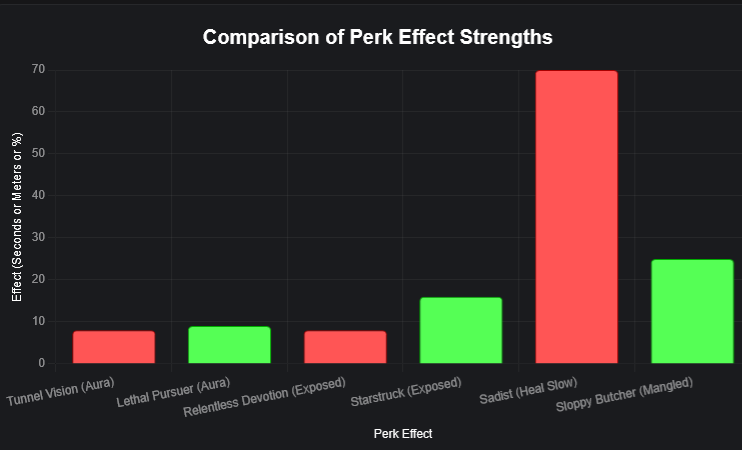
This chart shows:
- Tunnel Vision’s aura reading (8 seconds, balanced version) is comparable to Lethal Pursuer (9 seconds).
- Relentless Devotion’s Exposed radius (8 meters) is smaller than Starstruck’s (16 meters).
- Sadist’s healing slowdown (70%, balanced version) is stronger than Sloppy Butcher’s (25%) but not game-breaking, as it’s specific to Dying State healing.
This demonstrates the perks are in line with existing ones, not overwhelmingly dominant.
Conclusion
Tunnel Vision, Relentless Devotion, and Sadist don’t just buff killers—they add strategic depth, counter survivor meta perks, and create tense, engaging matches. They’re not about “spoon-feeding” kills but rewarding killer skill in specific scenarios (unhooks, hook control, slugging). With balanced tweaks, they ensure survivor fun by preserving counterplay (stealth, teamwork, gen-rushing). These perks diversify the meta, enhance the horror theme, and keep games dynamic, not boring or one-sided.
- Countering the Critique: The concern that these perks “buff the killer side significantly” assumes they’re universally dominant, but they’re designed to target specific survivor strategies (anti-tunneling, self-unhooking, recovery) rather than provide blanket power. They encourage diverse killer playstyles beyond the current meta (e.g., Pain Resonance, Pop Goes the Weasel), which keeps matches varied and engaging.
-
@Gh0st2317 said:
https://forums.bhvr.com/dead-by-daylight/discussion/comment/3936312#Comment_3936312
It won't be interesting. It'll just be insanely boring if the killers are just getting their kills spoonfed. There are already meta for killers right now, they don't need incredibly overpowered perks that'll end the game instantly.
I understand the critique that these perks—Tunnel Vision, Relentless Devotion, and Sadist—might feel like they "spoon-feed" kills to killers and could make games feel boring or unfair by being overpowered. However, I’ll argue in favor of these perks, highlighting their strategic depth, how they enhance killer gameplay without breaking the game, and why they can create engaging matches when balanced properly. I’ll address the concerns about them being boring or ending games too quickly, while showing how they fit into Dead by Daylight’s design and offer fresh gameplay dynamics.
Defense of the Perks
1. Strategic Depth Over "Spoon-Feeding” Kills
- Argument: These perks don’t simply hand kills to killers; they reward skillful play and create new strategic opportunities.
- Tunnel Vision: Disabling Endurance on unhooked survivors and granting 8/9/10 seconds of aura reading encourages killers to capitalize on unhooks but doesn’t guarantee a down. Survivors can still use map knowledge, stealth, or looping to evade the killer during the aura-reading period. This perk shifts the focus to post-unhook chases, rewarding killers who can track and outmaneuver survivors quickly. It counters Borrowed Time but doesn’t eliminate other survivor defenses like Dead Hard or Sprint Burst.
- Relentless Devotion: Disabling self-unhooking in the terror radius and applying Exposed within 6/8/10 meters of a hooked survivor forces survivors to rethink altruistic plays. It doesn’t guarantee kills—it requires the killer to stay near the hook and catch survivors during the rescue attempt. Survivors can counter by unhooking outside the terror radius or using perks like Distortion to mask their presence. This perk rewards map control and punishes sloppy rescues, not just “spoon-feeding” downs.
- Sadist: Disabling self-recovery and slowing healing of dying survivors by 80/90/100% encourages slugging but doesn’t ensure kills. Survivors can still be healed by teammates (albeit slowly), and the killer must decide whether to slug or hook, risking gen progression. This perk shines in scenarios where the killer can down multiple survivors but requires map pressure and game sense to capitalize on the slugging advantage.
- Why It’s Not Boring: These perks create tense, high-stakes moments. For survivors, unhooking or healing becomes a calculated risk, forcing teamwork and coordination. For killers, the perks reward aggression and map awareness, not passive camping or slugging. Matches become a chess game of positioning and timing, not a one-sided kill-fest.
2. Balancing Within the Current Meta
- Critique Response: The concern that these perks are overpowered and unnecessary given the existing killer meta (e.g., Pain Resonance, Pop Goes the Weasel, Lethal Pursuer) overlooks how they diversify killer strategies without eclipsing current options.
- Tunnel Vision: While the meta includes perks like Pain Resonance for gen regression, Tunnel Vision focuses on chase potential post-unhook. It’s a direct counter to Borrowed Time, a near-ubiquitous survivor perk, leveling the playing field. Unlike Lethal Pursuer, which provides early-game info, Tunnel Vision is situational (unhook-focused), making it less universally dominant.
- Relentless Devotion: This perk competes with camping-focused perks like Make Your Choice or Monstrous Shrine but offers a unique twist by disabling self-unhooks and applying Exposed in a small radius. It’s not an instant-win button—survivors can unhook from outside the terror radius or bait the killer away. It’s strong but situational, unlike meta perks that apply constant pressure (e.g., Corrupt Intervention).
- Sadist: Slugging perks like Knock Out or Deerstalker exist, but Sadist adds a new layer by slowing recovery and healing, forcing survivors to commit to altruistic plays. It’s powerful but requires the killer to down multiple survivors, which skilled teams can counter with quick pickups or gen rushing. It’s not stronger than meta slugging builds (e.g., Oni with Infectious Fright) but offers a fresh approach.
- Why It Fits: These perks don’t replace the meta—they expand it. They give killers tools to counter specific survivor strategies (anti-tunneling, self-unhooking, quick recoveries) while encouraging active play. They’re not “game-ending” because they rely on the killer’s skill to capitalize on their effects, and survivors have counterplay options (stealth, looping, gen pressure).
3. Enhancing Game Variety, Not Ending Matches Instantly
- Critique Response: The fear that these perks will “end the game instantly” or make matches boring ignores how they promote dynamic gameplay and counterplay opportunities.
- Tunnel Vision: The aura reading (8–10 seconds) is comparable to Bitter Murmur (5–7 seconds post-gen) or Lethal Pursuer (7–9 seconds at match start). It doesn’t guarantee a down—survivors can hide or loop effectively. This perk makes unhooks riskier but doesn’t end chases instantly. It encourages survivors to vary their unhook timing or use perks like Iron Will to evade chases.
- Relentless Devotion: The Exposed effect near hooks and self-unhook disablement create pressure but don’t ensure kills. Survivors can unhook safely by distracting the killer or using perks like Borrowed Time to protect the unhooker. The 6–10 meter Exposed radius is small (compare to Starstruck’s 16-meter radius), so killers must stay close to the hook, risking gen progression elsewhere. This creates a trade-off, not an instant win.
- Sadist: Slowing healing by up to 100% (32 seconds to heal from Dying State) is strong but not game-ending. Survivors can still be picked up, and killers must weigh slugging against hooking. Skilled survivor teams can counter by prioritizing gens or using perks like We’ll Make It to speed up healing. This perk extends slugging scenarios but doesn’t make kills automatic.
- Why It’s Engaging: These perks create intense moments—survivors must adapt to unhooking or healing under pressure, while killers must balance aggression with map control. Matches won’t end instantly because survivors retain core tools (looping, stealth, gen rushing), and the perks’ effects are situational, not constant.
4. Encouraging New Playstyles and Counterplay
- Argument: Far from being boring, these perks shake up the Dead by Daylight meta by encouraging new killer builds and survivor counter-strategies.
- Killer Playstyles: These perks support aggressive, hook-focused, or slugging playstyles, complementing killers like Hag, Trapper, or Plague. They allow non-meta killers to compete with top-tier ones (e.g., Nurse, Blight) by giving them tools to control key moments (unhooks, recoveries). For example, a Trapper with Relentless Devotion can trap hooks, making rescues a gamble, while Sadist on Plague maximizes her slugging potential.
- Survivor Counterplay: Survivors can adapt with existing perks and strategies:
- Against Tunnel Vision: Use Sprint Burst or Lithe to escape post-unhook chases, or hide with Iron Will.
- Against Relentless Devotion: Coordinate unhooks outside the terror radius, use Distortion to mask auras, or bait the killer away from the hook.
- Against Sadist: Prioritize quick pickups with We’ll Make It or focus on gens to punish slugging killers.
- Why It’s Fun: These perks create a cat-and-mouse dynamic where survivors must outsmart the killer’s hook or slugging pressure. Matches become less predictable, as survivors can’t rely on meta perks like Borrowed Time or Unbreakable as crutches. This keeps games fresh and challenging for both sides.
5. Balancing for Fairness
- Addressing Overpowered Concerns: While these perks are strong, they can be balanced to avoid being oppressive:
- Tunnel Vision: Cap aura reading at 6/7/8 seconds and limit Endurance disablement to within 12 meters of the hook. This preserves the perk’s anti-tunneling-counter purpose without making unhooks a death sentence.
- Relentless Devotion: Fix the Exposed radius at 8 meters and allow self-unhooking with a difficult skill check in the terror radius. This gives survivors a risky out while maintaining the perk’s hook pressure.
- Sadist: Reduce healing speed penalty to 50/60/70% and allow slow self-recovery (e.g., 50% slower). This keeps slugging viable but doesn’t shut down survivor recovery entirely.
- Why It Works: These tweaks ensure the perks are powerful but not game-breaking. They reward killer skill (positioning, chasing, map control) while giving survivors counterplay options, preventing the “spoon-fed kills” concern.
6. Fitting the Horror Theme
- Argument: Dead by Daylight is a horror game, and these perks enhance the killer’s terrifying presence. Tunnel Vision makes the killer feel like a relentless hunter, Relentless Devotion evokes dread around hooks, and Sadist amplifies the despair of being left to bleed out. These perks make survivors feel vulnerable, which is core to the game’s horror aesthetic.
- Why It’s Not Boring: For killer players, these perks make them feel powerful and in control, fulfilling the fantasy of being an unstoppable force. For survivors, the added pressure creates thrilling, high-stakes moments where every unhook or recovery is a gamble. This tension keeps matches engaging, not monotonous.
Countering the “Boring” Critique
The concern that these perks make games boring by handing killers easy kills assumes passive or unskilled play. In reality:
- Killer Skill Matters: These perks require active decision-making—when to chase unhooked survivors, when to patrol hooks, or when to slug. Poorly timed use (e.g., camping with Relentless Devotion while gens pop) can cost the killer the game.
- Survivor Agency Remains: Survivors can counter these perks with existing tools (stealth perks, gen-rushing, coordinated unhooks). The perks don’t remove survivor skill expression; they shift it toward smarter play.
- Match Variety: By countering meta survivor perks (Borrowed Time, Unbreakable, Deliverance), these perks force both sides to adapt, preventing repetitive gameplay loops where survivors rely on the same strategies every match.
Comparison to Existing Meta
To show these perks don’t outshine the meta, consider:
- Pain Resonance: Regresses gens by 15–25% on hook, applying constant pressure. Tunnel Vision is more situational, focusing on one survivor post-unhook.
- Pop Goes the Weasel: Regresses gens by 20–25% after a hook. Relentless Devotion trades gen pressure for hook control, a different strategic choice.
- Infectious Fright: Reveals survivors in terror radius on a down. Sadist complements slugging but requires more commitment to capitalize on slowed healing.
These perks don’t end games faster than meta builds (e.g., Blight with Pain Resonance, Pop, and Lethal Pursuer) but offer alternative playstyles, keeping the game fresh.
Conclusion
Far from being boring or overpowered, Tunnel Vision, Relentless Devotion, and Sadist add strategic depth, counter survivor meta perks, and enhance the horror experience. They reward skilled killer play while giving survivors room to counter through teamwork and strategy. With minor balance tweaks (e.g., shorter durations, smaller radii), they can fit seamlessly into Dead by Daylight without breaking the game or making kills feel “spoon-fed.” They encourage dynamic matches where both sides must adapt, keeping gameplay engaging and varied.
If you’d like, I can:
- Propose specific balance tweaks to address the critic’s concerns.
- Create a chart comparing these perks’ effects (e.g., aura radius, healing slowdown) to existing killer perks to show they’re not outliers.
- Search X or web sources for community opinions on similar perk ideas to gauge reception.
- Suggest a killer build incorporating these perks to show their strategic fit.
I understand the critique that these perks—Tunnel Vision, Relentless Devotion, and Sadist—might feel like they "spoon-feed" kills to killers and could make games feel boring or unfair by being overpowered. However, I’ll argue in favor of these perks, highlighting their strategic depth, how they enhance killer gameplay without breaking the game, and why they can create engaging matches when balanced properly. I’ll address the concerns about them being boring or ending games too quickly, while showing how they fit into Dead by Daylight’s design and offer fresh gameplay dynamics.
Defense of the Perks
1. Strategic Depth Over "Spoon-Feeding” Kills
- Argument: These perks don’t simply hand kills to killers; they reward skillful play and create new strategic opportunities.
- Tunnel Vision: Disabling Endurance on unhooked survivors and granting 8/9/10 seconds of aura reading encourages killers to capitalize on unhooks but doesn’t guarantee a down. Survivors can still use map knowledge, stealth, or looping to evade the killer during the aura-reading period. This perk shifts the focus to post-unhook chases, rewarding killers who can track and outmaneuver survivors quickly. It counters Borrowed Time but doesn’t eliminate other survivor defenses like Dead Hard or Sprint Burst.
- Relentless Devotion: Disabling self-unhooking in the terror radius and applying Exposed within 6/8/10 meters of a hooked survivor forces survivors to rethink altruistic plays. It doesn’t guarantee kills—it requires the killer to stay near the hook and catch survivors during the rescue attempt. Survivors can counter by unhooking outside the terror radius or using perks like Distortion to mask their presence. This perk rewards map control and punishes sloppy rescues, not just “spoon-feeding” downs.
- Sadist: Disabling self-recovery and slowing healing of dying survivors by 80/90/100% encourages slugging but doesn’t ensure kills. Survivors can still be healed by teammates (albeit slowly), and the killer must decide whether to slug or hook, risking gen progression. This perk shines in scenarios where the killer can down multiple survivors but requires map pressure and game sense to capitalize on the slugging advantage.
- Why It’s Not Boring: These perks create tense, high-stakes moments. For survivors, unhooking or healing becomes a calculated risk, forcing teamwork and coordination. For killers, the perks reward aggression and map awareness, not passive camping or slugging. Matches become a chess game of positioning and timing, not a one-sided kill-fest.
2. Balancing Within the Current Meta
- Critique Response: The concern that these perks are overpowered and unnecessary given the existing killer meta (e.g., Pain Resonance, Pop Goes the Weasel, Lethal Pursuer) overlooks how they diversify killer strategies without eclipsing current options.
- Tunnel Vision: While the meta includes perks like Pain Resonance for gen regression, Tunnel Vision focuses on chase potential post-unhook. It’s a direct counter to Borrowed Time, a near-ubiquitous survivor perk, leveling the playing field. Unlike Lethal Pursuer, which provides early-game info, Tunnel Vision is situational (unhook-focused), making it less universally dominant.
- Relentless Devotion: This perk competes with camping-focused perks like Make Your Choice or Monstrous Shrine but offers a unique twist by disabling self-unhooks and applying Exposed in a small radius. It’s not an instant-win button—survivors can unhook from outside the terror radius or bait the killer away. It’s strong but situational, unlike meta perks that apply constant pressure (e.g., Corrupt Intervention).
- Sadist: Slugging perks like Knock Out or Deerstalker exist, but Sadist adds a new layer by slowing recovery and healing, forcing survivors to commit to altruistic plays. It’s powerful but requires the killer to down multiple survivors, which skilled teams can counter with quick pickups or gen rushing. It’s not stronger than meta slugging builds (e.g., Oni with Infectious Fright) but offers a fresh approach.
- Why It Fits: These perks don’t replace the meta—they expand it. They give killers tools to counter specific survivor strategies (anti-tunneling, self-unhooking, quick recoveries) while encouraging active play. They’re not “game-ending” because they rely on the killer’s skill to capitalize on their effects, and survivors have counterplay options (stealth, looping, gen pressure).
3. Enhancing Game Variety, Not Ending Matches Instantly
- Critique Response: The fear that these perks will “end the game instantly” or make matches boring ignores how they promote dynamic gameplay and counterplay opportunities.
- Tunnel Vision: The aura reading (8–10 seconds) is comparable to Bitter Murmur (5–7 seconds post-gen) or Lethal Pursuer (7–9 seconds at match start). It doesn’t guarantee a down—survivors can hide or loop effectively. This perk makes unhooks riskier but doesn’t end chases instantly. It encourages survivors to vary their unhook timing or use perks like Iron Will to evade chases.
- Relentless Devotion: The Exposed effect near hooks and self-unhook disablement create pressure but don’t ensure kills. Survivors can unhook safely by distracting the killer or using perks like Borrowed Time to protect the unhooker. The 6–10 meter Exposed radius is small (compare to Starstruck’s 16-meter radius), so killers must stay close to the hook, risking gen progression elsewhere. This creates a trade-off, not an instant win.
- Sadist: Slowing healing by up to 100% (32 seconds to heal from Dying State) is strong but not game-ending. Survivors can still be picked up, and killers must weigh slugging against hooking. Skilled survivor teams can counter by prioritizing gens or using perks like We’ll Make It to speed up healing. This perk extends slugging scenarios but doesn’t make kills automatic.
- Why It’s Engaging: These perks create intense moments—survivors must adapt to unhooking or healing under pressure, while killers must balance aggression with map control. Matches won’t end instantly because survivors retain core tools (looping, stealth, gen rushing), and the perks’ effects are situational, not constant.
4. Encouraging New Playstyles and Counterplay
- Argument: Far from being boring, these perks shake up the Dead by Daylight meta by encouraging new killer builds and survivor counter-strategies.
- Killer Playstyles: These perks support aggressive, hook-focused, or slugging playstyles, complementing killers like Hag, Trapper, or Plague. They allow non-meta killers to compete with top-tier ones (e.g., Nurse, Blight) by giving them tools to control key moments (unhooks, recoveries). For example, a Trapper with Relentless Devotion can trap hooks, making rescues a gamble, while Sadist on Plague maximizes her slugging potential.
- Survivor Counterplay: Survivors can adapt with existing perks and strategies:
- Against Tunnel Vision: Use Sprint Burst or Lithe to escape post-unhook chases, or hide with Iron Will.
- Against Relentless Devotion: Coordinate unhooks outside the terror radius, use Distortion to mask auras, or bait the killer away from the hook.
- Against Sadist: Prioritize quick pickups with We’ll Make It or focus on gens to punish slugging killers.
- Why It’s Fun: These perks create a cat-and-mouse dynamic where survivors must outsmart the killer’s hook or slugging pressure. Matches become less predictable, as survivors can’t rely on meta perks like Borrowed Time or Unbreakable as crutches. This keeps games fresh and challenging for both sides.
5. Balancing for Fairness
- Addressing Overpowered Concerns: While these perks are strong, they can be balanced to avoid being oppressive:
- Tunnel Vision: Cap aura reading at 6/7/8 seconds and limit Endurance disablement to within 12 meters of the hook. This preserves the perk’s anti-tunneling-counter purpose without making unhooks a death sentence.
- Relentless Devotion: Fix the Exposed radius at 8 meters and allow self-unhooking with a difficult skill check in the terror radius. This gives survivors a risky out while maintaining the perk’s hook pressure.
- Sadist: Reduce healing speed penalty to 50/60/70% and allow slow self-recovery (e.g., 50% slower). This keeps slugging viable but doesn’t shut down survivor recovery entirely.
- Why It Works: These tweaks ensure the perks are powerful but not game-breaking. They reward killer skill (positioning, chasing, map control) while giving survivors counterplay options, preventing the “spoon-fed kills” concern.
6. Fitting the Horror Theme
- Argument: Dead by Daylight is a horror game, and these perks enhance the killer’s terrifying presence. Tunnel Vision makes the killer feel like a relentless hunter, Relentless Devotion evokes dread around hooks, and Sadist amplifies the despair of being left to bleed out. These perks make survivors feel vulnerable, which is core to the game’s horror aesthetic.
- Why It’s Not Boring: For killer players, these perks make them feel powerful and in control, fulfilling the fantasy of being an unstoppable force. For survivors, the added pressure creates thrilling, high-stakes moments where every unhook or recovery is a gamble. This tension keeps matches engaging, not monotonous.
Countering the “Boring” Critique
The concern that these perks make games boring by handing killers easy kills assumes passive or unskilled play. In reality:
- Killer Skill Matters: These perks require active decision-making—when to chase unhooked survivors, when to patrol hooks, or when to slug. Poorly timed use (e.g., camping with Relentless Devotion while gens pop) can cost the killer the game.
- Survivor Agency Remains: Survivors can counter these perks with existing tools (stealth perks, gen-rushing, coordinated unhooks). The perks don’t remove survivor skill expression; they shift it toward smarter play.
- Match Variety: By countering meta survivor perks (Borrowed Time, Unbreakable, Deliverance), these perks force both sides to adapt, preventing repetitive gameplay loops where survivors rely on the same strategies every match.
Comparison to Existing Meta
To show these perks don’t outshine the meta, consider:
- Pain Resonance: Regresses gens by 15–25% on hook, applying constant pressure. Tunnel Vision is more situational, focusing on one survivor post-unhook.
- Pop Goes the Weasel: Regresses gens by 20–25% after a hook. Relentless Devotion trades gen pressure for hook control, a different strategic choice.
- Infectious Fright: Reveals survivors in terror radius on a down. Sadist complements slugging but requires more commitment to capitalize on slowed healing.
These perks don’t end games faster than meta builds (e.g., Blight with Pain Resonance, Pop, and Lethal Pursuer) but offer alternative playstyles, keeping the game fresh.
Conclusion
Far from being boring or overpowered, Tunnel Vision, Relentless Devotion, and Sadist add strategic depth, counter survivor meta perks, and enhance the horror experience. They reward skilled killer play while giving survivors room to counter through teamwork and strategy. With minor balance tweaks (e.g., shorter durations, smaller radii), they can fit seamlessly into Dead by Daylight without breaking the game or making kills feel “spoon-fed.” They encourage dynamic matches where both sides must adapt, keeping gameplay engaging and varied.
If you’d like, I can:
- Propose specific balance tweaks to address the critic’s concerns.
- Create a chart comparing these perks’ effects (e.g., aura radius, healing slowdown) to existing killer perks to show they’re not outliers.
- Search X or web sources for community opinions on similar perk ideas to gauge reception.
- Suggest a killer build incorporating these perks to show their strategic fit.
I understand the critique that these perks—Tunnel Vision, Relentless Devotion, and Sadist—might feel like they "spoon-feed" kills to killers and could make games feel boring or unfair by being overpowered. However, I’ll argue in favor of these perks, highlighting their strategic depth, how they enhance killer gameplay without breaking the game, and why they can create engaging matches when balanced properly. I’ll address the concerns about them being boring or ending games too quickly, while showing how they fit into Dead by Daylight’s design and offer fresh gameplay dynamics.
Defense of the Perks
1. Strategic Depth Over "Spoon-Feeding” Kills
- Argument: These perks don’t simply hand kills to killers; they reward skillful play and create new strategic opportunities.
- Tunnel Vision: Disabling Endurance on unhooked survivors and granting 8/9/10 seconds of aura reading encourages killers to capitalize on unhooks but doesn’t guarantee a down. Survivors can still use map knowledge, stealth, or looping to evade the killer during the aura-reading period. This perk shifts the focus to post-unhook chases, rewarding killers who can track and outmaneuver survivors quickly. It counters Borrowed Time but doesn’t eliminate other survivor defenses like Dead Hard or Sprint Burst.
- Relentless Devotion: Disabling self-unhooking in the terror radius and applying Exposed within 6/8/10 meters of a hooked survivor forces survivors to rethink altruistic plays. It doesn’t guarantee kills—it requires the killer to stay near the hook and catch survivors during the rescue attempt. Survivors can counter by unhooking outside the terror radius or using perks like Distortion to mask their presence. This perk rewards map control and punishes sloppy rescues, not just “spoon-feeding” downs.
- Sadist: Disabling self-recovery and slowing healing of dying survivors by 80/90/100% encourages slugging but doesn’t ensure kills. Survivors can still be healed by teammates (albeit slowly), and the killer must decide whether to slug or hook, risking gen progression. This perk shines in scenarios where the killer can down multiple survivors but requires map pressure and game sense to capitalize on the slugging advantage.
- Why It’s Not Boring: These perks create tense, high-stakes moments. For survivors, unhooking or healing becomes a calculated risk, forcing teamwork and coordination. For killers, the perks reward aggression and map awareness, not passive camping or slugging. Matches become a chess game of positioning and timing, not a one-sided kill-fest.
2. Balancing Within the Current Meta
- Critique Response: The concern that these perks are overpowered and unnecessary given the existing killer meta (e.g., Pain Resonance, Pop Goes the Weasel, Lethal Pursuer) overlooks how they diversify killer strategies without eclipsing current options.
- Tunnel Vision: While the meta includes perks like Pain Resonance for gen regression, Tunnel Vision focuses on chase potential post-unhook. It’s a direct counter to Borrowed Time, a near-ubiquitous survivor perk, leveling the playing field. Unlike Lethal Pursuer, which provides early-game info, Tunnel Vision is situational (unhook-focused), making it less universally dominant.
- Relentless Devotion: This perk competes with camping-focused perks like Make Your Choice or Monstrous Shrine but offers a unique twist by disabling self-unhooks and applying Exposed in a small radius. It’s not an instant-win button—survivors can unhook from outside the terror radius or bait the killer away. It’s strong but situational, unlike meta perks that apply constant pressure (e.g., Corrupt Intervention).
- Sadist: Slugging perks like Knock Out or Deerstalker exist, but Sadist adds a new layer by slowing recovery and healing, forcing survivors to commit to altruistic plays. It’s powerful but requires the killer to down multiple survivors, which skilled teams can counter with quick pickups or gen rushing. It’s not stronger than meta slugging builds (e.g., Oni with Infectious Fright) but offers a fresh approach.
- Why It Fits: These perks don’t replace the meta—they expand it. They give killers tools to counter specific survivor strategies (anti-tunneling, self-unhooking, quick recoveries) while encouraging active play. They’re not “game-ending” because they rely on the killer’s skill to capitalize on their effects, and survivors have counterplay options (stealth, looping, gen pressure).
3. Enhancing Game Variety, Not Ending Matches Instantly
- Critique Response: The fear that these perks will “end the game instantly” or make matches boring ignores how they promote dynamic gameplay and counterplay opportunities.
- Tunnel Vision: The aura reading (8–10 seconds) is comparable to Bitter Murmur (5–7 seconds post-gen) or Lethal Pursuer (7–9 seconds at match start). It doesn’t guarantee a down—survivors can hide or loop effectively. This perk makes unhooks riskier but doesn’t end chases instantly. It encourages survivors to vary their unhook timing or use perks like Iron Will to evade chases.
- Relentless Devotion: The Exposed effect near hooks and self-unhook disablement create pressure but don’t ensure kills. Survivors can unhook safely by distracting the killer or using perks like Borrowed Time to protect the unhooker. The 6–10 meter Exposed radius is small (compare to Starstruck’s 16-meter radius), so killers must stay close to the hook, risking gen progression elsewhere. This creates a trade-off, not an instant win.
- Sadist: Slowing healing by up to 100% (32 seconds to heal from Dying State) is strong but not game-ending. Survivors can still be picked up, and killers must weigh slugging against hooking. Skilled survivor teams can counter by prioritizing gens or using perks like We’ll Make It to speed up healing. This perk extends slugging scenarios but doesn’t make kills automatic.
- Why It’s Engaging: These perks create intense moments—survivors must adapt to unhooking or healing under pressure, while killers must balance aggression with map control. Matches won’t end instantly because survivors retain core tools (looping, stealth, gen rushing), and the perks’ effects are situational, not constant.
4. Encouraging New Playstyles and Counterplay
- Argument: Far from being boring, these perks shake up the Dead by Daylight meta by encouraging new killer builds and survivor counter-strategies.
- Killer Playstyles: These perks support aggressive, hook-focused, or slugging playstyles, complementing killers like Hag, Trapper, or Plague. They allow non-meta killers to compete with top-tier ones (e.g., Nurse, Blight) by giving them tools to control key moments (unhooks, recoveries). For example, a Trapper with Relentless Devotion can trap hooks, making rescues a gamble, while Sadist on Plague maximizes her slugging potential.
- Survivor Counterplay: Survivors can adapt with existing perks and strategies:
- Against Tunnel Vision: Use Sprint Burst or Lithe to escape post-unhook chases, or hide with Iron Will.
- Against Relentless Devotion: Coordinate unhooks outside the terror radius, use Distortion to mask auras, or bait the killer away from the hook.
- Against Sadist: Prioritize quick pickups with We’ll Make It or focus on gens to punish slugging killers.
- Why It’s Fun: These perks create a cat-and-mouse dynamic where survivors must outsmart the killer’s hook or slugging pressure. Matches become less predictable, as survivors can’t rely on meta perks like Borrowed Time or Unbreakable as crutches. This keeps games fresh and challenging for both sides.
5. Balancing for Fairness
- Addressing Overpowered Concerns: While these perks are strong, they can be balanced to avoid being oppressive:
- Tunnel Vision: Cap aura reading at 6/7/8 seconds and limit Endurance disablement to within 12 meters of the hook. This preserves the perk’s anti-tunneling-counter purpose without making unhooks a death sentence.
- Relentless Devotion: Fix the Exposed radius at 8 meters and allow self-unhooking with a difficult skill check in the terror radius. This gives survivors a risky out while maintaining the perk’s hook pressure.
- Sadist: Reduce healing speed penalty to 50/60/70% and allow slow self-recovery (e.g., 50% slower). This keeps slugging viable but doesn’t shut down survivor recovery entirely.
- Why It Works: These tweaks ensure the perks are powerful but not game-breaking. They reward killer skill (positioning, chasing, map control) while giving survivors counterplay options, preventing the “spoon-fed kills” concern.
6. Fitting the Horror Theme
- Argument: Dead by Daylight is a horror game, and these perks enhance the killer’s terrifying presence. Tunnel Vision makes the killer feel like a relentless hunter, Relentless Devotion evokes dread around hooks, and Sadist amplifies the despair of being left to bleed out. These perks make survivors feel vulnerable, which is core to the game’s horror aesthetic.
- Why It’s Not Boring: For killer players, these perks make them feel powerful and in control, fulfilling the fantasy of being an unstoppable force. For survivors, the added pressure creates thrilling, high-stakes moments where every unhook or recovery is a gamble. This tension keeps matches engaging, not monotonous.
Countering the “Boring” Critique
The concern that these perks make games boring by handing killers easy kills assumes passive or unskilled play. In reality:
- Killer Skill Matters: These perks require active decision-making—when to chase unhooked survivors, when to patrol hooks, or when to slug. Poorly timed use (e.g., camping with Relentless Devotion while gens pop) can cost the killer the game.
- Survivor Agency Remains: Survivors can counter these perks with existing tools (stealth perks, gen-rushing, coordinated unhooks). The perks don’t remove survivor skill expression; they shift it toward smarter play.
- Match Variety: By countering meta survivor perks (Borrowed Time, Unbreakable, Deliverance), these perks force both sides to adapt, preventing repetitive gameplay loops where survivors rely on the same strategies every match.
Comparison to Existing Meta
To show these perks don’t outshine the meta, consider:
- Pain Resonance: Regresses gens by 15–25% on hook, applying constant pressure. Tunnel Vision is more situational, focusing on one survivor post-unhook.
- Pop Goes the Weasel: Regresses gens by 20–25% after a hook. Relentless Devotion trades gen pressure for hook control, a different strategic choice.
- Infectious Fright: Reveals survivors in terror radius on a down. Sadist complements slugging but requires more commitment to capitalize on slowed healing.
These perks don’t end games faster than meta builds (e.g., Blight with Pain Resonance, Pop, and Lethal Pursuer) but offer alternative playstyles, keeping the game fresh.
Conclusion
Far from being boring or overpowered, Tunnel Vision, Relentless Devotion, and Sadist add strategic depth, counter survivor meta perks, and enhance the horror experience. They reward skilled killer play while giving survivors room to counter through teamwork and strategy. With minor balance tweaks (e.g., shorter durations, smaller radii), they can fit seamlessly into Dead by Daylight without breaking the game or making kills feel “spoon-fed.” They encourage dynamic matches where both sides must adapt, keeping gameplay engaging and varied.
If you’d like, I can:
- Propose specific balance tweaks to address the critic’s concerns.
- Create a chart comparing these perks’ effects (e.g., aura radius, healing slowdown) to existing killer perks to show they’re not outliers.
- Search X or web sources for community opinions on similar perk ideas to gauge reception.
- Suggest a killer build incorporating these perks to show their strategic fit.
- Argument: These perks don’t simply hand kills to killers; they reward skillful play and create new strategic opportunities.
-
@Gh0st2317 said:
https://forums.bhvr.com/dead-by-daylight/discussion/comment/3935785#Comment_3935785
If those perks were to be added, no one would play survivor. Those perks will just influence more camping, tunneling and slugging. Making it incredibly killer sided. So no. Just no. And besides, it will harm the survivor side majorly as no one may play as much or will migrate to playing as killer.
perks will make meta more interesting and offer new opportunities to killer players
-
@Gh0st2317 said:
No. Just no.
can you elaborate…
-
2500 almost sounds like a typographical error for 25000, 2500 is just a ridiculously marginal amount of bloodpoints compared to anything else in the game that awards them
-
in what universe is leaving the match after the killer has won but before he kills you a draw?
-
u missed bro
-
gens that are twice as fast and immune to any sort of interaction and surv mains will still cry tunnel if killers try to win lol
-
the maps having a million unsafe pallets just makes the game boring as hell, survs just run from tile to tile without actually playing them and predrop, the pallets never run out so it works out fine for them
-
facecamping is toxic because its intentionally playing substantially suboptimally just to grief a specific person. this is no longer a problem
'camping' in general or just generally pressuring hooks to cost the survivors gen time and get advantageous chases/good hits is just playing the game, it isn't a problem that needs fixing. if unhooks were supposed to not be contested at all, they wouldnt exist
-
would rather gen perks be nerfed to be niche at best and gen speeds be generally slower tbh, theres no way gen perks wont end up just being optimal with the current way the game is set up no matter how much whack-a-mole is played with the back catalog