
Beaburd
Beaburd
About
- Username
- Beaburd
- Joined
- Visits
- 1,496
- Last Active
Comments
-
I didn't notice a change yesterday because survivors kept immediately unhooking before I got into a chase with someone else, and often times, before I even left the hook. So I just tunneled the person out and nothing changed.
Hopefully people will realize that you can take your time with saves.
That said, when/if people get used to the fact that you can wait longer to unhook, I do wonder what the long-term consequences will be. Part of me thinks generators might go faster, as there's less incentive to leave them before you finish one (since you'll have ample time to finish + rescue in more scenarios now). A part of me thinks there's also the chance that nothing changes because, ideally, people should stay on generators and refuse to unhook until someone else is in a chase, in which case this doesn't change much unless said chase happens in the last 10 seconds of a hook phase. Yet another part of me thinks nothing will change because players are too antsy for quick results and won't actually utilize the extra time given to them.
Curious to see what will actually happen in the future.
-
Blight and Wraith.
If I could never face either of them ever again, I would be quite happy.
-
Yeah, I don't use bat form basically at all unless I have a specific area I know I need to get to - and fast. Basically covering generators, exit gates, or cutting off escapes/windows.
I'm in the camp that thinks the utilization of equalizer and reshade is cheating so I won't be using that, but I also think the utility of bat form is good enough since the other forms meet my needs so it doesn't matter that much. I use wolf form pretty much all game, while switching to Vampire for loops, and bat only in the above niche scenarios.
—
If anyone's curious about how to make wolf work, I recommend trying the following:
With the common add-on to increase scent orb detection by 100%, paired with the -4 terror radius + Monitor and Abuse, you become a 20m terror radius low-standing dark wolf with information where anyone in roughly ~32m of your position is. You can forgo information perks, reduce the importance of terror radius reduction perks, and focus on utility or gen blocking/regression, since the rest is built into the kit already. Just be aware that (I believe) survivors do not leave scent orbs if they are walking or crouched, which is why low terror radius is helpful here so you can catch them off-guard more.
Alternatively you could do a scent orb add-on build. Although scent orbs bring your movement speed up to 4.8m/s, its duration is only 2.5s with a 6s spawn time. That means, on average in a chase, at base, wolf form goes 4.68m/s. With +50% scent orb duration + 17% reduced spawn time, you can raise average chase speeds to 4.75m/s. Helps for chasing in general and catching people off-guard on loops with low line of sight.
EDIT: Removed the last paragraph since I think it's inaccurate in hindsight, and I don't like basing on personal estimates.
-
@VomitMommy said:
https://forums.bhvr.com/dead-by-daylight/discussion/comment/3787226#Comment_3787226
Your whole issue seems with considering 2 escapes win for survivors, that it should be considered tie instead, if you go simply by numbers, right?
Well, even in sports, if side that was less likely to win even ties, that result is going to be considered better compare to other team, no?
If some noname ties with last year champion, for him that result is amazing, even tho it's a tie technically.
So devs want 60% kill rate, which simply means more survivors are going to die on average than escape, which makes survivors (especially soloQ) definitely less likely to win. So the result when two survivors get out is in favor of survivors in my book (at least for soloQ).
For a change I consider 2 kills a loss, when we play full SWF unless it's Nurse, or Blight. Because I know we are the one more likely to win.
Everything depends on chances for victory to me. Basically did you perform better or worse compare to expected outcome?
So that's my reasoning behind that statement.
Okay, this logic I can understand.
So you're saying that you believe killers have an inherent handicap given to them by the developers putting them at an immediate advantage in every game. Because of that handicap, anything tied (2 man escapes) should be considered a win for the survivors, since they broke even despite being the underdog.
You have lowered the barrier for a survivor win and increased the barrier for a killer win in a standard game setting, because it is easier for the killer to achieve their victory condition.
There are specific exceptions for SWF, but the above is generally true for you in all games otherwise.
That line of reasoning makes sense to me, thank you. -
@VomitMommy said:
https://forums.bhvr.com/dead-by-daylight/discussion/comment/3787043#Comment_3787043
But this logic is faulty because if you change the perspective to the survivor with this train of thought, then the killer is the winner with 2 escaping
What if someone considers 2 escapes win for survivors on both sides?
But for most players, it's personal result. Even hatch can be considered "win" for that single survivor.
For many players it seems escape = win.
So for 2K, you simply have two survivors that won, and two survivors who lost.
Basically when approach changes is for SWF, where they are more likely consider the result of the game as a team.
I have it even easier, I couldn't care less, if I escape or die. I consider it a win, if I got a good chase. Except when we play SWF...
Yes, this was addressed at the very top of the original response I made:
I have to acknowledge that because the developers intentionally leave win conditions ambiguous for the player to decide, any and everyone's interpretation of what constitutes a win, and therefore what the win-rates are is technically correct in their own way. As such I can't really say this viewpoint is wrong.
I am not saying they are wrong for interpreting victory conditions in this way. To quote my second response, the goal of my posts here are:
The post I made that you're responding to was primarily to challenge the logic of your ideas
So to respond to you when you ask:
What if someone considers 2 escapes win for survivors on both sides?
Exactly, so why even try to bring it into argument about balancing, when win rate is clearly highly personal thing.
They can absolutely do that - I have no problem that they do that and I cannot say they are wrong for thinking that way. The developers have intentionally made the game's win conditions subjective and vague, likely to foster inclusivity and encourage debates (like this) that keeps the community active.
But this is a forum for discussion, and the feedback section specifically is a forum for sharing ideas to improve the game. We, the players, post here in hopes of influencing other people to our ideas. We, the readers, (ideally) critically think about those post's contents, question their logic, and help filter through those ideas based on their logical flaws and merits. This is so we can evaluate others thought processes, potentially see new perspectives, and gauge whether or not those ideas relate to us, and in the majority sense, to the playerbase as a whole (which could then potentially prompt change, at the developer's discretion).
So when I see a player who makes a sudden claim that 2 survivors escaping is a survivor victory, immediately includes that result in the survivors' win rates as such to argue for a balanced game, and uses that in a feedback section in an attempt to influence the discussion, I employ that critical thinking. I am not saying they are wrong for doing so, that's their personal choice, but when they make those claims so publicly in an attempt to influence others, I want to find the flaws and levels of bias in that logic so I, and hopefully others, can make more informed decisions on whether or not to accept those ideas for themselves as well.
And so far, I have yet to see a counter-argument to the flaws I presented. All I've had in response to my criticism of the logic is a repetition of the faulty logic under question, and a third party intervention asking why I should question it in the first place. The latter of which I find a bit odd to question in a form of feedback, debate, and critical thinking.
But again, I'll end by stressing that I am not saying anyone is wrong for thinking of win conditions in a particular way - they can do what they want. I'm not even trying to convert someone else to my ideas - I'm well aware that most beliefs are tied to emotions and no amount of logic can change a person's mind in those scenarios. I was just hoping to clarify what logic they used to support their beliefs, which so far seems a bit biased and flawed.
-
@Devil_hit11 said:
https://forums.bhvr.com/dead-by-daylight/discussion/comment/3787007#Comment_3787007
there is just no killer that believes that 2k is winning for one unless your super egotistical or something. in fact, there are some killer that are not happy with 3k and will even slug 3 to get 4th as they only deem 4k as a win. Over-time though, when you play enough killer games, you just bored of doing a slug at the end because the time and effort to get 4k isn't really worth it in most cases over just playing more dbd matches. It is not really worth it to prologue game for like 3-4 minutes for what might just end up as slug kill when you could those 3-4 minutes on another match. like if you play 4 matches of 3-4 minute of slugging, those 3-4 minutes could been spent to play 5th match but like i said, some people get their joy from that. i personally think its poor designed end game that forces rng into conclusions of the matches which is why i don't really put much difference been 3k and 4k's.
This why sports have the concept of draws that apply when opposing teams have the same score
They also have special rules to eliminate said problem. Sometimes they're not enforced and they're just as number of scoreboard with the idea that the goal of tournament to score most # of points. if point are equal, they play tie-breaker match.
Killers therefore win almost twice as many games as survivor and clearly overpowered beyond belief and deserve rapid and brutal nerfs.
In just over half the games, half of the team is escaping every trial. I believe dev have once said they balance around 2 survivors escaping and 2 people dying every match, so at least according to raw stats, they're pretty much on mark. For me, what matters is my fun in playing survivor and killer. The perk updates for survivor do keep survivor interesting enough for me to have some fun with it. If we ask the question whether i have fun with killers? For a lot of them. Not really. Every now and again, you get this unavoidable loss as killer with majority of the cast. The win-rate stats in my opinion are carried by stronger killers who win too much while the lower end of the killer cast drag win-rates down. If you were to remove like top 12-14 killers with positive win-rates, i imagine that the killer's win ratio is much more negative especially if it the list only included like bottom 12 killers and their associated win-rate vs like… 1% of survivors if there even any statistics on that consider that i imagine that lots of the worse killer might not face the very top of survivor unless the matchmaker is lax.
The post I made that you're responding to was primarily to challenge the logic of your ideas, but you're just regurgitating the ideas again without addressing the criticism towards them.
The first paragraph in your response is repeating the concept that wins and losses should be based solely from the perspective of the killer (i.e. if the killer does not win, the survivor must be the winner). But this logic is faulty because if you change the perspective to the survivor with this train of thought, then the killer is the winner with 2 escaping. As a result, from the survivor's perspective, it artificially inflates the killer's win-rate to the point they become grossly overpowered and in need of immediate and harsh nerfs. Likewise, when you do it from the killer's perspective, it artificially inflates the survivor's win rate.
The last paragraph takes my quote out of context (it was a hypothetical scenario if the perspective changed to benefit the survivor) and repeats the same concept that the determination of who wins should be entirely based on the killer's perspective. But until addressed, that logic is still faulty since perspectives change depending on which side you're on, and focusing on only one leads to significant bias in the results.
They also have special rules to eliminate said problem. Sometimes they're not enforced and they're just as number of scoreboard with the idea that the goal of tournament to score most # of points. if point are equal, they play tie-breaker match.
Yes, I specifically mentioned that sports include special rules or situations (like overtime) to reduce the frequency of ties/draws.
Despite those rules existing though, it is still possible to get a tie in many sports, such as, but not limited to, the following:- American Football
- European Football (AKA soccer)
- Baseball
- Basketball
- Ice hockey
Source:
Draws, while actively discouraged and reduced through additional rules, are still a natural part of many sports competitions to signify that neither team was able to get a significant advantage over the other. The term draw is also rarely ever utilized in games that are prematurely terminated, since the definition of a draw means a tie occurred, but you cannot claim a tie occurs if a match does not conclude.
That said, it still not address the logical flaws I highlighted in the idea that if a game terminates in DBD, it must be a draw. That leads to paradoxical situations requiring additional rules, which in itself proves the logic is faulty.
-
Whether or not people agree, I'm under the belief that each player makes an implicit social agreement to try their best when they decide to queue up for a game. Disconnecting, giving up, or otherwise leaving the game violates this agreement to the detriment of others and is an incredibly selfish act.
So no, I hope that disconnect penalties continue. I would even go as far as to say I want them to become more stern with their penalties in the future.
That said, I do think the fact that roughly ~20% of games have at least one rage quitter is a symptom of one or multiple issues that needs to be addressed beforehand.
As to what those issues are, I believe it is a combination of the following:
- Boring core objective (generators)
- Linear and uninteractive hatch mechanic
- Archaic hook system
While these are quick ideas, I bet rage quit rates would drop if something like the following were implemented:
- Make generators more fun to do
- There's changes to this already in the works, so I'm waiting to see what the devs are doing
- Triple the number of chests in a match and make the last chest opened always have a hatch key
- Survivors therefore have a reason to open chests, get a secondary objective, and increases interaction opportunities when hatch closes
- Reduce unhook attempts to 1 per person with reduced penalties on a failed attempt
- Removes ability to give up on hook while still allowing deliverance, wicked, Up the Ante, Slippery meat, etc to continue working (buff the unhook chance luck perks though to match the reduce unhook attempts)
-
@Devil_hit11 said:
https://forums.bhvr.com/dead-by-daylight/discussion/comment/3786564#Comment_3786564
Nobody won means that game did not end. it also means that neither side completes its objective. The only way you can not complete your objective in dbd is
→ 2 survivors hide entire match for 60 minutes → Server closes down.
→Killer 3 generators for 60 minutes, Survivors are unable to complete generator objective → Server close down.
In every other case which is 99.9% of dbd games, the killer either acquired 3 kill or 4 kill which vast majority of killer will agree that they won the match or they did not get 3 or 4 kill and lost. 0 kill is worse loss possible. 1 kill is bad loss and 2 kill is close loss.
As i said in my previous post, i don't think survivor want close games. they want game to be super easy where you don't need think at all where you escape like 60% of the time, the killer almost never 3k or 4k and vast majority of games are 2 kill.
I have to acknowledge that because the developers intentionally leave win conditions ambiguous for the player to decide, any and everyone's interpretation of what constitutes a win, and therefore what the win-rates are is technically correct in their own way. As such I can't really say this viewpoint is wrong.
That said, I personally find the logic flawed in a couple of ways.
First, you're associating draws solely with terminated matches simply because of a singular relationship where neither has a winner. That's a bit iffy though, because a draw is defined as a match between two sides that ends in a tie. You cannot really have a tie in a terminated match because the match never reaches a conclusion, so the final results of each side can never be known.
Second, what if a match is terminated when only one survivor remains for whatever reason? While unlikely, that's technically possible. In that case, by your logic, it would be a draw since the game closed down. But a draw means a tie occurred. But a tie cannot occur if the killers typical win condition is fulfilled. But you cannot state the killer has won because you have associated canceled matches specifically with draws. At this point it becomes a type of paradox where you need to appoint new rules to have this niche scenario make sense. But the fact you need a separate set of rules to address this situation implies the initial logic used was flawed. This argument also works if a game terminates with 3-4 survivors alive for whatever reason, since that's clearly a killer loss in a normal game, but it has to be called a draw given you associate canceled matches with draws, so special rules would be needed here too.
This why sports have the concept of draws that apply when opposing teams have the same score, and a canceled match is labeled as simply canceled and rescheduled rather than calling it a draw. Granted there's usually special rules for overtime to reduce the amount of draws/ties that occur since they're less exciting, but most still have the ability to draw in the event overtime ties as well.
—
I also disagree with the logic that if the killer did not win, that means the opposing side automatically won. It's an argument that solely looks at one perspective (the killer's side) without consideration for the other, and comes off as a bit biased because of that.i have explained this multiple times…. the other side not considered winning means your side winning.
I could use this same logic in reverse, focusing on the survivor's perspective.
I, when I play survivor, do not consider my 'team' as winning when only 2 escape. Therefore, the killer automatically wins when 2 or less escape using this logic with the survivor's perspective. Given that the killer now wins when 2+ escape, that means the killer has a 64.59% win rate according to Nightlight, whereas survivors only win 35.41% of the time. Killers therefore win almost twice as many games as survivor and clearly overpowered beyond belief and deserve rapid and brutal nerfs.
That's an extremely survivor-biased outlook isn't it? But it's using the exact same logic you use, but with the survivor's perspective.
You could argue we should only focus on the killer's perspective when using this logic, but then you're creating new rules to fill gaps in your original rule. The necessity for those additional rules shows that the logic is flawed, as good logic does not have gaps that need special treatment to make sense.
-
@Devil_hit11 said:
https://forums.bhvr.com/dead-by-daylight/discussion/comment/3786473#Comment_3786473
but it is near 50% win-rate. according nightlight which records a total of 13,434 games so far, out of these games, survivor get 4 man escape, 3 man escape and 2 man escape 48.32% of their games. Killer get 3 kill or 4 kill in 51.68% of the games. This is within 2% margin.
13.434 is not like a crazy sample size but it is a sample size to give an idea for what win-rate margins are to some vague degree.
I understand why you associated 3-4 dead being a killer win, since that's the majority of the opposing side disposed of. I would also agree that constitutes as a win for the killer.
However, what is the logic in associating a 2 man escape with a survivor victory? Given the above majority-wins concept applied in classifying a killer victory, I would assume a similar logic would be employed for survivor, meaning 3-4 escaping would constitute a win for them. In that case, I'd also expect a 2-man escape to be classified as a draw since there's no definitive winner.
Referring to Nightlight's data on number of escapes:
0 escapes - 33.18%
1 escape = 18.5%
2 escapes = 12.91%
3 escapes = 16.6%
4 escapes = 18.81%Killers win with 3-4 kills 51.68% of the time. (33.18 + 18.5)
Survivors win with 3-4 escapes 35.41% of the time. (16.6 + 18.1)
A draw with 2 escaping/killed occurs 12.91% of the time.In that case, killer has a win rate that is ~46% higher than survivor's win rate.
Not that I'm saying killer needs a nerf. While I cannot say by how much, I do think their win rate should naturally be higher.
I just am not sure 2 man escapes should be classified as a survivor win, and wanted to point out the win rate discrepancy when the concept of a draw is applied. -
Yes.
Any form of undetectable, Trail of Torment included, makes the killer immune to aura reading. So what will happen is that your perk will periodically reveal your aura to the killer without you seeing where they are.
This means Unforeseen, Dark Devotion, Furtive Chase, Machine Learning, and any other killer perk or add-on that grants undetectable will make OoO a detriment to run. Also killer abilities like Wraith cloak, Pig stealth, Ghostface stealth, etc.
—
Edit:
Worth noting is that you can still see the killer's aura through oblivious with Object of Obsession, since the killer only benefits from aura reading immunity when undetectable, which is not related to a survivors oblivious status.
-
I'm experiencing this myself right now.
I logged into DBD a couple of times, went to the killer screen to play my favorite killers and record more games for data analysis. But instead of being excited to play, I just remembered how bad my last full day of playing was. Gens flying, feeling pressured, when I do well people rage quit, there was with a bunch toxic post-game chatters. It just discouraged me, so I logged off and haven't been on in a week.
My only advice is take a break. This happens to me periodically, but after a year or two break I get the urge to play again, have fun, then rinse and repeat.
If you really want to play though, I don't know what to tell you. I find it difficult to force myself to play something I don't enjoy, so I just let my whims take me wherever they want to go and don't think about it more than that.
-
I actually have data on this from my own games, which I recorded (can post the dataset on request).
Below stats only include games where I was a survivor myself (solo queue only):
Number of Games: 155
Survivor Win Rate: 31.6%
Survival Rate: 39.52%
Draw Rate: 11.6%
Rage Quit Rate: 21.3%What constitutes as a win is exactly what you described.
3-4 escaping = survivor win
2 escaping = draw
1 or less escaping = survivor loss—
I also have stats for my killers games too though, if interested:
Number of Games: 129
Killer Win Rate: 69.0%
Kill Rate: 71.3%Draw Rate: 11.6%
Rage Quit Rate: 17.83%You can do some math to get survivor win rates (19.4%) and survival rates (28.7) for these.
And no it's not a typo, the draw rate for both my survivor and killer games are the exact same, which I find both shocking and hilarious.
—
I do feel the game has the potential to be very survivor sided at the very highest level (SWF, co-ordinated, using strongest items/perks). But that's not the majority of games. In solo queue? Pretty killer sided, and I don't think there's much argument against that.
-
Camping helps ensure whoever on the hook will not be rescued, which is useful for securing 2 stages or even kills.
Camping has the negative of letting the other 3 people do whatever they want for 60 seconds (soon to be 70 seconds) per stage, which, at maximum against 3 other active people doing generators, is at least 2 generators being popped per stage.
But what if no one is doing generators and everyone is looking for a rescue? What if only 1 is doing generators? What if everyone prioritized their generators early on in the hook, and now there's so little progress on the hook remaining (~20-30 seconds) that the amount of gens lost is for camping the remaining progress is not meaningful?
In all of those situations I described, camping is a pure benefit with no down sides. The killer is accomplishing their objective (killing people), being reward points, and has no reason to leave. That is when people (should) start wanting to camp and why they do it - it benefits them.
Unless there is another emotion-based reason (they're upset), that's it, it's that simple.
They do it because it's a net benefit and it works. -
This is great, very happy to see these changes.
This means you're not stuck being an M1 killer just because you used your power to break pallets, generators, walls, to patrol, chase someone off an objective, or even just want to hold it to use Carnifax in a chase. You can also stop yourself from hostaging your own guard via bad patrol placements or being forced to chase the one being hunted.
Should improve the experience a lot.
-
Just had the no-chase bug happen to me 3 games in a row as Ghostface.
Platform: PC
Killer: Ghostface
Maps: Family Residence, Lampkin Lane, Mount Ormond Resort
Build: Lethal Pursuer, Friends Til the End, Play With Your Food, Grim EmbraceThe lack of chase occurred when both in and out of my power. Occasionally it would start working again, then stop again, then start again - it was all very inconsistent throughout the match. I could be right next to, or even hugging a running survivor and the chase would not activate.
While I did not video record my gameplay, it looks exactly like this clip I found on Reddit of a user suffering the same issue:
https://www.reddit.com/r/deadbydaylight/comments/1c9abso/chase_bug_does_anyone_know_why_a_chase_isnt/ -
Not related directly to what you experienced, but on the topic of hackers:
I did witness a hacker just a couple of minutes ago actually, at least I believe I did.
I was playing Ghostface on Lampkin Lane vs an Ace, and he was perfectly navigating behind building walls against me. When I say building walls, I mean the main house upstairs (near the gen), downstairs (by the kitchen I think?), and the top and basement floors of house of pain. Those were solid wide walls that are impossible to see through, capped off by a ceiling, but he was running exact opposite of my movements the entire time.
While I mostly heard his footsteps, I even witnessed him doing it when I proc'd Friends Til the End's aura reading against him a couple of times. I was undetectable via my power, so I was unsure how we was doing it.
Post-game he said it was a combination stretch res and my cloak that was letting him do it. The explanations sounded ridiculous to me, especially stretch res, given it was addressed and I'm not sure how it would help in the first place. So I'm just assuming he was a subtle hacker and reported him.
-
I hate to be that guy but don't play knight at the highest level, any survivor thats good will make the guards effectively useless. As using the ai against them is easy af. Against good player knight is just a killer that at best can waste time.
Step 1. Pick a different killer
Don't.
Normally I get a chuckle out of these kinds of responses thinking they're a playful joke of sorts, but given its the only response, my own experience with the Knight so far, and my inability to comprehend how Knight is anything but a worse iteration of the Twins has me believing it.
I guess I'll just take a break from Knight for a bit.
Thanks all lol -
@jesterkind said:
The bad rolls for chests aren't the brown and yellow items, those items are just a fairly low baseline for item strength. All the brown and yellow items - by which I mean, the medkits, toolboxes, and one flashlight that this group represents - actually do something and could easily be considered a win state when opening a chest; it's not hard to imagine someone searching a chest hoping for a medkit to heal themselves, at which point the brown medkit is exactly what they're looking for and they wouldn't be served in any meaningful way by getting something of higher rarity.
The bad item rolls are exclusively greens and arguably above: It's the base Map, which only tracks generators, and the Broken Key- arguably the other keys too, but at least the other two open hatch, whereas a Broken Key you get from a chest literally doesn't do anything. Those are the actual fail states when rolling the dice on chests, not the baseline of decent items.
This is my biggest problem with your suggestions, which are fairly reasonable otherwise- the actually unappealing items that people don't want when searching chests aren't being addressed at all here. Medkits and toolboxes are the only items you're proposing changes for, but they're also already the only items people actually want.
If we're tackling chest problems at their core, and we're doing that by changing items, we need to change Maps and Keys before we look at Medkits and Toolboxes. They're the underwhelming and sloppily designed items, not the two that function perfectly fine. We can only consider a chest overhaul a success if a reasonable survivor would be okay with getting rolled any item in there- obviously it's fine if someone was hoping for a specific item and groans when they get anything else, but if everyone universally groans when they roll The Item That Literally Does Nothing, we've still got a big problem no adjacent changes can fix.
Yeah I concede common med-kits are actually useful, but I don't know about toolboxes.
A common toolbox just gives ~5 seconds worth of generator progress, and chests always take 10 seconds to open. So if you get a toolbox, you're always losing time. Even if you get and hit 2 Great skill checks in those 5 seconds, that's just 7 seconds of time saved for a minimum 10 second investment. I just can't see that as worthwhile, so I always consider it a consolation prize for trying, but still means my effort was wasteful and meaningless.
In fact, all toolboxes aside from Commodious give a return that's lower than the cost of the investment. Even then, Commodious with add-ons gives 10.7 seconds of gen charges, which is just the cost of opening the chest so you only break even on the investment there. Still a loss for you if you took at least 1 second worth of time to travel to and from that chest, which is almost always going to be the case.
Concerning Rare items, I actually like maps for the points which is why I didn't mention it; but yeah, they are pretty useless otherwise thanks to their range and limited tracking potential (just gens). Totally agree that keys and maps should be revamped too though in hindsight. I'm hoping they just do a total rehaul of every item at this rate, even if some changes are less significant than others (med-kits).
Anyway love the points, agree with most! Maybe even all, as toolboxes acting as consolation prizes could be fine as well short-term. Just as long as there's some items (preferably unique) in chests that are exciting, rewarding, and satisfying to get and use.
-
@CrypticGirl said:
https://forums.bhvr.com/dead-by-daylight/discussion/comment/3779314#Comment_3779314
I did make notes in the "special notes" whether dying on hook was intentional or not; I.e. "Threw on second hook" (intentional) vs. "Died on second hook" (unintentional). I understand how that could have been confusing.
ETA: Also, I did take a gander at your spreadsheet. I do like all the details, but I tried to avoid as much side scrolling as possible in my own spreadsheet. All that side scrolling makes the data hard to follow, imo. But I might just make another column for additional details of the match, describing events or actions that led to our success or failure.
Ohh, I get it now, thanks for the clarification!
With that info, I downloaded the file as xlsx to work on it locally (I don't like Google sheet's tables and formatting options) and determine DC rates, intentional death (INT) rates, and rage quit (RQ) rates (DC + INT).
Count Criteria:
For # of DC'd games, I counted all notes that mention "DC" and manually sifted through to exclude excess DCs that occurred in the same game. This way, only 1 DC per game was counted.
For # of INT'd games, I counted all notes that mention "threw on" with points lower or equal to 10,000, then manually sifted to exclude excess INTs that occurred multiple times in one game. This way, only 1 INT per game was counted.
For # of RQ'd games, I got lazy and just added # of DC'd + # of INT'd games to get my total # of games with a RQ. This isn't perfect because there's likely games being counted multiple times.
Results:
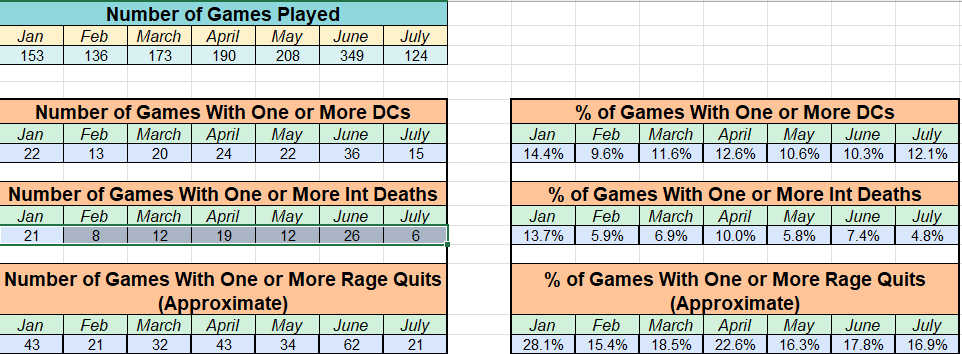
Average % of games with at least one rage quit (either intentional death or DC) is ~19.4% between Jan-July with your dataset.
Pretty close to my own recorded experience of 21.7% of games with at least one rage quit, so that's nice to see!There are some caveats with the rage quit calculations though (view notes #1 and #2) that may overestimate this rage quit %, by about ~3% if I had to guess.
Link to Workbook*:
https://docs.google.com/spreadsheets/d/1XUwDmFbW4TBDfP2YlsF4HQrE0B3bsBYe7RJ0zzpoyf4/edit?usp=sharing*Google Sheets decimated the work I did locally on Excel. See notes 3+ if curious why it's so ugly.
Notes:
- Rage Quits are estimated because I could not think of an easy way to compare INT and DC games to sift through duplicates, so I just added the previously sifted through INT and DC values to create my RQ values
- So some counted INT games could be included in games already counted for a DC
- I briefly compared Jan and Feb DC/INT games to check how many were likely duplicates, and it was just a few (~3-4), so if I had to guess, the % of games with a RQ is overestimated by around ~3% maybe? I don't think it's much, especially given:
- Min rage quits is at least the same as games DC'd, since I personally removed duplicates from that data.
- The workbook on Google Sheets has multiple worksheets because I copied each month, turned the data into tables, standardized point formats, then filtered based on my above criteria.
- Each month has two worksheets, one dedicated to DCs and one to INTs
- Uploading to Google Sheets removed my tables and their filter options, but kept the filtered results by automatically hiding the rows I filtered out using the above criteria
- Uploading to Google Sheets turned everything blue, I don't know why
- The tables posted in the screenshot above labeled "Number of Games With One or More DCs" and for INT Deaths were determined via the calculation (=SUBTOTAL(3, F1)-(1*x) to count all filtered rows, then remove duplicates by subtracting by x (x = # duplicates found)
- Because my tables were removed the calculations no longer worked appropriately, so I just copy/pasted the values
- How I determined total # of games is based on calculations you can view in the cells where the total games are given (see linked workbook)
- Basically I noticed each game has 6 rows of data allocated to it, with a date row every day in each worksheet regardless if played or not. So I counted all rows, subtracted by 34 (max days in a month + header row + 2 for extra rows), then divided that result by 6 and rounded up. That gave me a rough estimate of # of games.
TLDR - If you just want to know the results:
- These numbers are using the dataset from another DBD player (CrypticGirl) for games between Jan 2024 and July 2024
- Average % of games with at least one rage quit is between 16.4% to 19.4%
- The % of games with a rage quit is roughly the same as that witnessed by my own dataset, which was 21.7%
- I just realized I did not look for games with an AFK in CrypticGirl's notes, which my stats included, but I doubt it affects much
—
Anyway, that was fun!
The number of games affected by rage quitters concerns me even more with this now, since that was a lot of data and it still seems like a lot of games are being ruined by it imo.
PS:
Yeah, I totally get your disdain for scroll side-to-side since it makes it hard to see all your different columns of data.
It just makes calculations easier in the long-run so I learn to live with it. Otherwise I have to do weird filters and function-based calculations to analyze the data. But as long as there's a standard in place, which yours has in a beautiful fashion, it works.
Thanks again! - Rage Quits are estimated because I could not think of an easy way to compare INT and DC games to sift through duplicates, so I just added the previously sifted through INT and DC values to create my RQ values
-
@HolyDarky said:
I've noticed also more dcs or hook kills than usual. I guess, the problem is that many players are still in the 2v8 (there I have nearly no dcs or hook kills). So maybe more give up players are in the 1v4. I think with the end of 2v8, 1v4 will become a lot better but I am not sure because something in my mind thinks that players will give up more because they think "2v8 was so better than this, I don't wanna play this match anymore".
The problem is that dcing or dying on hook has no real punishment for the player. Players who have unlocked everything know this and do it if they want - in fact hook kill gets rewarded with BP and XP. They do it for the tiniest reasons like they don't like the killer, the map, the perk, the chase, or when a hit looks weird (they are like snowflakes). AFK players, on the otherside, might be because the queue time is longer and they go afk. The Lara in your post might be that she wanted the hatch or something. Some players are really selfish, especially when an archive or achievement comes into play.
Peanits, one of the developers, responded to this situation and said it is difficult to force someone to play a match that they don't want to play - which is funny because killers have no other choice than to dc to end a game and then why did this person joined the lobby. Survivors can do a hook kill or run to the killer and then die. Year, the problem is not the game but rather the player. However, in my opinion, the hook kills are the biggest issues because they are so free and easy. The developers should add a restriction to the 4%: You can no longer try an escape when you're the only hooked survivor (and when no other survivor is in dyingstate). Having no 4% in the 2v8 is possible and has a positive effect and I think it will also be good for the 1v4. Of cause, the survivor can still run to the killer and end this game on this way but then the killer has the choice to slug them - either dc, bleed out, or play the match. In addition, it is so stupid that one person can ruin the fun of four other players. Another option is to improve the report system and add the option to report players that give up but this would lead in more work and I guess the developers are not interested in this.
Some good points here.
I think you're right on the money with the second and third paragraph.
It is a player attitude problem. There's no real punishments for bad behaviour, and there's no incentives to keep playing because there are players who have everything they want unlocked, unlocked. So they have don't have an incentive to play, nor punishment to prevent them from not playing. It is also difficult to detect some players rage quitting since, like you said, they can just run to the killer and off themselves with plausible deniability that it wasn't intentional.
I'm starting to think the best solution to this problem is, funny enough, for the developers to start creating and supporting a more competitive atmosphere. If they had seasons or splits with real and unique ranked-based rewards (skins, not blood points), it would incentivize players to perform well in games. Pair that with a punishment system that targets those rewards if they're repeatedly inappropriate (DC, quitting, verbally abusive, etc.) maybe that would be enough to deter more of this negative behaviour.
The flip side to that though is then their casual audience might feel isolated since the unique rewards might not obtainable to them if they can't play enough or aren't good enough to get them. Given how big the devs are about inclusion I doubt it's a route they like, but I can't help but think it would solve some game quality problems. Might increase toxicity though.
-
@CrypticGirl said:
https://forums.bhvr.com/dead-by-daylight/discussion/comment/3779264#Comment_3779264
Mine is just a simple spreadsheet listing the Killer, Survivors, perks, map, # of gens done, # of escapes, BP scores and special notes (which would include if someone got tunneled, or DC'd/threw on hook, hatch escapes, or things like that. I don't have any fancy charts or graphs to depict a specific rate of any particular note; I really don't know how to do any of that stuff.
I'm not sure what you mean by "sample size," but if you want to check out my spreadsheet, I have it here (this covers January-July 2024 so far).
https://docs.google.com/spreadsheets/d/1lMKd1UaZQFIZTFVeC4CPYsQ1aajVccopefX2HiVE-oA/edit?usp=sharing
As promised, here's the approximate DC rates with @CrypticGirl dataset:
January: 13.8%
February: 9.6%
March: 10.7%
April: 12.7%
May: 10.1%
June: 10.7%
July: 11.4%Seems the average DC rate is about 11.3% on average.
I was just gonna edit it into my last post but I did have a question.I only counted games that had at least 1 DC for the above rates. I ignored all notes that talked about someone skipping hook stages or dying on first hook. Do you know if notes regarding hook stages was intentional by the person hooked, or just because the team failed to save them, or could be either depending on the game?
Either way that was a fun delve, thanks again! -
@CrypticGirl said:
https://forums.bhvr.com/dead-by-daylight/discussion/comment/3779264#Comment_3779264
Mine is just a simple spreadsheet listing the Killer, Survivors, perks, map, # of gens done, # of escapes, BP scores and special notes (which would include if someone got tunneled, or DC'd/threw on hook, hatch escapes, or things like that. I don't have any fancy charts or graphs to depict a specific rate of any particular note; I really don't know how to do any of that stuff.
I'm not sure what you mean by "sample size," but if you want to check out my spreadsheet, I have it here (this covers January-July 2024 so far).
https://docs.google.com/spreadsheets/d/1lMKd1UaZQFIZTFVeC4CPYsQ1aajVccopefX2HiVE-oA/edit?usp=sharing
Awesome, thanks for sharing!
It's so well organized, coloured, and dated. I'm definitely taking some time to browse this later and see if I can get a rate based on the notes section if that's okay. I might edit in the % here later. Kind of excited to see someone else recording their games too honestly.
I'll also post mine if your or anyone else wants a gander:
https://docs.google.com/spreadsheets/d/1oaT-E45AK5QmMx4e92Yuim2mQ7_EIDo3YOmx-6Bhua0/edit?usp=sharingAnd by sample size I just meant records or number of matches. But with that sheet I can just count - thanks again!
-
@FrostySeal said:
Simple as, most people are incredibly burnt out on DBD. This game and others like it rely on a sunk cost fallacy to keep you playing over the course of many, many years and because of that, you get a lot of players who just keep forcing themselves to play the game despite hating it. It's most apparent on Killer right now as sometimes you'll just play a specific Killer and will instantly get a survivor DC, have a short chase due to a mess up on their end making them DC, or hell even just have a normal chase with them and they'll still DC once you down them. It's noticeable on Survivor too as you'll have teammates that'll DC over literally nothing.
It's inevitable, unfortunately. Nothing the devs do will ever fix this problem because this is what the game is designed to do, its made to keep people addicted. Remember, live service games live and die by their engagement, look at Apex Legends or Overwatch 2 for example. These games are designed to maximize player engagement at any and all costs, even if it causes the player to hate the game.
I do agree that frustration, community clashes, and general negativity are emotions fostered by some developers to encourage addiction in their products. I would even see the argument that tactic is used in DBD, especially given their stance (or lackthereof) on topics of balance, third party programs, the competitive scene and other controversial topics.
These are, like you mentioned before, aspects of engagement to keep the community invested. But should rage quitting really be accepted as a normal practice akin to those? The act of quitting alone is a lack of engagement and discourages other players in the game from engaging since it impacts their experience. I struggle to think that having 1/5 games ruined would encourage people to play rather than dissuade them.
Even if it is a byproduct of practices meant to foster addiction, I would think it would be treated more harshly. But I suppose my train of thought might be wrong, and you could be right. If it was really a problem for them, they would state their stance on it and continuously try to address it. Since I'm not aware of either, I'm guessing that means it's not impacting business negatively or they're otherwise okay with it. Unfortunate if so.
I'm not noticing any more ragequitting than normal, and I also keep track of my matches.
This is actually perfect!
What attributes do you keep track of? Is rage quitting one of them specifically? If so, what % of your games have at least 1 rage quitter? And what's your sample size?
Legitimately curious if it's just me suffering with a nearly 22% rage quit rate.
-
Scooby Doo, Supernatural, and Metal Gear Solid.
I need:
- Shaggy saying "Zoinks!" when he gets in a chase.
- Dean Winchester saying "Son of a B-" when… whenever, honestly.
- Roy Campbell saying "Snake? Snake!? Snaaaake!?" when Snake, the survivor, dies on hook.
Edit:
Also if Snake ever uses Dramaturgy and gets a Brand New Part, please let him say "Metal Gear…" -
I just faced Nemesis with this this bug.
I should have been upset because it was hard to use my typical stealthy playstyle with non-stop coughing, but instead it was just hilarious. Not only that, but Mikaela's cough had a rythm to it that I couldn't help but dance along to.
Never thought I could enjoy listening to someone's airway obstructions so much.
-
@danielmaster87 said:
I think in theory the mode is still highly survivor sided, and would be in reality if MMR was a thing. 8 gens is simply too few to do, especially with how many filler pallets back to back there are to waste killers' time. There was 1 match I had which turned from a 6-8 man out to a 2-man out, because there were 5-6 people at the final gen that was seconds from completion, and every single person but me ran off and stopped it from getting done. No body blocks, no commiting, and they didn't even finish a different gen to make up for it. They just gave up. So of course killers are gonna kill a lot when that's what they're up against.
Some of the class results surprise me and some don't. Obviously Escapist is the best class, because it has Windows, Sprint Burst, and gives a mini Sprint Burst to allies. Medic should to be the next best pick, so people not picking it and losing with it is kinda weird. Fast healing and seeing injured teammates is never a bad thing, and considering people want to heal seemingly constantly instead of doing the gens, I don't get why so few people pick it. The only issue is when Medics stay on gens and non-Medics always go for uncage and heal, because those defeat the purpose of the class. You could deal with having 1, maybe 2, Guides but that's about it. It's not that useful a class. And Technician I'm iffy on because you really don't need gen stuff to make gens go fast, but at the same time it can make up for your teammates' slack.
I would say the mode, given equal skill levels, is survivor sided myself, and think the data reflects that to a degree.
Although the win rate of my team over 100 games was exactly 49 wins, 2 draws, and 49 losses (what a perfect split), it is important to note that this was during free weekend.
And although that means there can be both new killers and survivors alike, due to the number of people in each role, it was far more likely to get a new survivor on your team than a new killer. Pair that thought with the scatterplot that showed even having one person with low points (i.e. low contribution) on your team can negatively affect survivor win rates, and I do think the flood of new players would affect survivor win rates in a more negative fashion than it would for killer. That said, the same scatterplot's r-squared value shows one individuals under-performance is far from the only factor that would contribute to a game loss. I feel it is important to mention that so those players don't get singled out - while it's significant, there's a lot factors at play that lower win rates.
Not to mention I myself, as a more experienced player relative to the free weekend average, have a 60% escape rate and way higher average point generation (and even minimum points) than the average low performer. I think if the average player were more experienced, had higher average points (i.e. contributed to objectives more), and survived longer, we would see escape and win rates raise more in the survivors favor.
That said, these are ideal high-level skill scenarios. In the real world scenario with inefficient players and a wide variety of skill disparities, especially during free weekend, I think they nailed the balance pretty well for this event as a whole.
Side note:
It would be kind of neat to try this again someday when there isn't a free weekend and/or players are more experienced to out the above theories though.—
Concerning classes, I actually think Medic is understandably at the bottom and it was actually one of the theories I was most looking forward to testing. The ability for auras and healing speed sounds decent, but they are such conditional benefits to Guide.
- Medic gets team aura-reading while healing, which is harder to achieve than Guide just touching a random generator.
- Medic's aura reading is mainly beneficial to injured folks looking for heals; whereas Guide is beneficial to those same people + anyone free to do generators.
- Guide's gen aura also benefits people who aren't around by reminding them to do the objective (has for me anyway); meanwhile, seeing a far off healing aura that you can't interact with isn't that beneficial for others
- Medic reduces 4.15 seconds off a solo heal, or 1.85 seconds off a duo heal; which is 8.3 seconds and 5.55 seconds of total survivor time saved if you give those savings to each person involved.
- Meanwhile Guide saves a flat 2.7 seconds off generator repairs for every Great skill check; albeit if you get one, and if you hit the Great.
- The time saved from Medic depends entirely on what your team does with that time; whereas the time saved by Guide is directly invested in the objective
- Medic's ideal scenario and time to shine is also during uncages with mass resets. But what if everyone else, especially healthy non-medics, are doing uncages and helping with resets instead? Your value as a class diminishes because of other peoples actions.
There's just a lot of conditions and nuance to the Medic class, and it is so reliant on other people understanding your role and letting you thrive and succeed. That kind of team-dependency just does not exist for any other role. Even Guide, the other selfless class, at least gives the user the ability to control when to use its abilities and directly invests its benefits into core objectives. That's the biggest difference that makes Medic fall behind imo.
-
@dwight444 said:
this is cool op, fellow Tableau user here
I remember being so put off by it initially because it seemed so complicated but once I started learning it I realized how intuitive and easy it was
Hey, that's awesome - Tableau users unite!
Yeah, exactly the same for me.
It actually took me a year to finally start learning this thing after putting it on the back burner thinking it would be overly complicated. But like you said, once you get started, it's actually pretty intuitive.I say that but I still struggle with comprehending how to do some calculated fields to get the results I want.
An example is the Team Stats page where I just typed out static print with the best and worst killer duos and maps, when in reality I wanted to make it a dynamic field that changed when you selected certain maps and/or killers. But I was having trouble figuring out how to implement win and escape rates to that field, and somehow combine my killer 1 and killer 2 columns. I can do it in Excel or SQL, but I figured I'd just take a short cut, type it in, and make it a challenge to figure out how to do later.Anyway I'm rambling - happy you liked it! Thanks for checking it out <3
-
@crogers271 said:
That's interesting data.
I haven't played as much (probably 50 to 75 games), and mostly post free weekend, but this tends to track. I play medic usually because I try to play what the other survivors are not and I think its a little stronger than people think, but I also enter the game with a strategy for the role.
On the feast or famine - I feel like I've had a lot more games with a middle result than you did, but more importantly I think is the average number of gens completed. It's not unusual to have a 4k in the 1v4 mode with multiple gens remaining. I find that to be extremely rare in 2v8 and the gen count pretty much always gets knocked out.
You're counting hatch escapes the same as door escapes, correct? If they are hatch escapes without the gens getting completed they should be a different stat.
Nurse stats - this really varies based off the level of nurses you hit. I matched against some who barely needed their partner, and some who looked to be learning the role and were basically an auto loss.
Yeah if your experiences are after the free weekend, I wouldn't be surprised if you noticed more mid-level survivor escapes and less extremes than I recorded. I think the fact I was dealing more with new killers and new survivors could have played a large part in the extreme end game results I experienced. Could be interesting to try this again one day without free weekend and seeing how it differs (although I don't know if I have it in me to do another 100 runs right now lol).
In regards to the hatch question, I differentiate hatch vs gate escapes for my personal stats at all times, but not for team stats. For team stats, I just assume if 3 or more people escape, they all got gate; otherwise, if 2 or less escaped, they just got hatch. I thought that was sufficient given hatch spawn conditions. Is your concern that hatch escapes when less than 8 generators are repaired is may skew the data for average generators completed? If so, no worries, I recorded the # of generators done before hatches spawned or were closed.
Okay my treatment of Nurse stats was not great, thank you for bringing this up in particular.
I should have clarified that although survivors have the highest win rate against Nurse + Wraith, I do NOT think that means she's weak. In fact, the second worst win rate survivors have is against Nurse + Huntress with a 38% win rate for survivors there, and I remember being DOMINATED in those games. It really should be highlighted, and is kind of reflected by the stats, that Nurse can either be extremely weak (implied with Nurse + Wraith) or extremely strong (implied with Nurse + Huntress) depending on who wields her.
It's interesting to me that guide has highest win rate. Kind of makes sense though. Finishing gens is how to win.
Yeah, Guide stats shocked me a bit, but I agree do make sense.
What's kind of interesting is that all games that had 0 Guides (though it was only 3 games) were losses. Out of the 24 potential people that could have escaped in those 3 games, only 3 people escaped as well. That means all compositions without a Guide in this data sample had a 0% win rate and 12.5% escape rate.
Now the sample size is low to the point I would take these findings with (even more than) just a grain of salt, but I still think it's an decent reminder on how important it is to have people doing generators, and to have a class dedicated to both doing them and reminding others to do them.
-
@Mandy said:
Oh I love this and how it's presented, will take some time to look through it properly next week!
Thank you for sharing.
Thanks!
I went for an old book format to help simulate the feeling that these stats came from a book taken from the game's own archives - which I think would be super cool to have one day.
That said, super cool to have a dev review it! Definitely no rush - it's the weekend, so I hope you enjoy it first and foremost!
I appreciate that!This is some real dedicated data collection, for a solo project. Kudos on the research!
Thanks you!
Definitely played waaaay too much during the free weekend to get this data (45 games in a day I think), but hey, at least the new mode was fun enough that I didn't mind lol benefits of doing a project on something you enjoy.
-
Same issue, started just now actually (PC).
Blood web lags every time I level it up, with a random chance it crashes with the error message mentioned above in this thread, sending me back to the initial loading screen of DBD where it says "press space to continue."
-
BP incentive is completely disabled in regular mode, and it's still 400% in 2v8 mode.
As someone who initially hated 2v8 and is stealth-support survivor player (although I've been playing more killer than survivor the last month…), I still prefer queuing for 2v8 simply because of a combination of the points + knowing it's a limited time mode right now. Well, okay, I've also learned the power of the Scout class which has made 2v8 infinitely more fun for me and that's a large part too…
But anyway, I gather it's because of the point incentive in 2v8, the fact the incentive is disabled for regular mode, plus knowledge it's a limit game mode that is sucking away the survivors from the regular mode too.
As much as it might suck to hear, I have a hunch the killer queues are going to suck for both modes for the next few days at best, and the entire event in the worst case scenario (so a couple weeks).
-
Hands down, Scout is my favorite class too.
This class lets me act like how toxic players normally act, but without actually being toxic myself. Not only that, but I'm rewarded for doing it - and that feels amazing.
What I mean by that, and what I love doing is, just standing out in the open directly in front of the killer and staring at them. I do not teabag, I do not emote - I just follow, stare, and make sure they know I'm doing it. Typically they get so unnerved that they try to down me, but the maps are so dang filled with favorable tiles I can typically just loop them until they give up or they get the other killer to help.
If they give up, it's perma wall hacks all game on them; but if they get the other killer, then it's perma wall hacks on both + free time for 7 other people until I go down (which I will sooner rather than later).
I actually feel bad and like I'm just harassing them but it's what my class was made for, so I justify it's fine and learn to enjoy the strategy.
—The points are pretty amazing too.Lots of boldness points. I get the rest of my category points by only doing generators that have a Guide for the co-operative point bonus (only need 3 gens to max out objective points doing this), and otherwise doing saves/heals since I'm usually always on the move.It's just sooooo dang fun. I feel like I'm in total control until I get downed, and it's such a guilty-pleasure power trip for me Lol
-
Do I want:
- Sprint Burst for myself and my team on a 20 sec CD, 3% haste, and windows of Opportunity; or
- Aura reading on the killer for my entire team, Iron Will, Urban Evasion, and Alert; or
- Permanent 20 roll Bardic Inspiration on Great Skill checks when repairing, nerfed visionary, nerfed Better Together; or
- Empathy, heal-only Leader effect, and a nerfed empathic connection that only shows people where you are when you're healing someone else?
Keep in mind that if you actually try to use Empathy to chase after and heal people, you can typically waste more time than saved if they run away from you. You only really get benefit by unhooking then healing (since they won't move and can act as a beacon for injured people), but otherwise your class does basically nothing. If people go for rescues despite being another role, which they often do, it makes your job even more pointless relative to others. Nevermind when people get self heal on death hook. Maybe the injured survivor auras can help find a gen or a killer, but so do Scouts and Guides.
On top of that medic has, in my opinion, the least interactive skill kit. Oh passive aura reading and healing speed that I don't have to make an effort to utilize? Cool. You could technically use Empathy to body block, which I do and like the class for, but I strongly doubt anyone else really does this.
Basically it's the class with the least interactive abilities and arguably the smallest benefits. I wish they gave Autodidact, a full-time Empathic Connection aura effect, and/or some kind of utility in their kit like Diversion.
-
@Peanits said:
As others have mentioned, the purpose of the incentive is to encourage people to play Survivor in 2v8 to help balance out the queues. Survivors are needed most in the 2v8 mode right now and by a pretty large margin, so that's where the incentive goes.
We aren't able to support different bonuses for each mode at the moment, so the incentives for the regular mode are currently disabled. We're looking to separate this so we can support the appropriate incentives for both modes in the future, but to manage expectations, I would not expect the regular mode to have an incentive as big as the limited time mode (or anywhere near 400% for that matter).
Any chance you folks could give some type of indicator as to which side needs players in the main game mode?
I'm pretty impatient regarding queue times, so I typically let the bonus be an indicator on which side I can play at a given time. If I'm only in the mood to play, say killer, I also use the presence of absence of the BP bonus to decide if I can play my desired role or just take a break from the game until it's available. Because these bonuses are disabled for the main game mode, I now have no way to know which side has fast queues. Even a paltry 1% BP bonus for the side with the faster queues would be appreciated just to help me make quick decisions on what I want to do and when.
It just feels a bit unfair to punish regular players who are tired of 2v8 or just straight up don't want to play it at the moment for whatever reason.
-
Chase is another aspect, 6 seconds from average chase is not really a big deal.
Your time comparison seems better because of your multiplying system, which is simply incorrect. If you compare it as real time value, which is only thing that matters for killer, it's falling behind.
That's not true, single trigger of pop/pain res on 1/2 gens left is actually a big deal and is definetly something to give you chance for comeback. Because it gives you more time to do something with it (not 6 seconds)….
I can't say that for remote hooking.That's kinda why all perks should compare real time values, not imaginary amount from theory.
The time a single trigger of pain res gives at half value is 9 seconds, it is usable 4x per match, and has similar (albeit slightly harder) conditions to use than remote hooking (down + hook at a specific place, relative to just downing).
The time a single trigger of Pop gives at half gen value is also 9 seconds, is usable 11 times (same amount of times as remote hooking), and has a slightly harder condition (down + hook relative to just downing).
Even if we, to my own disfavor, do not use half-way wiggle point when carrying of 8 seconds and prefer instead to use the arbitrarily chosen 6 second average value you picked out, the time values are still similar. Remote hooking also has more lax conditions.
We are looking at raw values right now, while still neglecting the other benefits of remote hooking (namely reduced save opportunities, saved time walking back from a hook) to offset the value of passive 0.25c/s regression, for simplicity's sake.
So can you explain to me why, without relying on anecdotal evidence, that Pop or Pain's (you choose) raw 9 seconds of time saved on a single generator is so vastly superior to remote hooking generously low-balled 6 seconds of time saved with easier use conditions?
You're quick to criticize my logic, but I've yet to see you offer an alternate logical view point that extends past 'that's how it works' or 'everything sucks if you can't use it.'
So there is a limitation even for remote hooking…
It's a risk, not a limit.
You can use remote hooking on every down with no limit, as long as the brief 20 sec CD elapsed (which it should, given you stated the average chase time is about 50 sec?).
You can also slug without a limit until they die, but you risk them have unbreakable, getting healed, etc.. You risk not getting benefit here as well, but there's no limit.
Meanwhile scourge hooks, pain resonance anyway, that has a limit. You can only use it 4x per match until it's gone forever.
Scourge also has the additional risk of not getting a scourge hook though.Remote hooking doesn't create pressure, it gives you option to do so slightly faster, but it doesn't guarantee it. You have pressure from downing, but remote hooking had nothing to do with it.
Doing things faster is arguably the definition of pressure in many games, including this one.
Ever play an FPS?
If people continually rush down your position without a break, I guarantee you'll feel more pressure than if they did it in bursts that allowed for breathing room.
Likewise, if the timer on your game is ticking and you need to capture a flag soon or you lose the game - I guarantee you'll feel pressured to do that soon as well.Same logic applies here.
If the killer is repeatedly running down the survivors without break periods (which is the carry period), that's increased pressure.
If the survivor gets hooked and the timer to their next hook stage/death starts faster, that's increased pressure.And yes, remote hooking does guarantee you pressure.
It guarantees you hook faster, it guarantees the person is dying sooner, it guarantees that other survivors will need to react sooner, it also guarantees you are off and finding people quicker. The sheer act of accelerating the process of hooking means you are guaranteed to accelerate the subsequent parts of the game.It is not a question of if this happens - it always happens when you use the remote hook ability and it saves you time.
You argue the time saved is negligible, but as shown above, even in the most beneficial conditions where I'm letting you set the times without much dispute, the raw time saved (which excludes my time value logic) still nears the value of the top meta gen regression perks (6 vs 9 seconds). It also does that without their limitations (4x use for Pain res), easier use conditions (down + scourge hook for Pain, down + travel + gen kick for Pop). And I repeat, that I'm still excluding the other 3 benefits remote hooking gives to offset passive 0.25c/s regression - benefits that I'm certain will exceed its value.
So basically only thing that is affected is a survivor for your next chase, that's it. Noother survivor is really affected by it, they can keep doing whatever they want.
So the person on the hook isn't dying sooner than if they were hooked normally? The other two also don't feel the need to rescue the person faster? They're okay with letting them hit second stage or die?
There's no possibility that the chased survivor is leading the killer away from the hook, which is standard practice, and likely closer to the objectives of the other two survivors, or at least running past them?I suppose they can do what they want.
With that logic, I guess they could be in a locker with Left Behind and a purple key, waiting for everyone else to die. It's another minimal value argument that affects everything - not just remote hooking.I can make it work. Killer's time is 1:1. Survivor's time is 1:4.
I don't understand this, what is killer's 1:1 a ratio to?
You're saying 1 second of his time is equal to 1 second of… whose time?Likewise, I'm not sure what the 1:4 ratio is insinuating.
You're saying 1 second of a survivor's time is equal to 4 seconds of… whose time?If killer is wasting time, there is no other killer to progress the game / slow the game for you.
If 1 survivor does nothing, other three can keep working on gens / healing. So progress of that side is not halted. You can't say that for killer…This is the answer I was looking.
You're right, if the killer is wasting time, there is no one else to slow the progress of the game.
Meanwhile if a survivor is doing nothing, there's the potential for 3 others to still be doing something.So if survivor A was keeping the killer occupied for 30 seconds, both survivor A and the killer lose that 30 seconds equally.
However, survivor's B, C, and D can, by your own words, 'keep working on gens / healing. So progress of that side is not halted.'Another way to look at is, even though survivor A and the killer are busy for 30 seconds, survivors B, C, and D have been totally free and potentially progressed the game by 90 seconds in that same time frame. That was the primary (and appropriate) response against the argument to 'just extinguish the boon!' from the old boon debates. It's also the 1:4 time ratio that my logic was based around early in this conversation.
There's two ways to look at this that I find helpful.
—
Option #1 (interesting view):
The killer is at an innate disadvantage in terms of quantity of time spent on the map by nature of its role, since they're outnumbered 1 to 4. The reason this game works despite those odds, and the reason killers have such a high win-rate by the data (60%), is because this difference time quantity is balanced out by time quality. The killer's time is, by design, more impactful than survivors.
A killer's time is so impactful that every second a killer spends needs to be worth roughly 4 seconds of a survivors time just to break even with them doing anything on the map. That's not just a theory, it's a rule - it has to be. It does not matter how it's achieved, but the killer must have enough agency and strength to either propel its own time quality to match that of the collective survivor group, or to bring their time quality down so their total quantity matches his level. If killer doesn't, they would be overwhelmed. By that logic, a killer's time has to be worth roughly 4x more than a survivor's time.
Option #2 (simple view):
Every second the killer is doing something, the survivors are doing 4 seconds worth of something else.
If you take a second to do something that disrupts 4 people, that's 4 seconds worth of disruption occuring (1:4 ratio).—
That's why I multiplied the time saved value by 4 for remote hooking, but not for regression perks.
Regression perks just reduce the progress and time of a single generator that only affects, really, one person. Hit a gen for 9 seconds? One person reverses that in 9 seconds, or maybe 2 duo it in 5 seconds.
Remote Hook though?
That ~6 second rest period when carrying a survivor after downing? Gone - no survivor gets it.
The hooked survivor's timer starts 6 seconds earlier.
The chased survivor is found and chased 6 seconds earlier.
The rescuer, even if they don't leave the gen immediately, has to do so 6 seconds sooner when they eventually choose to.
The fourth survivor? Could be repairing, could be interrupted - who knows? Who cares?The main point is that you deprive survivors of 6 seconds of time they would otherwise have free reign on (you're occupied, you can't stop them). Not only that, you're putting pressure on them sooner. You're being proactive and forcing them to act sooner. Unlike gen regression, you aren't affecting one person - you're affecting everyone.
Not only that, but there was no restrictions to remote hooking. No limits. You could do it every hook if you wanted to - keep the pressure up indefinitely without a break. That still doesn't include the value of save reduction, nor walking back from a hook. It doesn't matter what killer you play, or who makes best use of it, that benefit was always present, and is always strong.
There's a reason why kill rates increased by, what was it, 10% on nightlight during the event?
Though, honestly, I'm sure remote pallet breaking had a large hand in that too (man I hated that event)But yeah, I stand firm in saying it was so broken.
-
This debate is getting a bit lengthy and repetitive, so I'll attempt to shorten it a bit.
No, your claim is the remote hooking as mechanic is broken. When it's not true for other perks with same or better effect, it doesn't make sense why it would work like this.
Because I understand the difference between saving time and slowing/getting time back.
Devour Hope, Undying, MYC, Flood of rage is decent build, all about saving time. But it's simply not good overall.
We're just going in circles at this point.
Yes, the perks you mention here are not meta - they are not the strongest.
The effects are good, the potential time-saving value is great, but they are inconsistent due to their innate perk flaws that were intentionally designed to inhibit their strength. One is a hex, the other has a cool-down, an exposure limit, and the general need to find an extremely alert survivor who may be getting body blocks.There are so many conditions to the perks you list that Remote Hooking does not have, that it's disingenuous to compare them.
Imagine if Devour Hope wasn't a hex and all tokens were permanent? Or what if MYC had no cool-down and the exposure was permanent? Suddenly these perks become overpowered and unfair right? I'd be surprised if you said no.
That's the degree their restrictions inhibit the perks effects and overall power. Remote Hooking does not have these abnormal restrictions. The best argument for its restrictions are downing somebody, but that's anything but abnormal, since it happens in every game.
Sure, you can bring up the minimal value argument again, where you could get no hooks in a game, like below:
Effect is simply not as strong for it to be better than perks that actually do something for you. Remote hooking does something only of you are able to perform well even without any help from the perk....
But then that argument applies to everything and provides no value to the conversation.
Otherwise Pop/Pain must be terrible since they '[do] something only if you are able to perform well even without any help from the perk.' But that's not true, is it?
It does affect each killer differently. Remote hooking is not strong on killers with low lethality, they can't efficiently use the time it gives.
It's good only on killer who can get a down quickly from start of the game and keep downing survivors reliably. That's why I think it would be best for Blight.
Comparing who can utilize time the most efficiently is just a killer balance issue, and doesn't say much to the overall strength of remote hooking itself.
Is ~10 seconds saved on Blight more valuable than an immobile and relatively weak killer like Myers? Sure.
Does that make remote hooking more valuable on Blight than Myers? Again, sure.But how does remote hooking compare to the other options Myers has? Does Myers have many other outstanding options that would exceed the value of remote hooking? Just because other killers are innately stronger than him and therefore use the perk more efficiently, does that mean it's a bad perk on him? Arguably no to all of those questions. He has 4 perk slots to boot, so I would not be surprised if remote hooks like in the event found their way into his build.
The really important questions here are:
- How does the perk/feature perform relative to an individual killer's other options?
- How does that same perk/feature rank among all killer's preferred perk/feature options?
Remote hooking, especially as it was in the event, is such a strong effect that if made into a perk, I am certain it would find itself into nearly everyone's build. Why? Because the value is high, the consistency is there, its generally useful on everyone, and there's no downsides that I can think of. That is incredibly strong, and I would say broken.
Support for my theory here can also be found in the event itself. These abilities were specifically designed to be as inclusively useful and strong as possible for all killers, so as not to exclude anyone from their use. The fact they designed them for the express purpose that everyone would use them, especially as an alternative to remote pallet breaking (which we both agreed previously is nuts in itself) is support for the idea that remote hooking is strong and everyone would continue to use them if given the chance.
Ideal scenerio is gen regressing to 0....
Yes, which would take 5 minutes of none of the 4 survivors touching the generator in that time to reduce to 0.
I personally thought that swayed away from the ideal scenario and more into a unrealistic one.
If you want to include it, that's fair, but keep in mind I excluded other time-saving factors of remote hooking out of convenience which I'd then have to include. Such as:- Traveling back from a hook
- The other 3 hook stages after the first 8 (before someone dies)
- Time value related to preventing (or reducing) saves
I have a good hunch that the time value of the above 3 scenarios exceeds that of the passive 0.25c/s regression though. Then again, that would imply you believe in my logic on how to calculate time value, which I don't think you do.
Oh right, because remote hooking made it so you got to actually use that time for anything valuable. Not really.
For most killers 6 seconds per hook is nothing. Especially if you are not slowing the game down with other perks.
Look at it this way, those 6 seconds you saved from remote hooking, if you use it to kick a gen means only 1.5 charges on generator from regression. That's nothing...
Your value amount (x4) is irrelevant compare to real time. Real time in the game is what matters and is difference between winning and losing. Slowdown perks affect real time value of the game. That's why they will always be better.
Why are you using your time to kick a generator that you yourself admit does nothing without the appropriate supportive perk to amplify this decision choice in the first place?
It would be my hope that you would use the time saved by remote hooking to find and pressure survivors faster, instead of doing actions that give no benefit. The time saved, which I'm very generously accepting as 6 seconds to prevent separate debate, is only useful if you're being proactive.
One of the benefits of time-saving features like Remote Hooking is it enables you to make plays sooner. But if you waste that time doing actions that don't benefit you, like kicking a generator for no reason, then of course it won't provide value. As soon as you remote hook, use that time to pressure the map - chase someone. Can't find anyone? Go search the gens.
Every second you spend on the map being proactive with the time you saved, is an extra second you forced people off gens into that awkward hooked/chase/rescue and/or heal/misc scenario where the only person getting anything done is potentially the 'misc' party. In solo queue, there's a good chance they're not doing anything either because you're nearby or they think they have to rescue too; but even if that last person is repairing, that's still one second worth of pressure on everyone else for each second you started this process sooner.
As a side note:
I still find it funny how I used to watch arguments about the killer's time being 4x more valuable than survivors when people talked extinguishing boons but here it's simply irrelevant. I'm not saying you argued that, but I did find it funny. I guess different strokes for different folks.Preventing Sabo saves. It just was possible to fleshlight save against it, in my experience pallet save worked too, but hard to prove now...
You know where I stand with this, but it's anecdotal evidence on both sides so there's no point arguing it.
That said, you did state saving was more difficult against remote hooking earlier as the window is at least smaller. Although my belief is the killer needs to mess up for it to be possible, at the very least the increased difficulty and reduced chance of a save still has value that I felt the need to point out. Even if neither of us can/have quantified that value.
They are not matching it, they are way better.
Your value is just a theory concept. It doesn't work when you try to compare it with real time values.
I hear this claim, but you haven't explained to me why other than just repeatedly stating it.
You've been lowering the amount of time remote hook gives to a theoretical average (6 seconds), which I haven't dispute since that's another debate. Since we're doing averages though, I'll use the half-way point on a gen for my theoretical average for pain/pop (45 * 0.2 = 9).
How is the 9 seconds of average gen damage by Pain or Pop, that affects a single generator on any single proc so superior to the 6 seconds saved off hook time? Unless you're running around kicking generators without any gen kick perks or otherwise wasting time, that time 6 seconds of killer time saved will at least affect:
- The hooked individual by giving them 6 seconds less time to be in a game
- The next survivor to be chased, who gets found 6 seconds earlier
- The rescuer, who has to stop repairing 6 seconds earlier to rescue/heal
- Potentially the 4th survivor who might want to rescue as well, or get involved with the chase 6 seconds earlier
You're killing the hooked survivor faster, you're finding people faster, you're forcing unhooks faster which in turn reduces hook state and progress faster - you're accelerating and pressuring the game faster.
That 9 second regression seems to fail in comparison, as it will only affect the survivor who is or will be repairing it next. Yes, it can passively regress at a rate of -0.25c/s afterwards; but that's still going to take another 60 seconds of no one repairing it to bring it up to 24 seconds of time gained for the killer, which is the same amount of collective time the game accelerated by with remote hooking just then.
if you I block all gens, or regress a gens that were finished in the end, then it does affect all players in the game. So they should be multiplied too.
Sorry, I don't know what this is referring to or asking.
If you compare time saved equally, remote hooking is just not even close, yet alone "broken".
Please show me how, because I do not see this light yet.
Basically if you are falling behind, then remote hooking does nothing for you. It's usually simply win more perk.
If you're falling behind and struggling to gets hooks, then hook-based regression perks do nothing for you either - I don't see the argument here.
Funny is the outcome when you need specific hook, for example Hag inside 3-gen, and remote hooking sends the survivor behind you. What of those perks actually is able to lose you a time?
Just like slugging and scourge hooks have a risk and a trade off, so does remote hooking.
By all means, if you want to run hook-specific set-ups and are afraid of this outcome of a wrong hook - don't use it.
Likewise, if you are running scourge hooks and are afraid someone will sabotage the hook you need, I recommend you don't use it.
Or if you're not confident that you can chain down people, I recommend you don't slug.These options aren't weak because they have innate risks and limits - they're still strong.
They just risks and scenarios you have to gauge and play around, which makes the game interesting.If you want to use the minimal value argument where nothing has value if it doesn't work though, again, we can do that for literally everything in the game. Even a nurse blink is useless if you can't land it.
I think overall you are not looking at this correctly. Whole idea about multiplying saved time by 4 is weird. Killer's time is matching real time 1:1
I'd love to know your stance on the old boon/extinguish argument from old then.
Since killer and survivor time is valued in a 1:1 ratio, which side do you think loses the trade when a boon is placed and subsequently extinguished? Is it the survivor who spent 14 seconds placing it, or the killer who spent 14 seconds finding and extinguishing it?Since the time value is a 1:1 ratio, surely the repeated action of setting up a boon and extinguishing it in the same amount of time it took to set up has a net neutral impact on the game, right?
I think you underestimate the value that each second saved has in the killer's favor.
Maybe it's best to agree to disagree then.
-
@VomitMommy said:
https://forums.bhvr.com/dead-by-daylight/discussion/comment/3756927#Comment_3756927
It's fine and dandy early in the match, but picture when there's 1-2 gens left, 1 dead, and we need an aggressive boon near the objectives?
You get to see all totems during the match, so that's just about memory. It's not difficult to remember generic location, so you at least know where to search. Not like totems are hard to find...
Teammates cleansing/blessings totems are an issue for all those perks, no?
Maybe it's a personal failing of mine, but I do find it difficult at times to recall the exact locations of totems I saw early on, especially if I'm in a chase or my attention is otherwise diverted when the perk procs. Doubly so on those troublesome totem maps like RPD, Lerry's, Midwich, etc. where it can be hard to orient myself to better understand where I saw those totems relative to where I was standing a few minutes ago, and where I am standing when I need it.
And issues surrounding totem cleansing is general are always a problem, but disproportionately so for Detective's Hunch because you're relying on old information for current and future boon decision making. But that old information can easily become misleading because it encourages you to check general areas you saw a totem before, but it no longer exists because it was cleansed without your knowledge.
In contrast, every other method for totem detection gives you current and up-to-date information on totems, so you don't waste time running around for a broken totem for embarrassingly long periods of time (rip my trauma).
Then there's also the use-case where a killer performs so well early and I want that boon up ASAP to support resets; however, there's so much pressure no one is doing a generator. Another frustrating scenario where, when I really need good totem info, I get absolutely no benefit from Hunch.
Meanwhile maps + red twine? On-demand, baby - no worries.
I really wish Boon: Illumination, Still Sight, or another perk gave dull totem aura reading in a similar fashion. -
@VomitMommy said:
https://forums.bhvr.com/dead-by-daylight/discussion/comment/3756902#Comment_3756902
With your playstyle Detective's hunch seems better anyway.
You get to see both objectives (gens) and totems. So that would help you find best possible spot for boon.
My problem with Hunch is it's not on-demand and I can't control when I get the information.
It's fine and dandy early in the match, but picture when there's 1-2 gens left, 1 dead, and we need an aggressive boon near the objectives? Not exclusive to, but especially when it's a harsh totem map like Midwich.
Those are the scenarios where good boon placement and totem info is needed most, but Detective's Hunch is unfortunately useless there. I need the totem to help get the gen, but I need the gen to proc my perk, so I can boon a totem to help with gen - it's just a frustrating cycle that deters me from the perk entirely.
It gets even more annoying when you have a vague idea of where a totem is from Hunch (yay!) but someone cleansed it without your knowledge sometime throughout the game. I'm embarrassed to admit how much time I spent looking for a broken totem once LOL
So yeah, now I just use green maps + red twine when I want to boon.
Though I deseparately hope, one day, there will be a perk for on-demand dull totem aura reading so I can stop worrying about needing the item/add-ons. -
@VomitMommy said:
https://forums.bhvr.com/dead-by-daylight/discussion/comment/3756549#Comment_3756549
Honorable mentions to Small Game and Counterforce. Wouldn't mind slight buffs to those honestly.
You need to buff hex builds for those to be valid anyway. They were played during Noed and Ruin meta.
I use boons periodically, and prefer booning strategically around objectives rather than once in a remote corner of the map.
My main goal for these perks is so they'll be viable for my type of play-style as opposed to just being useful for hexes, especially so I can stop taking green maps with red twine (and no, I don't like detective's hunch).
For Counterforce, namely giving it blessing speed or making the totems aura permanent if it's a dull totem. For small game, increased range and a 0.5 aura on ping if it's a dull totem.
Though heck, I'm not opposed to hex buffs either.
I like totems in general so yeah, buff those too and bring 'em back. -
@VomitMommy said:
https://forums.bhvr.com/dead-by-daylight/discussion/comment/3756587#Comment_3756587
Yes, that's why everything you listed is incredibly strong?
They are strong, but not broken, or even near best if you talk about generic killer perks. They are usually good only for selected killers.
which is exactly what I'm arguing is the problem with remote hooking
It's not really that strong when it is good only on few killers. For most killers in DBD pallet breaking was way bigger deal than remote unhooking. Time saved with those two is not even close.
But isn't that reflected in the game state?
Not really, if you play without perks to amplify value of downing survivors / hooking, then unless it is literally killing survivor, it doesn't impact game in major way.
Most killers have trouble using it even once due since not many are stealth and survivors hear them coming
That's why I picked Wraith. He can reliably get that. Even just two downs would in theory match the time saved by remote hooking, yet it's nowhere near as effective compare using Surge on Wraith.
I'd also argue that's why you don't see them as much - not because the time they save is irrelevant - but because they're just so inconsistent.
Even on killers they are consistent, they are niche. Survivors have a counterplay against it.
Exactly same counterplay against remote hooking. If survivors prevent your downing/picking up, you won't get any value. It won't help you with gens, it won't help you with actually downing survivors, it won't help you with finding survivors. It simply doesn't help you progress in game faster, nor slow survivors down.
All it does is saving few seconds when you manage to hook a survivor. I can match that time easily with any slowdown perk. With those unless it's just blocking type it can increase in value without really a limit per game.
Remote unhooking with small delay (0.2 sec) without cooldown wouldn't become meta perk. It wouldn't be bad, but there are definitely better perks for most killers.
I would play it probably on Blight, where I can just keep downing survivors fast, but that's about it.
For my own benefit and understanding I need to re-orient through a quick summarization of past events.
- I originally started arguing remote hooking is broken due to the total time saved with each remote hook
- I calculated the theoretical maximum value of remote hooking and compared it to the value of other perks to quantify its relative strength (compared to Pop and SFTBFL)
- You argued that, if time saved were so important, especially under my logic, then chase perks would be some of the strongest
- You brought up an example with the time value saved on 'Make Your Choice' using my logic to showcase the potential flaws with the logic
- I ended up agreeing with the calculations and saying the perks you listed, including the 'Make Your Choice' perk have very strong effects. In the case of the ideal MYC scenario, it did rival remote hooking.
- I also noted that all of the strongest perks in your list had restrictions that were designed to specifically make them less reliable due to their innate strength, and was ready to argue that removing the inconsistencies in their designs (to make it comparable with the consistency of Remote Hooking), would instantly make them meta (i.e. top tier, most used, the best)
- There is also the argument by you, weaved throughout this debate, that gen control or regression perks are the strongest perks and that restoring time lost is more valuable than saving time
Unless I'm missing something in that summary, I'll start responding now:
They are strong, but not broken, or even near best if you talk about generic killer perks. They are usually good only for selected killers.
It's not really that strong when it is good only on few killers
Doesn't this prove my point though?
We both acknowledge that the listed chase perks, whose value comes from saving time (like remote hooking), are strong. No dispute on my end there.
For the second half of the quote I'm assuming you're arguing that, despite being strong, they are not broken nor the best because 'they are usually good only for selected killers.' I would also agree with this statement, because why would a Nurse need bamboozle? Or Huntress/Trickster/Deathslinger need Spirit Fury + Enduring? Why would anyone want Blood Favor when it can be cleansed at the start of a match?
However these killer-specific limitations, or the perk restrictions themselves don't apply to Remote Hooking because it doesn't have them. These perk strengths are just a proxy to argue for the strength of remote hooking, but remote hooking doesn't actually have the weaknesses that limit the viability of these strong perks.
If anything, it sounds to me, and I would agree, that you're saying that these perks comparable in value to Remote Hooking are very strong but they are not broken specifically because they have these limitations holding them back. However if we removed Blood Favor's issue of inconsistency (i.e. it's no longer a hex perk), Coupe's issue of inconsistency (effect controllable by the killer, not the survivor), and ignored some killers outright not getting value out of some perks (nurse/bamboozle), aren't these perks immediately peaking the perk strength charts and becoming meta?
That last question is particularly important because Bamboozle and Spirit Fury/Enduring, the perks without significant restrictions that provide great value, actually are meta (i.e. the best) on the killers who can use them effectively. So I think that gives support to the idea that, without those conditions holding the chase perks back, yes, these perks would be some of the strongest in the game.
The reason I bring that up is because Remote Hooking, the feature of the perks who you chose to represent, is not a hex. It is controllable by the killer. Every killer can get value from Remote Hooking. The same limitations that existed on the aforementioned chase perks that provide similar maximum value to Remote Hooking but hold them back from being broken, do not apply to Remote Hooking, since it does not have them. Remote hooking is just a free effect, by itself, with no impactful restrictions, and with a similar massive time saved value as these other perks who have to be held back by conditions to keep them from being overbearing.
I can't help but think this supports my argument on how strong Remote Hooking is, because the perks that give similar value are/can be equally overbearing but are only restrained by their innate restrictions - none of which Remote Hooking has.
That's why I picked Wraith. He can reliably get that. Even just two downs would in theory match the time saved by remote hooking, yet it's nowhere near as effective compare using Surge on Wraith.
Putting aside my logic as to the value of time saved for a moment (since it would inflate MYC's numbers, but not Surge's) and just looking at the raw numbers:
Surge is about 7 sec shaved off each gen it hits per down. MYC, using your own numbers, shaved off 40 seconds per chase/down?I'm actually a little curious what logic you use to determine Surge is more effective than MYC, especially since you've stated you can reliably get MYC procs with Wraith.
Even on killers they [chase perks] are consistent, they are niche. Survivors have a counterplay against it.
Yes, that's the point I wanted to make.
Chase perks are strong because of the time saved, but are not broken because of their niche uses/limitations/restrictions/counter-play, which Remote Hooking doesn't have. See first section (under summary) above for details.
Exactly same counterplay against remote hooking. If survivors prevent your downing/picking up, you won't get any value.
Okay now I'm a bit lost, because we're back to using minimum values as an argument as to why remote hooking isn't good.
This isn't a valid argument though because nearly everything has a minimum value of 0 in this game if you can't use it. Pain Resonance and Pop must be terrible perks, even pre-nerf, because they also do nothing if a survivor prevents you from downing or picking someone up. Hex: Pentimento + Plaything must be equally awful for the same reason.
Using this logic, everything must suck because you can get 0 value out of it.
What's good then?All it does is saving few seconds when you manage to hook a survivor.
This is very valuable though, as supported by the chase perks you chose to represent Remote Hooking.
We agreed they were strong, even meta in some cases, but not broken due to their limitations - limitations that if removed, arguably do make them even more meta/broken. Limitations Remote Hooking does not have.
I can match that time easily with any slowdown perk. With those unless it's just blocking type it can increase in value without really a limit per game.
I hear this claim, but I still don't see the logic behind it.
Slowdown perks, like Pain Resonance or Pop, reactively affects one gen per down/hook.
Remote hooking by itself indirectly affects every gen by proactively getting multiple people off them sooner.The raw time saved by those slowdown perks in an ideal scenario vs 99% gens (~18 sec each?) is matched by the time saved of the killer in an ideal scenario (16 sec wiggle timer). The main difference is how many people get affected, with one generator being reactively affected with slowdown perks, and 2-3 people's generators being proactively affected by Remote Hooking.
Yes, regression perks are also accompanied by passive regression (0.25c/s I think?), but right now I'm still neglecting the value of preventing saves, the time it takes killers to walk back after traveling in that ideal scenario, and the time value of the person being hooked sooner. Pain reso is also limited to 4 hooks, and Pop requires travel time -further lowering their values which I did not include. I could include those restrictions here though, because they are not a proxy for Remote Hooking, they are the direct meta perks we're comparing strength to.
I just don't see how slowdown perks are even close to being equal to the value of Remote Hooking, never-mind matching it.
-
@Laluzi said:
https://forums.bhvr.com/dead-by-daylight/discussion/comment/3756594#Comment_3756594
He's an M1 killer with no anti-loop. If he cloaks to catch up, you can run to a pallet or window and always have time to reset because his uncloak gives the survivor both a cue and a head start.
He's fast and he can get close (though only to a point, even if LoS blocks his shimmer he's very loud), but his macro game was seriously hurt with the nerf to Sloppy Butcher - he has a much harder time keeping everyone injured than he did before, and while he can get the first hit easy if he gets the drop on you, his only leg up in chase is that he counters holding W.
Appreciate the response, but doesn't this just assume the best case scenario for the survivor where they're alert and near a defensive tile?
What about survivors out in the open on an isolated generator with no nearby pallets/windows, like on farm map?
What about survivors behind walls doing a generator (wraith can hide the uncloak), like on pretty much every other map?
What about survivors who are forced to waste a nearby pallet while doing a gen, and then are defenseless for the remaining 90 seconds at their current location?
What about a Wraith player that hits-and-runs, and never chases, therefore never having a need to anti-loop?When I think about it, the majority of the scenarios aren't as favorable.
Wraith moves 6m/s cloaked, is completely invisible outside of a 20m range, and emits growling noises only within around ~10m range, I think? So even if you're completely alert to his presence at the earliest time that you can be, you've got about ~3 seconds to react. Meaning if you don't have a pallet or window within 12m of your location at all times, aren't you just screwed into giving a free hit thanks to the new uncloak speed?
—
I've got a personal hunch that this killer is underrated due to the fact that he's, in a regular chase, a basic M1 killer. But in reality, I don't think he actually ever needs to chase anyone. Just catches you off guard, gets a free hit, leaves, rinse and repeat until your teams resources are sapped and those free hits turn into free downs.
-
@Dreamnomad said:
Ummm, no thanks? Wraith has plenty of counter play. If you think Wraith is OP then try playing Wraith for a while. You'll probably stomp for a week or so until your MMR gets high enough but once you get into a higher MMR plenty of good survivors will teach you Wraith's weaknesses.
I'm not going to dispute this claim, but can you name his weaknesses?
If nothing else, for the benefit of the original poster.
-
@VomitMommy said:
https://forums.bhvr.com/dead-by-daylight/discussion/comment/3756534#Comment_3756534
Bamboozle, Spirit Fury + Enduring, Blood favor, coupe, any insta down perk.
Those perks allow me to completely skip one stage of looping. They often give me hit I wouldn't get otherwise. How much value is that depends on a survivor. So basically from 15 seconds (I would say that's around time if you just hold W against M1 killer) to minute or two against good looper.I would say average chase for M1 killers would be around 50 seconds unless the survivor is at least decent and have good setup. So if I down a survivor after unhooking with Make your choice? I can do that under 10 seconds with Wraith.
So that would be 40 seconds x 4 = 160 seconds save. Yay, stonks. Best perk in the game. Well, not really.
It doesn't suddenly stop everyone else doing their actions. It didn't give me any time back on progress survivors already made.
Is saving time on killer's actions good? Yeah. Is it better than actual slowdown? Not even close
Try to apply this for information perks. How valuable is I managed to get into a chase with survivor, I normally wouldn't be able to find? That's definetly way more than 6 seconds…I would love to know how it is flawed, and how you rationalize that, using my logic, every chase perk would be broken.
If time saved would as effective as you claim, then the best build wouldn't be just stacking slowdown. You would stack information and chase perks to save as much of your time as possible on any actions.
You theory would mean the time saving perks for killer are more valuable than gen regression, which is simply not true. That's not how DBD works.
Bamboozle, Spirit Fury + Enduring, Blood favor, coupe, any insta down perk.
Those perks allow me to completely skip one stage of looping. They often give me hit I wouldn't get otherwise.Yes, that's why everything you listed is incredibly strong?
Bamboozle is literally meta on a wide variety of killers (Wraith, Bubba, Myers, Lich, etc.)
Spirit Fury + Enduring is also up there in popularity, has been meta, and is still meta for some killers (Legion, M1 killers in general).
Blood favor is so strong it has to be a hex, which lowers its consistency.
Coupe's effect is innately strong as well, which is why it's tied to two restrictions (survivor gen pops + cannot control which lunge to use it on).So the first two are powerful and are literally meta for some killers, the other two are powerful but have restrictions that put their usefulness outside of the killer's control. I guarantee if you removed the restrictions of Blood Favor and Coupe to improve their consistency and reliability to be on the level of Remote Hooking, they'd immediately surge to be meta due to the time they save.
In my mind, this kind of just proves my point in how valuable saving/eliminating time is for the killer, which is exactly what I'm arguing is the problem with remote hooking.
I would say average chase for M1 killers would be around 50 seconds unless the survivor is at least decent and have good setup. So if I down a survivor after unhooking with Make your choice? I can do that under 10 seconds with Wraith.
So that would be 40 seconds x 4 = 160 seconds save. Yay, stonks. Best perk in the game. Well, not really.
This is a fun example actually.
I can't argue average chase time, so I'll take the 50 sec average chase time you proposed at face value and go with that. It sounds reasonable, I think? Any debate would devolve to anecdotal experience and he-said, she-said arguments anyway.
In that case though, yeah, if you get the proc, it is saving you up to 160 seconds of total game time in that ideal scenario using my logic. But isn't that reflected in the game state?
I don't know how that isn't strong actually.
You have the unhooked survivor injured, running far away for dear life for heals.
You have the exposed survivor instantly down and dying sooner than they otherwise would.
You have one person who now needs to rescue.
You have the last survivor either repairing or healing the first guy so they get downed by a stealth killer immediately after again.No one's able to do much, or anything productive in that time for that moment - that's an incredibly strong snowball.
Imagine if you got that every hook? Isn't that just gg?But that's the issue, it's not reliable to expect to get it every hook is it?
Most killers have trouble using it even once due since not many are stealth and survivors hear them coming, because chase time can be so long (50 sec on average, right?) that it times out the exposed effect, and survivors can body block anyway.
The most agile killer's are either insta-downers (Billy) and don't need it, or whose power hits don't proc exposed anymore (Nurse/Blight).Once again, I'd argue the time saved and effect itself of these exposed perks are extraordinarily good.
It's just these amazing time saves are plagued by inconsistencies to balance them. I'd also argue that's why you don't see them as much - not because the time they save is irrelevant - but because they're just so inconsistent.In contrast, barring few exceptions, gen regression perks are inferior with time saves, but give guaranteed value. Hook someone? Pain + Pop is yours, and you either get to control where it goes, or it goes to the most repaired gen to delay it, which is usually what you want anyway.
—
I'm still convinced the time saved by remote hooking is blatantly OP, but after this discussion, I'm also convinced that a portion of my issue with it is how reliable and consistent it was in delivering that enormous value. Because you're right, in hindsight I do think some of these chase perks can give similar raw values to Remote Hooking, but I also don't have a problem with them because these perks have counter-play and are inconsistent in delivering that value. Unlike Remote Hooking, which has neither to unbearable degrees.
Try to apply this for information perks. How valuable is I managed to get into a chase with survivor, I normally wouldn't be able to find? That's definetly way more than 6 seconds…
I actually do think information perks are very valuable for this reason, and I have a hunch I'm not alone given the current arguments against Distortion + Weave Attunement + Lethal Pursuer + auras in general on chase killers.
-
If I had to pick 10 from each side?
Survivor:
- Better Than New
- Boon: Dark Theory
- Still Sight
- Mirrored Illusion
- Friendly Competition
- Hardened
- Left Behind
- Slippery Meat
- Ace in the Hole
- Up the Ante
Killer:
- Beast of Prey
- Blood Echo
- Dark Arrogance
- Deathbound
- Fire Up
- Hex: Thrill of the Hunt
- Leverage
- Hangman's Trick
- Undone
- Zanshin Tactics
Yeah, I'm disappointed how many newer perks I listed too.
—
Edit:
Honorable mentions to Small Game and Counterforce. Wouldn't mind slight buffs to those honestly. -
That's not true. You can say it makes pallet saves more difficult, because you can't screw up the timing, but it definitely was possible.
From what I understand, the moment you finish the animation to hoist someone up on your shoulder is the moment you are vulnerable to a save, but also it is the moment you can press the remote hook button. So if the killer times it correctly, the animation starts, and the hook goes through. In contrast, if they button mash or delay, then it's possible for a save window to eek out before the button press.
In that case, I do not think it is possible to save unless the killer messes up; but being reliant on your opponent messing up for 'counter-play' is a caveat you can extend to literally every argument in DBD which is why I excluded it.
If you want to use maximum time, then we can also say all survivors got downed next to a hook, which would be around 4 seconds of survivor's total time...
You're right, it can theoretically do absolutely nothing in some games, just like every other feature in the game.
The reason I brought up theoretical maximums is because most features, like perks, are hard capped as to the value they can deliver to a specified amount. Since every game is variable, these maximums are useful for gauging relative power to other similar time-saving features in the game. In fact, let's do that using a perk we already mentioned earlier: Pop Goes The Weasel.
Theoretical minimum? You don't hook, it does nothing.
Theoretical maximum? 11 hooks + gen kicks at 99.99% gen progress per gen is (11 * 0.2 * [90*.9999]) or ~198 seconds saved per match.
Compare that to the theoretical maximum of the remote hooks which were previously calculated at 512 seconds, over twice the value of Pop's ideal use-case, and the relative strength of the ability to remote hook should be apparent. For simplicity I didn't even include the time remote hooking saves when walking back from a hook to start exerting pressure, which has its own value (and is especially relevant on maps on Swamp, when you're forced to hook at the edge).
Slugging saves actually more time for killer than remote hooking. You don't need any animation, so is slugging broken?
Slugging is a unique case in that it takes double the time for someone to bleed out than if they were on a hook, does not count at all towards the time it takes to reduce their hook states (meaning unless the killer is fully bleeding them out or snowballs, they don't benefit from the down at all), and the user can recover/move on their own accord, minimizing the time burden on others to pick them up.
The reason it isn't overpowered is because of the above caveats. Slugging is literally just a gamble by the killer where they risk their last x time chasing to exert more pressure quickly on survivors in an attempt to overpower them. If the gamble fails, they lose everything they obtained prior.
Meanwhile, remote hooking allows the killer to exert that pressure as if they slugged, but without the risk to their prior progress since they get the hook anyway. Win/win for the killer with literally no downside in what's usually a risky move.
And your whole math is incorrect, simply because you calculate with 4 survivors. Well, just from that it's flawed, because you are hooking one survivor, his time is not really valid at that point.
The person being picked up, carried, and hooked, is still losing meaningful time though.
Whatever time the survivor had in being carried is removed from the game, which means they are on the hook sooner, their hook progresses faster, and their death will come sooner.
Example:
In a normal scenario:- Killer downs survivor A at time 0:00
- Killer takes 10 seconds to travel and hook survivor A, hooking them at time 0:10.
- Survivor A then has 60 seconds before reaching phase 2 at time 1:10
With remote hooking:
- Killer downs survivor A at time 0:00
- Killer takes 0 seconds to travel and hook survivor A, hooking them at 0:00
- Survivor A then has 60 seconds before reaching phase 2 at time 1:00
By losing the downtime during hooking, the hooked survivor might not be robbed of objective time like the other 3 survivors are, but they are still robbed of the extra amount of time they otherwise should have had before reaching another hook stage.
That time has value too, which is why I included it in the calculations.
Even if you ignore that value out of convenience, that's still 5-10 seconds robbed from each of the other 3 survivors, for a total of 15-30 seconds (depending if you use 5 or 10 sec hook time as an average) of survivor time lost per remote hook. With 8 remote hooks before anyone dies, the theoretical maximum value is 120 - 240 seconds over the course of a game.Notice I'm getting more and more favorable in my calculations for the benefit of the killer.
I'm doing that to showcase that the numbers are so absurd that I have room to be as lenient as you want me to be, and the value from remote hooking is still going to be absurd and exceed the max value you could get from most of any other killer perk/feature by far.In reality I could be including the time value of remote hook to 11 hooks (the max before the game ends), the return travel time when coming back from a hook for M1 killers, and especially the value of ignoring/reducing the chance of saves. Including all of that would be fair game for comparison purposes with the maximum benefits achieved from other killer time-saving perks/features.
What matters is gen time in this game. Your whole concept of saving so much time is flawed anyway.
If it worked like that, any chase perk is broken. That let's you down survivors faster, instead of hooking. But your concept here is exactly same. It doesn't hinder survivors, just saved time for killer.
I would love to know how it is flawed, and how you rationalize that, using my logic, every chase perk would be broken.
Let's look at Save the Best for Last with max stacks.
I think that's the best chase perk to check maximum potential value for?2.7 base wiping animation on hit, reduced to 1.836 seconds with 8 stacks of the perk, or a reduction of 0.864 seconds per hit.
The survivor would have ran an extra 3.456m in that time, which would have taken the standard 4.6m killer another 5.76 seconds to reach their position. My logic states that 5.76 seconds is 4x as valuable for the killer, so 23 seconds of game time saved per max stack hit if running in a straight line.
Let's give an unrealistic scenario where you get 10 max stack Save the Best hits in a game. I say unrealistic, because you don't typically start at max stacks and the obsession will likely reduce your stacks throughout the game. Still, the theoretical maximum value in this situation is then ~230 seconds of overall time saved. On par with the ideal Pop perk scenario, and substantially less (less than half) than remote hook's theoretical maximum.
Maybe I'm crazy, and I'm sure I'm innately biased, but the logic seems to work in my opinion.
If you have another example or a flaw to pick, please go for it. -
@VomitMommy said:
https://forums.bhvr.com/dead-by-daylight/discussion/comment/3756308#Comment_3756308
You can just look at it as opposite of slowdown perk.
If 5-6 seconds of remote unhooking is so busted, why it's not true for grim embrace? You halt progress for all survivors that could work on gens.
Information perks save you time in searching for survivors.
Chase perks save you time on downing/hitting survivors.
Those usually get way above time amount of remote unhooking.
Remote hook and Grim Embrace have some core differences that differentiate themselves from each other. The list of differences are below (listed in order of game impact):
- Remote Hook eliminates the 5-10 second downtime every survivor receives during the pick-up > travel > hook > travel period before each hook
- In contrast Grim Embrace retains that pre-hook sequence and only blocks generators after the hook occurs and everyone starts needing to do those hooked/chase/rescue/misc actions mentioned previously anyway
- Remote hook activates on every hook, regardless of circumstances
- Grim Embrace activates once per unique hook
- Remote hook prevents hook saves entirely
- Grim embrace's effect is subjected to potential hook saves that can postpone its effects
Although I listed 3 core differences that separates Remote Hooking from Grim Embrace, difference #1 is the one that really matters here.
Remote hook outright permanently removes the pre-hook time for all survivors on the map. Even the hooked survivor is affected by this because the sooner they are hooked, the less time they have on the game while on the hook (and the less opportunity they have to use their carry-related perks like Boil Over).
In contrast, everyone retains that pre-hook downtime against Grim Embrace, and its gen blocking effect occurs after the hook when everyone can start doing the standard hooked/chase/rescue/misc actions to reset game state. The gen blocking is therefore only really potentially affecting one person (the misc survivor, who is hopefully repairing), and not anyone else. At best it will stop a survivor from completing a generator momentarily, but that's a temporary stall instead of a time waste because that generator is not regressing, and that survivor has another role they can play when it activates anyway (rescue/chase/misc).
That critical difference in #1 is then compounded by #2, since, in this event, you could achieve this Remote Unhook pre-hook time elimination benefit up to 11 times in a match.
—
Side Note:
I also just realized that survivor carry time can extend up to 16 seconds if the survivor is constantly wiggling before they break out of the killer's grasp. So the maximum amount of time this perk can save is actually up to 16 seconds of the killer's individual time, or 64 seconds (16 * 4) of the survivor's total time.
It was therefore technically possible, especially against sabo users, that remote hooking in this event could save up to 512 seconds (8.5 minutes) worth of the survivor's collective game time for the killer in a game. That number was obtained by multiplying the above 64 seconds by 8, which is the total number of hooks you could get before killing anyone. That said, while possible, this is an unrealistic and extreme scenario.
Still, even if we assume Remote Hook saves 5-10 seconds on average per hook, that was still up to 20-40 seconds of game time saved per hook. Multiply it by 8 to represent the number of hooks you could theoretically have before killing someone, and this perk still has a maximum potential value of 160 - 320 seconds of collective survivor time saved in any one game.
Those numbers are ridiculously high, especially when you compare it to any other perk (including Grim Embrace).
Keep in mind, this side note still ignores the benefit of ignoring hooks saves.
It was just so unbelievably busted. - Remote Hook eliminates the 5-10 second downtime every survivor receives during the pick-up > travel > hook > travel period before each hook
-
Yup, glad the event is over and remote hook is gone - that was miserable.
People say 'it's not bad, it's just a few seconds saved' etc, etc; but those same people neglect that killer time is 4x more valuable than survivor time. This was a point that was brought up in reverse quite often when it came to boons, DS, and more survivor time-waste perks. So saving 5 seconds with a remote hook is equivalent to saving up to 20 seconds of overall game time, and saving 10 seconds (possible with travel time saved on remote hook) is equivalent to saving up to 40 seconds of game time.
If you think I'm exaggerating, look at this way.
When you hook someone, they are indisposed and doing nothing while you can do whatever it is you want to do. One survivor also has to go for the save, meaning they aren't doing any objectives either. If you get in a chase immediately after (very possible with remote hook), there's a third survivor who also is not doing antyhing. The 4th survivor may still do objectives, but, especially in solo queue, there's a better chance they're also attempting the rescue or the chaser is bringing you to them so they're also unable to do generators.
That remote hook accelerates the above process and so, while it might save you 5-10 seconds of your individual time, it will also immediately convert into pressure that gets spread to all 4 survivors and ends up saving you 20-40 seconds of overall game/objective time PER hook.
Putting that into perspective, a single pain resonance saves you 15 seconds of gen time. Even better, a Pop Goes the Weasel proc on a 99% gen saves you ~23 seconds of gen time. Depending on how much time that remote hook saved you, it was basically giving you a free pain, a max value pop, or even both of those perks worth of time every single time you used it.
That doesn't even include the benefits it had in denying rescues.
It was crazy overpowered, and I hope never to see it again. -
I'd prefer a rework.
Below is a rework I would love to see, but doubt will happen.
- Bring back a variation of his old sleep mechanic
- Cannot hit awake survivors
- Awake survivors cannot see nor hear Freddy at all (completely invisible)
- Asleep survivors can see Freddy and hear his lullaby only
- Survivors that are half-asleep can see Freddy intermittently
- Improve sleep mechanic by making it feel like survivors are in a separate world when they fall asleep
- Once asleep, the survivor's avatar drops down in one spot and cannot move until awake
- Only awake survivors can see this sleeping avatar, its aura, and can interact with it to wake it up
- The aura reading and ability to wake a survivor up can only occur after ~30 seconds (time TBD)
- The asleep survivor(s) are transported to a dream world where they cannot see with nor interact with awake survivors; but they can see and interact with Freddy and other sleeping survivors
- Only awake survivors can see this sleeping avatar, its aura, and can interact with it to wake it up
- Once hooked by Freddy in the dream world, the asleep body will levitate as if it's been hooked
- Allied survivors therefore unhook where the body originally fell asleep, not where Freddy hooks it on the map
- Once asleep, the survivor's avatar drops down in one spot and cannot move until awake
- The rate at which survivors fall asleep passively is based on proximity to Freddy
- Alarm clock stations remain the same in the dream world to wake you up yourself, but are replaced with sleeping pill stations in the real world
- This way you can choose to enter the dream to help an ally who is otherwise isolated vs Freddy
- Freddy now teleports freely to any object on the map on a lower cool-down
- Blood gushing from generators is now replaced by blood creeping up/down nearby objects
- Survivor sleep gauge fills up faster if near an area Freddy teleports to
- Replace Freddy's blood puddles with a real chase ability that makes him a threat in his dream world, to encourage people to wake each other up
- Example: Phasing/walking through walls/loops/objects at a slightly slower movement speed (actual power TBD)
I just want Freddy's identity as a dream demon to come back, and make putting survivors asleep a meaningful and threatening mechanic in this game.
—
Note:
Gave Freddy plenty of teleports to handle the fact that people can wake up a survivor and basically teleport them to safety. This lets Freddy keep up with them. Freddy also has the option to camp a sleeping body to force others to fall asleep and enter his world if they try to wake them up. Gives him plenty of distraction tools and the ability to juggle survivors.I'm sure there's some kinks in this idea, but I'd still love something like this.
- Bring back a variation of his old sleep mechanic
-
So much delicious hope in this thread.
The entity is feeding well tonight.
-
I think he is underrated as well.
The best way to think about his power is that his stalk is a ranged attack that only hits when you want it to. Don't feel discouraged if you let people go uninjured, since you're still 'attacking' them in an indirect way.
It only really gets tough against perceptive and good survivors on open maps or otherwise maps with good, directed check spots that can see you coming easily.