A reddit user did an experiment. Let's discuss the results.

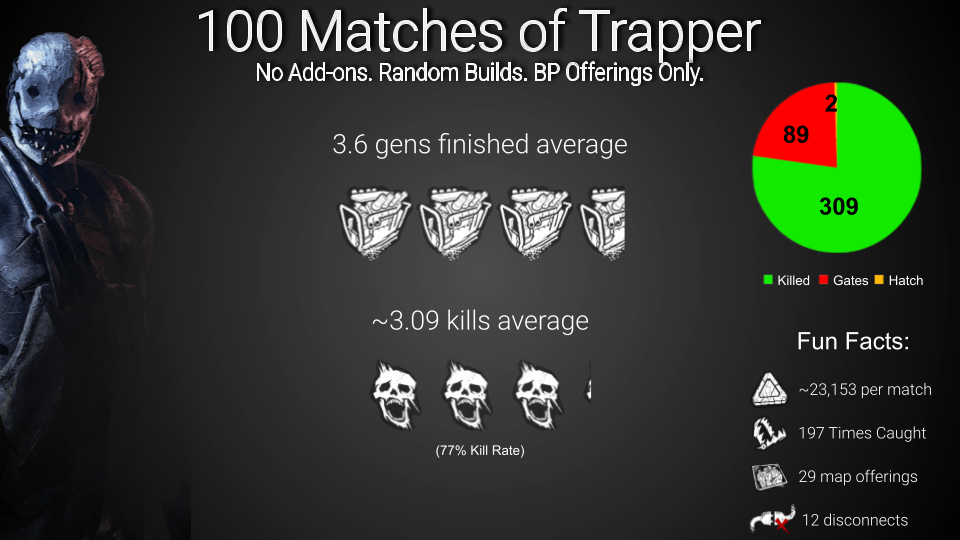
i-played-random-build-trapper-for-100-matches-heres-my-v0-smtbqvleyhid1.png

As you can see, the rules were:

  • Play only as Trapper
  • No Add-ons
  • BP offerings only
  • Random perk build

I won't bother typing the results out as you can read them on the graphic, but I'm curious what other people think of this experiment and what it means.

Reddit thread for the curious: https://www.reddit.com/r/deadbydaylight/comments/1erize6/i_played_random_build_trapper_for_100_matches/

Tagged: Mod

Comments

  • @Batusalen said:

    https://forums.bhvr.com/dead-by-daylight/discussion/comment/3783273#Comment_3783273

    In your most recent post you are using the phrase 'on average' to mean the most common result […] The concept of a winrate calls for a percentage, not a general statement

    No, I'm using 'on average' because we are talking about averages. Averages that can be translated to other kind of averages, like a percentage win rate:

    • 60% killrate on average = 2.4 survivors killed per match on average.
    • A killer win is 3K, so 2.4 survivors killed per match on average = killers win 40% of the time approx on average.

    Or:

    • 50% killrate on average = 2 survivors killed per match on average.
    • A killer doing a 2K is a draw, so 2 survivors killed per match on average = killers draw 100% of their game on average, or in other words, wins 0% of their games on average.

    This is why saying things like 0% winrate are so non-sensical

    It makes sense, but you either, again, don't understand what an average means, or you are simply refusing to accept what basic math and logic say. Simple as that.

    Beyond that, a 60% killrate is not needed to ensure parity. That's still wrong. Technically speaking, you could have a kill rate below 50% and still have a winrate above 50% based on game design

    The next phrase…

    (that's not true of DbD, but I'm back to pointing out the importance of uneven data sets).

    Now, let's forget you contradicted yourself for a moment, and please explain to me how you pretend to balance a game like DbD while granting everyone an equal chance of winning with just "uneven data sets" (which I'm going to guess are "kills distribution" in this case) when:

    • The win conditions for both sides are completely asymmetrical.
    • You can't directly compare skill levels of both sides, as they require completely different sets of skills and game sense.
    • One side is a team of 4 players that can have different skill levels.
    • That side is not even considered a team per win conditions, and each individual player in it will win or lose individually.
    • You have 5 possible match outcomes, which define the wins or losses of 5 different players.

    The answer is simple: You don't, you can't. Starting with not even having a reference to what would be a "balanced point". Because yes, if a killer is doing a lot of 3/4Ks we could assume he is "overperforming", but what would be the point it should be then? What combination of "Ks" in the kill distribution will make him "balanced"? How would you even guarantee that among all the players that use that killer the kill distribution will be even? Etc.

    So, even if "uneven data sets" can help identify if an individual killer needs balancing, it doesn't work in terms of overall balancing and will not help balance killers against survivors. That's why then we look at our win conditions, we notice that the common denominator is "kills", so we use an average kill rate as the target balancing point. And look at that, it even provides a "sweet spot" that allows us to guarantee an equal chance of winning for both sides (60%, 2.4 survivors killed per match on average, 40% win rate on average) without even having to worry about skill levels, side, character used, or anything else.

    When we reach that point, now we can use the kill distribution of each killer to balance those that are overperforming or underperforming until we get a balanced average (as again, multiple players with different skill levels will play the same characters, so part of the playerbase will get less than 60% kill rate, while the other will get more, or some will make more 3/4Ks, while others will make less. That's what an average means, by the way).

    So, there you go. At this point, if you don't understand it, it's on you.

    A killer doing a 1K is a loss, so 1 survivors killed per match on average = killers lose 100% of their games on average, or in other words, win 0% of their games on average (no negative winrate, mate).

    You're not thinking about what you're writing here.

    For any group to win 0% of their games on average, they would need to ALL win 0%, because, as you agree, there is no such thing as a negative winrate.

    If you have five killers with the following winrates

    1 - 50%
    2 - 20%
    3 - 10%
    4 - 0%
    5 - 25%

    Then the average winrate would be (50 + 20 + 10 + 0 + 25)/5 = 21%.

    That is how you calculate an average.

    Now, let's see a set of five killers that have a 0% winrate on average:

    1 - 0%
    2 - 0%
    3 - 0%
    4 - 0%
    5 - 0%

    Then the average winrate would be (0 + 0 + 0 + 0 + 0)/5 = 0%.

    Let's do the absolute minimum to deviate from that set to see what that does to the average winrate!

    1 - 1%
    2 - 0%
    3 - 0%
    4 - 0%
    5 - 0%

    Now the average winrate would be (1 + 0 + 0 + 0 + 0)/5 = 0.2% =/= 0%.

    So when you claim that on a 50% KR, the killers would win, on average, 0% of their matches, you do indeed claim, with absolute certainty, that NO killer in the game has managed to win a singular match.

    Because if they had won a single match, their winrate would not be 0%, and as a result, the average winrate could not be 0% either.

    Conclusion: Yes, we have a winrate of 50%, a loss rate of 50%, and a draw rate of 0%. Which, still, 

    means a draw rate of 100% on average.

    Legitimately, dude, you are getting confused. You're talking about the outcome of the average match, NOT average draws here. If someone has a draw rate of 0%, you CAN'T have 100% draw rate on average.

    Just please think about the distinction between these two things:

    The outcome of the average match

    vs.

    The average of all win rates/draw rates

  • @totallynotamegmain said:

    this is devolving really fast can we calm down?

    "Woosah, woosah" rub the ears - Martin Lawrence in Bad Boys

    I love seeing stats like op posted. I just wish there was more we could see about the matches. Or even a couple to watch.

  • @Batusalen said:

    https://forums.bhvr.com/dead-by-daylight/discussion/comment/3783490#Comment_3783490

    I simply wouldn't balance DBD with only kill rate.

    Neither is BHVR, just as I explained:

    When we reach that point, now we can use the kill distribution of each killer to balance those that are overperforming or underperforming until we get a balanced average […] But we can only do that once we have reached that target 60% killrate, and that is just what BHVR did.

    But good dodge to avoid answering there.

    saying "you either have to use my way of balancing the game using only kill rate, or come up with a different way using only that stat" is a false dichotomy

    What is false is that I said to you "do it only with the kill rate" at any point, specially after explaining that not even BHVR uses it as the only data for doing it.

    In fact, you are the one who said that "there is such high variance in the data set is a reason specifically to Not extrapolate based on the average of all those data, not a reason you Have to". So, it is you who said that the average kill rate is not needed to do balancing at all, not the other way.

    I assume when BHVR says they want to achieve a 60% kill rate, they mean that kill rate has a casual correlation with some other internal stats that they don't share with us, stats that contain more helpful information but for whatever reason (for example, trying to protect trade secrets or their own technologies) they don't feel it would be prudent to release to the public

    Yeah, let's just simply forget all the reasons, including the math and dev statements, that explain why it should be a 60% kill rate on average, and let's start making unfounded assumptions just because I don't want to agree with it. Totally logical approach.

    and that in getting those numbers to what they think is fair and fun, they estimate that kill rate will hit 60%

    Totally agree, as to get any other number to a place where it is fair and fun, like having an equal winning chance to everyone no matter their skill level or character used, the kill rate should by 60%.

    I know Peanits has said they look at far more than just kill rate, which would seem to support that theory.

    Or, and hear me out in this one, he meant that they look at a lot of other data because even if the kill rate is helpful for overall balancing, it is complementary to other data that indicate other, more specific things. To give an example, even if a killer has a 60% kill rate, if his kill distribution has a lot of 3/4Ks, it will indicate that he is winning more than he should and needs to be nerfed. Again, just as I explained, which casually coincides with what he said in the quotes @Moonras2 shared.

    But hey, yet again, "whatever makes you happy".

    what I'm getting from this is that you, too, agree that your previous assertions that "50% kill rate means 0% win rate" was erronious, and that things are actually a whole lot more complicated. glad to see that you've seen sense.

    @totallynotamegmain said:

    this is devolving really fast can we calm down?

    absolutely. i love you, @totallynotamegmain you're the cutest non-meg-main i've ever met.

  • @ratcoffee said:

    https://forums.bhvr.com/dead-by-daylight/discussion/comment/3783522#Comment_3783522

    what I'm getting from this is that you, too, agree that your previous assertions that "50% kill rate means 0% win rate" was erronious, and that things are actually a whole lot more complicated. glad to see that you've seen sense.

    https://forums.bhvr.com/dead-by-daylight/discussion/comment/3783523#Comment_3783523

    absolutely. i love you, @totallynotamegmain you're the cutest non-meg-main i've ever met.

    😊

  • @Batusalen said:

    https://forums.bhvr.com/dead-by-daylight/discussion/comment/3783459#Comment_3783459

    In that scenario you have a kill rate of 50% and a winrate of 50%. More specifically you have a winrate of 50%, a loss rate of 50%, and a draw rate of 0%.

    By the definition you posted:

    "Average, math, is defined as: An average is the result that you get when you add two or more numbers together and divide the total by the number of numbers you added together."

    So, let's do the math (with a total of 10 matches for simplicity reasons):

    • 10 matches = 40 survivors
    • 5 matches ended in 3K.
    • 5 matches ended in 1K.
    • 3 + 3 + 3 + 3 + 3 + 1 + 1 + 1 + 1 + 1 = 20 survivors killed in total.
    • 20 survivors killed in total / 10 matches = 2 survivors killer per match on average.
    • Now, using rule of 3: If 2 survivors where killed per match on average, and according to the win conditions a 2K is a draw, then killers draw their matches on average.

    Conclusion: Yes, we have a winrate of 50%, a loss rate of 50%, and a draw rate of 0%. Which, in short, means a draw rate of 100% on average.

    Unless you know the probability of the five different game outcomes (not even getting into hatch), you can't mathematically determine the kill rate percentage you need to determine what would create a winrate parity

    Can't I?

    • Survivors win condition: Not get killed. Ergo, a 60% killrate on average means 40% of survivors win their games on average.
    • Killer win condition: Get a 3K. Ergo, if a 60% killrate on average means 2.4 survivors killed per match on average, killers are doing mostly 2K, drawing those matches, while doing 3K 40% of the time approx. Therefore, they win 40% of their games on average.

    Now, let's try with higher kill rates:

    • Survivors win condition: Not get killed. Ergo, a 75% killrate on average means 30% of survivors win their games on average.
    • Killer win condition: Get a 3K. Ergo, if a 75% killrate on average means 3 survivors killed per match on average, killers are doing 3K 100% of the time. Therefore, they win 100% of their games on average.

    That won't do it. Let's try lower:

    • Survivors win condition: Not get killed. Ergo, a 50% killrate on average means 50% of survivors win their games on average.
    • Killer win condition: Get a 3K. Ergo, if a 50% killrate on average means 2 survivors killed per match on average, killers are doing 2K 100% of the time. Ergo, they win 0% of their games on average, as they draw 100% of their matches on average.

    Well, look at that. It looks like the only average kill rate that allows for average win rate parity is 60%. And I invite you to try to do it with any other kill rate you want.

    Is it clear now? Or shall we keep going with the fallacies and mental gymnastics? Not that I'm going to really keep with this, because at this point, there is definitely nothing else to explain. So, consider anything else you post answered with the BHVR go-to response: Whatever makes you happy.

    If 2 survivors where killed per match on average, and according to the win conditions a 2K is a draw, then killers draw their matches on average.

    No, we're outside of math and just talking about how words are used in English. That's a .500 win rate, an even split, etc. This is a game that has draws, saying that the result is a draw on average implies that most games result in a 2k.

    Can't I?

    You can't, and your examples are bad math.

    • Survivors win condition: Not get killed. Ergo, a 60% killrate on average means 40% of survivors win their games on average.
    • Killer win condition: Get a 3K. Ergo, if a 60% killrate on average means 2.4 survivors killed per match on average, killers are doing mostly 2K, drawing those matches, while doing 3K 40% of the time approx. Therefore, they win 40% of their games on average.

    The second part remains incorrect because you refuse to engage with the idea of an uneven data set. 2k is the least common outcome in DbD.

    This carries through to your other examples:

    • Survivors win condition: Not get killed. Ergo, a 75% killrate on average means 30% of survivors win their games on average.
    • Killer win condition: Get a 3K. Ergo, if a 75% killrate on average means 3 survivors killed per match on average, killers are doing 3K 100% of the time. Therefore, they win 100% of their games on average.

    What does the phrase 100% of the time mean? It means always.

    You seem to understand how the killrate is derived. The average is 75%, meaning there is a mix of game results that over many games result in an average of 3 killed in this hypothetical. You then turn around and use a totally different definition for what winrate would be.

    In this hypothetical and the framework for wins, we'd take every game played, how many where 3k or greater, and then we'd have the average.

    You could say the most common result would be a killer win, which is already true

    • Survivors win condition: Not get killed. Ergo, a 50% killrate on average means 50% of survivors win their games on average.
    • Killer win condition: Get a 3K. Ergo, if a 50% killrate on average means 2 survivors killed per match on average, killers are doing 2K 100% of the time. Ergo, they win 0% of their games on average, as they draw 100% of their matches on average.

    Again, that's not what an average means. If we keep with your simple math, on average they win 50% of their matches that are not draws (i.e. the average winrate is 50%). More realistically, we'd need more information as you could have a radically different winrate from a 50% killrate.

    Is it clear now? Or shall we keep going with the fallacies and mental gymnastics? 

    It's clear that you are committing multiple mistakes. This starts with an incorrect definition of what average can mean and a misunderstanding and refusal to even engage on the concept data sets.

  • @crogers271 said:

    https://forums.bhvr.com/dead-by-daylight/discussion/comment/3783478#Comment_3783478

    If 2 survivors where killed per match on average, and according to the win conditions a 2K is a draw, then killers draw their matches on average.

    No, we're outside of math and just talking about how words are used in English. That's a .500 win rate, an even split, etc. This is a game that has draws, saying that the result is a draw on average implies that most games result in a 2k.

    Can't I?

    You can't, and your examples are bad math.

    • Survivors win condition: Not get killed. Ergo, a 60% killrate on average means 40% of survivors win their games on average.
    • Killer win condition: Get a 3K. Ergo, if a 60% killrate on average means 2.4 survivors killed per match on average, killers are doing mostly 2K, drawing those matches, while doing 3K 40% of the time approx. Therefore, they win 40% of their games on average.

    The second part remains incorrect because you refuse to engage with the idea of an uneven data set. 2k is the least common outcome in DbD.

    This carries through to your other examples:

    • Survivors win condition: Not get killed. Ergo, a 75% killrate on average means 30% of survivors win their games on average.
    • Killer win condition: Get a 3K. Ergo, if a 75% killrate on average means 3 survivors killed per match on average, killers are doing 3K 100% of the time. Therefore, they win 100% of their games on average.

    What does the phrase 100% of the time mean? It means always.

    You seem to understand how the killrate is derived. The average is 75%, meaning there is a mix of game results that over many games result in an average of 3 killed in this hypothetical. You then turn around and use a totally different definition for what winrate would be.

    In this hypothetical and the framework for wins, we'd take every game played, how many where 3k or greater, and then we'd have the average.

    You could say the most common result would be a killer win, which is already true

    • Survivors win condition: Not get killed. Ergo, a 50% killrate on average means 50% of survivors win their games on average.
    • Killer win condition: Get a 3K. Ergo, if a 50% killrate on average means 2 survivors killed per match on average, killers are doing 2K 100% of the time. Ergo, they win 0% of their games on average, as they draw 100% of their matches on average.

    Again, that's not what an average means. If we keep with your simple math, on average they win 50% of their matches that are not draws (i.e. the average winrate is 50%). More realistically, we'd need more information as you could have a radically different winrate from a 50% killrate.

    Is it clear now? Or shall we keep going with the fallacies and mental gymnastics? 

    It's clear that you are committing multiple mistakes. This starts with an incorrect definition of what average can mean and a misunderstanding and refusal to even engage on the concept data sets.

    No, we're outside of math and just talking about how words are used in English.

    The guy doesn't even know what a rule of 3 is, and even when having the dictionary definition written on top of an example still doesn't understand what an average means. Keep pretending to fight basic math while making language-ambiguity fallacies.

    I will only say this:

    and refusal to even engage on the concept data sets

    Me two doritos earlier explaining to you how data sets are crucial for individual killer balancing, but not before having an average balance target because of the asymmetrical nature of DbD:

    @Batusalen said:

    https://forums.bhvr.com/dead-by-daylight/discussion/comment/3783273#Comment_3783273

    In your most recent post you are using the phrase 'on average' to mean the most common result […] The concept of a winrate calls for a percentage, not a general statement

    No, I'm using 'on average' because we are talking about averages. Averages that can be expressed as other averages, like a percentage win rate:

    • 60% killrate on average = 2.4 survivors killed per match on average.
    • A killer win is 3K, so 2.4 survivors killed per match on average = killers win 40% of the time approx on average.

    Or:

    • 50% killrate on average = 2 survivors killed per match on average.
    • A killer doing a 2K is a draw, so 2 survivors killed per match on average = killers draw 100% of their games on average, or in other words, win 0% of their games on average.

    Or (and this one is for you, @Firellius):

    • 25% killrate on average = 1 survivors killed per match on average.
    • A killer doing a 1K is a loss, so 1 survivors killed per match on average = killers lose 100% of their games on average, or in other words, win 0% of their games on average (no negative winrate, mate).

    This is why saying things like 0% winrate are so non-sensical

    It makes sense, but you either, again, don't understand what an average means, or you are simply refusing to accept what basic math and logic say. Simple as that.

    Beyond that, a 60% killrate is not needed to ensure parity. That's still wrong. Technically speaking, you could have a kill rate below 50% and still have a winrate above 50% based on game design

    The next phrase…

    (that's not true of DbD, but I'm back to pointing out the importance of uneven data sets).

    Now, let's forget you contradicted yourself for a moment, and please explain to me how you pretend to balance a game like DbD while granting everyone an equal chance of winning with just "uneven data sets" (which I'm going to guess are "kills distribution" in this case) when:

    • The win conditions for both sides are completely asymmetrical.
    • You can't directly compare skill levels of both sides, as they require completely different sets of skills and game sense.
    • One side is a team of 4 players that can have different skill levels.
    • That side is not even considered a team per win conditions, and each individual player in it will win or lose individually.
    • You have 5 possible match outcomes, which define the wins or losses of 5 different players.

    The answer is simple: You don't, you can't. Starting with not even having a reference to what would be a "balanced point". Because yes, if a killer is doing a lot of 3/4Ks we could assume he is "overperforming", but what would be the point it should be then? What combination of "Ks" in the kill distribution will make him "balanced"? How would you even guarantee that among all the players that use that killer the kill distribution will be even so he is balanced at any skill level? Etc.

    So, even if "uneven data sets" can help identify if an individual killer needs balancing, it doesn't work in terms of overall balancing and will not help balance killers against survivors. That's why then we look at our win conditions, we notice that the common denominator is "kills", so we use an average kill rate as the target balancing point. And look at that, if you do the math it even provides a "sweet spot" that allows us to guarantee an equal chance of winning for both sides (60%, 2.4 survivors killed per match on average, 40% win rate on average) without even having to worry about skill levels, side, character used, or anything else.

    When we reach that point, now we can use the kill distribution of each killer to balance those that are overperforming or underperforming until we get a balanced average (as again, multiple players with different skill levels will play the same characters, so part of the playerbase will get less than 60% kill rate, while the other will get more, or some will make more 3/4Ks, while others will make less. That's what an average means, by the way). But we can only do that once we have reached that target 60% killrate, and that is just what BHVR did.

    So, there you go. At this point, if you don't understand it, it's on you.

    So, even if "uneven data sets" can help identify if an individual killer needs balancing, it doesn't work in terms of overall balancing and will not help balance killers against survivors.

    […]

    When we reach that point, now we can use the kill distribution of each killer to balance those that are overperforming or underperforming until we get a balanced average […] But we can only do that once we have reached that target 60% killrate, and that is just what BHVR did.

    So like I said dude, whatever makes you happy.

  • @Batusalen said:

    https://forums.bhvr.com/dead-by-daylight/discussion/comment/3783542#Comment_3783542

    No, we're outside of math and just talking about how words are used in English.

    The guy doesn't even know what a rule of 3 is, and even when having the dictionary definition written on top of an example still doesn't understand what an average means. Keep pretending to fight basic math while making language-ambiguity fallacies.

    I will only say this:

    and refusal to even engage on the concept data sets

    Me two doritos earlier explaining to you how data sets are crucial for individual killer balancing, but not before having an average balance target because of the asymmetrical nature of DbD:

    https://forums.bhvr.com/dead-by-daylight/discussion/comment/3783421#Comment_3783421

    So, even if "uneven data sets" can help identify if an individual killer needs balancing, it doesn't work in terms of overall balancing and will not help balance killers against survivors.

    […]

    When we reach that point, now we can use the kill distribution of each killer to balance those that are overperforming or underperforming until we get a balanced average […] But we can only do that once we have reached that target 60% killrate, and that is just what BHVR did.

    So like I said dude, whatever makes you happy.

    The guy doesn't even know what a rule of 3 is, and even when having the dictionary definition written on top of an example still doesn't understand what an average means.

    I put two different definitions to show that the word average can mean different things. Mathematically it can be the mean, median, or mode, though it is generally the mean when people talk about it. I'm just asking you to choose one and stick to it.

    Rule of 3: There are more variables than you are accounting for which is why you don't have enough data. But being you think you can use that to solve this does explain some things.

    but not before having an average balance target because of the asymmetrical nature of DbD:

    Who said they shouldn't have a balance target? It's simply that a 60% target is not necessary to achieve the 40% winrate you emphasized earlier and that is not the outcome it has in the game right now.

    So like I said dude, whatever makes you happy.

    You've also said multiple times that you're done with the thread. I'm not, I think you're wrong, and the more this discussion goes the more things you seem to be wrong on, and I'm still trying to get you to either explain why you are correct, and if you are I'll happily admit you are correct, or for you to see the error in your reasoning.

    But why you're here:

    Multiple killers have the exact same kill rates, do you think that means they have the same winrates?

  • @Batusalen said:

    https://forums.bhvr.com/dead-by-daylight/discussion/comment/3783299#Comment_3783299

    The problem is that every average is made up of many numbers.

    No, again, the problem is that you don't know what an average is. Let's take 10 players in 10 matches, 5 of them do only 3Ks, the other 5 only 1Ks. The average kills per match is 2 survivors killed per match, which is a 50% kill rate per match on average, which again, means that killers draw their matches on average.

    That's it. Anything else is product of your imagination.

    You ignored all the math and did none yourself, and are jumping hoops of logic to suit your narrative even when faced with hard evidence to the contrary.

    Funny, because that's what you guys are doing. Either because lack of knowledge, or simply because like you said doesn't fit your narrative.

    And I'm done. At this point, you either understand it, or you simply not want to.

    The first paragraph was my entire point (on the topic of averages), that an average can have different results depending on how it is made up. Thank you for finally agreeing with me after all.

    The second paragraph says we did none of the math…

    @mizark3 said:

    https://forums.bhvr.com/dead-by-daylight/discussion/comment/3782970#Comment_3782970

    I'm pretty sure someone did the math before, and a 60% killrate means closer to an average 60% winrate, not 50%.

    I'll try to walk through the idea conceptually. Sets of 5 matches, 20 Survivors, 12 kills, 8 escapes. 60% killrate.

    Cases with Escape/Kill

    1.Most 4E 2.Most 3E 3.Most 2E 4.Most 3K 5.Most 3K with Most 3E (or 2E)

    (If there are more possible permutations feel free to include them in your reply)

    EEEE EEEK EEKK EEEE EEEK
    EEEE EEEK EEKK EKKK EEKK
    KKKK EEKK EEKK EKKK EKKK
    KKKK KKKK EEKK EKKK EKKK
    KKKK KKKK KKKK EKKK EKKK

    Killer/Survivor/Draw %s

    60/40/0 40/40/20 20/0/80 80/20/0 60/20/20 - using these for the averages, same result as #s

    Killer/Survivor/Draw #s

    3/2/0 2/2/1 1/0/4 4/1/0 3/1/1

    AVG. 52% Killer win, 24% Survivor win, 24% Draw.
    No draws is 68% Killer win, 32% Survivor win.
    (260/500 or 260/380 for Killer, 120/500 or 120/380 for Surv, 120/500 for Draw)
    Heck, even being favorable and splitting Draws 50-50 (rather than 60-40) for both gives 64/36 Killer favored.

    IME condition 4 or 5 is probably the most common, but mileage may vary. So while theoretically condition 2 fits your premise, all the other cases still exist and are contributing to the math. Plus I'm sure law of large numbers would converge on a 60/40 winrate with draws thrown out, but it still looks dire with Killer winning roughly double as Survivor on average with or without draws.

    One flaw is we don't know how Hatch is counted. Do they count it as an escape, or do they discard the result as a draw like they said they treat it as such for MMR? Hypothetically if the 3Ks were all Hatch escapes across the conditions, and they throw out Hatches, that could add an extra 7 results. That could add EKKK (Hatch for an 8th result extra) into EEEK (to maintain ~60% kill rate with 4/7K 58% since the Hatch didn't count), adjusting the stats to 52% KW, 26% SW, 22% Draw, or 67% KW, 33% SW with draws thrown out.

    So yeah, overall Killer has double the winrate of Survivor with a quick math check.

    (I figured out 5 more missing cases before I posted this: 4E/3E/1E/0E/0E, 4E/2E/2E/0E/0E, 4E/2E/1E/1E/0E, 3E/2E/2E/1E/0E, and 2E/2E/2E/1E/1E for a cumulative total of 50 matches, with 25 Killer wins (50%), 14 Draws (28%), and 11 Survivor wins (22%) or without draws ~69% KW, ~31% SW. That makes the odds even worse for Survivor wins in both draw or no draw scenarios.)

    What was this entire post then? Did you post a refuttal proving my methodology or arithmetic wrong? No? Then it would stand to be accurate, or you accept it as accurate, otherwise it would have been easily disproven. I mean if I made such a simple mistake as 1+3=25, I'm sure you would have jumped on that. That would mean our (or at the very least, my own, I didn't double check them so I take them with a grain of salt as well) point(s) is(are) supported by hard evidence.

    To the last sentence I say 'every accusation is a confession'. Since you have nothing to fall back on, you have baseless accusations, against claims defended by math.

    @Batusalen said:

    https://forums.bhvr.com/dead-by-daylight/discussion/comment/3783479#Comment_3783479

    you explained incorrectly. the fact that there is such high variance in the data set is a reason specifically to Not extrapolate based on the average of all those data, not a reason you Have to.

    Then again, explain to me how would you balance DbD with only those data sets, when:

    • The win conditions for both sides are completely asymmetrical.
    • You can't directly compare skill levels of both sides, as they require completely different sets of skills and game sense.
    • One side is a team of 4 players that can have different skill levels.
    • That side is not even considered a team per win conditions, and each individual player in it will win or lose individually.
    • You have 5 possible match outcomes, which define the wins or losses of 5 different players.

    Come on, explain the correct way of doing it without taking in count nothing else that those data sets, if I'm so wrong in my explanation of how and why.

    this is what I mean, you fundamentally don't understand why just the average kill rate is not a helpful stat for the kind of analysis you're trying to do

    Maybe because I never, here or in any of the past post about this topic, argued that only having the kill rate is helpful to anything, not I'm trying to do any "kind of analysis".

    What I had always said and argue is that "For balancing reasons, the kill rate should be 60%, and having it being that number is the only way the game will be balanced between killers and survivors" in response to everytime you people had claimed that it being 60% means the game is killer sided, and I had explained in detail how and why it has to be that way multiple times already.

    Just that. Like I said to @mizark3 earlier, anything else is product of your imagination.

    And again, I've said they already explained the why, "horror themes". It has to be close enough (for the game to be fun), but also lean Killer sided (to match the aesthetic/tone). I don't even disagree with that being the case. I do think a 60% killrate is fine, but I also acknowledge that makes the game Killer sided.

    In general, what I care about more is people above and below the target balance rate, and more importantly, the why. If someone has sub-60% killrates, they likely aren't good, and above-60% killrates means they are likely better. Pre 6.1 I won the same as after 6.1 (because my playstyle didn't involve letting Survivors proc DS/UB), but the killrates on average raised. Since they deleted all meaningful anti-tunnel in 6.1 (and people slowly caught on to the 3-gen perks), weaker Killers started crutching on tunneling (and eventually 3-genning) to kill/win, and there was nothing soloq Survivors could do about it. The immediate 'why' was deletion of anti-tunnel (and eventually 3-genning).

  • @Batusalen said:

    https://forums.bhvr.com/dead-by-daylight/discussion/comment/3783542#Comment_3783542

    No, we're outside of math and just talking about how words are used in English.

    The guy doesn't even know what a rule of 3 is, and even when having the dictionary definition written on top of an example still doesn't understand what an average means. Keep pretending to fight basic math while making language-ambiguity fallacies.

    I will only say this:

    and refusal to even engage on the concept data sets

    Me two doritos earlier explaining to you how data sets are crucial for individual killer balancing, but not before having an average balance target because of the asymmetrical nature of DbD:

    https://forums.bhvr.com/dead-by-daylight/discussion/comment/3783421#Comment_3783421

    So, even if "uneven data sets" can help identify if an individual killer needs balancing, it doesn't work in terms of overall balancing and will not help balance killers against survivors.

    […]

    When we reach that point, now we can use the kill distribution of each killer to balance those that are overperforming or underperforming until we get a balanced average […] But we can only do that once we have reached that target 60% killrate, and that is just what BHVR did.

    So like I said dude, whatever makes you happy.

    The guy doesn't even know what a rule of 3 is, and even when having the dictionary definition written on top of an example still doesn't understand what an average means. Keep pretending to fight basic math while making language-ambiguity fallacies.

    You've consistently been avoiding talking about this, though, Bats.

    The way you try to calculate the 'winrate on average' is not how you calculate an average. What you have been talking about is not the average winrate, or the 'winrate on average', it's just the outcome of the average match.

    These are not 'language-ambiguity fallacies'. No one is being ambiguous with their language.

    You are getting your terminology and calculations confused.

    Again, I urge you to think about the distinction between the following two things:

    1. The outcome of the average match
    2. The average winrate

    Because I feel that that distinction is tripping you up.

  • Actually this deserves its own thread, will update in a bit when I have a break at work

1 2 3 4 ›